Applying Warren Buffett's Wisdom for Financial Excellence in Your Painting Business
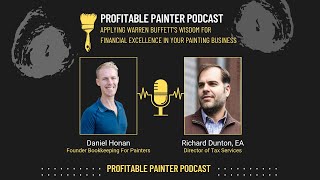
Daniel and Richard apply Warren Buffett's financial metrics to painting businesses, targeting gross profit around 40% and net margins above 20%. They cover overhead ratios, debt management, and whether to buy assets or stock when acquiring another painting company.
Chapters
Welcome to the Profitable Painter Podcast. The mission of this podcast is simple: to help you navigate the financial and tax aspects of starting, running, and scaling a professional painting business. From the brushes and ladders to the spreadsheets and balance sheets, we've got you covered. But before we dive in, a quick word of caution. While we strive to provide accurate and up-to-date financial and tax information, nothing you hear on this podcast should be considered as financial advice specifically for you or your business. We're here to share general knowledge and experiences, not to replace the tailored advice you get from a professional financial advisor or tax consultant. We strongly recommend you seeking individualized advice before making any significant financial decision.
This is Daniel, the founder of Bookkeeping for Painters, and this is Richard, the tax director. How's it going today, Daniel?
It's going well. It's a beautiful sunny day in Florida right now. It is.
Now we're recording this at the end of August and all the pumpkin spice is starting to come out. So I guess that's the unofficial start of fall. But it's still warm here in Illinois, and I know it's always warm in Florida, so I'm still clinging on to summer. I'm going to be honest with you. I like fall, but I can push that off for another month or so.
Yeah, I feel like I haven't experienced fall in years at this point. Living in Nicaragua and now Florida. So I can't say I miss it. I enjoy the sun. So despite my very fair complexion might lead you to believe.
Well, all you need is a nice flannel shirt, either some pumpkin spice or an IPA, and get that, get some leaves, those fake leaves going, and you guys will be all set.
Yeah, awesome. Uh, well, today I don't know if there's a segue that makes sense for this, but no, there's not.
Yeah, not from that.
No. Uh, so we're talking about Warren Buffett and the Interpretation of Financial Statements. This is a book written by Mary Buffett, his daughter-in-law, and it's a short read, but it's, it's really useful to, to understand what is if you were to give your financial statements to Warren Buffett, what would he tell you? Uh, and because obviously Warren Buffett made his billions from just reading financial statements and putting money in the companies that, uh, provided more value. So that's what we're going to be digging into today.
Sounds good. I love Warren Buffett. Um, he's I mean, obviously he's one of the most, you know, quintessential investors, you know, of our time. And the thing I really like about Warren is he's really kind of that mindset to get rich slowly mindset. You know, we're not, we're not looking for a unicorn. We're not looking for the next big thing. We're looking at the basics and we're reading financial statements. We're looking at does a company actually produce cash? Is this, uh, company having a, a, um, a competitive advantage, like a moat that's going to protect it from competition? So you don't have to get lucky. You can look at the fundamentals and know with a high degree of certainty that this is a company that's going to stick around for a long time.
Yeah, he's not doing anything fancy. Him and Charlie Munger are kind of like the common sense your common sense grand— grandparents or something like that. Like they're, they're just giving wisdom, like where to put your money, how to read financials and straightforward advice that makes sense. Like they're not doing anything fancy here.
Right. One of my favorite anecdotes about Warren Buffett is I guess he had this like tray on his desk or this folder on his desk that had, you know, papers in it. And someone asked him, you know, what's all this? And he goes, that's my, my too hard pile. If I look at a company and I can't understand it, I put it in the too hard pile and I pass on it, uh, which I thought was, you know, showed a certain amount of humility. Like, I know what I know and I'm really good at what I know. I also know what I don't know, and I'll let somebody else try and get rich with those.
Yeah. Yep. So we're gonna go through— I picked out 5 different metrics that Warren Buffett looks at when he's evaluating a business. And we're going to go through each of those 5 things and how you can look at your financial statements to see what Warren Buffett would say about your business. So the first one is a big one, it's gross profit. So if you've listened to this podcast for any length of time, hopefully you've picked up that gross profit is an important metric to know in your painting business. And Warren Buffett also thinks it's an important metric, and he says that having a gross profit of over 40% of revenue is basically identifies folks who have a competitive advantage in the marketplace. Yeah.
So if you have a, I was gonna say, if you have a consistently high gross margin, then it's kind of an indication that you're not competing exclusively on price. Right? You're not trying to come in there and be the, the lowest cost company, uh, because that's kind of a race to the bottom. And, you know, I mean, there are certain big corporations that have succeeded with that, but it's very difficult to do. Uh, you know, having that high gross margin shows that you have something more to offer than just discounting your services, right?
And, and if you are trying to be the low-cost leader, it's because you've figured out a way to deliver that service or product in a way just way more efficient than your competition, and then you can still maintain that gross profit margin. But you'd have to have some sort of technology or some process that, that would allow you to do that. Yeah. And just so if you're listening, you don't know what gross profit is, just to run through that real quick. Gross profit is your revenue, your top line money you got from your customer minus the cost that it takes to produce the project. So that would be your, your paint and materials and any painters that you had to pay to produce the work. That's subtracted from the top line revenue to arrive at your gross profit margin. And then the percentage is just taking that margin and dividing it by the, the, the top line revenue. So if you had a $10,000 project and it, it costs you $4,000 of paint and materials and labor to produce. You subtract that from the $10,000 and get $6,000. $6,000 divided by $10,000 is 60%, so that'd be a 60% gross profit margin, which would be above average because, uh, you know, uh, Warren Buffett looks for that 40% gross profit margin percentage. In the businesses that he evaluated. But even for, for us, we do internal benchmarking at Booking Mean for Painters where we evaluate painting businesses and see where their gross profit lands and compare it across, you know, different painting companies across the US and Canada. And 40% gross profit is, is about the average. It hovers right around there, 40, 41%, right about there. So if you're above 40% in gross profit, It's safe to say you are doing above average in the painting industry. All right. So the next piece, the next financial metric is SG&A. So SG&A stands for sales general administrative expenses. So this is, this is basically your overhead costs. As a painting business, this would be everything in your overhead costs. Except for interest paid on loan payments or credit card payments. Everything else, like your sales, your marketing, your admin people, your software, your insurance, that's all SG&A. So it's basically your overhead costs. So Warren Buffett basically has a wide, wide range of where this is acceptable. But basically the bottom line you want your, uh, SG&A, uh, to, to be no more than 80% of your gross profit. Um, so if your gross profit is— let's say your gross profit is at 50%, so you're doing above average— you wouldn't want your overhead cost to be more than 40% of revenue.
So 80% of 50%, correct?
Yeah, exactly. Yeah. And so the way that I like to think about this, and we've talked about this in, in a prior podcast, is I like to break up the overhead costs in a couple different buckets to make it easier for me to understand and to talk, to talk about with other people. And so just to dial it down a little bit more, because Warren Buffett, he's, he's looking across many different industries. And so there's a lot of varying differences in those different industries. But since we're talking about painting businesses specifically, here's a way you can look at overhead costs. So your gross profit, you take that and you split it up into 3 buckets. The first bucket would go to your customer acquisition costs. So just, this is your Advertising, marketing, everything it takes you to close a sale. That's the first bucket. The second bucket would be your corporate overhead, like paying your admin person, paying your S corp officer, paying your insurance, paying your software costs. That would go into the second bucket. And then the third bucket would be your profit. What's, what's left over after, you know, paying the first two buckets. And so those, those 3 buckets should roughly be about the same amount of, uh, money in each of those 3 buckets. So if— to run through an example, let's say you have a 45% gross profit, uh, 45% of revenue is what your gross profit margin is. About a third of that, 15% of revenue, should go to your customer acquisition costs. Uh, a third of it should go to your corporate overhead, which is your paying your admin person, your S corp officer, uh, your production manager, your office software, your insurance goes in that second bucket. And the third bucket and the other 15% should go to profit. That would be like a, a rough, uh, framework to evaluate, am I paying too much for my overhead costs?
I think with Warren Buffett looking at SG&A, he's just looking at like the first two buckets, the customer acquisition costs and the overhead. And I think his logic on this is that, you know, a company with a wide moat or like a good competitive advantage doesn't need to spend a lot of money on overhead to operate. They don't need to overspend on advertising to, to sell. Like, they've got that stuff dialed in and they're efficient. And so to know if that's the case, looking at that SG&A, those first two buckets, are they, you know, below a certain percentage, would let you know, you know, are you being efficient in your operations? Are you spending your advertising dollars wisely?
All right, so the next item that he looks at is income before tax. So basically your, your net income before any kind of a tax is applied, which for everyone listening, you're probably not a C corp anyway. All your incomes can be flowing through to your, your personal tax return, and that's where you'll be taxed anyway. But for your, your net profit, so if you're looking at your financial statement, your, your, your profit and loss, that net, that bottom line, net income. Warren Buffett generally looks for businesses that have a 20% or higher net profit, so 20% of revenue or higher. That's generally what he's looking for. Now, just to compare that to the average painting business, if you look at the, the national data, the average painting business, they're hitting somewhere around 12% net profit, so substantially lower than that. So the, the painting businesses that are hitting 20% or higher are definitely in the, the top 10, top 15% of painting businesses out there. All right, so the next metric that he's looking at is the ratio of interest payments to operating income. And this is where we're getting less into the, uh, the profitability look, because we covered that with gross profit, net profit, looking at overhead costs. Now we're kind of shifting focus to how much debt do you have? And he has a few different metrics to evaluate. Does your business have too much debt? First one being your interest payments as a ratio to, to operating income. And basically what he's looking for here is that you have a super low interest payments to operating income based off your industry average. And so for painting businesses, the industry average for having debt is, is like, uh, the debt-to-equity ratio is like 50/50. So 50% from, from debt, 50% from equity. And so generally, painting businesses don't have a lot of— they shouldn't have a lot of debt because you're not having to buy a factory to, you know, produce widgets. You're not having a lot of these capital expenditures to take on a lot of debt. Um, you're, you're a service-based business that you basically have to hire and train people and, and have them produce a service. So there shouldn't be a lot of debt involved in your painting business. If there is a lot of debt involved, there might be some sort of, some sort of issue in your, in your business model.
Yeah, I can kind of think of like the opposite, right? Like, think of like an airline. You know, an airline has tens of billions of dollars of debt tied up into, you know, airplanes. It's a necessity. They can't operate without them. A painting business is very fortunate in that it doesn't have to have all that CapEx expense. It can get away with a much lower, you know, debt-to-income ratio. So if we are, you know, finding that we, man, we have a lot of our money tied up in equipment and vehicles and that sort of thing, Uh, you know, it might be good to kind of reevaluate, are we using our assets as efficiently as possible? Uh, are we possibly overbuying equipment that we don't need? Uh, because that's, you know, going to lock up your money and, and limit your ability, uh, to grow.
Mhm. Another way to look at— another metric you can look at to see if you have too much debt in your business that Warren Buffett looks at is Do you have more cash than you do have— than you have debt? So if you add up your credit card debt, your, your vendor debt, you know, with Sherwin-Williams, your, your long-term debt with your vehicle note or vehicle loan, if you add that all up, is that, is that less than the amount of cash that you have on hand? Stated another way, can you pay off all your debt right now with the cash you have on hand?
Yeah, you can't go bankrupt if you can pay off all your debt right away. I know this, you know, when you're first starting out, that might not be possible, right? We might be getting the business off the ground with some debt, but it's not something that we want to get too comfortable with, especially as our business has grown and become more mature. We don't want to be always relying on having to use leverage to keep the lights on. We, you know, we can use debt strategically because, you know, we've talked about, you know, having a Sherwin-Williams account and, you know, pushing out our terms by 30 days or 60 days to help with cash flow. Or maybe it just makes sense to have a low-interest loan on a vehicle and that frees up cash for other things. But we don't want to get stuck in the trap of not having any cash and relying completely on leverage because that's a very quick way that companies go bankrupt is, you know, especially with how volatile interest rates are right now. If you've got a variable loan or something that's tied to the prime rate, you know, the Federal Reserve can make a few decisions and the next thing you know, you can't service your debt and now you're out of business.
So yeah, and so if you find yourself having to constantly get in debt, there's something wrong with the core of your painting business because painting businesses shouldn't be relying on debt to run the business. It should be equity. Uh, you should have more equity in your business than you do debt when you're looking at your balance sheet, which is the next metric. You should have more— you look at your balance sheet, it has all the balances for all your different accounts, assuming that the balance sheet is accurate. And if you look at your equity section, your equity should be more than your debt. And that's another metric that Warren Buffett looks at. And the bottom line is the— you're— you should be funding business operations with equity, not because you're taking out debt to fund the operation. So if you're having to get a lot of financing, there's probably something wrong with your business model. And I would go, and we've talked about this in previous podcasts, but looking at, are you taking a high deposit money down once you close the work? So you're getting cash in the door so you can pay your, your, your team and then fund the next acquisition of the next customer, you know, fund your marketing in other words. So that would be the first thing I look at, you know, look at how much money you're taking down. And then if that's not enough or you have some constraints on, um, how much you can take because you live in California or Massachusetts or one of those states, then doing progress payments, like money down when you book the job, money when you start the job, then money when you finish. So you're getting paid throughout that period, so you have a lot of cash flow coming in. Um, and, uh, I know a lot of folks get into trouble when they're working with general contractors where basically the general contractor is You know, not paying them any money down, and then they're not— they have to do— you go work for the general contractor, and then they don't pay you till 90 days later when they get paid, which they're basically using you as a financing company. So you're having to— so people get stuck in that craziness. Uh, try to avoid that at all costs. If you have to, make sure that that's a very small portion of what you do in your business. So, because it's going to eat up your, your cash.
Yeah, we talked about making sure that you have more equity than debt. And, you know, sometimes we get off on the wrong foot with that. You know, we've seen this happen where, you know, folks want to get into a painting business and they figure that the best way to do it is to, you know, buy a turnkey business, something that's already established. And there's a lot of advantage— advantages to doing that. But you might be able to structure it in a way where you're— because the problem with that, right, because you're obviously paying more for the business than the book value of the business. Otherwise, the current owner isn't going to sell it to you. So you're taking out loans, you're building up debt to buy a turnkey business, and you walk in immediately with a higher debt-to-equity ratio. Sellers love that. They, they, they, they love to do stock sales and sell the business as is. An alternative to that as a buyer would be to do something called an asset sale. And this is kind of where you, you have a buffet and you get to pick and choose. So you say, hey, I really love your painting business. I don't love everything about it. What I'd like to buy is not the whole business turnkey. I'd like to buy your assets individually. So I want those vans. I want your customer list. I want these employees, but I'm not buying the entire business as a whole. And there's, you know, for one, you're able to spend less on those assets. And two, there's some major tax advantages to an asset sale. The biggest one probably being that the way things are depreciated in a stock sale versus an asset sale. In a stock sale, you are inheriting the business as it is. So if the business has already written off a lot of its assets, a lot of its vehicles and equipment, then you inherit that basis as it is. There's nothing more for you to write off. But in an asset sale where you're buying the assets individually, you get to start all over again. So if you pay $20,000 for a piece of equipment, you're going to write off $20,000 for that equipment. Another big advantage to an asset sale is that you protect yourself from the liabilities that might be lurking around that previous business. Let's just use a hypothetical. You purchase a business in a stock sale. It's yours now. And all of a sudden you get a letter from a law firm, from somebody who got hurt, you know, a year ago on the business premises, and now they're suing the business. And you say, I had nothing to do with that. And they're like, well, it's your business now. And the business is the one at fault. Or maybe that business didn't pay its payroll taxes 3 years ago. And now the IRS is coming after you saying that you owe all these back taxes. That you don't know what could be lurking in a business's history. So a way to avoid that, don't buy the business, just buy the assets, start a new business with those assets. And it can include intangibles like customer lists, you know, the ongoing business concern, the goodwill, those types of things. And then they would— the old business would end and the new business would begin and you'd have some of that legal protection from any of the sins of the father, so to speak.
Yeah. Yeah. So basically, I think in most cases, if you're trying to buy a business, a painting business that's under $5 million in revenue, or maybe even higher than that, but at least $5 million or lower, you probably want to do an asset sale instead of a stock sale. You buy the assets piecemeal instead of buying the whole business as a stock sale. And hopefully that will limit the amount of debt you have to take on because we've had a couple of folks do those SBA loans to buy a business and then they're just buried in debt starting out, which sucks.
Yeah. And you might— and just to warn you, you might get a little pushback from the, from the seller because like we mentioned, you know, a stock sale is very beneficial for the seller. But not so much for the buyer. So it's going to be kind of a back and forth between you to try and figure out, you know, what you can, you can both agree on. But just kind of letting you give the, give you the option, like you don't have to buy the business as it sits. You can be picky and break up the assets. That's very common.
Well, so today we talked about a few metrics from Warren Buffett's book. Well, I guess it was written by Mary Buffett about Warren Buffett and his interpretation of the financial statements. So definitely a good short read, but I think we hit the highlights on how they apply to painting businesses specifically. Gross profit being 40% or more, your overhead costs need to be a smaller portion of that gross profit so you have some margin in there. Your, your net margin needs to be somewhere around 20% or higher to please Warren Buffett. And then your interest payments need to be super low because painting businesses don't typically need much debt to operate. You need to have more cash on hand than you need than, than debt overall, and you need to have more equity in your business than debt. If you're hitting all those things, then Warren Buffett might call you up and invest in your business.
That'd be awesome. I hear he's got something just, just shy of like $200 billion in cash right now. At Berkshire Hathaway. Um, and what, um, doesn't, doesn't Berkshire own, um, a paint manufacturer?
That might be true. I'd have to look that up. I'm not sure.
I, I could be wrong, but some, uh, if you're listening to this and you know, um, tell us in the comments of the Facebook group which, which paint manufacturer Berkshire Hathaway owns. I think it's Benjamin Moore. Yeah, but, but fact-check me on that.
Yeah, yeah. If you want to join the conversation, go to Facebook, type in Grow Your Painting Business. Love to hear your thoughts or any ideas for future episodes. And with that, we will see you next week.
Thanks for listening, everyone.
More from Daniel







What’s REALLY Holding Your Painting Business Back? (Find Your Bottleneck in 5 Minutes)



