Art Snarzyk: Revolutionizing Hiring and Retention in Painting Business: From Turnover to Top Talent
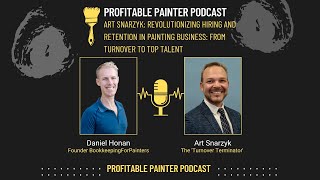
Art Snarzyk, the Turnover Terminator, talks with Daniel about hiring and retention for painting companies. They cover behavioral assessments like DiSC, role-specific profiles for salespeople, and how to use assessment data for onboarding and compensation design.
Chapters
Welcome to the Profitable Painter Podcast. The mission of this podcast is simple: to help you navigate the financial and tax aspects of starting, running, and scaling a professional painting business. From the brushes and ladders to the spreadsheets and balance sheets, we've got you covered. But before we dive in, a quick word of caution: while we strive to provide accurate and up-to-date financial and tax information, nothing you hear on this podcast should be considered as financial advice specifically for you or your business. We're here to share general knowledge and experiences, not to replace the tailored advice you get from a professional financial advisor or tax consultant. We strongly recommend you seeking individualized advice before making any significant financial decision.
This is Daniel, the founder of Bookkeeping for Painters, and today I'm here with Art Snarzek. Art Snarzek, known as the Turnover Terminator, has been involved in management and hiring since 1996. He has considerable experience in corporate America and spent 9 years running a successful painting company, which provides him an understanding of the challenges involved in hiring quality employees. He advocates for a scientifically tested method to attract, hire, and retain top talent, moving away from reliance on intuition and subjective assessments. How's it going, Art? How you doing today?
I'm doing really good. How are you, Daniel?
I'm doing well. Happy to have you. I'm excited to talk about this topic. Usually this podcast is a lot of numbers and stuff, and this talking about the people side of things is super important. Not to say that there's not science involved, which is really interesting to me. So I'm super excited to have you.
Well, I'm grateful to be here and excited to be here. And what we're talking about is really putting people to numbers so we understand them better. So that's kind of what I do is learn about people and measure certain attributes and traits about them. And that's how I help businesses with hiring and teamwork and individuals with their career paths and what they want to do in their life. So just get that stuff into numbers. So I think it's a nice bridge between you and I.
Yeah, exactly. So what actually— how did you get into this? How did you get into helping painting businesses hire?
Well, I think like most people, I fell into it. My life had a path and it kind of dragged me into it. But I was an introvert as a youngster and always curious, and I kind of have a warm style about me. So those are kind of unique things about me that led me to this, is I wanted to understand people and I had the curiosity to learn it. So in my painting business, I went through— I guess some of that was a lot of work experience in the corporate world and pharmaceuticals, but I owned a painting company with a friend and We got introduced to assessments to help us with our business partnership and how to better divide and conquer the different pieces of business in ways that suit our own style. And I just fell in love with these tools to help manage people in my business, so much so that I sold my portion of the painting company to my friend and jumped out, got certified in these sciences, and started consulting to businesses to help helping people with all of their personnel challenges and personnel and personal challenges as well. Wow.
Yeah. So you had a successful painting business and you felt so passionate about this that you dropped that and went full into helping other folks with their hiring and retention. That's, that's pretty, pretty significant move there.
It was. Um, interesting story behind that is I just had had my daughter and she was less than a year old and my company was fine enough. Uh, we were, you know, my The bills were paid and I had all the insurance and my wife didn't have to work. She could take care of the baby. And when I came home and I said, I think I want to do this, she didn't freak out. She said, yeah, you're supposed to do that. And so that was very kind of her and supportive. So, and risky, right? I mean, we had it all taken care of and here I am, I want to go do some passion work and it's a risk to be an entrepreneur, but she supported me and I, I went for it. 'cause I am supposed to do it. I'm good at it, humbly, and I enjoy it very much.
Yeah. Yeah. Kudos to her. But I think she, she had the right instinct. Uh, I've worked with you, uh, for, for my business and you, you've helped us really a lot with this process of, of hiring, attracting and hiring and retaining folks. So, um, you definitely are suited for this, uh, which is why I'm excited to talk to you today. Thank you.
That's kind.
So what are some of the common challenges that painting business owners face and how do you help them with those things?
Well, they're going to wring my neck if they don't, if they don't hear me say they can't find enough people. I mean, nobody can find enough people right now. So that's the big challenge. It's usually around hiring and retention. We want to hire people. We don't necessarily want to retain everybody because some people are a pain in the butt, but we also don't like losing numbers and production force. So there's a lot of focus on the hiring and more and more focus on that retention piece, but keeping the good people so they don't go somewhere else and adding more. You know, I just went through a really cool business training certification. It's called SmartRev and it's the science of revenue, how to predictably grow your revenue. And I love sharing that piece of business along with human stuff too. But there's a piece in there that says you need to You need to have enough staff to support your sales. Your company will never grow revenue-wise beyond your capacity to fulfill that stuff. So that's why hiring is so important because we want to grow and we're usually talking about top line numbers or squeezing GP or, you know, you get into the really cool stuff like let's do this cool stuff on the balance sheet. But all of that, none of it can be done without people to go out there and actually do the work. So it's all driven by that. So hiring is always the number one challenge for people in this, in this climate. And it's not just painting contractors, it's all contractors and the other industries I work with.
Yeah. What one of the interesting things that you did for, for us, my company, when we worked with you was you kind of developed, we, well, first I think we, and my memory's a little hazy, so you might need to correct me, but You helped to develop a job description that attracted— well, I think we determined what is that this person does, what's like the ideal personality type that this person should have, and then we drafted a job description to attract that type of person. And you use some pretty cool assessments. What a part of that is the, the DiSC assessment. Could, could you talk a little bit about, you know, because a lot of folks, you know, just to put it into context, a lot of folks between $500K and $1.5 million and $2 million-ish, they're looking for maybe a production manager to hire. A production manager was like a, might be their first big hire. They might have hired crews before or maybe a salesperson. And so those are kind of, you know, if you get those hires wrong, it could be pretty painful. So could you talk about how you help them with that process of developing what type of person they're looking for and that testing process using those tools that you have? Sure.
Yeah. And I'm glad that you remember that process. It's been a few years since we went through that with you. And so you remember it and I'm glad you don't remember all of it. Because that means it was painless and not memorable. It worked and it was great. But, um, very good. We got clear about the job first. Everyone, you need to get clear about the role itself and then get clear about the human that will do that role. What are the traits and attributes and skills? So once we get clear about what that person will do and we describe what, what their key accountabilities are, then we use those assessment tools to— for the business owner or the hiring team, uh, to go and measure what are the traits skills, attributes of a human that would fit that role perfectly and fit in our company. Now, we, we did that with very specifically with you, and we drew up what we call benchmark, you know, the ideal traits. What, where are the targets in self-management, in directness? Should they be passionate in these things? So we measure lots of things so that we could say, are we going to catch the right fish? So then, like you said, we attracted, we wrote a compelling job ad. One mistake I see business owners make often is They post a job description instead of a job ad. And a job description is very detailed and gets kind of granular, but a job ad is in fact an advertisement. So it needs to be less dry and to the point, matter of fact. It needs to be more sizzle. It needs to sell the position. Are you looking for this kind of position? Are you this kind of person? Would you like working in this environment? If you would, then read on. So real compelling. So that's what we did. We wrote a great job ad, attracted some people, and then when they come in on, on the back end, we have some great interview questions. If you're clear up front, then you know what the traits are. I need self-management and resilience and time management skills. Well, we can measure that, and we can also ask those specific questions if we know that those are important to the role, and we can assess how well they did or how well they score in those areas so we can make sure that we put all the right odds in our favor before we make a hiring decision.
And I know when you did this for us, you had many different tools. One of them was DiSC, which I remember. Yeah, but there was, there was more to it. Could you, could you— and so you're basically trying to, from what I remember, like determine what type of personality they have. And then does that fit the personality we're looking for? And then what their values are, does that fit in with what we need for the job description? So could you, I guess, you know, for painting business owners, you know, for those production management and salesperson roles, is there kind of a typical type of person that you're helping them trying to find? How much does it change company to company? Because I'm assuming, you know, different painting businesses have different values, you know, so it might be a little bit different on the values. But like, for example, do most folks go for their salesperson? Are they looking for someone that's high in influence like I, um, or is it, is it, is it different based off of like you know, um, the company and things like that?
Yeah, great question. Yes, it is different. There was a couple questions. First of all, the assessments— DiSC is a chunk of it. We like DiSC. There are lots of different assessments out there, and we smash a couple together in our one, uh, larger assessment. So, uh, it's 4 different assessments I usually am measuring so I can catch people from different lenses. DiSC measures our behavioral style, and that's super critical. And it's foundational, but it doesn't measure everything about you or me. So can I also get your values and your skill sets and the way you think so that I can determine, do you think the same way about business as I do? Or would you be a great painter or salesperson, but just not in our culture, in our company, because it's not our fit? So yes, in many areas we create benchmarks. I've done this, uh, so many times in the painting industry and others But I have enough data to see that here's what a typical salesperson in a painting company looks like. And if you're talking about sales to general contractors, it has this nuanced shift. So like you said, if you, um, a lot of people will generically go say in a DiSC model, I want a high D, high I, a very direct and influential, influential person. And that's a persuasive person. And, and that can be a good salesperson. What I found in the financial advisor industry is that we identified two top-performing salespeople generically across the industry, and one was a hunter and one was a farmer. So the hunter was your cold caller, the one that was going out and making something that happened, wouldn't like to go to networking events unless he knew the big fish was there. You know, that kind of thing. Takes a call and cancels his appointment because I'm going to go land this deal. He just makes things happen and shakes things up. Then you have the farmers who just go out and network, build friends in the community, and then people end up buying from them, right? It's not a— I'm not selling to you. They buy from them. So very interesting, the nuanced difference between a hunter and a farmer. We found that the values for the same— those what those people care about and what they, what they love in life are very similar. They want efficiency and productivity, and they also like a little bit of independence. I kind of want to be a maverick. I kind of want to do it on my own. I don't want to be micromanaged. Don't tell me how to do it. Watch, watch what happened in the morning, you know, that kind of thing. So it's interesting that their values were very similar, but their style was very different if you were a hunter versus farmer. There's a question in there that says, is there a generic benchmark for the industry of salesperson? And there is. And also, that's nice to have a nice benchmark that says, hey, most companies are hiring this way. But we also do it like we did with you, Daniel, and that's to get in and say, let's create a benchmark for your company because you have certain nuances to your culture. And what do you want for your person? What are the key attributes for your salesperson? Maybe you need a hybrid of a farmer and a hunter. Maybe you are only dealing with general contractors and you're in a real tough market, you might need a very driven and goal-oriented, detail-oriented kind of what other people might call a rougher salesperson to deal with general contractors because they're tough and quicker. So developing a benchmark individually for your company is more effective than generic, but go generic at least.
So when you say hunter, to equate that to the DiSC model, is that something like an ID or like an influencer?
There you go. Perfect.
And then what's the— what would the farmer be?
The farm. Very good. The farmer is usually an IS with a little bit of C. So an ISC, and that style is warm and engaging and kind of has some follow-through. So, and some detail orientation, a little bit of calendaring. This is, it's a more nurturing salesperson, the person that says, hey, this is what I do. And when you're ready, give me a buzz. And people do.
Cool. Yeah. This, this stuff like, and the other big component is the, is the values. But before we get into that more, just knowing like the roles and the person, the behavior personality that you're looking for can help a lot. It's just a matter of, I think then you can correct me, then get making sure there's value alignment. But like, but just half of it, or maybe half of it or a third of it is getting that behavior style down. It sounds like, and that's been super helpful for us knowing our different roles and what kind of behavior personality style we're looking for. Once we kind of know what it is, we know what to look for. And so that makes sense a lot easier for not only for hiring, but also how to reward and also retain folks when you kind of know what they're driven by.
It's interesting. I love that you said that when we know what we look, we're looking for, it makes it easier. And that's true. That's that clarity up front, right? Being clear about the job and what we need. And, um, DiSC measures how people like to interact. You know, it measures, do I want to be, you know, out front, or am I a little bit more introverted? Do I want to be very direct or a little bit indirect? Do I like details? So it's how we come across. I would suggest that our values are the most important to whether you're going to have success in the role. If your values match the values that get kicked off from a role If you love serving people and your job allows you to get accolades for serving people, that's going to be a great match. But if you love serving people and you don't get to do that, then that's a mismatch for that person and that job. So really, the values are most important. And then I would say your skills. So soft skills is what I measure, not the hard skills like, can you, you know, run a brush and can you use this estimating program? But it's more like time management, employee development, diplomacy and tact, interpersonal skills, you know, the empathy. We can measure those things to see how much they have. And sometimes too much is too much. But so I would say values is most important and critical, especially if you're going to measure, is this person going to be in this role for a long time or are they a flight risk? We can predict that. Then skills would be second. Can they do the job? Are they skilled at the things that we need them to be skilled at? And then thirdly, I would say is that DiSC or behavioral style, because I think you can do a job with different behavioral styles as long as you love it and as long as you're good at it. DiSC kind of tells me whether I'm going to like the way you do it, but your values tell me whether you're going to wake up wanting to do it, and your skills tell me whether you're going to be good at doing it. Okay.
Yeah, that makes sense. Values, like, that gets thrown around a lot, like, hey, make sure you have company values that people follow. And I kind of, when I first heard about values, I was like, kind of sound like, you know, BS, basically, just something like people are just giving, you know, lip service to some weird theory. But when we started doing it in our business, like have company values and then hire and fire and reward based off of those values, that really did help give us clarity on who is a good fit for the team. Do you help folks determine their values? And then, and then, and then you also test folks that are applying for positions to see if they meet those values? Like, how does that work?
Yeah, really good values. I thought the same thing. I thought that's just mushy stuff. How does that values and culture? These are all like squishy words. Do I need what, ice cream Thursdays and an Xbox in the break room? Come on, I'm trying to run business? What do I need values for? But values, um, I found that they were also, uh, not only important, but I've seen that they're the most important piece of the hiring process. So when people call me and ask for a DiSC assessment, really what they really need is that values assessment. DiSC just happens to be part of it. But it's— the values are a measurement of 6 factors that a scientist named Sprenger came up with, but 6 factors of your passions. What are you passionate about? And if you are passionate about what this company is passionate about and we can measure that stuff, well, then I know you're going to fit here. So it's really important, you know, some— here's an example. Some businesses, some painting companies are out there to crush competition and dominate their market and be known as the one. That's their value system. Others are out there to do something for the community. We really want to do this, these spaces for our families and make sure that our church is good. You know, it's, it's like a sense of, uh, almost like, I need to do this, it's the right thing to do, right? Some people do it from a beautiful place. It's like, I just want to create rich, wonderful spaces for people to enjoy. So those are different values. And the rich, comfortable spaces people are not going to get along really well with those we're going to crush the competition people, right? So that's the values conflicts and mismatches of why we have to get that right.
Yeah. What you said that there's 6 that have been identified. What are the 6 things?
Yes. So values in this model here, the 6 are about knowledge, like your passion for learning. One is about resources, resources. So your passion for acquiring or giving up your resources. Um, one is about being aesthetic, so loving the beauty in life versus being very objective and numbers and, or numbers-oriented. And then there is the social justice one, which is about altruism on one end, or maybe being more intentional about who you help and how far on the other end. The fifth one is the individualism, so that's being the maverick on one end or being very team collaborative on the other end of that spectrum. And then the 6th one is traditional, or being married to structure. I love following the system, I love following these rules, I want to belong to the team, versus I'm very open and receptive and dynamic and disruptive and innovative. So depending on where people fall on these 6 different dimensions and their passion for each— you don't have to get as nerdy as I do, but you can see the nuance in these graphs and say, I I understand what kind of person I'm about to hire.
So I guess it would be helpful if, if you, you know, um, if a painting business owner doesn't have stated values, they probably have, uh, like implied values in their business, but they don't have it written down anywhere. But yeah, I guess it would be helpful for them to translate their values, whatever they are, their company values, into these 6 measurable values so that when they do hiring, they could use that same test that you're, that you're using so they can say, okay, this person matches our values or this person does not match our values kind of thing. Is that kind of the idea there? It is.
And, you know, I make that super easy because I take it into numbers. So you don't have to like search too hard. You just go online and if we were to work together, we would, Whenever I'm hiring for a business, I always assess the top folks too to kind of see what their values are, because usually the top folks are feeding the rest of the company their values, and that's the value match for the company a lot of times. So I take their assessment and explain to them what their, uh, what their values are. And in some cases, it's interesting, there's kind of 3 mismatches that I look for. There's a me-you mismatch where Dan, you have these values and I have these values and they clash sometimes. Right? And there's a me-job mismatch where it's like the job requires this set of values or rewards these things. And I like being rewarded by these other things. So that's a mismatch. Sometimes there's a me-me mismatch, which is I have these values and these other values and sometimes they seem to like bump heads. One for me is I love learning and I also love resourcefulness. I love utility. I love capitalizing and ROI. So my values mismatch is I want to go to every seminar, but I don't want to pay for every seminar, right? I'm always counting the cost. Is that a good ROI if I, if I go there? So, you know, I have to watch that in my own values mismatch. But your values, your personal values, Daniel, may not be the values needed for your salesperson. They'll be close, and you might want them to share some of yours, but really to identify the values of a salesperson in your company, what should their values be? Might be a little bit different than yours, but there will be some like overlap so that you guys can stand each other.
Nice. Yeah, that's awesome. So I guess what would be the— what are some of the impacts that you've seen helping folks get this right? Like, you know, developing their values, testing for values when they hire people? What kind of impact have you seen this actually have on folks?
You know, the one I see most often is, thank you for saving us from that one, right? I wouldn't have known that. I was fooled during the interview. We ran the assessment, and boy, this really highlighted some things. I got to have a second interview, and those things popped up. I got, you know, it uncovered more questions for me to ask before I made a commitment to somebody or had to go through this 3-month honeymoon period of trying to figure out who you are. And once that happens, you know, as owners, we don't want to have to rehire. It feels like starting from scratch. So we don't like to do that. So the biggest benefit is really avoiding a lot of cost and pain of hiring the wrong person and turmoil it causes in your company. That's the number one. But I don't like, you know, avoidance goals. I like attainment goals. So the ones I don't hear as often about because they take longer is we still have Mary on board from 4 years ago. Do you remember when you told me that look for somebody dry during the interview and you're not going to like them because they come across this way, but that's going to be the perfect person? Well, that was Mary and she's still here. So those are the fun, exciting stories.
That's awesome. Yeah. So we kind of alluded to this before, but this helps the hiring process. And then you just mentioned it, you know, someone stays on for so long. I imagine that implementing this values and personality assessments into your hiring process and embedded in your culture and in your processes can help with retaining the right people. Um, so how does that look? You know, you do the initial hire. What, what can you use the data you have on that person to, to retain them for the future? Is there other things that we can do?
Daniel, I'm, I'm glad you asked that. That wasn't a planted question because I think a lot of people forget that this is just the starting point. These assessments are so rich. These are great coaching tools. You know, the next best thing you do with this information is after you hire someone is You sit down with them either on your own or with me, and we all three talk and we say, hey, these are the reasons we hired you. We totally know who you are and we like it. You highlight these things. We also know that you're not as good at those things, and that's okay. If we start to put things on you that are in those areas, push back and let us know, because we know you're going to fail at those things and we don't want that. You don't want that, you know, or you need to develop these areas. Here's some things we can work on. We wish your problem-solving abilities was a little bit higher, so we're going to get you a book or a course on that. So it can be coaching in that way, kind of getting past the honeymoon, because if you share your report and your employee's report and you guys talk about that, you can have really rich conversations of like, I like being spoken to like this and not like that. Here's how to motivate me. Here's my ideal environment. Here's when I thrive and here's when I don't. It's all in these 70-page reports you get with one of my assessments. And so it's not just hiring, it's— that's hedging your bet on the hire. It's also development and communication and maybe even some training. Like if you're hiring a salesperson and you have their assessment, let's dig through this and learn a couple attributes about assessments and other people. So because you're going to run into other people, and if you can identify that you're about to run into Mary, the homeowner, and she's this style, I might want to shift my presentation a little bit. Not to be disingenuous, but slow down or ask a question. I know Mary's a little bit more introverted. Maybe I just need to stop and give her time to ask a question instead of pushing it and driving it. So, uh, really understanding these tools for self-development, reading other people, team development— it's really how do I understand people and get the best out of myself and others.
Mm-hmm. And I imagine you could probably, with the information you have on the role or the person, you can develop compensation packages that might better align with what they would want. So it's going back to the salesperson thing we were talking about. You know, you said the hunter and the farmer. The hunter maybe is like ID, like influencing, um, dominant. So he's like, really wants to go after things. So that might be a good compensation package that does high commission or commission only maybe would be a good fit. Whereas the farmer that is, we said, what was it? S or S, I, C, is that right? Yeah. I, S, C. Okay. So that one might not work as a compensation package as, as much. There might be a better suited, like maybe a higher base salary with, uh, you know, some, some commission in there. Is that something that you've, you've seen? Or—
perfect, perfect. Yeah, you know, that, um, that hunter is going to get out of there quicker, out of the gates quicker, whereas a farmer takes more runway, right? You have to plant the seeds and water them. So you're right on it. So maybe Maybe you want to have hunters have a, you know, a strong commission push and let them go straight out into the world and do it. Whereas a farmer, a base, base plus, or maybe it's a draw, you know, and maybe that tapers over time as you know, that, that's going to taper off as your commissions go up. So, yeah, so different pay structures also around compensation.
It's—
that's a tricky issue because different geographies, locations play a part, different expectations, your company, uh, what your market's going through, what your company's going through, what you can afford. So compensation's tricky, but it gets more clear when you become more clear about who you need to hire. Because when you're clear about, you know, the traits and attributes and skill sets, especially through these assessments, we can measure against the general population. So I could say, hey, you're looking for a guy who's average in most areas and a couple of high skills in these areas. So, you know, average to a little bit above average pay. Or wait a minute, guys, you're looking for, you know, an integrator, chief operating officer, or, you know, a higher level person here, a sales manager. You know, you might, you might put more into it there, you know, really, really dig in and say, I really need these pieces, so I need to pay for them. If this helps, just the compensation is easier to get to when you're clear about the traits that you need for the role. The more traits and skills that you need in a person, the less likely you are going to find that person, the more they're worth. So the more you need to pay them. So really, it's that clarity upfront in the hiring process that can also help you to develop your compensation package. If you realize that you need an all-star who has all kinds of skills developed, Well, then you need to pay more. And if you realize, hey, I just have an average person with some, a couple other cool skills in these other areas, well, then you pay a little bit above average for that position.
Yeah, that makes sense. Um, do you have any case studies that, that you have that you could share, you know, that where a painting business really benefited from maybe hiring a production manager their first big hire or maybe a salesperson or maybe even installing, you had mentioned an integrator, maybe somebody, you know, to run their business, you know, that they'll shift over from running their own business to being a founder. Do you have any cool case studies with folks you've worked with?
Yeah, it's interesting. It comes back to the integrator. That was just something that came out of the book Traction and Every business owner, every business, their philosophy has a visionary and that needs an integrator to take those ideas and make those happen. And I started getting calls saying I need to hire an integrator. So I read Traction to figure out what that was and helping people and then creating benchmarks with individual companies. And I found the profile for an integrator. So I have a call with some EOS folks in a week here scheduled to talk more about that and maybe share with them EOS is the operating system for this book, Traction. But yeah, they coach this stuff and they're looking for integrators. But as I've developed these benchmarks, there's things that stand out that integrators have. And they're— you'd like that DiSC stuff, but it's typically a D, C profile with a lower I and S. So it's a really get it done now, get it done perfectly kind of person, a real driving person who might be a little bit you know, is may not have some of those softer people traits. So hopefully we're looking for other skills that they've bolted on, like interpersonal skills, but really a DC profile. And it's a, it's a tougher profile, um, a little bit rougher around the edges sometimes because it's so fast-paced and perfectionistic, but it's really good integrator.
Mm-hmm.
And I haven't seen an anomaly once from from that DC profile. There's some anomalies in their values, uh, every once in a while, uh, and skill sets, but the DiSC profile for an Integrator is always the same.
So when you say that you haven't seen anomalies, you mean that Integrators are almost exclusively DC? Is that, is that what you mean?
Yep.
Yeah.
Okay. I might see a DC with some I, or I might see a DC with no I and some S. But it's going to be a DC.
That's interesting. So if you're— it's good advice. So if you're looking for someone to run your business like a general manager, or you're the visionary of the business and you're looking for an integrator, that now you know your personality style you should be looking for. So that's interesting. That's cool.
And one caveat is that if you are an integrator and you don't have that style, Or you're— you have an Integrator in your business and they're not that style. That doesn't mean they can't do the job. They just do it differently. Remember, DiSC is the last one that I looked at. I want values first. Are you a values match for the position? I want skill set second, and then behavioral preference. I know I want a DC, but if it's— if it's a DSC, uh, I might make some consolations, you know, if their values match and their skills are good. There's no right or wrong answer to this. It's, I, it's just uncovering who I have in front of me and understanding that and making good decisions from that.
And cool. That's awesome.
Thanks.
All right. Well, um, do you have any, uh, last thoughts for folks that are struggling with hiring or retaining people in their, in their painting business?
Yeah, the biggest one is where to find people. Where do I find people? And that's the hard one for everyone. I see a lot of people developing more of a hybrid model where they're using employees and subs. I think that's, I think that's good. It's working for a lot of folks because there's so many few people to hire. They're hiring subs to take care of the work and managing that. So you may not run profiles on your subs and that's okay as long as you build good trust with them and treat them well. It's just like any other vendor almost. But what I would say to you and all people is always be hiring. It's a business process like marketing. Never turn it off. Never make it feel like, ooh, we have to start hiring over again. It's just something that's on. We might unplug the hiring machine for a couple of months, maybe during the winter, but it's so easy and developed our process that we just plug it back in during this cold season. You know, or we develop it in the cold season here or when we're not as busy, and then it's ready to plug in when we go. So start thinking about your hiring now. Think about how do I get more subs or bench strength. Make some friends out there in the world at the paint stores. Talk to that other painter, ask them how it's going, how's it, you know, those are people that might join your company in the future. And if you do have a hybrid model, I suggest that you really, you know, kind of give in to those subs. You know, there's usually smaller companies that got a handful of guys. Give them some tips to keep them in business. Like, hey, if you ever want to, you know, learn from this coaching seminar that I just went to, we're having a lunch and learn for all of our subs and it'll keep you in business or give you some good business practices. But the more you can do to make sure that they stay in business, the more they will stay in business, one, but two, they'll like you and make you their preferred go-to. So when you call and they have 5 other bids, they're coming to you because you help them. So do what you can to get those subs to be as sticky as you would employees.
Yeah, that's awesome advice. I really like the idea of continuing, continually reaching out to protect potential candidates and treating your hiring process like your marketing process. It's the same thing. Recurring calendar tasks you need to do, job ads you need to post, whatever the case is. So you have that turned on always, just like you always have your, your marketing turned on and going. So that's, it's a great point.
Yeah. So what, it's February and you're not very busy and it only costs $50 or $100 to post the ad? You might— you're not ready for that person until April. You're going to get applicants in February, right? They're laid off from their other company. That's a great time. You're slow anyway. Interview those guys, talk to them, make a connection and be like, hey, I'm not, I'm not doing anything right this minute. I just filled up, you know. So as soon as we open up, you mind if I give you a call back and just see where you're at in life? Wouldn't you like to have a list of people you can call when you get busy?
Yeah, exactly.
Develop that in the slow season. You know, right.
Awesome. Well, where can folks reach out to you if they need help with their, their hiring process?
Uh, interviewadvisors.com. I-N-N-E-R-V-I-E-U, uh, V-I-E-W-advisors.com. Or you can just call me, 314-282-9632. Art@interviewadvisors.com. Hit me with a question. Check out my website, uh, it'll be updated soon enough. It's like everybody's, it needs a refresh. But, uh, call me if you have a question and you don't see something on there. I love helping.
Yeah, definitely reach out to Art. He, he, him and his team are awesome. They've helped me personally in my business, and I know he's helped many other painting businesses. So avoid those mistakes. You know, of hiring the wrong person, especially on those key hires. So you can avoid that pain and grow without that. So love to hear your comments. If you go to Facebook, type in Grow Your Painting Business and find that group. We'll just go ahead and submit an invite and we'll let you in. Please let us know your thoughts on this episode. If you have any thoughts on the hiring process or if you have any ideas for future content, love to hear from you. And with that, we'll see you next week.
More from Daniel







What’s REALLY Holding Your Painting Business Back? (Find Your Bottleneck in 5 Minutes)



