Beyond Brushes: The Strategic Mind Behind a $5M Painting Company
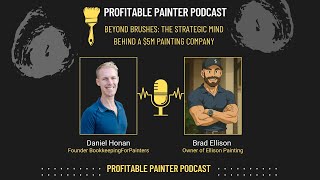
Brad Ellison grew Ellison Painting to $5.1 million in 2.5 years by spending 8-10% of revenue on paid marketing, tracking a 70% set-rate and 35% close-rate on leads. He scaled using only subcontractors, hired project managers and salespeople by industry benchmarks, and formalized a partnership with detailed contracts and equity splits.
Chapters
Welcome to the Profitable Painter Podcast. The mission of this podcast is simple: to help you navigate the financial and tax aspects of starting, running, and scaling a professional painting business. From the brushes and ladders to the spreadsheets and balance sheets, we've got you covered. But before we dive in, a quick word of caution. While we strive to provide accurate and up-to-date financial and tax information, nothing you hear on this podcast should be considered as financial advice specifically for you or your business. We're here to share general knowledge and experiences, not to replace the tailored advice you get from a professional financial advisor or tax consultant. We strongly recommend you seeking individualized advice before making any significant financial decision. Welcome to the Profitable Painter Podcast, the show where painting contractors learn how to boost profits, cut taxes, and build a business that works for them. I'm your host, Daniel Honan, CPA and former painting business owner, and your guide to mastering the numbers, that drive success. So let's dive in and make your business more profitable one episode at a time. And this episode, I'm super excited because I'm here with Brad Ellison. Welcome to the podcast, Brad.
Hey, Daniel. Thanks for having me, man.
Yeah, I'm super excited. A lot of listeners probably have heard of you before. You had— I mean, we'll get into it, but you've built an amazing business in a very short amount of time. So I'm super excited to, uh, to get into your story. Um, could you kind of give folks just what has been your journey? What are some major milestones in your, um, what brought you into the painting industry? What are some major milestones that you've hit in the last few years?
Yeah, sure. So I, um, actually stumbled into the painting industry, uh, about 8 years ago, and my wife and I had been recently married. We quit our jobs and decided we didn't want to work for anyone else ever again. And we launched a health insurance business together, which was my background. Uh, but the health insurance industry is very seasonal. Um, we really— 3 months a year that we really had work to do. And so we're like, well, what are we going to do? We got, you know, we got pregnant right after our wedding. We had a baby on the way and didn't seem reasonable or responsible to not work the other 9 months of the year. So, uh, we thought, well, we should get a, uh, I should find a seasonal sales job, maybe something in the trades makes sense. And, uh, that was on a Saturday night. The next morning I met a local painter that owned a pretty decent sized company here in Metro Detroit that was looking to bring on a sales guy and then ultimately someone to buy his business. So met him on a Sunday. By Tuesday we came up with a partnership agreement. He hired me to essentially run, sell for his business and run his business. Which I did for the next 4 and a half years with the intent of, of buying it. Push came to shove, we decided to not move forward with purchasing his business. And so April 1st of 2022, we launched Ellison Painting. Ellison Painting, since then we are— we just had our 3-year anniversary. That first year, the first 7 months we were in business, we, we sold and produced about $1 million worth of business. 2023, we sold and produced about $3 million. 2024, we did $5.1 million. So within 2 and a half years, we had scaled up to a $5 million a year painting business. Um, so it's been a wild ride. I've been really fortunate to be kind of right place, right time, right relationships with the right people. Um, though I think there's a conversation to be had around whether that's luck or creating opportunities or recognizing opportunities. But I've been fortunate to get plugged in with a lot of the kind of leaders in the painting industry, including leaders of the Painting Contractors Association. And now I'm honored to serve on the board of directors for the Painting Contractors Association as of end of 2024. So yeah, pretty, I think it's a pretty impressive business. There haven't been too many people, maybe any, that grew their residential painting company as quickly as we did. Though, even if we are the first, we definitely won't be the last. I'm already seeing some of that.
Yeah, I mean, I've worked with hundreds of painting businesses, and there's definitely been folks that have grown their business to do $1 million in the first year or close to that. Um, I can't think of a business that did $3 million in this— in the second year. I think that's— and then let alone $5 million in the third year. Um, I mean, there's people that have gotten close, maybe $2 million or $2.5, $3 million. So there could be maybe someone I'm just like not thinking of, but to hit $5 million in the third year, for sure, there's nobody that I know of that, uh, that has done that. Um, not to say there's, there hasn't been anybody, but obviously there's at least one person. Um, so yeah, it's super impressive. I mean, I just like, you must have been just like, what was your day-to-day like during those 3 years? Um, and I, maybe it hasn't stopped, maybe you're still in the grind, but like, is it, uh, as much work as it seems or did you, do you have some sort of secret that, uh, you can share with us? But it just, that's just like a, a huge amount of work.
I think. People are surprised to hear that it's not near as much work as they think it would be. And during the past 3 years, I've probably, probably worked a lot less than other companies that are struggling to get past that $1, $1.5 million. Um, what, what is the secret? I don't know. I would say if there, if there is a secret, it's that I don't allow myself to work more than I want to work. I don't— I'm not passionate about working. I'm passionate about building a business that allows me to not have to work if I don't want to. And so even from the get-go, that first year when it was just me and my wife, I'm, I'm managing all the sales and marketing. She's managing production for the, you know, for that first 6 months. Even then, I was still getting to the gym every day. Even then, we were home with our daughter for family dinner, um, every night. It wasn't like I was working 70 hours a week and, and we were both running around with our, uh, like a chicken with our heads cut off. Certainly stressful and, uh, there were some after hours and handling emails and stuff on the weekend. But now we kept— we were pretty strict about keeping our schedule more focused on our family than it was on the business, and that's always been the case for me. So, you know, I, I'm a pretty darn good salesperson, and so I was able to sell, you know, 40 to 45% of the estimates I gave. Pretty smart when it comes to marketing and partnered with agencies that were delivering decent quality leads and a high enough volume that I could do 25, 30 estimates a week and just kind of feeding that, that machine. Uh, yeah, so work-life balance for me has always been super important. I don't— it's, it's not as stressful or as time-consuming as people might imagine from the outside seeing how quickly we grew. Mm-hmm. Yeah.
It sounds like you, you had your wife helping you with production. So you had, you had the sales and marketing. Your wife was, was she pretty much like the office, like production manager? Did you guys use subs initially?
So we only use subs. Okay. We've always only used subs.
Okay. So that's, cuz that's, that's a, uh, a common constraint folks fi— find is that if they don't have someone else in the business, they don't have a partner or they don't have a wife that is awesome as your wife, apparently, that can run production. You know, they're, they're, they hit that constraint of they can only, they're doing sales and production simultaneously and they kind of run around, you know, $700,000.
For sure. Which is why, as you know, so many guys hit that $1 million, $1.5 million ceiling and they will sometimes never get beyond that, right? Because they haven't effectively offboarded some of the responsibilities. We, you know, we launched in a different, in a different situation than most. I did have a wife that was willing to give me 6 months of her time to be my project manager. And we did have some money that we had been saving that we used for a really healthy marketing budget right out of the gates. We budgeted $13,000 a month for marketing. Starting from day one, right? So I, I had the funds to pay an agency to get those leads. It wasn't like I had to go around, knock on doors, or, or cold call, or do a bunch of, um, community networking. We had, we had paid marketing leads coming in right off the get-go.
Yeah.
And there's no way that I could have sold $1 million in that first 7 months without those two things. The the marketing and the project manager. People always ask me, all right, well, if you were me, you know, I'm stuck at $1 million, what do I do? Well, either choose either sales or project management to be your focus and hire someone else to do the other piece. And if they, if you don't do that, you are never going to push through that plateau, like ever. There's no way. Yeah, I have a higher capacity than most, I think. But I couldn't— $1.5 million business with me doing all the sales and all the project management. That is my nightmare scenario. That is 80 hours a week with no family time. And even if it's a profitable business, have no opportunity to enjoy the profits, right? Because you're always working. So I think people make the mistake of, of not hiring that person, and they make it even worse by saying things like, well, Once I can afford it, I will hire a project manager. Well, if you wait until you can afford something in your business, you're never going to do it, right? I'll wait. I'll wait to start spending money on marketing until I can afford it. Well, until you start spending money on marketing, you're not going to be able to afford it. So you just take the, take the leap, trust that you, uh, you have the right systems in place and, you know, it's a calculated risk. But it's a, it's a calculated risk that so many people before us have made that we should have pretty predictable results. Yeah.
Yeah. Great stuff. Um, so first, initially the thing that jumps out is when you first got started, you were doing paid ads like immediately. You weren't afraid, you weren't afraid to spend on marketing, which I feel like a lot of folks when they're getting started or you know, under $500,000 in revenue. They are a bit— they're basically just doing referral and repeat work, and they're afraid to spend money on Facebook ads or direct mail or door-to-door because there's some risk there. Like you said, like, you do have to figure something new out, maybe not familiar with, and that can be a little scary. But it sounds like you pretty much— you took that risk immediately, did not hesitate, and, and went in with a marketing agency that knew what they were doing, apparently.
For sure. And I, and I had run that other painting business locally, right? So it was a kind of similar structure, similar type of business as Ellison Painting is, though we used very different paid marketing channels. That business existed almost completely off— it was HomeAdvisor and then it became Angie Leads. But we would spend $200,000 a year on Angie Leads and we would generate $2 million worth of business directly from that. So I understood that paid marketing in the painting world worked, but we had never done Facebook ads, we never really done Google Ads. But I spoke to people within our industry, you know, people that you know as well, that said, yeah, here's the data. Here, you spend this, you get this. We— you and I both know all the same marketing agencies that were around 3 years ago, and I had proof of concept from friends and colleagues that already used them. It, it didn't feel like a big risk it just felt like I have to be willing to spend the money to get the reward. Yeah.
Yeah. No, knowing the numbers and, uh, knowing what you're looking for, like if I feel like a lot of the folks being afraid of spending money on marketing, and also you mentioned making a new hire, is that they don't know what they should be paying for, what, what kind of return on investment they should be getting from marketing, or how much do they pay in compensation for their, uh, for their new hire and, and, and how is that going to affect their, their— so it's often the, the fear is rooted in just not knowing what, what to look for. Like, so did you have a pretty good understanding of what the marketing numbers should look like? Like what, what you should be spending? You mentioned, you know, $200,000 in indie leads to get, uh, $2 million in revenue, which is about a 10x return on investment. Is that pretty much kind of your rule of thumb there?
Yeah, so we had, um, if you talk to Nick Slavik, you talk to Jason Paris, they say kind of the same thing, that companies are trying to grow aggressively, which obviously that was what we were trying to do, should be willing to spend, uh, up to between 8 to 10% of their target revenue back into marketing. So if I wanted to do— I wanted to, I wanted to operate as if we were a $1.5 million a year company right off the get-go. Well, divide, you know, 150 or $1.5 million times 10% is $150,000 divided by 12. What do you got? $12,500 or something like that. It's close to that, $13,000 a month. So I was willing to spend up to 10% of my target revenue back into marketing. And it was, it was partly because of my experience running the other painting company, but also because these guys and gals that I knew and trusted that were running painting companies said, hey, you want to grow aggressively, you got to invest 8 to 10% back into marketing. Yeah. And what we found is that first year, the first calendar year, I think we spent, uh, we were at 8% cost of marketing. And then the year 2023, when we did $3 million, we were— we dropped down to about 7% cost of marketing. And then we did $5 million, we were at 6%. Cost of marketing. So like the bigger that we get, the cost of marketing has continued to drop. But I'd still, even to this day, you know, we're trying to take a big, big jump this year without me selling as actively as I was last year. And so I'm willing now to spend 10%. And if we're trying to do $7 million, that's $700,000 just into marketing alone. I'm willing to spend it. I don't want to. Right. The goal isn't to spend $700,000, but the goal is to spend as much as we need, but hopefully as little as possible to hit our sales goals.
Yeah. And I bet, you know, you mentioned the cost of marketing kind of goes down as you grow. I bet when you were super small, like in the first few months of operating, when you were spending that $13 grand on marketing, your marketing percentage was probably a lot higher of a percentage. It might have been 15 or maybe even higher.
Only the first month.
Only the first month.
The first month we spent that $13,000 and I sold like $60,000. But then starting after that, I think every month after that I sold at least $150,000. So I was under 10% by month 2.
That's awesome.
But that's again, I'm a decent sales guy. I was fully invested in the business. I'm like, this is my family's survival on the line. And so even if I wasn't working a ton of hours, you bet your butt I was hustling and working hard.
Yeah, yeah. And, you know, for, for those folks that are small, I think it's a good point just to highlight what you said was you wanted, you wanted to hit $1.5 million. And so you said, okay, that means I need to spend $150,000 and I'm going to divide that by 12. And that's what I'm going to spend on marketing. It wasn't like you, you, you didn't look at, okay, I'm doing, you know, $10,000 a month right now. So I need to spend $1,000 on marketing because some people—
it's all about your target revenue, right?
Exactly. So that's a big point. And it can be a little scary again because you're not— when you first started, obviously you had zero revenue, but even in the second month, you might not have a lot of revenue. So it can be scary, but it can work. Not to say you just hire a marketing agency and then it just works. There's definitely work to be done in that. Could we dig into this a little bit like to, you know, that we want to have a 10x return, but what things should we really be focused on, especially with working with a marketing agency like you did with set rates, close rates? What should we be trying to do to make sure that we're getting a good return on investment with the marketing dollars that we're spending?
Yeah, great, great question. So our goal, and I'll admit the first, that first 8, 9, 10 months, we didn't have an admin at all. It was me and my wife. And so any lead that came in, I was handling and I answered the phone when someone called 4 times. Right. And that's the worst. We at Rollout Marketing, the agency that I run now, we're like, you gotta call and you gotta answer the phone. Like that's, that's rule number one. But I, I didn't have the really bandwidth when it, during working hours, I didn't want to answer the phone. I wanted to be going out and selling jobs. And so we set up some autoresponders. Uh, if, if someone called in, they automatically got a text back saying, hey, sorry, we couldn't answer the phone. If you're calling to schedule and ask them to click this link. And it was a link to our Drip Jobs estimate request form. As soon as it came through, I would call back or schedule it and and do it. Um, so the way I operated then is a little different than we operate now, but we're aiming for a set rate of at least 70%. So of the estimates that come in, people that reach out via Facebook, website, phone call, whatever, 70% of them we want to schedule into estimates. If we do that, then we are— and the numbers continue to work out in terms of closing rate and all that. We will get the return that we need on our marketing. And that varies seasonally. During the, the spring months when everyone wants to get their house painted, everything's hot, our set rates higher. During the winter months when people are more passive, or maybe end of fall where they're reaching out for exterior estimates but they don't really want it done this year, they want it done in the spring, the set rates start to drop then. But overall, we're looking for 70%. And, uh, at Ellison Painting in general, we're averaging between 75 to 80%, so we're outperforming what our expectation is generally. Um, so that's set rate. When it comes to, you know, if we're talking about closing rate now on sales, our goal is 35%. So 35% of the estimates that we deliver, we want to turn into jobs. That's a little lower than other companies aim for, but we do such a high volume of estimates that we found that that number works really, really well for us because it allows us to continue to charge the rate that we want to charge, a really profitable rate, which then allows us to pay our subcontractors really well, allows us to pay healthy sales commissions. But if we had half the leads, we would not be able to— we'd have to be closing at 55 to 60% in order to continue to operate. Right. But 35% is what we aim for.
Yeah, that, that's a really good set rate. And, uh, because I, I see folks that they're using, you know, paid social and their set rates are like 33%, you know, and that, that can really drive up your, your marketing costs. So if you're looking at your profit and loss and you see like 15% for marketing, 20% for marketing, That might be the problem is your set rate is too low. And just so if you're listening, set rate, what the heck is that? The amount of folks that get on that, that come in as a lead that you actually get on the schedule to do an estimate for. So the, so it sounds like Ellison Painting is doing, you know, of 10, 10 leads that come in, you're, you're putting 7 or 8 estimates on the calendar.
Correct.
Um, and what is that? Uh, what's your mix? Like, is it, do you guys mostly do paid social or is a lot of, you're getting probably a lot of referral and repeat now too?
Uh, yeah. So I mean, if I'm, if I look at our stats, I would say like organic Google is probably around 20% of our sales and leads. Paid Facebook. Last year, I think we did $1.2, $1.3 million just from Facebook ads. From Google ads, we did another, I don't know, $800,000 or so. Referrals, $900,000, you know, about $1 million. So we have a really, we have a pretty good mix. And the set rate definitely varies based on those sources. You know, our set rate on Facebook ads, I'm looking at last year, let's see. About 55%. Our direct mail campaigns, 86%. People that just saw us, like maybe saw one of our vehicles driving, 78%. Organic Google, 72%. So the, the set rate is a lot higher for some lead sources than others. But with my marketing background and my sales background, we, we have a culture of if we're going to spend money on marketing, we are— we need to get every penny we can get out of those marketing dollars. And certainly there's some leads that come through that will never ever set for an estimate. We'll never get 100% set rate, right? But if, if we're really working our systems and we have really good follow-up systems and we're reaching out to these people time and time again until it's clear that they're never going to schedule, then we are, we're making our marketing dollars stretch way, way further. And that's how we go from budgeting 10% and only spending 6%.
Yeah, that makes sense. Yeah. And yeah, those set rates are really strong. And I think the general rule of thumb is to shoot for 50% set rate for Facebook because it's more of like an outbound. People aren't looking for you. So it has a lower set rate. But you guys are exceeding that there. And then the inbound stuff, like coming from the website or from Google, it's, it's higher, you know, so that, that makes sense. And so the other piece of that was the close rate, which, you know, 35% you're good with. And that seems, you know, reasonable. 1 out of 3, approximately. Very doable numbers. But it seems like the The thing I think that probably sets you apart from a lot of other businesses is that set rate. Because I would imagine, well, based on my experience, the close rate is usually not the issue. Most folks can get a close rate of around that, you know. But the set rate, I think, is the big thing that is really impressive about your company is probably why you have such low cost of client acquisition.
Yeah, I agree 100%.
Um, so year 1 focus was on not afraid, you know, you weren't afraid to spend on marketing and you blew it up from there. And then year 2, uh, then you needed some help with hiring someone to focus on production so you could focus on sales and marketing. Um, and you mentioned not being afraid to spend money on that person. Did you, did you have a Well, I guess, why was that? You just knew that it worked? Were you— did you have a compensation plan in place? Were you using a framework or something? Like, what made you so confident in that big hire there?
Yeah, I mean, we just followed industry benchmarks and all the data that you and I have available to us says that for, uh, in our market, for what we charge, for every $1.5 million worth of sales, you need one sales guy and one project manager. So going into 2023, when the goal was to sell $3 million, what's the math? Two sales guys, two project managers. So I was one of the sales guys. My wife transitioned out of the business October of '22. I hired my first project manager then. And then in the spring when we started ramping up for exterior season, I hired my second project manager. And hired my second salesperson. And, uh, 2023, we also had a, uh, another, another project manager that came on, didn't work out. We covered for him. 2023 was a miracle that we got to $3 million. We just had a lot, a lot happen. Uh, it was— that was the hardest transition year, I think. Uh, and then we hit our $3 million. We still hit it, right? And it was very, very profitable. Because I was still selling a lot. 2024, the goal is $5 million. And what I, what I did was I knew that at some point I was going to hit a ceiling. The company was going to hit a ceiling because I had a ceiling and I didn't know what that ceiling was. Again, I think I'm more capable than most. My ceiling is probably higher than most, but I knew I was going to hit the ceiling at some point. And I'm not the kind of guy that is, you know, just for ego's sake, wants to see how far I can push it without help. And so I made the decision to bring on a partner. And so this guy that I had known since he was in 8th grade, we had worked together at a marketing agency for a couple of years after he graduated college. Really smart, really capable, and complementary skill set to me. So the goal was $5 million. Based on our math, we needed 3 sales guys, we needed 3 project managers. So I was still selling. I brought him on to lead all of production. At that point, we had a, a project coordinator that was scheduling all the projects. We had an estimate scheduler as well. So we had a team of 8 to get us to the $5 million. I might have been able to get to $5 million without my partner, but it would have been very, very difficult. Right. And I may not have gotten there. So bringing him on board at that point was definitely the right decision. Um, so that, yeah, that last year was actually the most profitable too. We had the most overhead, the biggest staff. But if you look at, if you look at my books, like seller's discretionary earnings, we, we did, we sold $5.1 million and STE was over a million dollars.
Wow.
So it was super profitable even through all all of this growth. Um, this year is really going to be the test, I think, because now I have a team of 3 full-time salespeople, not me. And I'm, I'm selling a fraction. I sold $2.5 million of the $5 million last year. The goal this year is to sell less than $1 million, me personally. And I'm only doing— I'm only taking referrals and repeat business, stuff like that. And, uh, my partner is also trying not to actively be managing projects either. So now we have 2 full-time project managers, 1 part-time project manager, 2 project coordinators, estimate scheduler. This is— this will be the big test, whether Ellison Painting is a real business that can sustain without, you know, big bad Brad selling, um, or whether some of the magic was me selling. Who knows?
Yeah, yeah. So I love this. Um, so you, you brought on a partner in that third year because you, you knew that you had some blind spots. So we all have strengths and weaknesses, and, and it sounds like he's more production-oriented and you're more sales-oriented. And, uh, what— how did— how did that come about with vetting your partner? How do you know— how did you know he was the right fit? And then How did you structure that partnership? Because that's a— that can be a super messy thing. I've definitely seen this where if you don't have the right, you know, understanding expectations and also documented kind of like contract, uh, you know, it's basically like getting married to somebody. So it can be very draining, um, if it doesn't work out. And, uh, do you have any thoughts on, um, on how to properly set up a partnership and what did you learn that worked there?
Yeah. So, well, the vetting had been done for the 20 years leading up to the partnership, right? Again, I've known him since he was 13 and everything I'd seen of him from 13 to 34 or however old he was when he started working with me was, and we had worked together as well, pointed to the fact that he's the type of person that I would be willing to partner with. And, and I've said this before, there's only 3 people in my life that I would feel absolutely comfortable partnering with without a question. One is my wife, uh, one is my little brother, and one is Tim. And I, when I launched Ellison, I told him, listen, I'm launching my own company now. Eventually, I think you should come partner with me. Now's not the time, but let's keep talking. And I would keep throwing out feelers, and he had this fancy corporate consulting job where he's traveling around the country, where working with Fortune 500 companies on systems and culture and all this stuff and making really good money. And he was always like, nah, nah, nah, you know, painting, no, gross. And, but then he had his first kid and the traveling around the country wasn't as much fun as it was. And so he is like, all right, I think this might be the time. Let's start talking. So the vetting was done, but then it was like, all right, well how do we partner or how do we structure this? And how do we protect each other? Uh, Jason Paris is a great friend of mine. He's— him and his partners have kind of laid a foundation of how to partner with people. And even though I know Tim so well and I trust him so much, and I— he feels the same about me, like, we are— this is all going to be in writing. We are going to agree with— on everything. We're going to think about as many contingencies and, and, um, roadblocks as we can. And get it all written and agreed upon ahead of time. And we also agreed that the first year was actually going to be a trial. So 2024, he operated as a partner, but he was an employee and I paid him a salary. I paid him a $75,000 a year salary, which is what I paid myself. And then his compensation was an additional 20% of profit on top of that at the end of the year. And we both agreed at the end of the year, if, if 2024 went well and I'm thinking, yeah, Tim is a great partner and he thinks, yeah, Brad's a great partner, then we move forward and actually sign the contract. But we had negotiated all the terms right out of, right out of the bat, right off the bat. So and what one of the signs that I knew it was going to be a good partnership is in the first negotiation meeting that we had, we found ourselves arguing for the other person. And what I mean by that is, let's— I would say, well, let's hypothetically— I have a brain injury and Evil Brad appears and tries to take advantage of you. What are the ways in which I could do that? And so I started pointing out, all right, I could do this, I could do that. We need to make sure that the contract addresses that so I don't have the ability to do that. And then he would do the exact same thing, you know, well, you deserve to be a minority or a majority owner. And So with that, I think you should have the power to do this, this, and this, even if I disagree with you. Like, all right. So we were really operating and discussing in good faith, trying to look out for the other person more than ourselves, which is how Ellison Painting operates. And that's part of why we've had so much success, is if we are putting the, the best interest of our subcontractors ahead of our own, or the best interest of our customers ahead of our own, the goodwill pays off, right? And we don't do it so that we can benefit more, but that's just a result of that. So we, we had all the contract terms laid out, we had the contract drawn up, end of the year we're like, yeah, this is a no-brainer, the business is very profitable, we're working really well together. And so we, we made the deal and he is now officially a 30% owner of Ellison Painting. And our roles, our roles changed. He's, he's essentially running the business. I'm CEO. I'm serving in like the visionary role, but he is managing all of the people. He's technically managing the salespeople. He's managing the production and which then freed me up to run rollout marketing as well.
Hmm. That's, that's awesome. I love the, the fact that you guys red teamed your, your, your, uh, Like evil Brad. What can I do? That's a really—
so many people do. I mean, I'm sure you've seen the horror stories. Everyone's like, no, no, we don't really need anything on paper. We know each other, we trust each other. And then it all falls apart. Someone gets screwed, relationships are destroyed, financial futures are destroyed. Like, let's just— we, we have— we believe in each other. We believe that we are both operating in good faith. And even so, Let's just have it all in writing.
Yeah, it makes sense. And, uh, I think it's a good exercise to go through, obviously document and, and, uh, get a signed contract and a clear understanding. But I love the, uh, adding in the what could I do to mess this up and like discussing that with the partner ahead of time, uh, or the potential partner. That, that's, uh, that's a good one. I love it. Um, So was it— so it sounds like it was basically an option to buy in 30% by 30% at the end of the trial period. And, and then he had the option to, to buy in or not based off of how that first year went, it sounds like.
Yep. And the way we, the way we structured the purchase price was also a really healthy— we each gave in a little bit. He wanted, he wanted to buy 40%. I wanted to sell 20%. We agreed on 30%. But rather than just straight up 30% on the valuation of the business at the end of 2023, what we did is I said, all right, I'll sell you 20% at the 2023 valuation. The next 10% is going to be based on the valuation at the end of this year when we're working together. And so what ended up working out is his 20% actually cost him less, or cost— yeah, it cost him less than the 10— the next 10%, which was, which was good. When you look at the total value that he's receiving, he's already positive equity. And I felt honored that I wasn't selling my business, a portion of my business, at like a really, really discounted rate, right? So we locked in a portion of it because we worked hard in 2024 and we were really profitable. I was rewarded with the extra payment on the 10%.
Yeah, that makes sense. And And aligns incentives as well. Like, yeah, so get you guys moving in the same direction. So that, that makes a lot of sense. No, I appreciate you sharing that. I feel like partners, it's, it's, it can get really messy really quick. And it sounds like you guys did it the right way with really making sure the match worked, red teaming ahead of time, getting everything documented, and then having a a compensation plan and an option to buy that made sense for both of you and aligned your incentives. So no, that sounds great. Um, cool. Well, I'd probably like to talk to you for the next couple hours, but I don't want to steal your time. But, uh, this has been an amazing, uh, conversation. I really appreciate you spending the time to discuss, you know, things marketing, partnerships, scaling to from $0 to $5 million over the last 3 years. Um, do you have any asks of the audience, uh, or any tips or anything, any, anywhere that if you want to connect with them? Um, the floor is yours.
Yeah, so we, we operate pretty open-handedly at Ellison Painting. So, um, we have, we have a lot of resources that we've developed, uh, sales brochures, subcontractor info packets, really good playbooks for sales and project managers. We kind of share that stuff freely. So if anyone wants to reach out to me for any of that stuff, I'm happy to share it. No real ask other than if you're not a member of the Painting Contractors Association, I would say for you that would be a benefit. Connect with like-minded contractors. The, the PCA has a ton of resources to help businesses big and small, new and old. And, you know, I just— I love the PCA and it's been instrumental to my growth and in particular the relationships I've made through the PCA. So I don't benefit if you join, you know, it's not like I get paid to be on the board of directors, but the industry does better when we all do better, as our friend Nick Slavik says. So join the PCA, reach out to me if there's any way I can help and happy to do that.
Awesome. I really appreciate your time, Brad. I definitely echo everything you just said with the PCA. Great resource and always has amazing events. Really appreciate your time, Brad. And for the listeners, with that, we will see you next week.
More from Daniel







What’s REALLY Holding Your Painting Business Back? (Find Your Bottleneck in 5 Minutes)



