Biography Edition: Crafting Your Empire on Rockefeller's Principles of Business Mastery
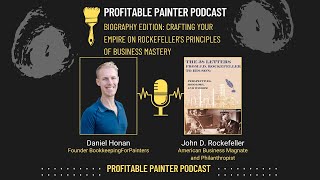
John D. Rockefeller rose from poverty in Richford, New York to build Standard Oil through relentless work and bold action. His 38 letters to his son reveal his philosophy: separate honest mistakes from irresponsible behavior, plan meticulously, and persist despite setbacks. Lessons for painting business owners on vision, accountability, and continuous action.
Chapters
Welcome to the Profitable Painter Podcast Biography Edition, where we delve into the lives of some of history's most successful individuals to uncover the strategies, tactics, and mindsets that propelled them to greatness. Today, we're exploring the extraordinary life of a figure whose passion for work and conqueror mindset allowed him to monopolize an industry. Join me as we navigate through the, this journey of this remarkable individual and extract valuable lessons you can apply to elevate your professional painting business Get ready to be inspired, to learn, and to transform the way you think about success and leadership in your own entrepreneurial journey. John D. Rockefeller was an American industrialist and philanthropist who founded the Standard Oil Company in 1870, which became the world's first and largest multinational corporation. His business practices set the standard for the oil industry and later for American capitalism. Rockefeller became one of the wealthiest men in history and used his fortune to fund extensive philanthropic endeavors, significantly impacting education, public health, and scientific research. His legacy is a complex blend of ruthless business tactics and generous philanthropy. So I recently read the 38 letters from J.D. Rockefeller to his son, and these, these letters are just packed, jam-packed full of wisdom. And so I'm going to go through John D. Rockefeller's life and talk about, basically read some excerpts of the letters that he wrote to his son on different, about different parts of his life. He wrote most of the letters towards the end of his life when he's kind of mentoring his son as his son takes over Standard Oil and his businesses, but he's often writing about what happened in his past. So let's get into things. So in 1839, that's when John D. Rockefeller was born in Richford, New York. And he was basically raised by his mom. He had an absentee father who was in and out a lot. His father did teach him about loaning money and negotiation. He was pretty hard on his— on his— on John. And one of the things that folks noticed about John D. Rockefeller is that he always seemed to be thinking. He was a slow learner but patient and persistent. And Rockefeller described himself as a reliable as reliable but not brilliant. And from very early on, John D. Rockefeller wanted to be the richest person in the world. There's a— the story that he tells his son about when a photographer came to the school, to John D. Rockefeller's school when he was in elementary school, and they were going to take a picture. And back then, taking— getting your picture taken was a big deal, obviously, because this was back in the the 1840s or somewhere in there. And so John D. Rockefeller was excited about it. He was like, oh, okay, great, I get to be in a picture. So he was feeling pretty good about himself. But then the photographer motioned to the teacher and was like, hey, let's not get that kid in there. He's got tattered clothes and it's going to ruin the picture. So, and he was pointing at John John D. Rockefeller. And so the teacher pulled John out of the picture because his clothes were all tattered. And because John came from a very poor family, he was very proud and he held himself well, but he just didn't have the funds to get nice clothes. So he wasn't able to get in that picture. And he kind of told himself like, I'm I'm gonna show everybody because I'm gonna become the richest person in the world and I'm gonna take all the pictures I want. So, uh, 1855, when he turns 16, he starts his first job as an assistant bookkeeper, and he's very excited about getting this job. He actually marked it as a celebration for the rest of his life as Job Day, and he celebrated it more than he celebrated his own birthday. Here's a quote from the book: As you know, when I was young, my family was very poor. I remember that the books I read when I was in high school were bought by my neighbors. In the beginning of my career as a bookkeeper, I was only earning a weekly salary of $5, but it was only through unremitting effort that have enabled me to establish an inviolable oil kingdom. In the eyes of others, this may seem to be a legend, but I think it's— it is the reward for my perseverance and hard work from the God of Destiny. And he— there's a whole letter where he goes on about how you should view your work as pleasure. And if you view your work as pleasure, life is heaven. If you view your work as duty, life is hell. And there's other quotes like, I never treat work as hard labor without fun. Instead, I found infinite happiness from work. Work is a privilege. Work is the foundation of all businesses, the source of prosperity, and the shaper of genius. So the lesson here is you should embrace work. Don't shy away from it. Dig into things. And it really comes through that John D. Rockefeller, he was all about work. He celebrated job day every year, more so than his own birthday, because he loved work and he was all in for that. So in 1859, Rockefeller enters the commodities business with his partner Maurice B. Clark, forming Clark Rockefeller. And then a few years later, he enters the oil industry by investing in an oil refinery in Cleveland, Ohio. Here's another quote from the book: A very ordinary plan, if it is actually implemented and developed, it will be much better than a good plan that is abandoned halfway, because the former will be carried out consistently. So there's a whole letter about action, taking action. Opportunity comes from opportunity. Action is another positive attribute, attribute of mine. I never like to talk in vain because I know that there is no result without action, and there is nothing in the world that, that is obtained from just thinking. Here's another quote: Many people who lack action naively think that others will care about their affairs. In actual fact, other than yourself, others will not be very interested in them. People are only interested in their own things. So basically saying nobody's thinking about you, handle your own business, take action and go. Don't worry about what others are going to think. They don't really care about you anyway, or the details of your life, or what you're doing. So worry about your stuff, your business, and take action and get things going. And here's another quote: "Son, life is a great battle. To win, you need to take— you need to act, act again, and act forever." So basic lesson here is taking massive action. Do not sit back. Do not over— don't get stuck in analysis paralysis. Don't just read a bunch of books and don't implement them. You need to take action. He even says, says the, you know, there's that phrase knowledge is power. He doesn't like that. He thinks that's like half of the equation. He said knowledge is not power. Getting knowledge and taking action on that knowledge is power. And one of the things that really comes through reading Rockefeller is he seemed to be, he was very fond of Napoleon. And he even, in one of the letters, he goes into about why Napoleon was, was an amazing person. He basically said that Napoleon was able to organize resources and inspire and lead his men very effectively. And he wonders, you know, what kind of business person Napoleon would have been if he was, instead of conquering on the battlefield, if he was conquering in the business world. And he really admired the fact that he that Napoleon inspired his officers and made them and trained them to be very capable on the battlefield. And that was something that I think Rockefeller tried to do in his own business—inspire his, his team and empower them to take action on his behalf. In 1870, Rockefeller co-founds Standard Oil Company, which quickly becomes the leading oil refinery company in the United States. And then a couple years later, he begins aggressive expansion and acquisition strategy known as the Cleveland Massacre, significantly increasing Standard Oil's market share. And here's a quote from the book: Visionary businessmen are always good at finding opportunities in every disaster, and that's how I did it. Before we started our journey of conquest, the oil industry was in chaos and there was no hope at all. 90% of the refiners in Cleveland had been crushed by the increasingly fierce competition. If they did not sell the factory— if they did not sell the factory, they can only watch themselves go extinct. This was the best time to acquire an opponent. So basically, this— during this time, during the Cleveland Massacre, there was a lot of competition, and Rockefeller capitalized on this opportunity to get some funding from the banks and buy out his largest competitor and then work down the line from there. He went up, went to the top first, bought them out, and then went down to the subsequent smaller oil refineries and bought everybody out basically. And here's another quote from the book: It really has nothing to do with conscience. An enterprise is like a battlefield, and the purpose of strategic goals is to create the most beneficial state for oneself. For strategic considerations, the first target I choose to conquer was not a small company that was vulnerable, but the strongest opponent, Clark Payne. This company was well known in Cleveland and were ambitious as they wanted to acquire my star oil refinery. I will have to strike first to gain the upper hand. I took the initiative to meet the largest stakeholder of Clark Payne. I told him that the chaotic and sluggish era of the oil industry should and in order to protect the industry that countless families depend on for survival. I wanted to build a huge high-performance oil company and welcomed him to join. My plan impressed Payne, and finally they agreed to sell the company for $400,000. I know that paying Clark Payne is not worth that amount at all, but I did not reject them. Acquiring Clark Payne meant that I would gain the title of the world's largest oil refinery and will also serve as a strong pioneer in the industry to efficiently bring together the refiners in Cleveland. The trick really worked. In less than 2 months, there were 22 competitors under the leadership of Standard Oil. So basically, for the Cleveland Massacre, he first did the bold move of going straight to the, the biggest competitor and pitching him this, this plan that he had to unite the oil industry. And bought them out for $400,000, which he got from bank loans. And then he— and then once he got the top dog, the other smaller ones fell like dominoes, basically. In the following years, I conquered oil refineries in Philadelphia, Pittsburgh, and Baltimore successively, and I became the only master of the oil refining industry in the United States. If I were only lament on my bad luck at the time and follow the crowd, I might not have I might have been conquered, but I planned my luck. Anything can happen in this world. He sounds a lot like Napoleon, uh, when Napoleon discusses luck. Luck is, is the remnant of design. In other words, we create our own luck and no action can eliminate it. So Rockefeller doesn't really believe in luck. He thinks that you create luck by taking action and making things happen. And that was also what Napoleon said as well. It's something very similar to the same effect. So in 1882, Standard Oil Trust is formed to control multiple companies under, under one entity. And here's another quote from the book: I'm well aware that if we were to be profitable again and make money forever, we must tame this industry and have everyone act rationally. I regard it as a responsibility, but it is very difficult to do. It requires a plan, a plan that places all the oil refiner— refining businesses under control, my control. John, to be a good hunter in a profitable hunting ground, you need to think hard, be careful, and be able to see all possible dangers and opportunities and things, as well as to study all kinds of strategies that could endanger your dominance. Like a chess player, I thoroughly researched the situation and evaluated my strength. I decided to use the base camp of Cleveland as my first battlefield to launch a war in order to rule the oil industry. After conquering more than 20 competitors there, I moved quickly to open up a second battlefield until I conquered all of their opponents and established an oil industry in a new order. You could tell from the language that he's using, he thinks of himself as a conqueror. And this is very— he planned everything out. You know, he talks a lot about action, but it's not like he's just taking action with no plan. He has a very thought-out plan to go about taking over the oil industry. So the other component is, is the knowledge. Now he says knowledge is not power. Basically getting that— you want to get the knowledge, but the biggest thing is also taking the action to put that knowledge into practice. In 1892, the Ohio Supreme Court declared Standard Oil must be an illegal monopoly. And then several years later, eventually the U.S. Supreme Court rules that The Standard Oil is a monopoly, must be broken up into 34 smaller companies. And ironically, that's when Rockefeller actually becomes the first billionaire, right around that same time. And also around that same time, Carnegie, who— Andrew Carnegie started the steel industry. He came and visited Rockefeller and they were talking, and Carnegie asked Rockefeller a question. He said that, you know, your people that work for you, they seem to be invincible. They're able to accomplish anything. What do you do? Are you incentivizing them with money? What is it that you're doing that keeps them so motivated and inspired to work for you so diligently? And Rockefeller said, you know, it's basically I have a principle where I don't blame the folks that I work with. My subordinates. I don't ever blame them, but I also don't ever take any excuses for or tolerate any kind of irresponsible behavior. So if something bad happens, if somebody makes a mistake, I just work to solve the problem. You know, we try to work through it, understand what my responsibility is, what their responsibility is, ensure that they're taking responsibility and that they're not being irresponsible in their behavior. As long as they're not being irresponsible in their behavior, I'm not going to punish them. Or blame them, because punishing people or blaming them will— you'll lose respect from the folks you work with. So you want to entrust your— the folks you work with, with great responsibilities and hold them accountable to those responsibilities. But if they make a mistake, you know, don't get mad at them or or blame them. So I thought that was a very, very insightful, you know, in that distinction of, you know, don't, don't ever blame folks if they make a mistake, but you all at the same time, you don't want to tolerate irresponsible behavior. So you have to distinguish those two things. So in 1913, the Rockefeller Foundation was established, and then 1937, John D. Rockefeller passes away at 97 years old. So he had a long Long Life. And I think some of the lessons that we can take from John D. Rockefeller is, again, big vision— common theme that we keep hearing over and over again. He had a huge vision from the— from when he was a kid. He wanted to be the richest person in the world, and he stayed with that vision throughout his life and ended up accomplishing it. Another thing is understanding all opportunities and dangers through planning. He was a big planner. He— oh, from a— starting from a young kid, you know, when he was playing chess, he was very thoughtful in every move that he did in chess. And he also did the same thing when he was taking over the oil industry, is very planned out. He thought of all the dangers, all the opportunities before he took action. But then he— the next big thing we should learn from him is taking action with the knowledge that you You gained all— you studied, you've done— you studied the opportunities, you studied the dangers, you studied the history. Now it's time to take action, and you take, take bold action. And this is also a very common thread that we hear again and again with these biographies, is taking bold action. Fortune favors the bold. And then another theme that comes out of studying Rockefeller's life is being persistent. John D. Rockefeller works hard, he's persistent, he's reliable, and he, throughout his whole life, he is working towards a goal. And then the last thing I think we can take away is, is how do you treat your, your team to get the most out of them? And he gives that basically, that, that idea of don't lay blame don't blame your folks or get upset at them for making mistakes, but at the same time, don't accept irresponsibility. So if they're being irresponsible, it's time for them to go because you should be clearly telling them what the responsibility is and what you expect of them. They can make mistakes, that's fine. We'll fix it, we'll figure it out, we'll solve it. But if they were being irresponsible, that's, that's the time for them to go. And so with that, I definitely recommend getting The 38 Letters from John D. Rockefeller to His Son. It's jam-packed full of wisdom, really interesting read. And with that, I'll see you next week.
More from Daniel







What’s REALLY Holding Your Painting Business Back? (Find Your Bottleneck in 5 Minutes)



