Biography Edition: Ray Kroc's McDonald's Legacy and Entrepreneurial Masterclass
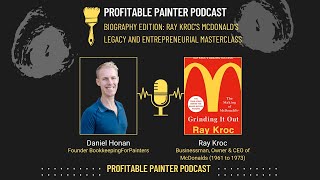
The episode of the Profitable Painter Podcast explores Ray Kroc’s life as recounted in his autobiography Grinding It Out, extracting entrepreneurial lessons for a painting‑business audience. It begins with Kroc’s early years – a restless, idea‑driven youth who lied about his age to serve as a Red Cross ambulance driver in World War I, where he met a young Walt Disney. After the war he bounced among odd jobs – piano‑playing in speakeasies, paper‑cup sales, real‑estate – before committing fully to selling paper cups. A pivotal moment came when he left that stable job to market the Multimixer, a milk‑shake machine, despite a disadvantageous 60 % ownership by his former employer. Financial strain forced him to mortgage his house, illustrating his willingness to risk everything for a belief. In 1954 he discovered the McDonald brothers’ streamlined San Bernardino restaurant, recognizing the power of a stripped‑down menu and assembly‑line service. He secured a franchise agreement that gave him rights to replicate the design but imposed restrictive written‑approval clauses and paid only 1.4 % of franchise revenue, creating tension with the brothers and his wife, Ethel. Kroc opened his first franchise in Des Plaines, personally cleaning, managing supplies, and demanding perfection, embodying a “lead‑from‑the‑front” style. He later hired Harry to devise a payment formula that combined a fixed minimum with a percentage of sales, shifting profit focus from royalties to real‑estate ownership and dramatically increasing margins. To gain full control, Kroc negotiated a $2.7 million buy‑out of the brothers, financed by a group called the “Twelve Apostles,” whose 0.5 % revenue share proved a bargain compared to the royalties he would have paid. The episode then outlines Kroc’s management philosophy: decentralization, granting authority to franchisees, minimal corporate bureaucracy, and a belief that “thinking small keeps you small.” Throughout, Kroc’s relentless determination, focus on a single, perfected process, and willingness to iterate contracts and financing are highlighted as actionable takeaways for painters – simplify service offerings, perfect the process, protect margins, and adopt a hands‑on, persistent mindset.
Chapters
Welcome to the Profitable Painter Podcast Biography Edition, where we delve into the lives of some of history's most successful individuals to uncover strategies, tactics, mindsets that propel them to greatness. Today, we delve into the remarkable journey of an individual whose unwavering determination and pursuit of excellence revolutionized the fast food landscape. Join me as we navigate the journey of this remarkable individual and extract invaluable lessons you can apply to elevate your professional painting business. Get ready to be inspired to learn and to transform the way you think about success and leadership in your own entrepreneurial journey. Ray Kroc was an American entrepreneur renowned for transforming McDonald's into the world's leading fast food chain. Initially a salesman, Kroc discovered a small but efficient restaurant run by the McDonald brothers and saw it as a franchise opportunity. After becoming their franchise agent, he eventually bought the brothers out and revolutionized the fast food industry with his focus on standardization, franchising, and global expansion. Kroc's visionary leadership made McDonald's a symbol of quick-service dining worldwide. So I recently read the book Grinding It Out, which is an autobiography by Ray Kroc. So Ray Kroc was born in 1902 in Oak Park, Illinois. As a kid, he, he was described as someone who daydreamed a lot, but once he got an idea, he acted on it. And he gives an example of when he started his, his lemonade stand when he was a kid. At age 15, Kroc lied about his age to serve as a Red Cross ambulance driver during World War I. And through that war, he ended up going overseas. And here's a quote from the book: As school ended that spring, the United States entered World War I. I took a job selling coffee beans and novelties door-to-door. I was confident I could make my way in the world and saw no real reason to return to school. Besides the war effort was more important. My parents objected strenuously, but I finally talked them into letting me join up as a Red Cross ambulance driver. I had to lie about my age, of course, but even my grandmother could accept that. In the company— in my company was another fellow who had lied about his age to get in. He was regarded as a strange duck because whenever we had time off we went out to the town to chase girls, he stayed in camp drawing pictures. His name was Walt Disney. So that's kind of cool that he actually met Walt Disney while serving during World War I. Now, after the war in the 1920s, Kroc held various jobs including playing piano in bands, selling paper cups, and working as a real estate agent. And he describes his schedule as basically he started working at 7 o'clock in the morning and all the way until 2 a.m. with like a couple hours off in that period to have dinner. And he described it as he loved to work. It wasn't work to him, it was play. So he loved to work, but he was very— he had a lot going on. He was working several different jobs. And, and this was during the '20s. He ended up— he was in Florida. He was playing piano at night for basically some gangsters who were— this is during Prohibition. They were selling alcohol illegally, and he was playing piano at like this bar. It ended up getting busted. He went into jail for a short period. It was like for a couple days, but he ended up getting out and he decided to go back to Chicago, which is where he's originally from. And he decided that he was going to focus on doing one thing. So there's a quote from the book: When I returned to selling paper cups, I vowed that this was going to be my only job. I was going to make my living at it, and to hell with moonlighting of any kind. I intended to devote every ounce of my energy to selling, and that's exactly what I did. So I think the lesson he learned here was to focus on one thing, because before he was doing so many things and his energy was just being zapped. It's pretty exhausting. So that's what he does when he gets back to Chicago. From the 1930s and the '40s, Kroc became a successful salesman at Lily Tulip Cup Company, and he eventually comes across— so he's very successful doing his sales role. He actually becomes a sales manager, and he's bringing a lot of business to the Lily Tulip Cup Cup Company. And this is during the time when a lot of stores were doing fountain drinks and milkshakes and that sort of thing. So he'd go around and basically sell paper cups to them. And so that was a pretty— he built up a lot of accounts like Walgreens. He got that account. And then eventually he came across someone who invented the Multimixer, which is basically something that mixes milkshakes. And he thinks it's a great idea, and he takes that and he wants to quit his job because he was getting kind of annoyed with working at Lily Cup. He felt like he wasn't appreciated, and he was really inspired by this idea for the milkshake mixing machine. His company actually had the Multimixer contract because when Kroc initially got the contract, he, he brought it to his company. He thought as an opportunity for them to invest in it and they weren't interested. And so he's like, okay, if you're not going to do it, I'm going to do it. But then the, uh, his company wouldn't give the contract back. They basically, uh, ended up being a 60% owner in the business that Croc started, which was a pretty bad deal because he was actively running the business and doing everything. And his former employer, the Lily Cup Company, owned 60% of that. And he ended up telling his wife, who he married his wife back when he was like 18 years old, and he's pretty much a workaholic. And he's— so he— this is a quote from the book. Ethel was incredulous at the idea that I would give up my position and go off on a flyer like this. We had just moved into a fine home. We were extremely comfortable there. Ethel loved it, and she felt threatened by this proposal. "You are risking your whole future if you do this, Ray," she said. "You are 35 years old, and you're going to start all over again as if you're 20? This Multi-Mixer seems good now, but what if it turns out that it was just a fad and it fails?" "You just have to trust my instincts," I said. I am positive this is going to be a winner. So he basically quits his stable job at the paper cup company to sell this multi-mixer. And here's another quote from the book: For me, this was the first phase of grinding it out, building my personal monument to capitalism. I paid tribute in the feudal sense for many years before I was able to rise with McDonald's on the foundation that I lay. Perhaps without that adversity, I might not have been able to persevere later on when my financial burdens were redoubled. I learned then how to keep problems from crushing me. I refused to worry about more than one thing at a time, and I would not let useless fretting about a problem, no matter how important, keep me from sleeping. And so basically, he has to take out a mortgage on his house to fund the— his multi-mixer business. He's— so he's running the multi mixer business. It's very difficult because his former employer has 60%, so he's basically not making much money at all. And around 1954, he hears about this restaurant in San Bernardino, California that uses 8 multi mixers, which was a lot of multi mixers in one restaurant. So he's really intrigued. And so he goes out to visit the McDonald brothers, who had this original restaurant in San Bernardino, and he saw a lot of potential for a nationwide chain when he visited it. He just— the operation was very efficient. There was loads of people waiting in line to get hamburgers and fries at this McDonald's restaurant, and he was super impressed, and he thought it would be an amazing thing to have these McDonald's all across the United States. And so here's a quote from the book: It was a restaurant stripped down to the minimum in service and menu, the prototype for legions of fast food units that later would spread across the land. Hamburgers, fries, and beverages were prepared on an assembly line basis. The simplicity of the procedure allowed the McDonald's to concentrate on quality in every step, and that was the trick. Basically, they simplified this process of making hamburgers, fries, and drinks. You know, they provided just those 3 things. It was very simple, but then that allowed them to perfect that process. And so I think this is a good lesson for us. If you can dial in your process for cabinet refinishing or exterior painting or interior painting, whatever it is, really focus on that one service line and just perfect that process instead of trying to go after many different service lines, like you do everything, like I'll do, I'll paint anything, interior, exterior, cabinet refinishing, staining, all this, all these different things. Instead, maybe it might be an approach is to just really simplify your offer and then go in and perfect it to make, you know, customers super impressed and delighted with the service that you're offering. So he ends up, you know, talking to the McDonald's brothers, seeing how he could franchise this business with them. And so here's a quote from the book: I would have rights to franchise copies of their operation everywhere else in the United States. The buildings would have to be exactly like the new one their architect had drawn up with the golden arches. The name McDonald's would be on all of them, of course, and I was 100% in favor of that. I had a feeling that it would be one of those promotable names that would catch the public fancy. I was for the contractual clauses that obligated me to follow their plans down to the last detail too, even to signs and menus. But I should have been cautious there. The agreement was that I could not deviate from their plans in my units unless the changes were spelled out in writing, signed by both brothers, and sent to me by registered mail. This seemingly innocuous requirement created massive problems for me. There's an old saying that a man who represents himself has a fool for a lawyer, and it certainly applied in this instance. I was just carried away by the thought of McDonald's drive-ins proliferating like rabbits with 8 multi-mixers in each one. So At this point, you know, when he does this initial agreement with the McDonald's brothers, he's still kind of thinking about the multimixer business that he has and the fact that it's going to have a lot of multimixers. So he doesn't quite have the vision that his money is going to be made just with McDonald's. So the terms of the contract aren't super favorable to him. He just, you know, he just described there that they would have to— any changes in the units that he does everywhere else in the United States, he'd have to get written permission from the McDonald's brothers, and they signed it and sent it via registered mail, which obviously is an issue. But he's also only getting 1.4% of revenue from the franchises that he's opening up across the United States, which is not, not that much. So it's, it's not a, a very good deal. So here's another quote: Ethel was incensed by the whole thing. We had no obligations that would be jeopardized by it. Our daughter Marilyn was married and no longer dependent on us, but that didn't matter to Ethel. She just didn't want to hear about the McDonald's or my plans. I had done it again, and once too often as far as she was concerned. The quarrels we'd had when I took over Prince Castle and then when I extended the mortgage on our house to buy out John Clark were mere preludes to this one. This was a veritable Wagnerian opera strife— opera of strife. It closed the door between us. She dutifully attended McDonald's gatherings in later years and was well liked by operators' wives and by women on the staff, but there was nothing more between us. Our 35 years of holy matrimony endured another 5 in unholy acrimony. So basically, McDonald's kills his marriage, and by the next year Ray Kroc opens up his first McDonald's franchise under his management in Illinois. And so this marks the beginning of the McDonald's Corporation. Here's a quote from the book: It was a messy way to start, being in default on the first unit, but there was no choice. I went ahead with the building, telling myself that when I got breathing space, I would fly out to see the McDonald's and get all the contractual wrinkles ironed out at once. That would have worked had the McDonald's been reasonable men. Instead, they were obtuse. They were utterly indifferent to the fact that I was putting every cent that I had and all that I could borrow into this project. When we sat down with our lawyers in attendance, the brothers acknowledged the problems but refused to write a single letter that would permit me to make changes. So he needed control to, to make these changes in the different franchises he was building because there's just slight differences, but he wasn't getting the written permission that he required by contract. So this was definitely an issue, and the McDonald's brothers weren't really working with him on that. Here's another quote from the book: "I would drive down to Des Plaines each morning and help the place get ready to open. The janitor would arrive at the same time I did, and if there was nothing else to be done, I'd help him." I've never been too proud to grab a mop and clean up the restrooms, even if I happened to be wearing a good suit. But usually there were a lot of details to be taken care of in terms of ordering supplies and keeping the food operation going, so I'd write out the detailed instructions for Ed McLucky concerning them. Ed came in about 10 o'clock in the morning to open the store at 11. I would leave my car at the store and walk 3 or 4 blocks to the Northwestern Station where I'd catch the 7:57 Express to Chicago and be in my Prince Castle office before 9 o'clock. In the evenings, I would commute back to Des Plaines and walk over to the store. I was always eager to see it come into view, my McDonald's, but sometimes the sight pleased me a lot less than other times. Sometimes Ed would have forgotten to turn off the sign when dusk began to fall, and that made me furious. Or maybe the lot would have some litter on it that Ed said that he had forgotten to pick up. Those little things didn't seem to bother some people, but they were gross affronts to me. I'd get screaming mad and really let Ed have it. He took it in good part. I know he was as concerned about the details as I was because he proved it in his own stores in later years. But perfection is very difficult to achieve, and perfection was what I wanted in McDonald's. Everything else was secondary for me. So I think a couple of lessons here, so, and themes that I've seen in other founders and leaders. So first of all is he leads from the front, you know, he's not afraid to get his hands dirty, get in, you know, he was doing the janitor's work at certain points. So He's not afraid to get his hands dirty. And, you know, if your employees, your workers see that you're striving for perfection, they're going to model their behavior after you. And this is something that Jeff Bezos did. Alexander the Great, even he led his troops from the front, which was not necessarily common. He wouldn't be in the back just doing the strategy. He would be actually leading you know, a contingent of his force. And then at this point, he actually still has a multi-mixture business that he's doing, and he has that one McDonald's store. So that's why he's traveling back and forth. But eventually he's going to figure out a way to make some real money with the McDonald's franchises, and he ends up hiring someone, this guy named Harry. And here's a quote from the book. This is the real This was the beginning of real income for McDonald's. Harry devised a formula for the monthly payments being made by our operators that paid our own mortgage and other expenses plus a profit. We received this set monthly minimum, minimum, or percentage of the volume the operator did, whichever was greater. After time, we began realizing substantial revenues from the formula, and we could see that we're merely nibbling around the edges of this huge hamburger frontier we were exploring. So basically, once they start getting more— once Ray starts getting more franchisees opened, more McDonald's stores open, he realized, working with Harry, that owning the real estate and getting the payments from the franchisee was a lot more profitable than just relying on the royalties, because like I said before, he only was getting like 1.4%. And so It kind of demonstrates just one little tweak in the way you're doing things can really have outsized results. And I kind of think of this as for painting businesses, for gross profit. Gross profit is like the number one profitability measure you should be looking at, and if you can just get your gross profit up by a few percentage points, it's really going to have an outsized impact on your bottom line profit. So that is something that you could really hone in on. Take a look at changing the, your process for how you produce the work to get a little bit bigger of a gross profit margin, or change your pricing structure, or both, to get a higher gross profit. And that's gonna greatly change how much profit you're getting, because gross profit is just a huge lever for overall profitability. So a few years go past, he's opening up multiple locations throughout the United States, and eventually the— he's trying to figure out, okay, I need to get out of this contract with the McDonald's brothers because it's just not working. So he ends up basically calling the McDonald's brothers and saying, what price do you want? How much do you want for your share of the business? And they basically, they give him a number, $2.7 million, which is a lot of money, especially It's a lot of money now, but it's especially a lot of money back in 1961. So they asked for $2.7 million, and he's basically— he doesn't have that money at all. So his jaw drops to the floor when he hears how much money they want, but he wants to figure out a way to get out of this deal with them, and he wants to own, you know, McDonald's completely. So he figures out a way to finance it. So here's a quote from the book: I was an extremely— it was an extremely successful deal. All concerned were happy. The Twelve Apostles, which is— the Twelve Apostles is the group that helps him finance this. The Twelve Apostles wound up making $12 million on it. And while that seemed like a terrific price to pay, remember that we had been forking over 0.5% to the McDonald's brothers all along anyhow. The total cost of the transaction to us, about $14 million, was peanuts compared to what the corporation earned in the years that followed by retaining that 0.5% instead of paying it to Mac and Dick McDonald. On today's system-wide sales of more than $3 billion, that 0.5% would be up there over $15 million a year. And so this, this was written back in 1977, and they were doing $3 billion then. McDonald's now is doing, you know, I think 10x that at least. So it's, you know, they asked for $2.7. He does some financing with 12 Apostles, and 12 Apostles basically got a percentage of the revenue, which was 0.5%, which was what the McDonald's brothers were getting anyway. And so they pay off 12 apostles over the course of a few years. It ends up costing Ray $14 million to buy out the McDonald's brothers. But as he says, you know, getting them out saved him a whole bunch of money because otherwise he would have had to have paid the McDonald's brothers like $15 million a year by 1977. So from the 1960s, 1970s, McDonald's expanded rapidly across the United States and then internationally. And here's a quote from the book: I maintain that authority should go with, with a job. Some wrong decisions may be made as a result, but that's the only way you can encourage strong people to grow in an organization. Sit on them and they will be stifled. The best ones go elsewhere. I knew that very well from my past experience with John Clark at the Lily Cup Company. At the Lily Tulip Cup. I believe that less is more in the case of corporate management. For its size, McDonald's today is the most unstructured corporation I know, and I don't think you could find a happier, more secure, hardworking group of executives anywhere. So basically, he has a structure where he has a team that has a lot of authority. The franchisees, they have to run their own stores. And he tries to incentivize them and give them guidelines and a system, but he lets them kind of take the reins and go with it. He doesn't provide— have a lot of rules. He has a more decentralized structure. Here's another quote that stuck out to me is he says, I believe that if you think small, you stay small. And that's just a common theme that we keep seeing over and over again from Exelon— Alexander the Great, Jeff Bezos, Napoleon. You have to have a big vision. If you put limits on your thinking, you're going to— you're not going to do big things. Here's another quote from the book: the key element in these individual success stories and of McDonald's itself is not knack or education, it's determination. This is expressed very well in my favorite homily, Press On. Nothing in the world can take the place of Persistence. Talent will not. Nothing is more common than the unsuccessful men with talent. Genius will not. Unrewarded genius is almost a proverb. Education will not. The world is full of educated derelicts. Persistence and determination alone are omnipotent. Coming from Ray Kroc himself, determination is the key, and he definitely had determination throughout his life as we just went through. So I definitely recommend you, you you pick up the book Grinding It Out by Ray Kroc. It was definitely a good read. I think some of the lessons that we can take from him is determination, not giving up, creative thinking, getting, you know, setting up these systems and figuring out the best way to win in situations where, you know, it did not look good for him. Plus, he saw the value in stripping down processes and perfecting them. And then that allowed him to really scale his business and repeat it over and over again. And with that, I'll see you next week.
More from Daniel







What’s REALLY Holding Your Painting Business Back? (Find Your Bottleneck in 5 Minutes)



