Boost Your Painting Business with Tom Droste: The Advantage of Project Performance Reviews
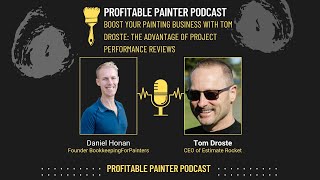
Tom Droste, CEO of EstimateRocket, explains why painting contractors need post-project reviews to catch mistakes and refine processes. He details how a single software platform storing estimates, invoices, and photos reduces chaos, and why a non-blame culture during reviews helps top performers train the rest of the team.
Chapters
Welcome to the Profitable Painter Podcast. The mission of this podcast is simple: to help you navigate the financial and tax aspects of starting, running, and scaling a professional painting business. From the brushes and ladders to the spreadsheets and balance sheets, we've got you covered. But before we dive in, a quick word of caution. While we strive to provide accurate and up-to-date financial and tax information, nothing you hear on this podcast should be considered as financial advice specifically for you or your business. We're here to share general knowledge and experiences, not to replace the tailored advice you get from a professional financial advisor or tax consultant. We strongly recommend you seeking individualized advice before making any significant financial decision.
This is Daniel, the founder of Bookkeeping for Painters, and today I'm here with Tom Drost. Tom Drost is the CEO of Estimate Rocket and he coaches company leaders in sales and profit planning. And software implementation. EstimateRocket is an all-in-one business management software for contractors that helps them run their entire business from lead to paid, all-in-one platform. How's it going today, Tom?
Going great, Daniel. I really appreciate you having me on today.
Absolutely. Glad to have you here. Excited to get into the discussion. Can you kind of give me some background on how you came to start and run SL Rocket?
It's a long story. So I actually started out my career as an accountant, you know, went to school for accounting, got out and worked in accounting for a couple of years and started using computers in my accounting work back in the, you know, in the old days before Excel even. And I really liked that part of it. I didn't like the accounting quite as much. I like the, you know, the conceptual parts of accounting, but not necessarily the day-to-day accounting work. And so I started getting more and more computers. I actually quit my high-paying, full benefits job in accounting and went to a computer store and was doing training, teaching people how to use the head of training or something like that. My father-in-law thought I was, as I found out years later, thought I was a whack job leaving my job, my good high-paying job for a computer store. What are you nuts? You know, But anyway, so that led to consulting because this was in the, you know, heyday of people starting to utilize PCs in everything. And there was just a, you know, a wealth of opportunities there. And I got into writing mostly things that had to do with supporting accounting. I didn't, wasn't really writing accounting software, but I was writing software that kind of did everything around accounting and supplied accounting with information. So that was really kind of my, you know, genesis for getting into it. And I also did it, you know, I've always enjoyed helping people. You know, I wrote software mainly to make their lives easier and make their lives better and allow them to do, you know, get more done in less time and those kinds of things. And that was really fun. And I love working with users and helping, you know, because you could see people go, oh my God, that's great. You know, you're saving me so much time by doing that. And And so I have had— this is my second software company. The first software company, actually, we worked with supermarkets a lot and we ended up getting into these really huge supermarket chains. And it took for me all the fun out of it because I wasn't able to work with the people that it really mattered to that were really actually using the software day to day. So I actually started the Logical Engine, which became Estimate Rocket, and about 12 years ago. We didn't start EstimateRocket until about 7 years ago, and we've been full on with EstimateRocket since then, and I love it. I get to work with entrepreneurs every day, help them to build their businesses, and yeah, I really love it.
Yeah, that's awesome. And it sounds like we're cut from maybe similar cloth, being accountants by training. But yeah, no, that's awesome. We do have a lot of clients that work with EstimateRocket and and love it, you know, everyone, painting businesses from, you know, that are doing a few hundred thousand to that are doing, you know, up to a few million. So it seems to be a good tool that folks definitely like. And one of the things that I think a lot of folks like about EstimateRocket is the ability to track your customers' projects and to do that, thus allowing folks to do project performance reviews. Could you talk about the role of project performance reviews in, you know, a painting business's success and how estimateRocket might support that?
Yeah, it's really kind of huge. And quite honestly, the term kind of came out of a report that we had called the Profitability Report. And a customer that was using it and growing really quickly actually came to me at a conference and said, hey, by the way, that profitability report is awesome. We have these meetings every week with our crew leaders and estimators on any projects that were either way better than we thought they were going to be or way worse than we thought they were going to be. And we use that. We know who the estimator was. We know who the salesperson was. We know who the crew leader was that ran that project. And we can get together right after it's finished and have a great conversation with them while it's all still fresh in everybody's minds so they can You know, it's not like everybody's going, "Oh, that was a year ago," or a month ago. "I don't remember, you know, what I had for breakfast." And to, "Yeah, geez, you know, on the estimate I forgot to take this note and, you know, I noticed it on the site and I forgot to document that." And sure enough, that bit us in the butt when we went back to do the work because I hadn't told the guys what I had seen. I hadn't left a message or a note in the project for the guys that were going to— the crew that was going to do the work, and it fell apart, you know. Or the flip side, you know, well, you know, we— I had the project was a little more complex than the crew thought it was, and maybe we didn't pick the right team members for that, or maybe we need a little bit more training for some of those team members for a new product that was used. It just gives you a time to to quickly reflect while it's still fresh in your mind and use it to progress. It's the whole objective of it is not to beat people up over it, but to figure out what went wrong and figure out how we can communicate more effectively or what process we might need to put into effect to stop this from happening in the future. Documentation really ends up being a huge piece of it. I mean, that's one of the things we did have done in Estimate Rocket is there's lots of ways to document what you're doing through notes, emails, photos. There's just so many ways to do it. And it, and it's all right there for you. And so you do go back to review the project, you can see everything, you know, you see all the trail of what happened on the project. So it's really, it's a really, really valuable tool.
Yeah, it sounds like a couple of key things here. One is you got to have some sort of tracking mechanism to know what's going on on the project. Number 1, and 2, you got to do it like free, like timely. You can't wait 2 months or 3 months after the project has occurred. So you have to be tracking this data pretty on top of it. And then 3, you got to bring the key players in and so you can hold people accountable and get the right heads put together.
Yeah, really critical.
Yeah, that's pretty, that's, that's, uh, pretty cool. And I think, uh, you know, that's going to be a big moneymaker. I would think if you're taking the highest, you know, finding what the best practices are from your most profitable jobs and also mitigating the, the worst, you know, the jobs that are most, uh, draining on your profits, you know.
Yeah, it really helps on both sides.
Yeah. Capturing those best practices or adjusting your process to avoid those painful events that might occur on a project can really move your business forward.
A lot of time there's training opportunities, I think, that come out of it as well. I mean, a lot of the time those problems that occur are A, because people don't understand what the existing process is for doing something, Or in a lot of cases, either they've never done— the crew may never have done that particular type of work. There might be some specialty, you know, piece involved there. And, or it might be a new product that a new coating or something that there just has some nuance to how it's applied or else it becomes a nightmare. And that way, you know, if that happens to one team, you know it's going to be happening to other teams. So you get that opportunity to to, you know, uh, preempt those potential problems from happening downstream as well.
So what does a business like this, like if a painting business implements a process like this, what should it kind of look like? Or what would you recommend? What have other painting businesses done that you've seen have been successful?
Yeah, it's, um, It's a real challenge implementing a piece of software that, you know, runs your business. It really is for anyone. People experienced with technology and people not experienced. And it doesn't matter how easy or difficult the product is to use. It's a matter of mapping your processes to this tool. And, you know, every tool has its nuances. No tool is going to work exactly the way you want it to. There's going to be some things where you might have to alter your processes. But I think what, what we find the biggest challenge is that people don't have documented processes, you know, without their automation or for the existing automation that they're using. And exactly why, I'm not sure. It's sort of probably in a lot of cases, it's the, the tool or the software product or whatever you're using becomes the process, but there's no outline of what that process is written down. And again, it can be a simple outline of steps of here's how we go from top to bottom in a project throughout the lifecycle of a project. But if you don't have that, then if you're, if you're starting from scratch, it's almost easier because you don't have anything to unlearn or to remap in the process. If you're Moving from one product to another product, again, you now you have that challenge of, okay, the product may be the process. We've got to extract that process and figure out how we're going to map that process to this new product because it's not going to be exactly the same no matter, you know, which, what thing you're coming from or going to. So I think that's the biggest problem is a lack of documented processes in companies. I think the other, the other challenge is biting off too much at one time. You know, you have to have an implementation, an implementation plan that says, okay, here's, here's the first thing that we're going to do. Here's the second thing we're going to do. Here's the third thing we're going to do. Because a lot of the products people are looking at are products that do, you know, run, touch a wide segment of their business. It's not just a a little narrow piece, I often think of I wish I was CompanyCam because CompanyCam does one nice focused, you know, narrow thing and it's something that's easy to insert into an existing process. We kind of have the challenge of being a big nut and, you know, end-to-end thing. And you can, I'm sure you can sympathize in accounting software migrations. It's just it's a big process because it touches, generally touches so many parts of your business.
Yeah, going to the—
it's a ride.
No, I definitely, I can definitely sympathize there. Going back to your, the process documentation, some folks, you know, like you said, they don't, they don't have processes documented. They definitely have processes, they're just not documented. It's just like in someone's head, uh, often the business owner, he, he or she might know like all the steps of the business, but it's not written down anywhere. Or maybe sometimes in an employee's head and, you know, hopefully that employee doesn't leave. So do you have any recommendations for a painting business owner that might have their processes in their head or in their employee's head, but they don't have it documented anywhere?
Sure. Yeah, the best advice I would give on that, and there are many different ways to go about it, but is sit down with a Google Doc or a Word doc and start an outline, just a numbered outline of the steps that you go through for a process. Okay, incoming lead, what do we do? We write down the information, we call somebody back, we put it in our system, we We send out a communication to the person and keep communicating until we get a hold of them. And I mean, it's literally that to me, that's what it all boils down to is, you know, just step by step. And it's things that are, like you said, they're all in people's heads, but they don't always write them down. The bonus is that by doing this type of thing, when you're done, and you now are growing and you need to hire new people, all you need to do is show people the process book because the process book or standard operating procedure book or whatever, you know, you can call it whatever, standard operating procedure sounds really sexy. You know, we now have our SOPs and, but it really works. It's something for people to go by. And if you're doing it in something like a Google Doc, it's, It's malleable. You can, you know, add things, move things, make changes as you need them. But getting it down somewhere other than in your head is the key. And it doesn't have to be complex. It can be a very simple, you know, simplest list of steps. It's just what do we do? And don't go into too much detail. You want to go into enough detail that people, that is, if someone's reading it, they can go, oh, okay, yep, that makes sense. I know what, I know what entering the data is. Maybe not, maybe you need more someday in that process, but start out with the simple ideas, the super obvious things. Just say that they have to be done. You don't have to say every detail about them. And just go down the list of your major processes. And then, you know, periodically when you have time, you go back and, and add, you know, supplement the areas that really don't have enough information so that when someone looks at it, they're like, hey, how do we do this and this and this? Well, add it to the doc. The hardest part is the first time you go through it, obviously.
Yeah, definitely. And to tie it back to performance, project performance reviews, you know, that would be— you obviously want to do your document, your processes in the beginning, but then there's a process of updating your processes, right?
With your—
in a key time to do that might be You know, if you have a terrible project and it's because your process doesn't, you know, have a good handoff between sales and production, maybe that process needs to be updated because you found out from your project performance review that the reason why, you know, Mrs. Smith's job went terribly was because of that failure of the process.
Right. And just sometimes just getting the two operations and sales in the room together enlightens everybody to, oh, you need that information to actually do the work? I wasn't thinking that way, you know, because I'm sure as an estimator goes out on site, they observe all kinds of things and they may be in their brains going, well, they'll know that. They'll know that. They'll know that. But if it's something that becomes a basis of how the project got estimated, then you, you probably want to document it because otherwise it gets lost and then the guys doing the work don't have a clue, or you forget to bring this thing that you needed for this job that was called out in the notes, or it really helps.
Yeah, definitely. Are there any other things that a good, you know, performance review does that helps take, you know, the business to the next level that we haven't covered already?
I think it's the attitude that it's done in, in the respect of it's not to beat people up. It's not to, you know, it's not to chastise people for what they've done. It's to figure out how we can constantly improve and get better at things and keep it in a positive light, not in a, well, you did and you did. You don't want to blame. You want a solution that's going to help everybody, you know, help avoid this thing in the future. I think that's a really big, really, really important thing is to keep it. And you may have to, as a manager, you know, as the leader of the company, you may have to manage that and make sure that everybody's going into it with the right attitude. If somebody's attacking somebody else, you gotta, you have to stop, say, hey, that's not, that's not acceptable. That's not why we're here. And, you know, we need to figure this out. And, you know, 9 times out of 10, the attacker is probably the person who really did something wrong in the first place. So gotta watch those things. Joys of management.
Oh, yeah.
Yeah.
And along those same lines, it might be like doing a performance review on projects be another opportunity to kind of, especially if you have a larger painting business, you might be kind of separated from what's going on on the ground, but that might be an opportunity for you to see like who's doing really good things and who's doing maybe not so good things so you can reward and promote accordingly.
Yeah, I think that, and I think the one other offshoot of that that's really important not to lose is that when you see those, the people that are excelling, it's an opportunity to use those people to train and bring up and work with the other, you know, do a lunch and learn about this thing that we just learned. And you bring in the people who don't, maybe don't have the same level of experience and show them what, you know, hey, there's this thing that we figured out when we're, when we're masking or when we're using this particular coating or when we're doing that. And then all of a sudden the— it raises the level of the whole team instead of just that group that happened to be involved in that particular project. And you— it multiplies, you know, pays dividends in a bigger company if you use it effectively because everybody gets to benefit from, from that learning experience.
Yeah, absolutely. So another topic I wanted to ask you about is sales backlog. So a lot of folks I've heard, you know, talking to other painting businesses, there's sometimes, there's a disagreement on how much of a backlog of production should they schedule out. Like, should they schedule out only a month of work and then not take any more clients on, or should they just go, you know, book 6 months out? You know, sometimes there's a hesitation to book work far out in advance because I'm not sure the exact— I think some people feel like bad because, oh, I'm gonna make the customer wait so long. It's not ethical or something like that. Do you have any thoughts on that?
Yeah, I think you're right about that, by the way. That is a big part of it. And I think especially when you're smaller and you're busy already, the concept of committing to more work can be daunting. But if you're, if growth is in your plans, then you have to manage that because it's really, it's much easier to grow when you've got a solid backlog of work that's already been committed to by customers than it is when you've just got, you know, a couple weeks worth of work that are already committed to. The challenge is that you probably need to have, one of the challenges is you need to have a decent system for keeping track of it. And that may be another thing that discourages people from, you know, from booking work out into the future is they don't have a system for keeping track of, okay, how much have I committed to? What have I put on the calendar as planned dates for these things? How have I communicated to the customer? How am I communicating to these customers that are in my backlog that have, you know, have committed to work? So there are some, you know, there's some baggage that comes along with the backlog for sure. But I think there's also a lot of people who want it now, but there's also people that are like, a month is fine from now. I'm not— this is not an emergency, just something I really want to get done. And my— to me, if someone's really high quality, I know personally when, you know, we're hiring contractors for— to do work at our house, I don't care how long. Literally, most cases, I don't care how long I have to get booked out. If it's 2 months, a month, 2 months, you know, maybe 6 months might be a for certain things. But if I'm hiring that person generally because that person's really good and they're going to give me a really good experience and I'm willing to wait because it's, again, what I'm doing isn't an emergency. So, you know, and I think, I think there's a lot of people out there that are like that. I really do. If, you know, if you've sold them on what your capabilities are and, you know, what kind of experience you deliver to your customers, then they're going to go, Okay, yeah, well, I wish I could have it next week, but, you know, 2 weeks out, 3 weeks, 4 weeks, 5 weeks, 6 weeks, I can live with that.
Yeah, so being a homeowner, I can definitely relate to that. Like, I'm, you know, as long as it gets taken care of, most of the time it's not an emergency, especially for house painting, unless you're like trying to sell, obviously, or something like that, right?
Right.
It's usually not a huge emergency, so I don't I don't think, I think most folks are good with waiting. So, and I believe Estimate Rocket doesn't have a capability to actually schedule out projects. So you can keep good visibility on things.
Yeah. Yeah. You can, you can schedule, you know, you can put the, put the project in, in the calendar, which does two things for you. A, you know where that project is and what its value is, where you've, where you've tentatively scheduled it. And so when you go to schedule the next one, you're like, okay, and those weeks are already booked up. So now I can book out into the next week. And the other thing it does is if you have people moving, you know, moving their schedules around, okay, let's say we're out 2 months now and somebody 2 weeks out cancels or says, I can't do it. It's going to be 2 months before I can do it now. Now you've got this list out here because not too many people are going to are gonna say, oh no, I don't want you to come early. So now, but if you've got, if you've got some backlog, then you can look into your backlog and go, ooh, I can move that person up. They were really antsy to get it done. I can move them up and then we'll fill you into that slot that's 3 weeks out or someone else into that slot. It gives you a little more flexibility and, and again, a little more comfort level that, you know, you're gonna keep the engine running at the way you need it to keep running.
Yeah, absolutely. Yeah, that makes a lot of sense. And I know a lot of folks are, you know, either at worst, worst case scenario, they're keeping, trying to keep it in their head, which that's not a good place to keep it. Um, yeah, but, uh, trying to use like a paper calendar or Google Calendar can kind of get a little difficult to, to do that, um, yeah, management. Instead of using something like Estimate Rocket where you can actually have that system designed for contractors to do that kind of thing.
Yeah, Google Calendar is great, except that usually there's a lot of other stuff in it too instead of just your, you know, key business stuff. And that's one of the reasons why it's kind of helpful to have that isolated and to, you know, be able to see just the work, not work and personal and everything else you got going on in your life.
Yeah, absolutely. Cool. So what are some of the biggest benefits you think folks see when switching to something like EstimateRocket where they can have the ability to track leads, to track projects, you know, from lead to project completion to getting paid? What are some of the biggest benefits that you've seen painting businesses get from that?
Yeah, I think the biggest overall benefit is having everything that you need to know about a project in one place that's easy to get to. And it comes in, you know, you have the documentation, you have notes, you have, you know, your original proposal, you have your scope of work, you have when you invoice them, you have when they paid, you have your expenses. Everything's in one spot and super easy to get to. That doesn't sound like much until you get a lot of projects and you're looking around to find out, oh, what happened on that project? That was like a month ago, or it's coming up next month. What did we promise them? Oh, here's the, here's the scope of work. Here's the, you know, here's what you committed to. And all in one place, need to send them out an email, send them out an email through there, through the application. You get that captured in it. And the other piece that goes along with that are the automated follow-ups is the, you know, they're at each stage of the project, even after you've booked it, you know, you have an automatic follow-up that you can send out to say, you know, to confirm their work appointment and then to maybe send them a message that says, hey, here's what to expect when we get there. It just is a way to constantly be communicating with people during the course of the project without really working very hard to do it. And I think that's probably one of the biggest challenges and probably one of the biggest complaints of contractors. And by the way, programming contractors are no different. I always had this problem when I first started my programming business many years ago. It's just hard, you know, it's hard. There's no good place to keep these, this stuff that keeps you on track and lets you know what needs to be done next. And it really does help a lot.
Yeah. Yeah. Having all the sales notes for, you know, work orders when they're scheduled for, like if you have an admin person in the office like that, that wasn't a part of anything, right? The sales, they weren't part of the production. And then they get a call from a customer, just being able to go to one place and open it up and answer some basic questions.
Yeah, it's huge.
And take notes. Like, that's gonna keep your, if you're trying to grow your business to a level where you're not involved in every detail, that's gonna be critical is having a platform that your team can use to get a picture of what's going on in the business.
Yeah, that transparency of information between everybody in your team. Again, that, that's the having it all in one place. You're not waiting, you're not waiting to for someone to get back to the office and open a file drawer or somebody's got it in a Google Doc and that's not shared and you need to get them to share it, but they're not in for the next 2 days. I mean, there's just so many things that it really helps in terms of keeping everybody you know, in the know, and it eliminates confusion. It, you know, reduces that chaos of not knowing what's going on. Uh, it just really becomes an important tool. And again, especially if you're growing. If you're not growing, hey, maybe you, you know, it might— some of these tools may be more than you need. But if you're growing and your business is booming, you have to have systems to manage it.
Yeah, yeah, absolutely. Yeah, it's critical to have those processes like we talked about, and then that project review process where you're constantly adjusting those processes and getting better. Yeah, because you, you know, if you, if you're constantly having those same issues over and over again, that's going to limit your growth. So you have to have those, right, those functions built in so you can you can improve and grow.
Awesome.
All right, uh, are there any final tips that you have for painting business owners that are looking to grow their, their business?
Um, get your, get your processes in line. I think that's a really, it's a really important thing. And, you know, you, you could actually, if you're in that early growth stage, you know, sit, you know, sit down in the evening, uh, not that you really want to sit down in the evening, but it's really just a matter of sitting down and getting your thoughts out on paper. And by the way, all of our devices now, in the old days, 5 years ago, they did not do dictation well. And it was really hard to like use them. They, some of them recorded stuff, but you couldn't like get to text easily. They have gotten so good at that. I mean, it's crazy. You could write a book just, you know, using dictation. So you can even sit there and just talk to your phone or your, or your Mac and have it write out your process, you know, write your process for you without having to type it all. Because I know my biggest problem when I type isn't typing, it's that I keep going back and editing it 1,000 times and I never, you know, without finishing it. If I was talking it, I'd just get it all down and then I'd go back and edit the whole thing. Yeah, lots of ways to get it down.
Exactly. And even nowadays, I mean, you can, like you said, get a transcript pretty easily. And then just throw it in ChatGPT and just say, hey, format this in a, you know, step-by-step process. It could probably do an 80% solution.
Yeah, you could tell it regardless of how this looks, this is a standard operating procedure. So please format it appropriately. Yeah.
And absolutely, you could do all your processes in your business in an afternoon. Doing that method.
Yeah, that's a really good— that's actually a great thought.
All right, cool. Well, where can folks reach out to you or learn more about EstimateRocket and how it can improve their painting business?
Sure. Well, you can get to me anytime at tom@estimaterocket.com, and you can visit estimaterocket.com and learn all kinds of cool things about our product. We also do live product walkthroughs a couple times a week. That's a great way to see kind of from start to finish what Estimate Rocket can do for you. Awesome.
I appreciate your time today, Tom. And for the listeners, if you have any questions or if you're interested in Estimate Rocket, you can go to Facebook, type in Grow Your Painting Business, and ask some questions about for Tom and that he can respond to and get back to you on that. And with that, we'll see you next week.
More from Daniel







What’s REALLY Holding Your Painting Business Back? (Find Your Bottleneck in 5 Minutes)



