Cabinet Kings: Mastering the Art of Refinishing
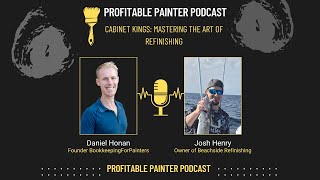
This content was created by balanced-griffin. This content was uploaded by balanced-griffin. This is a YouTube podcast episode titled "Cabinet Kings: Mastering the Art of Refinishing" from the Profitable Painter Podcast (recorded/posted 2025-07-18). It is an interview hosted by Daniel Honan, CPA and former painting business owner, with guest Josh Henry (a South Carolina cabinet refinisher). The conversation covers Josh's 10-year journey from tub refinishing to building a $1M+ cabinet-focused business (about 9 employees and a 5,000 sq ft shop), his decision to niche in cabinet refinishing/refacing (80–90% of revenue), operational structure and delegation, pricing and gross margins (reported ~50–75%, commonly ~60–65%), marketing and lead generation (word-of-mouth, local Facebook groups, paid channels discussion), and plans to scale while maintaining quality.
Chapters
Welcome to the Profitable Painter Podcast. The mission of this podcast is simple: to help you navigate the financial and tax aspects of starting, running, and scaling a professional painting business. From the brushes and ladders to the spreadsheets and balance sheets, we've got you covered. But before we dive in, a quick word of caution: while we strive to provide accurate and up-to-date financial and tax information, nothing you hear on this podcast should be considered as financial advice specifically for you or your business. We're here to share general knowledge and experiences, not to replace the tailored advice you get from a professional financial advisor or tax consultant. We strongly recommend you seeking individualized advice before making any significant financial decision.
Welcome to the Profitable Painter Podcast, the show where painting contractors learn how to boost profits, cut taxes, and build a business that works for them. I'm your host, Daniel Honan, CPA and former painting business owner, and your guide to mastering the numbers. That drives success. So let's dive in and make your business more profitable one episode at a time. I'm super excited today. I'm here with Josh Henry out of South Carolina. How's it going, Josh?
Good. How are you?
I'm doing well. I'm doing well. So I'm really excited to get into your story today. Um, can you give the audience, the listeners, an idea of how you got started in the painting industry and what has been your journey along the way? Some major milestones.
Okay, um, well, I've been in the industry since I was 18. Um, started, found an ad in the paper when I was living out in Florida. It was actually for a tub refinisher, so didn't know anything about it. When applied, got the job, and one thing led to the next. Um, just started branching out from there, and then I moved to South Carolina, tried to find a job, nobody would hire me, so end up starting my own company. And from there we kind of just expanded, um, just as more needs came up, we just kept on going with it. Um, one day somebody asked, hey, can you paint our cabinets? I was like, well, you know what, why not? So, uh, just pretty much started growing from there. And then like I said, one thing leads to the next. We, uh, got more into the cabinet side of things and, um, just we just kept on, kept on growing. So, and now, uh, we're at the point now we have 9 employees, uh, 5,000 square foot warehouse. We, uh, are probably the largest cabinet company around here in this area. We offer refinishing, refacing, custom cabinets, and, uh, yeah, things have just kind of taken off.
That's awesome. It— so I love this because A lot of folks I speak to, like, especially if they're doing below $350,000 a year, they feel like they have to do everything. They have to do interior, exterior, cabinets, flooring, like they have to do all the things to get more revenue. And, and I'm like, no, there's actually folks out there who just do one or two things really well. and they become known for those things and they just blow up. And, uh, I feel like you kind of fit that, that latter definition where you've kind of found a, a niche and you've become known for that niche and you've, you've been really able to, to capitalize on that. Is that fair?
Oh yeah, definitely. Uh, I don't want to go out and do anything and everything. We just found our little specialty and we were good at it, so we stick with it. Um, I try to teach myself and I'm always learning. There's always stuff to learn in this industry, so I'm always trying to stay up to date on the technology and, and, uh, all the new stuff coming out in the industry. So pretty much we can offer the best product and best service possible.
Yeah. And, and how long have you— I know you started when you're 18. How long have you actually been running this business at this point?
10 years now.
10 years. And where, where have you gone from? Obviously, you started up 10 years ago. And what, in terms of revenue, just to get an idea of how large an operation you're running, where's the revenue looking like these, the last year or so?
Last year, we were breaking a million.
Okay, awesome. So you're just doing cabinet for the most part, is cabinet refinishing, refacing? Um, that's the, the core, like 80% of your revenue is coming from that. Is that fair?
Or— yes, about 80-90% is all cabinets.
Okay. And, and you're doing, you know, a million plus in that, in that ballpark, uh, just doing that one service. And, uh, so that's, that's awesome. So you probably have like a really dialed-in process, I would imagine.
We do.
Yeah. Could you, could you, um, how did you— what, what gave you the— because I feel like a lot of folks that are, you know, they maybe want to niche but they feel like, but I'm— it's hard to give up that revenue when, when, you know, oh, I want to niche in cabinets, but then someone comes to you like, hey, can you paint the exterior of my house? How do you maintain that discipline? Like, no, we actually just do cabinets. And just, you know, turn down that, that revenue that's, you know, easy because the person's just asking you, hey, can you just paint the exterior of my house? How do you manage that? Like, what do you— what's your mindset with that?
I just don't want to mess with it. We, we found what we like to do and we're good at it. So that's why I stick with— so somebody asked me to paint their house. That's, that's not my thing. I just want the specialty stuff. So it's just been a habit for me. And all my guys that work for me, they specialize in one thing. So I have somebody that all he does is spray doors all day in the shop. I have somebody that sprays cabinets on site all day. And then our carpentry team, um, as well as some installers and stuff. So everybody is good at their job and that's kind of what they stick with. So I don't want to go and throw curveballs and be like, hey, can you go out here and just paint this room now? Because it's just not what we do. So we just find our specialty and we stick with it.
That's amazing. So you even have it broken down specific to the person where they have a role within the cabinet refinishing, refacing process that they— yeah. And so I can't imagine, they must be like super efficient.
They are. So these people, they do this all day, every day. So that is their one job. That's their task. They know what to do, the ins and outs. Um, if there's an issue, they know how to correct it. So I mean, they're, uh, that's what they're good at. I tried before having people that do a bit of everything, um, in the process and just turns to be that not everybody's good at everything. So pretty much I'm just finding people that are set and they're skilled in that one area and that's, that's where they shine. Hmm.
Yeah, that's, that's great. And I guess so now that that's how it runs, like you have folks that have their own position, they know their role. They're efficient. Did you have that vision early on? Like, how did you get there? Because I feel like that's, uh, if you— yeah, did you have that vision early on? Or like, and if you didn't, how did you end up getting, getting this vision of, you know, everyone has their own job, we only do cabinet refacing, resurfacing? How did you get there?
It took a while. It took me to, uh, really let go and trust people to do things. So task delegation, that was my biggest thing. So beginning, I tried doing everything myself, and because I was like, nobody's going to care about this company as much as I am, so nobody's going to put in the effort, they're not going to go above and beyond and make sure the customers are happy like, like an owner will. So that was my biggest hurdle going through this, is actually letting go and stepping back and be like, you know, I can't scale this business if I am the business. So that was my biggest thing. And then once I started growing and getting more skilled, uh, employees that came in, pretty much it's a long journey, but as soon as you find somebody good, you just got to take care of them and they'll take care of you.
Yeah. And when you started early on, were you also just focusing on cabinet resurfacing, repainting? Exclusively when you, when you started as well, or did, was that, did that evolve where you then niched?
That evolved too. So it started out with, uh, tub refinishing and repairs, stuff like that. And then, uh, I started doing this as a part-time job, so I wasn't just, you don't just show up one day and okay, we're slammed now. So, um, I started easing myself into this, doing little side jobs here and there, and just kind of grew to where I could quit my day job and do this full-time. And then from there we just kind of scaled everything. And cabinets came along just probably like a couple years into it. Somebody asked me if we could paint their cabinets or if I could paint their cabinets. Back then it was just me. And, you know, I knew a lot about coatings. I knew the process and application, how to do it. So I was like, you know what, why not? Gave it a shot. It was a recurring customer, so they kind of knew my work and everything and did the job. And, you know, looking back on it all these years later, I realized I could have done way better than I did, but took the jump. And then after that, I just kind of been trying to teach myself and better myself with all the different, you know, application methods and the coatings that are out there. And now this, it kind of just took over, and now we just specialize in, in all this.
So you sound like you were— you started with tub refinishing, and then you, you tried out cabinet refinishing, resurfacing, and then that That worked out well. Was it because the demand is higher for that, that you decided to kind of more focus on cabinet refinishing, resurfacing, or was there something else involved?
It's bigger ticket jobs. So I was looking at the big picture here. I mean, we could refinish, get a tub done and make like $800, $900 on it. Or we could do a kitchen. Kitchen, we're at $5,000 to $10,000.
So, yep.
Just, uh, it's bigger work. It fills the schedule more. A tub we do in a day. Uh, cabinets is going to fill the schedule, keep the guys busy. And word of mouth, it's just a bigger like wow factor. So people see it, they go into their other friend's next-door neighbor's house, oh, your kitchen looks beautiful, who did it? And then it kind of goes off from that. So now, I mean, we don't even really advertise, it's all just straight word of mouth.
Oh wow, that's really good, especially for your level, uh, for revenue, a million dollars in revenue. So, and then you've only been doing cabinet resurfacing, repainting, I mean, resurfacing, refinishing for what, 7 or 8 years at this point?
Yeah.
Okay. Yeah, that's, that's really good growth for, for $1 million in revenue for 7, 7, 8 years. So, and it's all referral and it's because basically you're wowing people and they're, they're telling their friends when they come over and see the kitchen and And that seems to be really working really well. So that's awesome. So what I guess you're— you mentioned earlier that you're pretty much the go-to person. There's no one else in your area that specializes in cabinet sink, right? Is that accurate?
So we're the only people that specialize in it. There's other companies out here that will do it, but our means of selling this to people is, hey, we do this all day, every day, versus somebody that just does a kitchen once a month or once every couple months. So that's like our biggest selling point there. I've invested a bunch of money back into the company, so we have an actual permanent spray booth, um, thousands of dollars in equipment. Um, we even tint our own coatings in-house. So I mean, I've invested a ton of money to show people like, hey, We're devoted. This, this is what we do and we do it well.
Yeah. And because of that, your ability to communicate that in your sales process, have you found that you're able to charge higher prices than other folks in the—
okay, we are one of the most expensive companies out here, but people will still go with us.
Um, they're just—
we use it to show people that we're selling quality, right?
I mean, I, you guys are— your team is doing cabinet restaining or, um, refinishing, resurfacing every single day. Uh, so they're, they're probably the— I would imagine they're the best in the area for sure. That's all you guys do. And so you're able to charge more money. Plus it sounds like your guys are super efficient, I would imagine, because they're doing the same job every single day. So your, your margins I would venture to say, are probably pretty good. So you're just able to, um, see a lot of benefits on the sales side, charge more money, you're more efficient, so you have higher gross profit. Would you mind sharing your gross profit margins? Like, what do you typically hit?
And, um, well, let's see, we're probably grossing We probably have like 50 to 75% profit off most of these jobs. Wow.
So on average, you say it sounds like you get like on average 60 to 65% gross profit margin on a typical job. Yeah. Yeah, that's, that's amazing. That is amazing. And I've, I've looked at financials for, you know, hundreds of painting businesses. And that is in the top 1% for sure in terms of other painting businesses, even at $1 million and above, you know, because as you usually for, for businesses, as they grow, they get a better sales process, they get better at their processes. So the gross profit margin does improve over time generally. And, you know, the top, top 20%, they're doing, you know, 50% plus. Like, the top 20% of the folks that I've worked with are doing 50% gross profit or higher. The top 60, 65%, I mean, that's just, that's such, that's top tier. I don't know, you know, the highest gross profit I know that, you know, someone hits on a regular basis. You know, is about 65%. Like, that's the highest I've seen it. So you're like right, you're right there with the highest that I've ever heard of. So that is amazing. Congratulations on the success there. Like, that's, that's like, I can't emphasize that to the listeners how amazing that is. And it's just, it's just amazing what you can do with when you're niching down and being disciplined and then getting your team also niched down, like they're niched down on a particular task that they do every day. So they're super efficient. You're able to charge higher prices and you're just killing it. So kudos to you. That's amazing.
Thank you.
Yeah, absolutely. And I guess what do you see, like what's the next step for you? Are you trying to grow to the next level or are you just like, man, this is, great, I'm good with kind of staying in this revenue range and, you know, because I'm sure you're, you're making a decent living and everything like how, what's your thinking on the next steps for your business?
We keep on growing. I just hired on another sales rep. So we're just trying to crank stuff out and increase. I mean, we get too busy on the schedule. I just hire on and start training more guys. And do it like that. But I mean, right now I'm happy with where we are, but I'm still trying to, um, pretty much every task I'm doing, I'm trying to train somebody else to do it so I can step back from the business and work on trying to grow it. So sales was my biggest thing where I was always doing sales and dealing with customers, stuff like that. Now I have a salesperson that's handling that side of everything, so it gets me more back into the shop, make sure quality is still going good even though we're cranking out more work. Um, so I mean, once I can feel confident with all this stuff, then we'll go and bring on another salesperson and more guys and keep on going at it. So yeah, just gotta make sure the quality stays there. That's the one thing I don't want to be out too far to where we start going downhill. We're not putting out the same product, and then that's where things start going south. So just try to make sure I still stay involved with everything, but also try to step back at the same time and let it all grow.
Right, so it sounds like you, you're bringing on a salesperson. So you're— are you no longer doing sales, or you're just doing some of the sales?
I just do some of it. I try to do— I work with the normal regular clients that I've been working with for years, but other than that, like, any new, uh, requests that come in, it all just goes to her.
Gotcha.
Okay, so you have a salesperson, and then do you have like a like a production manager who's kind of managing the, the production side of things as well?
I do. I have the, the salesperson kind of handles the client from the start to the finish. Anything carpentry related, they deal with my lead carpenter. He works on everything from design to, uh, you know, install. I have a, the shop painter, he's the one that kind of goes and, uh, runs from, you know, start to finish on all the finish side of things. So I guess I don't really have somebody like in charge of the entire project. It's more of like a whole team effort. We all work together and get it all done.
It sounds like the salesperson is at least, uh, they're responsible for that client relationship through the entire— yeah, they are.
So they're kind of like the project manager on it.
Yeah.
Okay.
That makes sense. Cool. So it sounds like, you know, you have a pretty good team in place at this point, where, you know, if you stepped away for a couple of weeks, it could still operate without you, which is great. And so, you know, I know you mentioned earlier on that right now the growth is really referral and repeat work. Have you looked at doing outbound type marketing, like, to get the word out more aggressively to grow it?
Uh, I have. I used to— I've done all types of advertising. I've been on TV. We've done commercials, uh, newspapers. I have my logo on buses, gyms, all types of stuff. And, uh, pretty much my biggest return on investment has just been word of mouth. Um, a lot of that other stuff, you're just spending a ton of money and not seeing any results from it. So that's why I've kind of dialed back on my marketing and just been running off word of mouth. But I mean, Google Ads, Facebook leads, those have been pretty big for us out of everything we've done.
Oh, Facebook Ads?
Yeah, I mean, like the local Facebook groups, um, people ask for cabinets and stuff on there and just word of mouth. We can just take over one of those posts with recommendations.
Gotcha. Okay. Yeah. So not Facebook ads, but Facebook groups where you're—
Yeah.
Okay. Gotcha. Okay. Yeah, yeah. Repeat referral works. Definitely the cheapest form of marketing. And it's the best because they're coming in pretty warm because they either worked with them before or they worked with their friend or whoever, their family member. So those are always the best type of leads. And you could, you know, there's definitely businesses out there that just do repeat referral. And over time, you know, they grow to millions of dollars in revenue. It just usually takes a longer, you know, they're in business for 20, 30 years and then they're doing multiple millions. But from what I've seen, A lot of the folks that get growth quickly, they're having to do some sort of outbound. A lot of the, a lot of folks are doing like Facebook ads or direct mail to targeted neighborhoods, or they're doing door-to-door marketing. And that, that those type of outbound, like getting, finding people who need your service and growing off of usually one of those three things or a combination of those things. And they definitely are more expensive. And from— and this is great for you because like you're at, you know, 60, 65% gross profit. And the kind of the rule of thumb when you're growing aggressively is that you should allocate about a third of your gross profit to customer acquisition costs if you're trying to grow aggressively. So if you have, let's just say, 65% gross profit divided by 3, so that gets us to $21,000. $1,000,000.6 for customer acquisition costs, which customer acquisition cost is basically your marketing spend plus what you pay your salesperson. And so that's what you should be up to the amount you should be willing to pay for customer acquisition. So to kind of break it down further, your average job size is what, like $7,500 or something?
Uh, I think we're at like probably $8,500.
$8,500. So $8,500 times 0.65 to get your gross profit is about $5,500. And so if we divide $5,500 divided by 3, that would give you about $1,800. And that would be, um, basically what I would typically look at, like recommending to spend on on closing the deal. So that would be paying a marketer or paying for a marketing source like Facebook ads or direct door-to-door, or plus your— what you have to pay your salesperson for their time and commission, everything. So all the costs to close the deal. So $1,800, usually the way that splits out is usually the salesperson gets somewhere around 8% of what they close. Like maybe you pay them 6% of what they close plus payroll taxes ends up being 8% or so. And then, and then the rest of it, marketing costs. So if you're, if your average job size is $8,500 and your salesperson is actually doing more than just sales, they're doing sales plus production management. So really, that's good because I said 8% per salesperson, but my definition was just closing the deal, but you're actually paying them to also kind of do a little bit of project management through the project. So that's, that's a pretty good amount to pay because doing project management on top of sales, that's like another 4 to 7% on top of the 8%. So, so 8% on $8,500 is $680. So that leaves about $1,000 to spend on getting the lead, roughly. So, um, that would be like the recommend if you were going to do outbound marketing, looking at where you can spend $1,000 and get a lead in so that your salesperson can close it. And, and, uh, and then have that, you know, basically grow more quickly than, than just relying on repeat and referral. Now, pretty easily you should be able to do that like Facebook ads, because I know Facebook ads, it's usually about $60 on average per lead. And depending on your set rate and your close rate, you know, most folks are paying around $400 to $500 for a closed deal from Facebook ads. So if you have a $1,000 budget, that's, you know, well within you know, you close a couple, couple jobs by spending $1,000 instead of just one. So Facebook ads might be an option for you. Of course, there's also door-to-door where that's a cheaper option. It should be cheaper than Facebook ads. It just takes more time to build that door-to-door outbound team and more training and management. But that's definitely a good option as well. And then direct mail. It's, uh, it can work in certain, certain neighborhoods, especially if you have certain neighbors you're targeting. It just takes some time to get, to get traction. It's not as immediate as like Facebook, but it can be around this similar cost of Facebook, but you just take more time. So, you know, I think, I think you have an awesome opportunity based off of where you are now, how much margin you have, and then you have you know, a good amount of money you could set aside to, to, to basically plug into your customer acquisition, you know, to, because you're basically, if you can keep your, your, like I said, your average ad costs, your marketing spend to $1,000 per job, you basically put in $1,000 and you get $5,500 back at a gross profit, right, on your average job size. So It's a pretty good, you know, you basically, you have a money printing machine on your hands, it sounds like. Just finding the right marketing channel and you can definitely grow it to the next level, it sounds like. Cool.
Awesome.
Well, I think this has been a really awesome conversation. I really appreciate your time today, Josh. Do you have any, any final thoughts for any listener that's maybe looking to, to niche in a particular niche in their, in their business? What should they be thinking about on, you know, a way to do that appropriately, or just any other thoughts for the business owners that you think would be, you wish that you had known, you know, looking back on your career?
Um, I mean, just don't wait. Time's ticking. So if you want to, uh, specialize in something, get to it. Uh, task delegation. If you want to grow your business, you just can't be the business. You got to step back. So I wish I would have known that a long time ago. Um, so there was many years where all it was was just me doing it, and, you know, definitely wouldn't be where I am today if I still had that same mindset. So But Matt, that's it.
Excellent advice. I really appreciate it, Josh. You've been super generous with your time, Josh. Really like to thank you for sharing your insights on the industry and on your business.
Super.
I think you provided a lot of value today. So I really appreciate that. Awesome. No problem. Absolutely. And for the listeners, we will see you next week.
More from Daniel







What’s REALLY Holding Your Painting Business Back? (Find Your Bottleneck in 5 Minutes)



