Crafting a Legacy in Paint with John Busick's Innovative Business Strategies
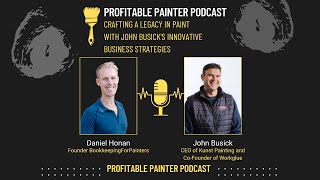
John Bucic, a fifth-generation painter and CEO of Kunz Painting, talks about running a family business with systems. He covers labor percentages, material costs, gross profit targets, crew incentives, and WorkGlue, the software he built to track jobs and connect with QuickBooks.
Chapters
Welcome to the Profitable Painter Podcast. The mission of this podcast is simple: to help you navigate the financial and tax aspects of starting, running, and scaling a professional painting business. From the brushes and ladders to the spreadsheets and balance sheets, we've got you covered. But before we dive in, a quick word of caution: while we strive to provide accurate and up-to-date financial and tax information, nothing you hear on this podcast should be considered as financial advice specifically for you or your business. We're here to share general knowledge and experiences, not to replace the tailored advice you get from a professional financial advisor or tax consultant. We strongly recommend you seeking individualized advice before making any significant financial decision.
This is Daniel, the founder of Bookkeeping for Painters, and today I'm here with John Bucic. John Bucic is a 5th generation painter and 3rd generation owner of Kunz Painting, a premier residential and commercial painting company located in San Rafael, California. John is obsessed with systems, workflows, and customer service. He is WorkGlue's visionary leader and CEO of his third-generation family painting company. John originally saw WorkGlue as a simple solution to run his staff of 30+ painters. It was such a game changer, he wanted to help other business owners reap the benefits of more time out of the office. Hence, WorkGlue was born. Today, John continues to be WorkBlue's biggest advocate for simplicity, key features, and developing new partners. John lives just outside of San Francisco, California with his wife and two sons. Welcome to the podcast, John.
Awesome. Thanks for having me.
Absolutely glad to have you. Super excited to get into your background. A fifth generation painter. That's, that's pretty amazing. What's the story behind that?
Uh, story goes back deep. Um, apparently we're not very smart people because we just can't get out of it. But, um, no, I'm just kidding. Um, happy to be here. Uh, story goes back in the late 1800s, my great-great-great-grandfather was immigrating from Germany to New York from— and, um, headed west. And his first job was actually painting rail cars, that classic black. So he was painting the rail cars as they moved west. Um, eventually landed in San Francisco and became a painter and a grainer there. His two sons actually started manufacturing paint, so we were originally a manufacturing company. They grew it to about 11 stores up and down the state, had a huge factory in downtown San Francisco. Unfortunately, in the 1930s or so, the main factory burned down. and, um, they kind of lost everything at that point. They didn't have insurance back then. Uh, so my grandfather came back from the, uh, Korean War, and he and his twin brother started paint contracting. So since then, we've been, um, out and about doing, uh, paint residential and commercial here in Marin County, in San Francisco as well. And we've recently expanded north up to Napa and Sonoma counties.
So wow. So you must have some really— you must have a huge amount of knowledge in the family on painting. Like, you, you went from manufacturing and now you're doing— you're running 3 generations of painting businesses, uh, or of the painting business, which is amazing. Um, what are like some of the key things that you've learned either from your own experience or passed down from your family in terms of systems, workflows, and customer service? Because I know those, I think, are the pillars that have, uh, probably shaped your, your company's success. What are some, like, key things that you've learned?
Yeah, that's a great question. I'm, I'm super grateful, fortunate. I, I realize that, um, you know, a lot of people that are out there starting their own bit own business in the painting industry, you know, really struggling out there sometimes to find jobs, find employees and such. So I inherited an established business. That said, there are other challenges that come with that. As a lot of people say, business is messy and not easy. So no matter what stage you're in, some of the things I've learned over time been passed down to me. That is one of our core values over here is to basically do what you say you're going to do, and, um, you should be fine at the end of the day. As long as you do what you say you're going to do and take care of people at the end of the day, um, good people, good business, good clients will find you and stick with you.
And I know you mentioned core values. So is that something that you guys have in your business that you try to really attract and employees like in the Traction? I don't know if you're familiar with Traction, that EOS system. Is that something that you guys employ in the business or?
Funny you mentioned that, Daniel. We are actually in the process of taking a deep dive in EOS. We've hired an EOS coach that's kind of meeting with our management team and we're going through all that. But taking a step back, my grandfather was a pioneer. He sat on the national board for PDCA back in the day in the '50s and '60s. In fact, I just went to the national PCA conference and they had some old photos sitting there and I saw my grandfather sitting at one of those tables and that was just pretty cool for me to look at those pictures back then and see him. My point to bring that up during the core values though is they didn't call them core values back then, but he certainly had them and he was kind of a pioneer with that business thinking. So we've always had these, he called them key principles when I grew up, that's what he had kind of listed in our shop. And 3 of those key principles are now our core values, which we call, so. We've always had them. Now they're just coming to the forefront and we're managing the business around those core values.
Okay. A lot of folks, you know, at least when I was younger, when someone would say core values, my eyes would kind of glaze over and I didn't really understand how they could be useful or, or powerful in the business. What, what things have you, I guess, what results have you seen using core values in the business? And, and how do you actually make sure your team is on board with those core values?
I don't think that ever ends. That's a constant massage, finding different ways to bring those to the forefront. We start every meeting and discuss our core values in different ways. A lot of times it's through a story or something that happened during the week. Say something went south on a job and how we corrected it and maybe used one of those core values to, you know, one of them is do what we say we're going to do. So, you know, we screwed up on XYZ and we fixed it by telling the customer we were going to fix it and we followed through on that. So, I think it's something that you constantly need to keep your finger on and bring it to the forefront. And through storytelling, I think is how you avoid kind of the glossy-eyed, especially so some of your new employees grasp what you're really talking about.
Yeah. And I imagine it would help with decision-making at the lower level when they know what the core value is, do what you say you're going to do. They don't have to ask permission, you know, they, they know what, what your take is on that. And so, you know, if the salesperson mistakenly said, you know, we'll paint that for free, or that's included, you know, in the quote, but it wasn't put on the quote, you know, maybe that can be solved at the lowest level when the production manager knows like, hey, we said we're going to do this. So let's go ahead and follow through and do it even though it might you know, monetarily hurt the business, but we want to follow through with what we said.
Yeah, absolutely. I mean, we're looking for customers for life. Some of our crew leaders and production managers know that that is absolutely the direction that we want, that autonomy, that decision-making. You know, it's part of the marketing budget, to be honest. You do a good job, What better dollars are spent on marketing than taking care of customers so they become repeat and referral?
So, yes, absolutely. Yeah, that's a great point. A lot of people don't think of their customers as recurring, you know, revenue in this business anyway. They, you know, they're very focused on getting the customer and then producing the work. But then after that, it's kind of not You know, now it's the next, getting the next customer. So not a lot of attention is paid on, hey, this is a customer that we're going to keep over the, you know, their lifetime or however long they'll be in the area. So that seems like that's a deliberate strategy on your part.
Yeah, absolutely. We've, I'm going back to your original question. We inherited that mentality. 68% of our business is repeat referral. So it's a heavy, heavy portion of our business. And we want to continue that because the closing rate on those, as you know, is, is much, much higher and a lot easier. So what's—
what programs do you have in place to make sure customers are reactivated or, you know, turn into customers again?
What do you mean? Are you talking SOPs? Are you talking software? What are you talking about?
So do you— you mentioned that, you know, make sure we take care of our customers so that they come back to us later. Do you have a system to reach out to them periodically to see if they need help? Like, like a direct mail or email or—
Yeah, we use— you can use any one of them, but we chose Constant Contact. We use that. We also have our customer database. I know we're talking about it here, but we use WorkGlue for that, for a customer database, and spit that off. There's different categories of how we track people within there, and they become a referral client at that point, and that list gets exported to Constant Contact. And that's how we continue that path. There's other areas to market to existing customers. Say it's a residential repaint that you finish, so you can mark a date within the system that we've created and follow up 2 years later, a year later, and say, hey, reaching out, probably a good idea that we do a power wash. Maintenance check on your property. It's been 2 years XYZ. So we kind of put a monthly list together based on finish date of that repaint and kind of hit those lists as going forward.
Okay, so you have a, a life cycle kind of planned out for us, like an exterior repaint. Um, you know that 2 years from now they we should be reaching out to them to, to do a pressure wash. And so they're like in a constant contact workflow that follows up with them, you know, you know, 2 years from that point, or make sure that we send off that. So that's kind of built into the, the system where you have different milestones to reach out to folks depending on the project.
And most of it's trigger and status of the customer. That's how we kind of track it. There's multiple ways to set that up. I hire smart people, much smarter than me, to handle that.
But that's awesome. Since you mentioned Workloo, how did, how did Workloo come about? I know I read in the beginning about your bio. Basically, you built Workloo to solve problems that you had in your your current business. So, uh, could you go through, I guess, what those problems were? What was Work Louvre fixing, and how did, how did that actually come about?
Yeah, good question. Um, when I came into the office, so I was— I went off to college, did the corporate world thing, um, realized that wasn't really my, my speed, was— I wasn't built for that. My father offered me the opportunity to come back into the family business, so I did that. And prior to being able to come into the office, though, he forced me to work in the field. Excuse me. And working in the field as a crew leader, learned from the bottom up basically how operations worked and such. Well, as I was going through that process, about a year and a half in, our office manager of 15 years, who essentially was every SOP on the back end, went out overnight with a career-ending illness. And, um, I was brought into the office overnight and had to figure out all the systems. Um, we didn't use very much technology back then. This is in the early 2000s. Um, still very heavily Microsoft-based. And then we decided, um, I started chipping away at things. I needed a CRM. I needed a timekeeping system. I needed payroll system, accounting, you know, all the buckets that you need to kind of fill to run the business. I started doing all these one-off apps out there, so before I knew it, I was logging into 8 different apps, and it became cumbersome, difficult to manage my business. Uh, nothing really sank. It was kind of double entry, quadruple entry. So I met a software developer through a friend and, um, here locally in the Bay Area. And I was kind of telling him exactly what I needed to kind of pair these few things. So he built some custom stuff for me, and I had a little, you know, kind of a little hodgepodge system that was married. And, um, I was at a PDCA event and a residential forum, and some other painting contractors saw what I was logging into and looking at my business from the computer, and they were like, hey, what is that? And I kind of showed them and they actually forced me to come up and do a little presentation. And half the room was like, how do I get that? You know? So before I knew it, I called my software guy. I had no intention of getting into the software world, but I said, I think we might have something here. So that's how WorkLou was born. We brought on a few early adopters and some investment and really kind of grew the product. I actually was just using it and a lot of people, a lot of contractors over the years since then have really built WorkLoupe together. So it's built based on the contractor's perspective, which is a really neat thing because I think that's a different perspective when it comes to software today.
So yeah, that's, that's always the best software is where the founder built it to solve his own issues. So that's, it's always refreshing to, instead of like an outsider trying to figure out like what's going on. And so like, for example, PaintScout, they, you know, they were solving their issue with estimating and so they created PaintScout, which I think PaintScout and WorkBlue work pretty well together, if I'm not mistaken.
Correct. Yeah. Yeah, John and I over there, we, we kick things back and forth. Uh, they're a great product, great company. Um, Workload does not do estimating. Uh, we directly sync with back and forth with PaintScout. So it's kind of a good little mirror, um, back and forth, little merge, as well as QuickBooks Online. And that's kind of where you guys come in. So it's, um, it's from A to Z through those 3 systems. Um, obviously you have some one-offs here and there. And that's where Zapier comes into play today. Yeah, essentially what Worklue does, what it solves today's problems, your biggest buckets, it's a project management system. So it starts off when you close the deal, it becomes a job. And at that point you start scheduling either employees or subs in there, start tracking different costs, expenses within that. You're communicating in Worklue from the office to the field. We have a mobile app that all the field crews or subs can use, and they get all the details of the project, find out what they're doing when, so on and so forth. Um, and from there, so you're scheduling your employees, you're scheduling the job itself. So there's two different schedules. What a lot of people forget to think about, you have your employees that you're scheduling or subs, and then you have the actual job schedule, which is in the future date, right? Mm-hmm. So I'm doing— Daniel, I'm doing your house in September. I need to get that on the schedule. I don't know who's there yet, but I'm plugging it on there. So Workloot helps you with that. And then there's a bunch of other bells and whistles in between that help you manage the project from A to Z. Once it closes out, it syncs with QuickBooks Online so you can bill it and track change orders and stuff like that.
That's awesome. So since you've been working with Worklu, because it's been— you guys have been in business for what, 10 years? For a little while, right?
Realistically, uh, probably since 2017 is when we really, really launched. So, uh, 10 years we've been at it. Yeah.
So, uh, what have you seen in terms of numbers? Because I'm sure you have a lot of data in Worklu. What does a healthy painting business look like in terms of how much should they be paying for labor or, or materials and that kind of thing?
Yeah, it depends. I mean, a commercial business versus a residential is going to be a little bit different. But if you're primarily residential, you're anywhere from— I see 25 to 35% labor is kind of a healthy business, around 10 to 15% material and sundries are in there. That's, that's kind of the typical— obviously material is going to go up on the commercial side. Labor might drop a little bit more because you're offsetting that with maybe equipment that you're renting or anything like that, or assets you might purchase and bill back. But yeah, that's, that tends to be the sweet spot for, for labor. One thing that I also do track in my company is, uh, sundries and inventory. So that kind of syncs up. So when you bill out sundries, we do some larger projects, so sundries do come into play when you're, you know, ordering rolls and rolls and rolls of tape. Those do add up, but on the average residential project, it's probably not even worth tracking almost because it takes too much time to track. So, um, That tends to be the big buckets for me, uh, for what I'm seeing. Um, we could, we could get probably pretty into the weeds, but most people probably don't want to hear me talk about that.
Yeah. Uh, for, for labor, you, you said 25 to 35% for direct labor, like on the job site, the crews on the job site, right? That's what we're talking about there.
Correct.
Correct. Okay. So I think some people listening might be like, Wow, that's not a lot at all, because I've seen, you know, folks pay 50% to labor. And so basically, you're the— from what you've seen, healthy painting businesses, they, they're basically— their labor is one-fourth of the revenue, one-fourth to one-third of the revenue that they bring in, which is correct.
Yeah, third, you know, 33%, I think, is the average. Even if he jumped up to 37, I think you're healthy. But if you're in the 50% labor range, that is a tough gross profit margin to be working with. Don't get me wrong, we— ours does increase during the wintertime to keep our guys busy. So we tend to knock that GP down. You know, a healthy GP that I'm seeing today— excuse me. A healthy GP that I'm seeing is anywhere around, you know, 40 to 50% is kind of the healthy range that I see really successful painting companies hitting, some up to 60%. Um, anything below that, for, for me and my perspective since I run a painting business, is a little dangerous. There's not much room for error. So, um, something to be considering. Think about.
Yeah, that, that makes complete sense, and, uh, it does reflect what I see as well. Like, 40% is the minimum gross profit, like, after paying for direct labor, direct materials. 40% needs to be a minimum. Hopefully not shooting for 40% because that's like kind of that the average, but yeah, 50% is usually at least a starting target. And then, um, as you grow and everything, maybe even getting that up to 55% or maybe even 60% for some folks. That's— but yeah, that definitely reflects what I've seen for sure.
And it also depends on your, you know, supply and demand, current economy. Like we were trying to hit 60% for the last few years because there were such good years that, you know, you couldn't get to everything. So you wanted to bid things a little bit higher and take the premium. But now that it's slowly shifted a little bit, now we're shooting for 55, 50. So it kind of depends on the market as well. Yeah.
What things have you, have you used in your business to get your gross profit to hit, you know, 55 or 60% gross profit? What, what things have you implemented in the business, whether it's systems or software or whatever it is?
I think it's you can use whatever systems you want as long as you— I think a great starting point is a system. SOPs, if you're into standard operating procedures, those things are something that you're a repeatable process. You want to get those on in writing. You want to get everyone following the same standard operating procedure because then it's repeatable. A perfect example for us is checklists. We use checklists within WorkGlue, and while people are out on their mobile app in the field, We have standard operating procedures for checklists. Say we're starting your house to paint your house, Daniel. Our crew leader knows to meet with you. There's a checklist on his app that he clicks each button and writes a note. Met with owner. Owner's expectations are X, Y, Z. Next question are what? Where should we put our job shop? Right. The stuff we're bringing on site location takes a picture of that, puts it in the checklist. So it just makes that crew leader follow the questions that we want them answered on day one. Did we find any scratch glass, any broken materials, anything like that? They take the picture and put it in on the checklist. So we kind of have that documented before we even get started. Another one checklist that we have is the closeout process. So how, how I want that to roll every single time so we don't skip a step. So I don't personally, as the owner or project manager, have to be on site and make sure that stuff gets done. So that's a, that's kind of an example how we use it.
Yeah, that, that's, that's awesome. So basically they're using Workload to go through step by step for each project. They have a checklist they follow and then they notate, check it off, notate what they did or would take a picture of, of the, of where they're storing the, the tools in between you know, when they're going to come back next.
And so you can, you can, you can build custom checklists, however many you want, whatever stage of project. And it's pretty open source. So you can kind of build that. Another thing that we do is daily job logs, the crew leaders responsible to put in at the end of the day, take pictures, and, and most of them use like the voice microphone on the phone and talk into it about explaining what they got accomplished for that day and what their plan is for tomorrow. And any issues that came up on that day, they're supposed to report, and any injuries or anything like that, accidents or injuries. So we capture that every day, comes in, we have a daily job log report that we look at at the end of the day or the early next morning. So that way our crews are set up, have everything they need, and we continue to check progress.
Okay, so basically you're, you're preventing issues that, you know, we're leaning forward using that checklist to prevent issues, which should make things more efficient, move, makes, make sure things move, uh, works, uh, more smoothly. And then you have those end of job, end of day job reports, which kind of make sure that we're ready for the next day, it sounds like.
Exactly. And for, since a large percentage of our, our business is repeat A lot of times we access those job logs going back and saying, hey, you know, 6, 5, 6 years down the road, how do we set up that scaffolding? How do we set up the ladder work? And we quickly can look at those pictures back from the previous project. The next time we go, same with managing colors and all that, like everything gets uploaded into the system. So we're much more efficient. We're not matching colors a lot. We keep the formulas on file. Another thing that outside of software that keeps us efficient is we do weekly crew leader meetings. So crew leaders report back where they're at on the project. PaintScout does a phenomenal job of creating the estimate and the work order at the same time so people know how many hours are estimated on this project and exactly what they're doing. With photos to boot. So we, we provide those with our crew leaders and hold them accountable.
So, so they get the budgeted hours with everything that was put in the proposal in their work order. And then each week you're reviewing, okay, how did we do on, on this job so far? Or maybe it's done already and you're reviewing, okay, you were budgeted for this, what actually happened? And then you're saying, okay, what are what went wrong and what went right. Is that kind of what, what's going on there?
Exactly. And we're not perfect. Some guys slip up, some guys are better than others at reporting. Um, some— one thing we really are good at, and, uh, people like yourself appreciate that at the end of the month, is, um, we're on top of job costing. So we know exactly where we're at on every single job, every— down to every material receipt. So that process really quick, you can make it pretty slick. Say Juan goes to the paint store, picks up 5 gallons of paint, the receipt comes in the email, it automatically goes into QuickBooks Online. We sync with QuickBooks that pulls into Workloo. So the guy out in the field knows exactly what they've spent on material and labor at that second. So today's world is pretty fascinating. It's pretty exciting in the painting business in terms of leveraging technology if you do it right. Um, and it really helps improve efficiency, that I've learned.
Do you reward your, your crews if, if they come in under budget or anything like that?
So we have a performance bonus system that, um, there's kind of 5 checks for every job we track for the crew leader. Is the customer happy? It's yes or no. These are all not subjective. These are just yes or no questions. Did they get the job logs in for every single day? Yes or no. Were they under, under 10% under budget on hours? Yes or no. And did they get the customer feedback? Did they get their— we have a form that we give the customer, it's a customer report card. Did they get a 9 or 10 on that? And then the last one is, did they hit their production hours, budgeted production hours for the month as a whole? Meaning, did they work— say they have, you know, 80 hours for 2 weeks. Did they work the full 80 or did they not work the full 80? Okay.
And that, that 9 or 10, is that the Net Promoter Score system?
Correct. Yeah, pretty much.
Okay. Awesome.
So they have those 5 things that they, that they need to hit.
And if you have, if you follow EOS, that is their number, right? Those are their KPIs that they're trying to hit. My production manager is required to hit a certain GP based on all that. So if we're doing our job on the estimating side at a certain gross profit margin that we're bidding and holding our production managers accountable to those numbers and he's hitting those numbers, And the crew's hitting those numbers, all of us are hitting our number that we're trying to follow.
So everyone's moving in the same direction. And is there— so they get like a bonus each month if they—
quarter— we do, we do a quarterly bonus. All of those add up to 5 points per job. So if you're hitting your points every month, you can earn up to 5% of your W-2 per quarter.
Nice. Okay, that's, that's, that's good. All right, um, so what, uh, what, what kind of future developments does, uh, Worklu have going? Because I know you, you guys are constantly improving the, the software. Because I know, uh, Pain Scout I think was added in the last year or so, and you have integrations with Zapier set up. Is there anything else, new features, or developments coming down the pike?
Yeah, we have a few payroll developments happening, payroll syncs with a few different companies, direct syncs that are going to be pretty robust and pretty exciting on that end in terms of HR. The mobile app, the hours, like syncing hours to payroll, syncing hours, vacation time, sick pay. There's a whole list of other stuff that's going to happen over time and entering an employee one time and it syncs back and forth. You don't have to enter it in multiple areas. So, um, the, the other one that we just released, it actually, um, it's pretty exciting. Our mobile app just had a huge update. So now you can try, uh, access documents and photos within the, from the field. So once you can make certain documents public to the company or whoever is a user is or certain kind of hidden. So there's two categories there. For the guys out in the field now, they can pull up any scope of work documents, schedule, you know, maybe a designer sent a PDF schedule, you can upload that into Workflow and the guys in the field can access that. Simple stuff like that. The mobile app also just updated the timekeeping piece to where now there's multiple layers. You can enter the cost codes and stuff like that if you track cost codes. So you can take it an extra deep layer on that. So it's constantly improving. We always have improvements rolling. Our improvements with PaintScout continue to roll out as well. As they improve, we improve and vice versa. Same with QuickBooks Online. QuickBooks continues— Intuit continues to produce better and better APIs out there. So their API is constantly improving and so do we.
So what should folks do if they're interested in reaching out to you or interested in using WorkGlue in their own business?
Yeah, Phil, you can always email me, john@workglue.com, or you can go to the website workglue.com and all you need to do is click on schedule a free demo or training. And that will set you up immediately and you can find out and do a little tour and go from there. Awesome.
Yeah, and I highly recommend Worklu. We have several clients that use you guys and they love the, like you said, the way it integrates with Pain Scout and then also QuickBooks Online and it keeps their business running. So definitely highly recommend you check out Worklu if you haven't already. And with that, we'll wrap things up here. Love to hear your thoughts in the Grow Your Painting Business Facebook group. If you're not already a member, feel free to go to Facebook, type in Grow Your Painting Business, and join the group. Ask questions about Work Glue and give any feedback on future podcasts. Love to hear from you. And with that, we will see you next week.
More from Daniel







What’s REALLY Holding Your Painting Business Back? (Find Your Bottleneck in 5 Minutes)



