Creating Value in the Painting Industry with Torlando Hakes
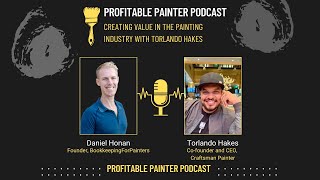
Torredo Hakes explains how he shifted from hourly pricing to value-based proposals that focus on the homeowner's desired outcome rather than labor costs. He identifies three drivers of buying decisions: price, urgency, and brand perception, and shares how his Craftsman Painter Collective helps contractors use unit-based pricing and co-branding to close more deals.
Chapters
Welcome to the Profitable Painter Podcast. The mission of this podcast is simple: to help you navigate the financial and tax aspects of starting, running, and scaling a professional painting business. From the brushes and ladders to the spreadsheets and balance sheets, we've got you covered. But before we dive in, a quick word of caution: while we strive to provide accurate and up-to-date financial and tax information, nothing you hear on this podcast should be considered as financial advice specifically for you or your business. We're here to share general knowledge and experiences, not to replace the tailored advice you get from a professional financial advisor or tax consultant. We strongly recommend you seeking individualized advice before making any significant financial decision.
This is Daniel, the founder of Bookkeeping for Painters, and today I'm here with Torlando Hakes. Torlando Hakes is the host of the Paint Ed podcast and founder of the Craftsman Painter Collective. The Collective is a group of paint contractors that produce high-level work across the US. Their mission is to make a difference in the lives of their customers, neighborhoods, and the community of fellow craftsmen. Welcome to the podcast, Orlando. How's it going?
Good. Thank you for having me. It's an absolute pleasure.
Awesome. I'm super excited to have you on here. I'm really interested in hearing some of the ideas that you have around pricing. And also maybe some ideas about how to save money on marketing or how to not waste your money on marketing. But, uh, first off, um, I— to go to the pricing bit. Now, this is like, folks that come to Bookkeeping for Painters often have, like, especially if they're just starting out or even if they've been around for a while, uh, a lot of them seem to have an issue with pricing and getting that right. And that's always a big pain point. So I'd love to hear kind of what's your thoughts on some of the key pricing strategies that you've learned through your experience.
Yeah, absolutely. You know, years ago when I was in, when I first started in painting and running my own business, you know, it was very much just like you go in, You try to figure out how much time it's going to take you. Who knows how you want to give yourself a raise. So like, you know, I, when I started my first painting company, I was 22, 23 years old and I had a backpack full of supplies and showed up to that first estimate on a bicycle. You know, I mean, I was, I was a kid and I had no idea what I was doing, you know, and I, and I went in there and You know, I'd been working for another painting company and it was, you know, 2008, the recession. And, you know, he closed down the company. Yeah. And so that's, that's how I started at the beginning. And it wasn't like he knew what he was doing with pricing either. So, you know, I had no tools. I had no idea. So I knew that he was paying me, you know, about $12.50 an hour. And so, you know, I thought to myself, well, if I'm in business for myself, I need to give myself a raise. And so, you know, $20 an hour sounds pretty good. And because, you know, being 23, you give yourself an $8 raise, that sounds pretty good, right? And so I went in there and I thought, okay, so she wants me to peel down this wallpaper and she wants me to then paint it. And it's, you know, it's the living room, the kitchen, the hall, that, you know, stairwell. I remember all of this. And I mean, $20 an hour removing wallpaper and just kind of guessing how long that's going to take you. That, I mean, that wallpaper came off in dime-sized shreds, you know. So, so there was just no way that I was ever going to make money on that job. And, and it ended horribly. And over time, you know, I tried to get a little bit smarter. I tried to track my time and figure out how long things were taking. But I kept hitting these roadblocks where, okay, now I'm hiring crew and I'm bringing people in and I'm trying to figure out how much time this is going to take. And it's never the same amount of time. I tell my crew it's going to be one time and some of them hit it, some of them don't. Some of them are faster, some of them are slower, who knows what. And meanwhile, you know, I've given myself another raise from $20 to $35 an hour. And I'm thinking, well, that's not bad. And that seems like that's about what this market is. And, you know, mind you, this was several, several years ago. And the listeners, you know, probably listening in here are thinking $35 an hour. That's peanuts, you know, like I've got employees that I pay more than that, right? Well, I remember one occasion I went to a house and I was doing a bid and I, you know, it was a beautiful house. Their, you know, the wife was a pediatrician. She's actually my pediatrician, my kids' pediatrician today. I didn't have kids back then, but You know, she was a doctor, her husband was a physician's assistant. And, you know, I present with them the bid and, you know, how I had it laid out was, you know, here are the number of hours that I expected to take and here's what I charge, $35 an hour. And he looked me in the eye and said, "Torlando, I can't justify," paying a painter $35 an hour. I don't even make that and I'm a physician's assistant. How am I supposed to pay you $35 an hour? And that was the moment that I realized that, you know, the people that we paint for, they don't value our time at all. They don't value what we bring to the table. They don't value people, not more than they value themselves at least, right? They might appreciate you, but they're not gonna value your time more than they're gonna value theirs unless you are seriously, you know, protecting their life savings or something like that. You know, like we understand lawyers, you know, that, you know, they're really, you know, protecting us. But for us trades folks, I'm afraid that our customers just aren't gonna see us that way. And, and so that moment was the moment where I, I had to wrap my mind around a better way. I had to, I had to divorce the idea of value coming from the people that are in the house doing the work, and I had to move the value to the work that's getting done. And, and more than that, what the customer ends up with, right? What is the, what is the storybook ending that they're getting? And it moved it from a conversation of my price is based off of my time and my time is valuable to their house is valuable and they want it to be in a glorious state at the end. And that's the thing that has value. And so my whole pricing perspective stems from that. But we also, it can't be unmoored from the fact that we are paying people by the hour or by the day or by the job. We still have those costs, but the question now is how do we extract the value from the customer?
Yeah, that's an excellent point. Basically value-based pricing instead of here's what I'm going to charge you by the hour. And that's a huge distinction for the person receiving the estimate because like you said, they might have some idea of how much they're going to pay somebody by the hour. But in the same, in the same breath, you know, they also have, what is this job getting valued at? For someone else to take care of this, what would I pay, you know, for it to get done the right way? And those two ideas strangely can be true that they would, they only want to pay someone $20 an hour or $15 an hour to do it. But at the same time, they'll, if someone can take this project off their hands, they might be willing to pay $5, $10,000, which will be way more than $15, $20 an hour when you actually do out the hourly rate. But if they get that taken care of off their plate and it's an amazing experience and they have an, an, an excellent improvement to their, their home, they're more than willing, willing to pay it. So I think it's, I love how you kind of make that distinction of, you know, instead of like thinking of it like an hourly thing that you gotta charge the client, it's more, hey, this is the value you're gonna get outta this experience and this, uh, project we're doing for you. And that's going to reposition it in their mind, and, uh, you'll be able to unlock more profitability there. I think that's excellent.
Absolutely. Yeah, there's, you know, there's a lot of— I think a lot of tradespeople have, you know, they have a lot of ego wrapped up in, in what we do. And, and, you know, there's a degree to which that's understandable. Like, we work hard, we're underappreciated, you know, we sweat for a living, uh, you know, it's, uh It's hard work out there. You know, it's understandable why we would have so much pride in what we do. But that, you know, there's that whole, you know, they always attribute this to Picasso. I don't know if it was actually Picasso that did this, but, you know, there's that story of a guy who goes up and sees Picasso on a park bench and says, "Will you, you know, will you draw me a picture?" And the idea is that Picasso draws a line and says, that'll be, you know, $8,000 or whatever it is. And he goes, $8,000? You just— you took 10 seconds to draw that line. And Picasso goes, yes, but it took me 20 years to learn how to draw a line in that way. And you know, you'll see people repeat that story, whether it's a fable or not, I have no idea. And they use that as this, like, justification for— why their expertise is so valued. And I'm not saying that their expertise is not valued or that the fact that they have all of this experience, that it does speed up the process for a good job. The problem is when you take that mentality and you use it as this mark of pride and you use it to kind of put yourself in this, in kind of this victim state of, well, people don't appreciate all my hard work. They don't appreciate my experience and my history. And so like, you're not paying me for, you know, to show up and put a coat of paint on your wall. You're paying me for all those years of experience. Well, I'm sorry, customers don't give a rat's ass about any of that. You know, like they're just there, they just want the best deal and they want the job to look good, you know? The question is, can you for a second drop the ego and think about what the customer really wants here and think about how you're going to service them in a way that is showing that value? Because value is simply the price minus the cost, right? That's the mathematical equation. The value of the job is the price minus the cost. And so once you subtract out the labor and the materials, the difference, you know, your gross profit, that has to represent some added value to the customer that they would not be able to get on their own if they were either doing the job themselves or hiring their nephew or, you know, son-in-law to do the job. Like that added value that you're giving, and sometimes it is, part of it is the experience, the expertise. But part of it is the assurance. Part of it's the management. Part of it is help with color. Part of it is, you know, a clean house or moving the furniture or whatever it is that you can add to the, to the value of the project that's going to warrant the higher price. Because what will happen is, is they will not see any value if their baseline expectations are not met. Where they see the value is when their expectations are here, but what they get is way up here. And that's when they're like, holy cow, that was worth it. Yeah, they were a little more than, than the competition, but totally worth it.
Right? Mm-hmm. What are some things that you've found that are easy ways, or maybe not just easy, just ways that you can add value? To, you know, residential repaint clients?
I know you kind of listed a few real quick, but yeah, I mean, those, those ones that I listed, those are the low-hanging fruit, right? Obviously they expect your team to be managed, they expect your team to be clean, they expect your team to, like, you know, inspect the job before they do, right? Like, no, no customer wants to babysit a crew. If they're babysitting your crew, if they're calling you too much, then you're not giving them the value, right? Those are the kind of the low-hanging fruits. But I think the things that, you know, really set customers, you know, off and really help them like love the job that you're doing are when you've paid close attention to what their specific needs are. And you've customized and tailored that experience to them. And so, you know, I would recommend— what I would recommend is actually going through all of your reviews online and just seeing, like, just digesting what people say about you. Go through it because the things that they write about in the reviews, those are the things that are remarkable, right? Those are the things that were worthy of a remark online. And so literally, right?
Yeah.
So, so if they say they were so clean, they were so detail-oriented, they were punctual, they explained everything so clearly, they made sure my cat didn't get out, they, you know, watered my plants, whatever it was, you know, that they, that they write in those reviews, I would just make a list of every single thing that they say about you and then start to tally, put a tally mark next to the repeat things. And the, the, I would say like the 3 to maybe 5, but definitely no more than that, maybe 3 or 4 traits that pop out over and over and over again in your reviews. Those are your, that's your value proposition. That's the thing that people care about. Those are the things that you wanna double down on. You know, don't just say, oh, that's what they say, you know, so we're good on that. I would lean into those hardcore, right? So, so if they say something like, The communication was excellent. Well, okay, communication is important. Okay, that makes sense to me. A lot of people say that. Well, let's examine. Have we been just kind of naturally being good communicators, or do we have a process in place, or do we have principles in place, right? You know, do we on a weekly or biweekly basis, do we send out emails to all of our customers, letting them know where they're at on the schedule and letting them know that we haven't forgotten about them? Do we send them a daily report once we're on the job, letting them know what got done and what's going to get done tomorrow, right? Do we have employees, team members who are so customer service oriented from the beginning that we don't even have to train it. You know, the, the other day I was on one of my job sites. I was so proud of my guys because I was just, I was just there being a fly on the wall, and, uh, and I overheard both people on— it was a two-man crew— I overheard both of them having individual conversations with the homeowner, one, one after the other. It was like two different instances, and I got to hear the difference between, you know, the the way that they talk to me and the way that they talk to the customer. And both of them were so polite, so kind, so gentle, so good-natured. They spoke with a smile on their face. I was in another room, but I could hear their smile and I could hear the smile on the customer's face, right? And it dawned on me, I didn't teach them that. I have not had any kind of training whatsoever on good customer service. I hired people who I felt had those qualities, right? One of our core values is to spread kindness like confetti, right? I don't hire people unless they're kind. And so if I hire a kind person, I don't have to worry about training them how to talk to the customer. They already know, it's 'cause it's who they are, right? And so that's one of those value adds, right? So when I'm on the job and talking to the customer or on the estimate talking to the customer, talking about my crew, I'm gonna say, you know what, you're not gonna find kinder, sweeter people. They're quiet, they're polite, you know, they're just really good young men, and I think you're really gonna like them, right? That's added value. Think about how nerve-wracking it is to bring somebody into your house, especially if you're a female consumer, some guy, some ragtag, you know, motley crew of a group coming in. You don't want to be there while they're there, right? You know, that's the experience that they're used to getting. You know, can you find those people that can justify added value in a way that matters to your customers? Communication is important to them. If the experience is important to them, how do we bring in people and hire people that, that, that's who they are. That's how they live.
A lot of gems in there. We just said, uh, so first was like going through your reviews and identifying how are you providing value, right? You know, as it stands now. So you can kind of say, hey, here, here are my uniques, or here's my, uh, you know, my, my proposition. This is what I'm good at. This is how I'm providing value, going through historically to see what, what are you doing naturally? Well, I like that idea of, of, you know, going through your reviews and, you know, checking off those, those communication or, you know, cleanliness, whatever those things are that you're providing your customers. And then you, you, you said, you know, actually having maybe codifying it in your business as a, as a core value so that you can continue to reinforce those uniques in your business as it grows. Because, you know, as I'm sure you know, it's easy kind of when you're smaller to not necessarily maybe make the core values very explicit because you're, as the business owner, probably involved very closely with a lot of things. So those kind of come through. You embody your core values. Naturally and you're doing a lot of the work. So those are coming through. But as you grow and you're hiring more people to do the work for you, having the core values communicated explicitly with your team and hiring against those core values and, and firing against those core values and promoting against those core values will help you maintain the essence of your company and then to continue to provide that same value as you grow. So I love everything that you're saying. It's, uh, that makes a whole lot of sense. Um, do you mind sharing what your core values are? You said one of them was, um, you know, sprinkling kindness or something to the effect.
Yeah, spread kindness like confetti. Um, uh, be fearlessly authentic and, and don't stop until you're proud. Those are, those are the three key characteristics that we hold. And then they're part of our broader kind of guiding principles where we have a set of critical actions, you know, the critical actions, you know, being to, you know, be conscientious of time, cleanliness, quality, to level up, you know, every day and to do the work right the first time. Right. And so, you know, our, our, our principle, the guiding principles there are, are in place to, for, for two reasons. One, the, the key characteristics, those are the things that if you don't have those things, you don't get hired. Right. Cause I, cause I don't, I don't have the resources to teach you how to get there. Right. Some, some companies might have the resources to, babysit you and train you up from training wheels in terms of those soft skills. I don't have that time, unfortunately. We can polish what you've got, but I can't take you from, you know, I can't take you from being on the outskirts of society and you know, in, in rough land and, and, and then turning you into somebody who can be in, uh, in somebody's house with their, with their wife and kids. You know, I, I can't do that, right? Um, but what I can do is I can take somebody who has these 3 things figured out, you know, they're authentic human beings, they're kind, they, they work until they're proud of what, of the work that they do. They wanna be proud of the work that they do. I can start there, right? And, and we can, and we can progress from there. The critical actions, those are the things that if you do these things every single day, you'll be successful here, right? So, so one is the stuff that you have to come with and the other is the stuff that you got to do every single day.
And I, and we started this conversation talking about value, like how do you provide that additional value? How do you charge more? Really is the question, like how do you price?
Sure.
To, you know, so you can be profitable. And, and now we're talking about core values, which is really the same thing, or key characteristics, I think you're calling it, and critical actions.
Mm-hmm. Yeah.
Different terminology, but I think we're talking about the same thing.
Well, your, your people are the value, right? The people are the product. You know, they're, they're, they're getting, they're getting a paint job and there's an outcome that, that stems from the people that that you hire. And, and, uh, and so, you know, we have to have people who can, you know, who can deliver on that value, right? It's not— we're not iPhones, we're not— right, you know, we're not Teslas, right? Like, all of the quality assurance in those products happen in another country long before they're shipped to the US. Uh, when we do a paint job, they're putting a down payment on a product that hasn't happened. And when it does start to happen, it's happening under their own roof. And so they're watching, they're watching the process of the sausage get made. And nobody wants to see the sausage get made, right? And so it's not typically a very pretty process. It's very nerve-wracking. But when you come in that first day and your team looks good and your team looks like quality, And you didn't have a pretty website and a slick sales process. And then the unmarked van with the rusted outside and crew, sub crew comes in and nobody can communicate. Nobody knows what's going on, right? All of these things, or they, maybe you've got the crew that smells like cigarettes and booze and weed and, and all of that, it's like you have this great posh marketing and sales experience, but your operations experience, that's not what I was, that's not what I thought I was getting, right? And so, so that's, that's why I talk about the values and who you're bringing in because, because that's who's delivering the product. If you don't have that right, then you're not going to be able to deliver any, any added value at all. You really have to get that part right.
Yeah, it's excellent point, and it makes perfect sense because you're really— the painting business is in— you're in the business of delivering services with people. I mean, like you said, you're, you're not a— you're not selling iPhones here. So, right, people is what it comes down to, and you got to get everybody on the same sheet of music. And that comes down with, you know, your— what you called the— your key characteristics, critical actions. To get everybody moving the same direction, provide that, that additional value.
Yeah, I mean, it just has to follow the same thread throughout, like the brand experiences all of that, you know, like operations is the brand, you know, the sales process is the brand, the website is the brand, it's all the brand, it's all the experience, right? And there are 3 reasons, 3 primary reasons why people will choose one company over the other. The first is, the first two fit kind of under a utility factor, and the other fits under a desire factor. So the first two is price and urgency. If the customer is utility-driven and they value a cheap price or a bargain more than they care about the other stuff, then, you know, you're going to have to have a pricing strategy that's driven around, okay, how can I make this job more economically priced, right? And so, you know, the thing about value, that word value, what I think is interesting, it's like, if you think about the crown jewel, you know, that's a priceless gem, right? The value is beyond measure. It's the crown jewel, right? But then you go down to Walmart and you shop in the generic section and you're going to find a lot of products that are of great value, right? So that word value is a little bit, it's a little bit of a chameleon. And what it really amounts to is the alignment between those expectations and the price, right? So people can value different things. People can value a low price. They're just more, they're just a more utility-driven buyer. But people can also value things like urgency. You know, okay, we've got May graduation happening, we got these graduation parties happening, and we got to get this house painted before our guests come because I can't show my face if, you know, if my trim is this nasty, right? I got to get this, you know, this deck, you know, this deck stained before, you know, before we start grilling out and bring you know, bring all these teenagers and parents and stuff around, aunts and uncles, all that, right? So maybe they have this, this sense of urgency that they got to get it done right now, right? And in that case, they might not care so much about price. They might not care about who can do it, you know. Oh, I, you know, I've been using, you know, Johnsonville Painting for the last 43 years and they're the best company on earth. Well, they're not available. I'm sorry, I got this graduation party and I'm just going to have to use the other guy who can do it. You know, we'll come back to you guys next time, right? So there's that utility factor of price sensitivity and urgency. But then there's that third one, which, you know, a long time ago I thought it was quality. And you might see some of these memes online where it's like, oh, you can get, you know, price, speed, or good, but you, you can only get two, right? And I, and I sort of believe that. Um, the, the only thing is, is that it's, it doesn't hold up in, in, in all circumstances, right? Because if you take a look at the companies who, um, in our industry do use subcontractors, um, some of them have really brilliant subcontractors, you know, that do really high quality work and they get them for a pretty low cost. And so getting the quality doesn't actually necessarily mean that you— that it's, it's gonna be always high priced. So what they're, what they're paying for, cuz the thing is, is if they went with the paint contractor who used the sub, or if they went directly to the sub, they went directly to the sub, they'd get a much lower price, wouldn't they? But they'd get the same quality. So, so What I realized is that that third factor, it's really about the brand. It's really about the promise that comes with the brand, the reputation that they carry, the whole look and the whole feel of the brand. Is this a company that I see myself— can they help me become me? Right? When we buy a brand, it's not just about the utility of the factor. It's about what that brand helps us feel and help us become. You know, when I was in middle school, you know, there were uniforms at our school, okay? But they weren't imposed by the school themselves. They were imposed by the other kids. And so if I wanted to be in the popular group, you know, I might be dating myself here, but if I wanted to be in the popular group, I had to let go of my JNCO jeans and, you know, my comic book t-shirts, and I had to start wearing button-down polo, khaki pants, Doc Martens shoes, right? I had to dress a certain way. I had to wear American Eagle and Abercrombie Fitch if I wanted to be in that popular group. That was the uniform that, you know, that the students gave each other, right?
Yeah, I think we're in the same high school. Yeah.
And so if I didn't get that, if I didn't get those clothes, if I didn't wear that brand, I couldn't be the kid that I wanted to be, right? Thing is, that doesn't change as we get older. It just gets more expensive. You know, if I want to be the kind of person that I want to be, I have to drive a certain car. I have to live in a certain neighborhood. You know, I have to send my kids to certain schools. I have to get my— I have to maintain my yard a certain way, right? I have to keep my house painted. And am I the neighbor who, when my service providers show up, they show up in the rusted-out van and and the sketchy people? Or do they show up in the van that looks sharp, that's lettered, that is clean, that's newer, that the crew is all in whites and all good shirts? You know, like, what does that experience look like? What signal am I sending to my neighbors? Am I telling them that I belong here? Or am I telling them that I'm a phony? Right? So that's that factor. That's the brand factor that matters.
Yeah, that's, that's, that's huge. And, and so just to draw it back to what we're talking about, like we're talking about pricing and value, and if you can, you can, you know, increase these, these, these 3 reasons to buy that you mentioned— price, urgency, and having a brand, brand that people are attracted to or want to, to do business with— if you can get these you know, all compelling, you're going to have, you're going to increase the, the desirability of what you're offering and probably going to increase the amount you can charge your customers. So I think that's, yeah, excellent food for thought on actually evaluating your brand and what are you communicating to not only the customer that you're dealing with in front of you, but the, the community, you know, the neighborhood that you're working in.
Absolutely. Absolutely. So that's the foundation, right? Like, you have to make sure that your brand and your positioning to your target customer is all aligned in a way that allows you to charge what you need to charge. But that's not to say that you can't make money in other segments. You know, I mean, there's, you know, at this point, you know, being on the speaker circuit that I'm on, you know, I talk to a lot of different people who, some of them do really, really well. And if you saw their prices, you would, if you were charging, if you were trying to compete on their price, you would end up in the poorhouse, but they're not. And it's like, how is that even possible? And it's just that they're playing a different game and they're accentuating things that matter more than others. You know, you can, if you have, let's say for example, you're a company that does, you're on the opposite end of residential repaint and you do production painting. Well, these folks who do production painting, it's a manufacturing process and they don't care about brand. They don't bother with websites. They don't bother with any of that stuff 'cause that stuff doesn't matter in production painting. What matters is speed and getting to it now. And so they have their processes dialed to where they've got, they've got a crew that they do, they do trim and that's all they do. And once the house is prepped, they come in after the preppers and they just do the trim and in half a day, and then they go to the next house and they go to the next house. And once that trim's dry, another crew comes in, hammers out the walls, does them as fast as possible. Right? And that's a totally different mindset mentality. The price, you know, residential repaint guys would never be able to make it work. And it's all about the type of game that you're running, right? So if we're in residential repaints, again, the value is subjective to the buyer, right? The buyer's the one that determines what they value. And your job is to figure out how to customize that price to match what they value. It is not impossible to compete on price. You just have to know how to direct your crew in a way to be more efficient when it matters, right? You also have to be careful about your overhead because if you are, you know, just kind of trying to crank through leads, you do all the lead services and you do the— you spend, you know, a monthly retainer with, you know, an ad agency and a Facebook agency. You got your coaches and, you know, I got all these people, all these expenses. Well, you're going to have to have a tremendous amount of lead volume, and that's not going to give you a lot of wiggle room on your price. You have to build up your price that you can afford all of that, you know, overhead expense that you've got, right? I'm sure that you see this all the time. You know, fixed expenses are a death knell to a seasonal business like ours, right? And so, uh, you You know, yeah, I mean, yeah, I'm sure you could speak a lot to that.
Yes, this is all true. These are all facts. Um, uh, so I, I'd like to pivot just a little bit. Um, and could you tell me about the, uh, Craft— Craftsman Painter Collective? I know this is something that you've recently started in, in a few months ago, uh, that's gained a lot of traction recently. Um, could you let the listeners know about this a little bit more?
Yeah, for sure. So we just launched at Expo actually as a collective. And I'd had this idea kind of in the back of my mind for several years and finally just felt like the moment was right and felt like the timing was right. And so what we offer in the collective is We offer, you know, community under the Collective brand. We offer help, you know, I think that's, I think understanding and knowledge, you know, if there's like, I've recently, I've talked about this topic of pricing and this idea of like building up your cost from the ground up, you know, you build it up from, okay, how much is this job going to cost to produce you? Can we turn all of the measurements in the house into a single unit so that we can implement unit-based pricing? And codify everything so that it's a simple, you know, a simple tally of units throughout the house. And then we talk about that price factor of like, okay, how much does this unit need to cost? And if we can understand that unit cost and we can understand, you know, how much it costs us to build that, then we can have a structure, a cost structure in our business that actually makes sense, that actually makes us money. And so in the collective, I've got community members who in our chat, they'll send me questions about that. You know, I had a collective member, Danny, a couple weeks ago. He said, you know, "I'm getting the leads in, but I'm having a hard time, you know, closing the final deal. And I'm not sure if it's my pricing. I'm not sure if it's my process." And so I was able to say, "Hey, well, let's talk about this." You know, so we do a little bit of asynchronous mentoring in the group where people will send me a voice message and say, "Hey, what about this?" And then I'll respond either in voice or I'll produce a video that kind of explains it fully. And then we have, you know, some digital tools and resources and some apps that can help you do— can help you grow your business and manage things better. And so that's the main idea. And especially for those folks that are a little weak on the branding piece, when you co-brand with Craftsman Painter, you kind of get that badge of quality that comes with it. And so, you know, we're really about elevating ourselves and the quality of work that we do and getting folks that, you know, are definitely in that stage of, you know, maybe they've been subcontracting for a long time or maybe they just started. In business a couple years ago or within the past couple years, and they, and they just need that added, like, help to prove that value, to show that they're valued. And, and when you become a part of that, a part of the collective, and, and, you know, we take that Craftsman Painter logo as like a badge of credibility, you know, that's the factor that's going to allow you to close more deals, close them at a higher rate, and, and, and then just take a lot of stress off your plate as a business owner.
That's an awesome, uh, sounds like an awesome resource and, uh, opportunity really. And so how, how can folks learn more about the, the collective?
Absolutely. So, so what I would say is, uh, you know, I'm, I'm always open to, to chatting with people. Um, if they want to go to craftsmanpainter.com/torlando, um, you'll, you'll get my, uh, that's my digital, uh, card. You can book a meeting with me to have a chat. I mean, I, you know, we can talk about anything, but also I would go to, for information specifically about the collective, I would go to craftsmanpainter.com/collective and make sure that you subscribe to my YouTube channel at Craftsman Painter. A lot of great educational resources on there.
Yeah, and I'll include the links in the show description. So, Grace, I'd like to talk to you longer, but I know I want to be cognizant of your time. I didn't— I know we didn't hit everything that I wanted to talk about, but we hit a lot of good things in this episode. So I really appreciate your time, Torlando. Uh, definitely dropping some knowledge bombs here today.
For sure. All right, not a problem.
Absolutely. And with that, we will see you all next week.
More from Daniel







What’s REALLY Holding Your Painting Business Back? (Find Your Bottleneck in 5 Minutes)



