Dmitriy Ivanchuk: From Family Business to Entrepreneurial Success in the Painting World
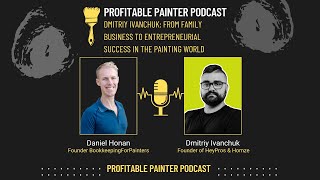
In this episode of the Profitable Painter Podcast, host Daniel (founder of Bookkeeping for Painters) interviews Dmitriy Ivanchuk, founder and CEO of HeyPros and Homesy (formerly HomeZ). Dmitriy recounts his entrepreneurial journey, beginning at age 18 when he launched a painting company to help his immigrant father earn a better living, leveraging digital marketing to secure the first job. He explains how his experience with subcontractor management and the labor shortages during COVID inspired the creation of HeyPros, initially envisioned as an Uber‑style marketplace connecting painting companies with subcontractors. After early success but resistance from companies to share revenue, HeyPros pivoted from a marketplace to a SaaS/subcontractor‑CRM solution. To validate the platform, Dmitriy founded Homesy, a residential flooring and painting company, scaling it to over $3 million in annual revenue by 2023 using HeyPros as the operational backbone. He details HeyPros’ core functionalities: job dispatching, customizable compliance/document management, in‑app communication, change‑order tracking, and automated billing/invoicing. The product is built for non‑tech‑savvy subcontractors, offering both a mobile app and a magic‑link text workflow that requires no app download. Upcoming integrations with PaintScout and CompanyCam, as well as roadmap items like customizable workflow statuses and employee‑management features, are discussed. Dmitriy emphasizes a strategic focus on labor management rather than becoming a full ERP, preferring integrations with best‑of‑breed tools. The conversation concludes with contact information for HeyPros demos.
Chapters
Welcome to the Profitable Painter Podcast. The mission of this podcast is simple: to help you navigate the financial and tax aspects of starting, running, and scaling a professional painting business. From the brushes and ladders to the spreadsheets and balance sheets, we've got you covered. But before we dive in, a quick word of caution: while we strive to provide accurate and up-to-date financial and tax information, nothing you hear on this podcast should be considered as financial advice specifically for you or your business. We're here to share general knowledge and experiences, not to replace the tailored advice you get from a professional financial advisor or tax consultant. We strongly recommend you seeking individualized advice before making any significant financial decision.
This is Daniel, the founder of Bookkeeping for Painters, and today I'm here with Dmitry Ivanchuk. Super excited. Dmitry Ivanchuk founded HeyPros in 2021, a software built to help painting companies manage their subcontractors. From compliance, dispatching work orders, and billing. He also founded HomeZ.com, which is a residential flooring and painting company, in 2022 and scaled it to over $3 million in annual revenue in 2023. Welcome to the podcast, Dmitry. How's it going?
I'm doing well, doing well. Thanks for having me, Daniel.
Absolutely. Super excited to have you. I'd like to, you know, dig into your, your, uh, your history. Could you kind of, before we do that though, could you kind of give us a description of what you do? How do you describe what you do for folks?
Yeah, so currently I'm, uh, the CEO and founder of HeyPros, which is a subcontractor management software. Um, we primarily work with painting companies and a little bit with flooring companies, helping them manage their subcontractor databases and help them efficiently dispatch work orders. But we'll get into that more later. But yeah, so that's primarily what I do. I founded a couple of other companies, Homesy.com being one of them. And since scaling it, we've passed it on, but still actively part of it and still helping it grow.
Nice.
Awesome.
And from my understanding, you actually had a background even further back. Worked with your dad in his painting business. Can you tell me about that a bit?
Yeah, of course. Yeah, my first, uh, my first painting job was at the age of 16, uh, working summers, uh, at the painting company my dad used to work for. He's, uh, he's been a W-2 employee, painting employee, for his whole entire life. And, um, I worked at the company that he worked at for a few summers, and then at the age of 18, I thought, hey, um, I'd really love to help my dad out and give him a better paycheck. So at the age of 18, I founded my first painting company and went out and started looking for jobs and hired him on as the solo painter. And then we got a couple more painters and really helped him pretty much quadruple his income within the first year or two. So it was kind of where I got my start, and that was about 9 years ago. But that's something that got me started in this painting space and led me to understanding subcontractor management and then founding a software for it, and then also starting a residential flooring and painting company to kind of prove that we know what we're doing.
That's, that's amazing. So you hired your— you wanted to help your dad out. When you turned 18, you started your own painting business, hired him and brought him on, and then tripled his, uh, take-home pay. That's awesome. How did— like, that's amazing just by, you know, if you were doing that now as a 20, 30-year-old or whatever, but to do it when you're 18, that's pretty impressive. Like, what's— where did you get that idea and like, how did that come about?
Yeah, so I've always been into digital marketing and When I, when I was 16, I was taking a lot of marketing classes in high school and learning about Google Ads and Facebook Ads and stuff like that. But when I turned 18, my dad was really miserable working as a W-2 painter, making like $16, $18 an hour or something like that. And he really wanted to be his own kind of business owner. But since we're immigrants and he immigrated from Ukraine, I was born there too. He didn't really know the language and didn't know how to go and sell jobs. So he kept pushing me saying, hey, when you become older, you're going to kind of help me out. And so I always thought of that as like my mission. So when I turned 18, I went, opened up a contractor's license in the state of Oregon. That same evening, launched a website because I knew how to build websites, launched a Google ad, and within 24 hours got our first lead. Went out and estimated the job, didn't know what I was doing at all, sold the job, and we split the profit two ways. And I made like $700 in two days, and he made $700 in two days, and it was the most money we've ever made. So we kind of went rock and rolling from there.
So awesome. That's a, that's the American dream right there. That's awesome. That's good stuff. Okay, so you, you started that with your dad, and then Uh, what, what made you do the, the Hey Pros? What made you start that and helping folks with managing subcontractors?
Yeah, so the dream was always, uh, based on the experience that I saw with, uh, with my dad and seeing kind of how subcontracting worked. Um, a lot of subcontractors are stuck in a, uh, almost like a rat race where they're working with one company. And that's something that these new compliance contractor, subcontractor compliance laws in many states are trying to battle, preventing a subcontractor from working with just one company. But that's kind of what happens is even if you're a subcontractor, you're kind of stuck working with one company. You don't have very many options. You don't have very many abilities to be able to take work from anybody else because you are your own business owner, but you don't have very many avenues of getting work. And the reason is because it takes a lot of networking, it takes a lot of seeking out to try to find jobs. And most subcontractors or contractors for that matter, don't know how to go talk to a client. So they would prefer to get their jobs from a GC or from a painting company or from a flooring company, whatever trade they do. And so when looking at the example of my dad, I thought, well, why wouldn't there be kind of a way to— and this was when I was in high school, it was the early days of Uber. So that's what I was hearing a lot of. And so I was thinking, Well, why couldn't there have been a way for contractors to be able to get work from many different companies? A lot of companies sell painting jobs or flooring jobs or any other trade. Why can't they be able to have their own little mini empires or mini networks of subcontractors that they could give out work to? And why can't we handle the difficult part of it, which was the compliance, the negotiation, and the payment of it? Right? Why couldn't we help? Allow these immigrant or non-immigrant subcontractors be able to get jobs fast, easy, and without the need of knowing the language even. So that's kind of where the idea was born. It's a pretty long story of how we got there, but I launched my painting company with my dad and did that for a few years. Got it to a point where it was pretty autopilot. And then kind of got connected with another company that does marketing, things like that. And so they actually stepped on as an investor of HeyPros through a friend of mine who actually was the original founder of HeyPros. He was a flooring installer. He was a subcontractor, and this was early days of COVID right before COVID and right after COVID. Where a lot of our local companies in the Oregon area, Oregon and Washington area, were complaining about labor shortages. They were saying there was not enough painters in the area. And being in the industry, I had a lot of friends that were painters that were sitting at home during early COVID days saying they didn't have any work. And so it was kind of like, well, if there's not enough work, but you're saying there's a labor shortage, but there's a bunch of guys sitting around with no work, what's really happening here? And that's where the idea came of, hey, let's create a platform where companies can be able to easily get work out to all of their subcontractors in one fell swoop.
So it's basically like the Uber for subcontractors.
Yeah, exactly.
Instead of going on, a lot of folks go to Craigslist and make a post or maybe try to hang out at the paint store, put an ad at the paint store. They can go to HeyPros and basically see subcontractors and reach out to folks there? Is that kind of—
That was the original intent of it. And I'm glad we're taking this direction. That was the original intent. We want it to be a marketplace, right? We want it to actually be an Uber for contractors. But that turned out to be a very big mistake on our end. So that's exactly what we did in late 2020, early 2021. When we launched the first version of HeyPros, it was, we went and found hundreds, I think it was 300 or 400 subcontractors, and we found a few dozen painting and flooring companies, and we started connecting them through our platform. And what we found is it worked way too well, but nobody was willing to give us a share of the profits for all the headache that we went through. So we were connecting at one, like, we launched in August, in August 2021, and by December we were doing, I think it was 300 or 400 jobs a month. So in just 5 months, we were dispatching 300 or 400 jobs a month where we were connecting these companies to subcontractors. But they were taking our subcontractors and keeping them and just not using the platform anymore, or they just didn't want to give us a share of what we were doing. But we were ultimately taking a lot of the risk. We were making sure all these guys were compliant. We were making sure that they did quality work, we were vetting them, and then we wouldn't really be able to take a cut off of it. So we kind of stopped doing that and said, okay, well, what we've proven is this actually works. The software that we built does do what we want it to do, but maybe we shouldn't just be giving out subcontractors. Maybe we should be helping these companies use the tools to better expand their networks rather than just mooching off of the network we've built for them. So that's what happened and that's where Homesy starts. So we didn't originally come to that conclusion of we're going to provide software. The first conclusion we came to was, well, if you guys aren't willing to pay us for our services, then we're just going to build a much bigger and better flooring and painting company than you guys could ever build because we have the labor. So that's what we started. And in January of 2022, that's when we founded Homesy, which was supposed to go and compete against all of these flooring and painting companies in our town that were refusing to basically give us any credit for the help that we were giving them. So we said, well, let's see if we could do this. And that's when we founded Homesy and kind of scaled it from there.
Okay, that's awesome. So basically it's like the equivalent of you know, using Uber one time, but then getting the, the number of the driver and then just using him as your driver directly, like coordinating instead of like using Uber again. Okay. And so yeah, that, that's, that's tough. But then it's hilarious on how you, you got back at the folks that weren't using the app properly. You just started your own business using the same platform to at least partially to, to get subcontractors and and using that to scale? Because you scaled it very quickly. You started in 2022 and by the end of 2023, you're at $3 million in revenue.
Yep. Yeah, we, we just took a very head-on approach. We started our own company and just said, okay, well, we're going to take our local market and we're going to see what we could do in our local market because we were still— our goal was always, I mean, building a, building a nationwide flooring or even painting company is not really in our goal. That's way too much work. That's decades worth of building. That's a lot of infrastructure. That's very difficult to do. So the goal was never let's build a nationwide painting company, but we did want to prove that what we had actually worked and it was able to help businesses scale. And so that's what we did in our local kind of Portland, Oregon area. We launched Homezy. We went heavy on marketing. We hired estimators. We used the subcontractor base that we already built, and we essentially just went full speed ahead. And within the first 6 months, we were already doing close to $100,000 a month of work. And all of this was just because of the background knowledge we had. I had built a painting company, and some of the other founding members had worked with subcontractors. So we just hunkered down and did the best that we could and proved that what Hayprose was able to do actually helped businesses scale. And so we kind of did that for 2 years. We kept building Hayprose, and Hayprose was by no means a perfect software at that point. And I don't think it's a perfect software right now either. We're still continuously developing. But what it allowed us to do is really go alongside a real company that was willing to cooperate. Because it was our company and give us the feedback we needed in the real world to continue developing tools. So that's what we did. We started onboarding 5, 10, 15, 20 subcontractors, started doing like 60, 70, 80 jobs a month, started selling more and more and trying to figure out, well, what's the best way to dispatch? What's the best way to schedule? What's the best way to price these jobs for our subcontractors? And so everything came from trial and error. Over the last 2 years.
Yeah, that's great because it seems like the best softwares are always, you know, somebody created it to solve their problem first. And then so you guys use it in your own company to solve your issues and then now you're just providing that software because it like, you know, John from PaintScout, Tanner from DripJobs, David from Protiv, all those guys built that software for basically first for their business and then, and then, and now they're providing it to everybody else. So that, that, that's awesome. Okay. So let's dive into, I guess, what, what issues were you, did you have HeyPros, the software that you developed, what is that really solving? Like, you know, because I know just from my experience working with folks, like, compliance is big for subcontractors, like getting— making sure you get your W-9, your insurance, your subcontractor agreement signed. Are those the type of issues that it's kind of helping solve, or?
Yeah, yeah. So What does Haypros really help solve? I keep mentioning it helped Holmesy scale, and the reason why it helped Holmesy scale is because, in my opinion, selling a painting job is a lot easier than fulfilling a painting job. Most issues happen during fulfillment. I think Buildertrend did a study a couple of years ago, and one of the statistics that they quoted was I believe it was 51% of jobs, construction jobs, go south on budget or scheduling due to miscommunication between the company and their labor. And it's really true because you can go and sell a job. I can hire a salesperson, I can teach him how to talk to a customer and sell a job. But when it comes to actually completing that job, if you don't have the right labor working on it, on the certain schedule and don't have a good project manager that can ensure that everything happens smoothly, everything goes south. And that's where the money's made, right? Customer will not pay you if the job is not done correctly and you're going to have a ton of issues. You're going to have change orders, you're going to have delays, and you're going to end up losing money on that job. You're not going to make any profit if you can't fulfill it in the way you promised. And so And that's really where HEYPRO steps in, is the classic way of doing it in this industry is you get a job, it's sold, and then you give it to a project manager. And the way that your project manager typically works is very manual, very manual. You pick up the phone, you call your list of 10 painters and you say, hey, are you available to take this exterior painting job that's happening in about 2 weeks? It's cedar shingles on a 75-year-old house. It has X, Y, and Z, and we're willing to pay $5,000 for it. He goes, "Well, can you send me an email with some pictures or can you text me some pictures? I want to take a look. What's the timeline? How soon does it need to be done? I need to take a look at my schedule. Wait, you said $5,000. What's the square footage of the house?" There's softwares out there like Drip Jobs and Paint Scout to do a very detailed estimate for the homeowner. But the subcontractor, the painter, gets almost none of those details when they're trying to make the decision on doing the job or not. And so how can you expect a craftsman to take on a job and then not have questions when they didn't get adequate details communicated to them? And so there's, there's no easy way for you as a project manager to get in front of all 10 of your painters and say, hey, who's the best one for this job? And we're not just picking cheapest price, we're picking who's actually going to do this job the best. And project managers always resort to first come, first serve. The first person that picks up the phone and says, I'm willing to take it, is usually the job, the person that the job goes to just because of how much time it takes. We have some clients of ours that are doing, I don't know, 30, 40 jobs a month with one project manager. If I'm a project manager that's physically managing these 30 jobs a month and I'm also the one that's calling 5, 10 subs to see who's available to take it. That's just so much manual work, right? When we started HeyPros, I mentioned it was because of a labor shortage during COVID time. And the reason why there was a labor shortage was because there was such an influx of work. But these project managers were spending 4 hours on the phone a day trying to call their list of subs, seeing who's available. So it's just an inefficient way of getting the right information in front of the right person and matching up that best contractor to the job because you've got schedules, you've got pricing, you've got location, you've got skills. And so that's, that's what HeyPros really solves is we allow you to post a job to, let's say you pick 5 of your best painters that you think will be a best fit for this job. You post all the details once, you send it out to them, they all get a notification, they can all take a look at the job in their leisure. You don't have to go call them, they can all place a— we offer a couple of different options. We offer them to either place a bid on your work order if you want them to, or you could just give them an option to say, I'm interested. And so what you get is you get a list of, let's say, 3 painters that say, I'm interested to take this work order for this date, for these details, for this price. And then you take your pick. We allow you to have a review system so you can be leaving your subcontractors a review after every completed job. You can see the gallery of their completed work so you can see who specializes in that particular job. And on top of that, we also offer compliance management. So you're creating compliance requirements for each and every subcontractor, and you can ensure that this person is qualified to do exterior work because you gave them the opportunity to do exterior work for your business. And if you don't want them— if you want to not allow your project managers to let the sub take on exterior work, you can prevent it by not giving them that working category. So it's completely customizable in allowing painting businesses to really pick and choose who they they choose for which job and how they dispatch work and keep it all organized and easy to access.
So when they, when you, okay, so I closed a job and I'm looking to schedule it. Let's say I'm using PaintScout. So I have a work order that PaintScout generates. Do I like enter the information in HeyPros or is there like just upload it, a PDF or something like that? Or like, how does that process work?
So you upload all of the information from the PaintScout signed job into HeyPros. But funny enough, we're actually working on an integration with PaintScout currently. And ideally in a few weeks or a month or so, you should be able to just see, as soon as a job is signed in PaintScout, you'll see a draft work order already built out inside of HeyPros with all of the details from your PaintScout signed estimate. That you want to pass over. So all your project manager has to do is set the work order price and assign it to or send it out to 5, 10, 20, 30, or all of your subcontractors right then and there. So we're working on that integration, but at the moment, yes, you download the details from PaintScout, you just upload it and create a work order in HayPros, and then hit publish, and you can publish to one or all. Or any number in between of your painters.
That's awesome. So PaintScout integration to come. You have approximate timeline?
We're working on it. I hope that it's going to be in the near month or two at the latest. I hope we're done with it in less than 2 months, but definitely in the next month or so.
Okay, cool. So we're recording this in mid-March of 2024, just because this might be released a little bit later.
So hopefully it'll be out by the time we release this.
Yeah.
Okay.
No, that's really awesome because I know a lot of folks use Pain Scout. And so that's awesome that it integrates that piece of it. But otherwise you could upload or download and upload it to the system and then notifies all the subcontractors that you want to notify. And is this like an app that the subcontractor has on their phone?
Yeah. Okay. Yeah. So we created a desktop app and a mobile app. But so there's a mobile app. It's very user-friendly, very easy. We designed it around the idea of a 50-year-old subcontractor that's not good with technology. So very user-friendly. And we went a step above and beyond that and we actually created an option for you to not have to force your subcontractors to download the app. We have a text work order version where if your subcontractors never want to download the app, they just get a text message with a magic link every single time there's an actionable item, and all they have to do is click the link and they're automatically logged in on the web version and they can do whatever they need to do. So it's designed around the idea of 50-plus-year-old subcontractor that does not want to use technology.
Yeah, no, that's good to know because I know there's definitely those folks out there that don't want to download any kind of app. So, so it works, they just get a text message, they can just click on it and it opens up. So that, that's, yeah, that's amazing. Okay, good stuff. All right, so we got getting, getting the, the job or getting folks on the job, getting a subcontractor. Allocated to a job. And then I think you mentioned, you know, the compliance piece. So I'm assuming when they, the subcontractor is getting on the app, there's like an onboarding process or something where they can provide those, those, uh, you know, key information pieces for, for the, the painting business, like, uh, insurance or sub agreement or W-9, that kind of stuff.
Yeah, exactly. Uh, so we, we wanted to create it as, as open-ended as possible. So each, each painting business does compliance a little bit differently, so we wanted to make it as customizable as possible. So when you're building out your account, you can create your own custom requirements for, um, any which way you want, meaning you can have a general requirements list where you have it applicable to every single subcontractor you onboard, but you can also have custom requirements that you create that you can assign to just one or two or five subcontractors. So if someone needs a particular certification, especially for commercial jobs, you can assign it just to a couple subcontractors. And our system doesn't prevent you from onboarding contractors if they're not compliant. So what we allow you to do is we allow you to actually invite them and get them into the system and then assign these compliance documents to them. So you, you in theory, if you wanted to use Hapers this way, could actually dispatch work orders to uncompliant subcontractors, let them tell you they're interested, and then not, and then have that barrier of, well, if you want to take this work order, you need to fill out these documents for me, right? So you're not forcing 10, 20 subcontractors to fill out documents for you if they're never going to take a job from you. So you can really onboard them into the system, let them say, I'm interested in taking this work order, but we prevent them from being able to take that work order until those documents are done. So we kind of move that needle a little bit. Further down the road. So you don't have to do all of that grunt work in the beginning if you don't want to with compliance. I mean, doing compliance with 20 painters and then having 2 of them actually work for you is a lot of work.
Yeah, that makes sense. So basically you don't ask for that information until they say, hey, I want to work for you this job specifically, and then you get all that information and that just stores right there in HeyPros. So if workers' comp audit comes around, you have all that information.
Yes, everything, everything is saved per subcontractor. So the reason why we built it this way is we saw a lot of companies using a CRM to manage their subcontractor compliance. They would create like another CRM account on monday.com or Salesforce or HubSpot and have all their subs in there with documents attached. So that's, that's pretty much what we allow you to do is have— it's like a subcontractor CRM specific for your subs, right? So you can leave notes on your subs, you can mark them compliant, you can mark them compliant, you can give them authorized categories, store documents in there, assign documents. And on top of all that, we also have a reminder feature. So you can literally toggle a little toggle that will remind your subcontractors if a particular document is expiring. And then if it does expire, we give you a toggle that allows you to basically say, hey, this document, like let's say a COI, a certificate of insurance, is important for my business. So if this one expires, this is a non-negotiable for us. This will mark them non-compliant in the system and a project manager will not be able to give them a work order. And that's what our system allows is basically automatically marking them non-compliant as soon as that document expires.
That's good. Yeah. Because I know you get the insurance in the beginning and then you're like, okay, well, I completed that task, but then, you know, by next year you've forgotten that insurance needs to be you know, so if you're not reminding them, they don't give it to you and then you don't have it. And yeah, so you're back at square one. So that is a really awesome feature. Um, okay, so what, what other, um, is there any other, uh, issues that this is— that HEY Pros is solving with that working with subs?
Yeah, uh, the biggest one is also communication. So when a work order is dispatched through HEYPROS, um, that work order lives inside of HEYPROS until it's done. So we offer communication inside of the app, so there's back and forth, uh, there's a chat thread inside of the work order that's dedicated to that work order between the sub, the project manager, and any other staff that need to be attached to that work order. So any communication, pictures, documents, files, everything can be communicated in that chat and it's stored on that work order. So if a, if a painting company owner needs to access a job and see what was communicated between a PM and a sub on a job 2 years ago, he could find that within seconds on HEYPROS rather than asking the PM to scroll through years of text messages with that subcontractor, right? And then change orders are tracked inside of HEYPROS with timestamps and IP addresses and approval and rejection of change orders. So everything is tracked, documents are stored in there, and another integration that we're working on is CompanyCam. So we want to release that in the next few months as well. So all of these documents that are being communicated back and forth inside of Papers are just automatically synced to the project inside of CompanyCam by default. So you don't have to have the subcontractor upload them twice, the project manager upload them twice. And then obviously something we mentioned is billing. Right? We handle the billing of the work order. So when, when a subcontractor is done with the job, they can mark the work order done inside of Haypros, and that running total with the change orders and the original starting prices being tallied up inside of Haypros. And what we do is we create an invoice with all of those line items, change orders, and starting price in there that the project manager can then approve or reject. And if, if the work order is approved and the subcontractor has marked it done, Then we generate a PDF invoice that gets sent over to a bookkeeping software or the accounting email that can easily be then stored and paid out.
Nice. So taking through, it's solving basically all the issues I could think of in terms of dealing with your subcontractors from the work order to compliance, billing. Work order changes. And plus you're building integrations with, uh, PaintScout and CompanyCam, um, to make these things, you know, talk to each other. And, uh, yeah, that, that's awesome. Um, is there, um, anything else that, uh, you got coming down the pike?
I mean, we're always working on stuff, right? Um, we have We really, we're not venturing. I don't think we'll ever, not I don't think, I know for a fact we will never venture away from subcontractor or labor management. We don't want to become an ERP, right? We don't want to deal with anything except for the labor portion, right? So we would much rather integrate with other softwares that do things better, but we want to focus on just labor management. The next things is just further organization of the job, the work order, such as improving customization of statuses, allowing customizable workflows for the status of the work order. And then another thing that I really hope to touch on this year is getting into employee management and being able to help with employee labor in addition to subcontractor labor. So I hope, I hope we can get into that this year as well so we can be kind of the solution for painting companies that use both, right? So be able to store all your work orders for both your employees and your subs in one place.
Yes, that would be, that would be amazing.
All right. That's next. Yeah.
All right. Good stuff.
Cool.
Well, if folks wanted to reach out to HEY Pros or learn more about HEY Pros or yourself, what would you ask them to do?
Yeah, definitely. Definitely. If you want to learn more, go to heypros.com and request a demo with us, or if you want to reach out to me directly, I'm all open to chatting and learning about people's journeys and companies and helping out. So you can reach out to me directly at dimitri@heypros.com or just request a demo on heypros.com and ask one of our fantastic reps to get in touch with me. Yeah, we're a fairly small company at this point, so we're all very tight-knit.
Amazing.
All right.
Thank you, Dmitry, for your time. And for those that are listening, definitely check out Grow Your Painting Business. If you go to Facebook, type in Grow Your Painting Business, join the group, ask questions for Dmitry. I'll add him into the group if you have any questions for him. And also, if you have any ideas for future episodes, definitely let me know. Your thoughts. And with that, we will see you next week.
More from Daniel







What’s REALLY Holding Your Painting Business Back? (Find Your Bottleneck in 5 Minutes)



