Employee Retention Credit for Painting Businesses Webinar
The webinar, presented by a tax professional, provides an informational overview of the Employee Retention Credit (ERC) – a refundable payroll tax credit created to help businesses retain W‑2 employees during COVID‑19 disruptions. After a disclaimer that the session is not individualized tax advice, the presenter walks through the ERC’s purpose, the $400 billion funding pool, and how it compares to the PPP. The core of the session details the three qualification pathways: (1) a significant decline in gross receipts (≥50% in a 2020 quarter versus 2019, or ≥20% in a 2021 quarter), (2) a full or partial government‑ordered shutdown where the impact exceeds a “nominal” 10% threshold of 2019 business activity, and (3) being a “recovery startup” that began after February 15 2020 with average annual gross receipts under $1 million. The presenter explains how to assess partial shutdowns, including service‑line suspensions, operational modifications (e.g., virtual consultations), and supply‑chain disruptions tied to government orders. Documentation requirements, especially the need to retain the relevant state stay‑at‑home orders and supplier evidence, are emphasized as the burden of proof in an audit. Risk considerations are discussed, noting audit probabilities, penalties for non‑compliance, and the three‑year statute of limitations for amending 941 returns. Credit calculation details are covered (50% of qualified wages in 2020, 70% in 2021, per‑employee caps, and the inability to double‑dip with PPP). The webinar concludes with a step‑by‑step claim process (questionnaire, document review, 941 amendment submission, IRS processing, and receipt of refund) and mentions that third‑party ERC specialists typically charge about 15% of the credit, payable after the refund is received.
Chapters
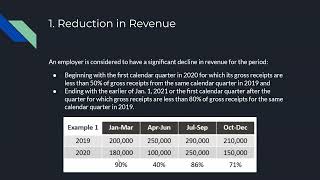
All right, folks, we're going to go ahead and get started with the Employee Retention Credit webinar. So first off, just going to give a disclaimer here. So this is— this presentation is just to provide some informational— some information on the subject matter. It's not specifically tax advice for you or legal advice for you. So if you'd like that, we can definitely do that. We do tax planning, and we can look at your specific situation. But don't take this as specific tax planning advice for your specific situation because there's a whole bunch of nuances to the employee tax credit— so, employee retention credit. So this is supposed to be to inform you so you can take that information and then act accordingly. Either reach out to us or to a professional to help you further. Alright, so we'll jump into the agenda here. First of all, we're going to cover what is the Employee Retention Credit, how do you qualify, what are the risks involved, because with every tax strategy you employ, there's going to be some sort of risk that you're taking on. And then if you do qualify, what is the process to go and kick this— get this started. And then if we have time, we'll try to cover any questions. Alright. First of all, what is the Employee Retention Credit? So the Employee Retention Credit is a refundable payroll tax credit that you can take against your employment taxes. So Congress came up with this basically to, to alleviate the impact that COVID-19 had on businesses, specifically businesses that were put under stay-at-home orders or some kind of government shutdown. Specifically. And then those, those businesses kept, you know, employees on their payroll during that time. So this is Congress's way of kind of giving help to those businesses that kept people on their payroll during that period. So there's been several changes to this credit over the past couple of years, mostly to expand it. So we're going to go through and, and cover some of the nuances with this. Congress set aside $400 billion for this program, and as I mentioned, has made several changes over the past couple years, making it easier for impacted businesses to qualify. However, everyone doesn't qualify, and we'll go through who does and who doesn't. So it's a pretty big program, $400 billion as a point of reference. The PPP was $500 billion, so it's almost just as big as the PPP program. So far we've had about 7 clients submit for the ERC, qualifying for an average of $65,000. So it's quite a significant— I mean, obviously ranges, it depends on how many employees you have on payroll during the specified period, but it can be— the help can be pretty significant. Then the caveat here is there are specific requirements that you have to meet to take this credit, and then there's associated risk with, with that, and everything is not black and white. There's definitely some gray in there and interpretation. So let's get into how you, how do you qualify. First of all, you have to have W-2 employees in 2020 or 2021. No more than $500, which nobody on this call will have more than $500, but you got to have W-2 employees. And this does not include yourself if you're a 50% or more owner. So these are folks that are non-owner employees. And then, um, the second thing that you have to have is you have to have at least one of the following things to occur. You have to have either And these are ors, so one of the following things have to occur, not all of the following things. One of the following things: either you have to have a reduction in your tax basis revenue or your gross receipts relative to, most cases, 2019. So if you compare your 2020 to 2019, you have to have a decrease in revenue, and we'll go into more details on that. Or number 2, You have to have a full or partial government shutdown. So there was obviously many stay-at-home orders, you know, back in April of 2020, and that extended for different periods of time depending on what state you're in, and those government orders could have modified your operations or, you know, certain— parts of your business were not able to operate potentially. Additionally, you know, a government order might have caused disruptions if you had certain things that you purchased for your business and had a more than nominal impact on your business. You could have, you know, had sort of a partial shutdown. So that's the second thing that— and we'll go into more details on each of these things, but that's the second piece there. Or you are a recovery startup business, and this is basically a business that started after February 15th, 2020. So if you started your business after then, then you, you can qualify if you had W-2 employees during this period. So we're going to jump into each of these 3 items. So first of all, you know, W-2 employees, if you at least had one during 2020 and 2021, Then we're going to go into the next 3 things, which is reduction in revenue, full or partial government shutdown, or number 3, recovery startup— recovery startup business. Basically, you started your business once the pandemic hit. All right, so the first one, this is the first way you can qualify for this credit. It is a reduction in revenue. So this one's pretty straightforward. You can take basically your 2020 and 2021 financial statements by quarter and compare it to your 2019, uh, financial statements by quarter. So an employer is considered to have a significant decline in revenue for the period if basically in 2020 your gross receipts went down by 50% or more compared to the same quarter in 2019. So you just basically, like the example shows here, the bottom, you line up your, your quarters for 2019 and 2020, and you see, okay, did my gross receipts— did they decrease more than 50% in 2020 when compared to 2019? And then if that's not true, then you can look at 2021 and do the same thing, except for 2021, it's actually a lower threshold. You only have to decrease by 20% compared to 2019. So you compare 2021 once again each quarter, the, the gross revenue, gross receipts— we're not talking about profit, not your bottom line, but your top line, right? Your top line gross receipts to your 2019 gross receipts. So 2021 compared to 2019 by quarter, and you have to have a 20% reduction in 2021, 20% or more actually 20— more than 20% reduction, um, 2021 compared to 2019. So that's the— if you have that, if that is true for your business looking at your financial statements, then— and you had employees that you kept on payroll, then you would qualify for this, uh, Employee Retention Credit. So that's one of the ways, um, and again, it's more than 50% in 2020 and more than 20% in 2021 by quarter. All right, so let's say you look at your financial statements and that is not true. You— and this is, you know, you actually did better in 2020 and you did better in 2021, or at least it wasn't— you didn't have that significant amount of reduction. There's still different ways you can qualify, so we'll go into the second way you can qualify. So you had employees, and then you also had a full government shutdown. Now, this is probably not the case for anybody on this call. You probably didn't have a full government shutdown where the— you might have, but I'm not aware of a case. You have to actually go to your state and stay-at-home order and see what it says. But for the most part, it probably didn't apply to you fully. Now, a full government shutdown, you would— you know, you would not be able to do any of your business. For the most part, you know, the stay-at-home orders had a provision for construction or specialty trade contractors to allow them to work in certain— at least in certain ways, providing, you know, services to critical infrastructure, for example. At the very least. So, um, the, the real part that you might have actually qualified under is the partial government shutdown. So we'll get into that. So an employee— an employer that operates in a essential business may be considered to have a partial suspension of operations if, under the facts and circumstances, more than a nominal portion of its business operations are suspended by a government order. So when I— when we say more than nominal, that means more than 10% of your business. So for example, you know, maybe interior painting, right, is 20% of your business, and you can do interior painting, so that would be considered nominal. But the key here is that you need a government order, and it needs to have more than nominally impacted your business. So the government order, we'll get into this, but the government order needs to have said something either not listed the service that you provide as an essential business, effectively shutting it down. And then, you know, that part of your business, that service line, whether it's, you know, residential painting or interior, interior painting, you know, that in 2019, it was more than 10% of your business, and then, and because of that shutdown in 2020, you didn't— you weren't able to do that, you know, in April of 2020, or April, May, whatever, whatever the case was. So let's go through an example. Let's say you had residential— residential painting accounted for over 10% of your business revenue in 2019. However, in April, your business was unable to do interior painting due to government shutdown limiting residential painting work. So, and like I said, a lot of these stay-at-home orders, they had provisions for construction or specialty trade contractors to provide, you know, services to critical infrastructure, but sometimes they didn't provide that, you know, provision for residential work. So continuing with the example here, you continue producing commercial work during this period, you didn't have a— and you did not have a reduction in revenue. So again, you don't need a reduction in revenue to qualify under this. Your revenue could have went up, but you could have— you could qualify because you had a partial shutdown because due to the stay-at-home order, or whatever your government, your state government said, you know, that you were on it, you were not allowed to do residential work, you know, whatever that service line for your residential side does. So if that was the case for that period of time, let's say, you know, like the example says, in April, those wages that you paid your employees, they could have been working on commercial stuff, you know, But you may still qualify for the Employee Retention Credit if you have employees during this time since the government order had a more than nominal impact because residential painting, in this example, was more than 10% of your business in 2019. So we'll go on to the next example. Alright, so we talked— we kind of talked about this one. Interior painting accounted for more than 10% of your business revenue in 2019. However, in April 2020, your business was unable to do interior painting due to government shutdowns. You continued producing exterior work during this period and did not have a reduction in revenue. So you may— even though you didn't have a reduction in revenue, you you still may qualify because, you know, due to that government order that was preventing you from doing residential interior work, you still may qualify for the ERC if you had employees during this time and, you know, interior work was more than 10% of your business. All right, so modification due to government shutdown. So this is a subcomponent of the partial shutdown. So there's a lot of businesses had to modify what they were doing due to shutdowns. A lot of the times, you know, pivot when something, you know, in the case of, again, residential work was in some areas that was not permitted. You had to do some sort of pivot. And again, it has to— that modification in your business processes how to have a more than nominal effect on your business. And again, it goes back to the 10% reduction. So modifications. All right. So a lot of, you know, painting contractors or related trades, you're doing in-home consultations for color consultations or, you know, interior painting estimates. And all those things in the home accounted for over 10% of your business revenue or employee working hours. It doesn't have to be revenue, it can be employee working hours in 2019. However, in April and May in 2020, your business was unable to do in-home consultations due to government group meeting orders, so you had to modify your in-home consultation process to be virtual. And require personal protective equipment, whatever, whatever the modifications in that your business due to that, you know, segment of your business that is over 10%, you had to do those modifications. So in this case, you may be, you may be qualified for the Employee Retention Credit if you had employees during this time since the government order had a more than nominal impact on your operations. All right, um, so another subcomponent of this partial shutdown thing is supply chain disruption. So for an employer to claim a full or partial suspension due to a governmental order that impacts its supplier, it must consider the relevant facts and circumstances. So suppliers, we're talking about you know, how you're getting your, your, your paint, your, any materials you need to do the work that you need to perform, the services you need to perform. So your suppliers are your, your, your hardware stores, your paint stores, and anywhere else where you get those critical goods to execute your work that you do. So you have to In order to meet this supply chain disruption qualification, you have to have— the supplier has— the supplier's ability to make delivery due to— of its goods to your business was shut down or, you know, cut off because of a government order. Again, so it goes back to that government order thing. You'll need to have— a government order to say, show, basically say, you know, okay, due to a government order, the supplier was shut down, and that's where I got all of my materials, whatever type of materials, in order to do my work. So I was not able to do work because I didn't have a substitute. All right, the second one is the employer's ability to purchase critical goods from an alternative supplier. So, uh, let's say you had a Benjamin Moore store and a Sherwin-Williams store. The Benjamin Moore store shut down, but the Sherwin-Williams store was still there, and it had the— you know, you needed blue paint, and Sherwin-Williams had blue paint. Um, so you, you had an alternative right there. But if you didn't have that alternative, you would qualify for this supply chain disruption. Um, and then number 3, the consequence on the business due to its inability to purchase critical good. So obviously it needs to have— it needs to be substantial, some sort of substantial either modification to the way you did things, like, and we'll go through some examples to illustrate that real quick. All right, um, before we get to the examples, uh, did some research on PPG. So they, according to their annual report, they did have some retail store shutdowns in the US. So probably impacts more of the— if you have a rural painting business or rural trades business, some of those retail stores potentially were shut down in your area, and you probably know better than me at this point, but it might apply. Sherwin-Williams, it looks like they just reduced their hours and changed the way they did things, but not necessarily closing, it looks like, from their annual report. But again, You know, it depends on where you are and what was going on. So, all right, so let's take an example here. Primer was not available in local paint stores for 2 weeks during one quarter due to government shutdowns. There was no primer alternatives available, so you had to delay production on, on 6 jobs. So again, it An example, I think Benjamin Moore, they have a lot of independent, they have all the independent stores, and maybe they, the government ordered to say retail stores and they shut down, and that Benjamin Moore store was the only store that you, you know, you kind of live in rural or something like that, and there's not a lot of paint stores in your area, and so you didn't have that access to that, those supplies. As an example. All right. And then another example, drywall glue was not available in hardware stores due to government shutdown. So this goes back to beyond the store, but going back to like the drywall glue producer, like the supplier, whoever produces that. So again, it has to go back to a government order. So, you know, say in this case it would be a drywall glue company, was unable to do their work because of a government shutdown, so they had to use— so that drywall glue did not get to the hardware store, so you were unable to purchase it even though the hardware store was open. It wasn't on the shelf, so you had to use some sort of alter— an alternative that wasn't you know, as efficient as using drywall glue. So in this case, screws or whatever. And so, and then also it has to meet that nominal impact rule, which is 10% or more of your business. So your drywall repair and installment was at least 10% of your business in 2019. And so that would be another example of how the partial shutdown supply chain disruption could have impacted your business. All right, so we got a question. Was the burden of proof on that? For example, oil-based primer was missing here for 3 weeks in 2020, mud also missing for 4 weeks, et cetera. So this goes back to— the government order. So the question that I would ask, and the way that the IRS is interpreting this, is it has to be based in a government order. So there might be other reasons, and I don't know why the, you know, these, these things specifically happen. Like, the oil-based primer was missing for 3 weeks in 2020. It could have been for something other than a government shutdown. So it's going to require a little bit of research to cover yourself. Now, when you— when you submit for the credit, they're not going to necessarily ask you for the government order. However, we'll get to this a little bit later on the risks. If you're audited, they're going to ask for it. And, you know, the IRS just hired 87,000 new IRS agents, so It's one of those things where you want to make sure you kind of have your bases covered with, okay, so how was— why was the oil-based primer missing? Was it because of the US-based, you know, supplier that made the oil-based primer was shut down at some point and they were unable to make this, you know, an amount of primer, and they were, you know, so there was a supply chain disruption because of that. Same thing for the mud, or was it just because of other reasons like government orders outside of the US? Because this has to be US government orders, you know, like China shut down their production, you know, plant. If China shut down their production plant and that impacted oil-based primer and mud, and that's why you weren't able to get it for those weeks, then you, you wouldn't qualify in that case. So it's, again, it does take some, some research to figure out for those things, you know, why, why did that happen, in order to be conservative and make sure you're covered when you, when you submit for this, uh, this credit. All right, um, all right, so we talked about government orders. There's a bunch of links, and I'm going to send out the slideshow So you can get these links. It breaks down all the orders that came out by state. So you can go and look if you don't remember. You might remember or not need it, but it's good to have the document. Like, hey, this, you know, Pennsylvania, you know, have the actual stay-at-home order that, you know, listed who was shut down. It also should help with If you had suppliers, you might have to figure out who the supplier was and then see where their production is out of and then see if they were shut down or make a phone call or something like that. But this is where these links can get you the government orders by state. And usually there's a stay-at-home order and, you know, and then they'll provide a list of essential workers or essential businesses And then they'll have like a list of, you know, folks that can work and can't work. So let's take an example for Pennsylvania. They had a stay-at-home order on April 1st, and they said only life-sustaining businesses on April 1st, and then they attached a list of businesses that could and could not operate. And so this one, you know, specialty trade contractors, they were not able to— and building finishing contractors, which is painting— they were not able to operate during this stay-at-home order from April 1 to May 8. So unless, you know, unless they had a an emergency repair permit or whatever. So in this case, this is pretty, pretty clear-cut, um, you know, that would allow a painting business in Pennsylvania to qualify for the ERC even if they didn't have a revenue reduction because they have the stay-at-home order. Um, and so that would, you know, again recommend just get the stay-at-home order with the attached list of essential businesses. Your revenue could have stayed high for that quarter because maybe you did services in commercial areas, you know, that were permitted or whatever the case was, but you did have that partial shutdown. All right, so action items here. First is find the government order, see if you're business was essential. And you're probably going to find in some— in a lot of— again, like I said before, a lot of states, they distinguish between critical infrastructure, commercial, like those kind of construction. That was okay. That was essential. But then sometimes, sometimes, not all the time, they made a distinction like the residential. That was not essential. And so you'll just have to look at your state's order, see what it actually said. Obviously, we know Pennsylvania— I believe New York did the same thing— and there's more out there. I haven't looked through all the stay-at-home orders. So, so that's the first step. The second step, determine if your business had more than 10% impact compared to your 2019 financials for the segment of your business that was impacted. So in this case, residential was the example we're kind of giving a lot. So if you have some sort of resi— you do commercial and residential work and you— at least 10% of your business was residential, and then in April and May you technically weren't supposed to— you had a stay-at-home order that did not allow you to do that part of your business. Your revenue stayed high that whole time, that's fine. You should still be able to qualify under the Employee Retention Credit. All right, now this is the last way to qualify, and this is a Recovery Startup Business. So basically, if you're a new business, if your operations began after February 15th, 2020, and then you had less than $1 million in average annual gross receipts, then you may qualify for the Employee Retention Credit. Um, and, and you actually can qualify for an additional quarter in 2021, the fourth quarter, which all the other businesses cannot qualify for the fourth quarter, but the recovery business can. So I think you actually have a higher threshold of per employee for the amount you can qualify for because of that. Now, if the employer qualifies for the ERC under the drop in gross receipts test or the full or partial suspension by government order, the other two that we just covered, then you can't qualify under this test. So, so in this case, obviously the drop in gross receipts wouldn't apply to the recovery business because they started in 2020. And so they didn't have any 2019, so that shouldn't apply to them. But they cannot have had a full or partial suspension of business. They can't have met that test. If they meet that test for the full or partial suspension of the government order, then they would have to use that as their qualifying test, and they wouldn't be eligible for the fourth quarter of employee wages credit. Um, so this one's pretty straightforward. It's basically, did you start business after February 15th? Did you make under $1 million, um, in revenue? Okay, then, and then you also had employees that you were paying during this time, then you, you pretty much, it's pretty straightforward on this one where you can qualify for the Employee Retention Credit. All right, so This is something you can refer to. There's a— obviously I'm going to send this out, and it kind of gives you just a breakdown of everything, most of the things we covered. Just to highlight a couple things, so the percentage of qualified wages is 50% for 2020, 70% in, in 2021. So you get that as as your credit amount. So if you paid someone, you know, $1,000 in 2020 for the period of time that you were shut down or you qualified, um, you know, $500 would come back as a credit. And then there's— so that's the amount of the credit, how you calculate it. And then the maximum amount of credit, there's a cap per employee, uh, per— and also per the— per year or, or calendar quarter, depending on which, uh, you're, you're looking at, 2020 or 2021. Then the statute of limitations, I'll just mention here, you can only go back for 3 years. There's a couple different time limits here, I guess. One, there's only $400 billion set aside for this program, so once the money runs out, it ran out and no one else can get this credit. The other thing is you can't wait more than 3 years to go back and amend your 2020 or 2021, uh, payroll tax returns in order to get the credit. So there's a timeline there as well. All right, so let's cover the risk. So what— because whenever you look at tax planning and taxes, you always want to evaluate the risk of actually dealing with the IRS, basically. So What is the risk of applying for the ERC? Basically, it depends on how aggressive a position you're taking on the ERC claim, because like we kind of went through, it's a little— it's not, it's not exactly black and white. There are other organizations out there that are pushing folks to sign up for the ERC that are probably taking a lot more aggressive, you know, component, aggressive stance on this, on claiming this credit. So, um, you know, you're— if you— I'm giving you— I'm pitching you a more conservative approach, making sure you have that government order. So, um, that is a consideration there. And so it's possible for the— you know, if the IRS gets more funding, that they'll start challenging these ERC claims and that take the positions outside of the existing IRS guidance. And the existing IRS guidance says tie everything back to government order, pretty much like we went through several times. So, um, so if you're going beyond that interpretation, then you're definitely taking a risk that the IRS will challenge you. And just to give you like a more numbers approach here, like 1 in 200 taxpayers— and this is before the increase in budget and the increase in, you know, IRS agents that we're going to see here in the near future with the 87,000 new IRS agents. But historically, an average taxpayer has a 1 in 200 chance of getting audited. If they make more than a million, it's like 1 in 20. If you make more than $1 million in a year, about 1 in 20. So definitely take that into consideration when evaluating the risk. So if the IRS come back and say, "Oh no, you didn't actually qualify for the ERC," they're going to take the money back, obviously, then also charge you a penalty and interest if they don't agree with your logic on why you submitted for the ERC. And then obviously if you commit fraud, that's criminal. So, um, you know, don't, don't make stuff up to submit for the ERC, obviously, because they, you know, we have 3 years to go back, the IRS has like 10 years to go back. So you don't want that hanging over your head. Um, and then if it goes to court, uh it's anyone's guess on how the judge is going to, to, uh, you know, come down on the ERC law. So those are the risks, um, just to help you make a better decision. All right, so let's go over the process. Um, so we've partnered with— we've done ERC submissions, amendments, um, on in our, uh, for folks ourselves. We've recently teamed up with ERC specialists who focus— focuses solely on the Employee Retention Credit, so they're pretty efficient at doing these. So we'll go through the process. You can— stage 1 is to see if you qualify. You can— I'm going to put this in the chat, actually. So you're going to complete the questionnaire. And go through that and keep the— this webinar information in mind while you're completing that questionnaire, remembering the government orders and nominal, you know, 10% or more of your business. Or you can do a free tax consultation with me and/or my team to kind of go through your specific situation. To see how we can help. We obviously do more. We do tax planning in general, so we take a holistic approach to look at your full situation, not just specifically the ERC. And we may be able to not only look at the ERC but actually find some other things that you can do to save in tax. So that's your first step, is one, see if you qualify, complete the questionnaire, or start with us and schedule a free consultation. And then stage 2 is document review. So the ERC specialist is going to basically ask you to provide some documentation for your payroll and your PPP. And so the payroll is for obvious reasons, because you have to— one, for your, your 941s, which you can get from your payroll provider so that they can do the amendment. Also, your like your hours and pay per employee. So you can get that from your payroll provider, upload that. And then your PPP information is for basically to prevent you from double dipping. So you can still qualify if you took the PPP, but you basically can't double dip on the same period of time, like the same quarter. You can't take the— get the PPP forgiveness and also ERC for the same period of time, but if it's different times, so, uh, qualify for the ERC if it's different periods of time. And so, uh, they're going to do a document review, and then they're going to analyze your submission documentations and provide analysis of the exact amount of ERC credits that they're going to file for you. And once you sign the agreement, they're going to submit your, your 941 amendments to the IRS. And so this takes 2 to 3 weeks, 1 to 3 weeks or so. Stage 3 is processing, so basically waiting for the IRS to complete their side of things. So this can take a long time. You know, we've submitted for folks beginning of the year and they're still waiting to get a refund check. So it can take a while, 6 to 9 months, maybe longer. So it definitely takes a while. And then stage 4 is you receive the funds, and the IRS basically submits a check to you in the mail. And that is the process. So I'm gonna— if you have any questions, you can go and plug them into the the chat, I'm going to also plug the links here in the chat so you can get that. I'll also send out the slide deck so you can refer. Is it a flat fee for help with this, or do you guys charge a percentage of the credit? So right now we are not doing the actual ERC submissions anymore. We're teamed up with the ERC specialists. I believe they do charge a percentage, and I believe it's 15%. Don't quote me on that, but I believe that's what they charge, 15% of the credit. And I also believe that they don't charge you until you receive your refund check.
More from Daniel







What’s REALLY Holding Your Painting Business Back? (Find Your Bottleneck in 5 Minutes)



