Family, Faith, and $4 Million: The Blueprint for Painting Success
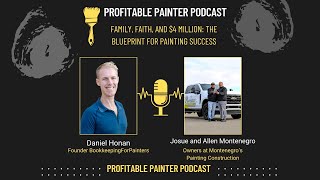
In this episode of the Profitable Painter Podcast, host Daniel Honan (CPA) interviews brothers Josué and Alan Montenegro, CEO and COO of Montenegro Painting & Construction, about how they built a multi‑million‑dollar painting business in Idaho. The conversation begins with their move from California, the launch of the company in July 2021, and their early guerrilla‑marketing tactics (door‑to‑door, flyers, magnet signs). They discuss the shift from pure residential work to a 60/40 residential‑commercial split, highlighting a breakthrough $600 K multifamily project that grew to about $1 M through change orders, and a later $225 K Fred Meyer job that exposed contract and payment‑term risks, nearly bankrupting the firm. The brothers explain their cash‑flow strategy: keeping a residential crew for quick‑pay jobs, taking 20‑50% deposits, and maintaining a cash reserve of roughly $100 K (2‑3 months payroll) before tackling large commercial jobs. They describe securing a bank line of credit in 2025 to provide a safety net, and outline their rapid revenue growth (≈$160 K in 2021, $485 K in 2022, $1 M in 2023, $2 M+ in 2024) with a target of $3‑$4 M in 2025. Operational insights cover team structure (15 field employees, 3‑4 office staff, executive assistant, project manager duties), hiring practices (personal interviews, cultural fit, commission‑based sales), and the importance of family communication and positivity. Finally, they share future goals (purchasing land, building a warehouse) and advice for other contractors: choose the right market, avoid low‑margin jobs, maintain strong contracts, and keep a positive, communicative family dynamic.
Chapters
Welcome to the Profitable Painter Podcast. The mission of this podcast is simple: to help you navigate the financial and tax aspects of starting, running, and scaling a professional painting business. From the brushes and ladders to the spreadsheets and balance sheets, we've got you covered. But before we dive in, a quick word of caution. While we strive to provide accurate and up-to-date financial and tax information, nothing you hear on this podcast should be considered as financial advice specifically for you or your business. We're here to share general knowledge and experiences, not to replace the tailored advice you get from a professional financial advisor or tax consultant. We strongly recommend you seeking individualized advice before making any significant financial decision.
Welcome to the Profitable Painter Podcast, the show where painting contractors learn how to boost profits, cut taxes, and build a business that works for them. I'm your host, Daniel Honan, CPA and former painting business owner, and your guide to mastering the numbers that drive success. So let's dive in and make your business more profitable one episode at a time. I'm super excited today to be talking to Jose and Alan of Montenegro Painting. Super excited to jump into it. Welcome to the podcast, guys.
Thank you.
Thank you. Appreciate that. I appreciate the opportunity, man. Thank you.
Absolutely. No, I'm glad to have you. You guys have built a great business over there in Idaho, and so I think you will bring a lot of value to the podcast, so I'm super excited to jump into it. Could you, just for the listeners, could you kind of give us a picture of what your journey has been in the painting industry? Like, how'd you get started and what are some major milestones that you've had along the way?
All right. First of all, I just want to introduce myself, you know. I am Jose Montenegro, CEO of Montenegro's Painting and Construction.
And I'm Alan Montenegro, I'm the COO for Montenegro's Painting and Construction.
So we start, we moved from California like 5 years ago, almost 5 years and a half ago, and we start working. We was working for another company in Idaho, like, you know, employees per hour. And one day, you know, I just talked to my brother and I told him, bro, we need to make something, you know, together. We have a good communication and quality. You know, we're master painters, we know the work, you know, 100%. So, uh, we decide to do our own business. You know, we build the logo and, uh, we find some magnets, uh, some signs, magnet signs, and we buy one small black Tacoma and we start knocking doors, you know, knocking doors. And big companies, huge painting corporations, uh, doing cheapest work as subcontractor, you know. And, um, 5 months later, or almost 8 months later, the people, they start know about Montenegro, you know, and who they are. Oh, they do good job. So that's how we start.
Nice. So it sounds like you guys moved over from California to Idaho, you teamed up with your, your brother Alan, and you guys just basically started doing guerrilla marketing. It sounds like you're doing getting put putting signs up and then going door to door, just knocking and trying to find folks that were, that need some painting done. Is that right?
Yeah. We make some business card flyers, door hangers. We was walking on subdivisions, knocking doors. If I see construction and my brother, we saw like construction, we stopped by and we tried to find the superintendents or somebody on the project and introduce myself and offer them our services. That's how we started, you know.
Okay, yeah, definitely guerrilla marketing. That's awesome. I mean, the business card flyers, doing networking. Were most of the— starting out in the beginning, um, were most of the work that you're getting residential repaint, I'm assuming?
No. Yes.
Okay.
Yes, it's residential on the beginning.
Right. And that was back in, was it 2021?
Yeah, 2021. Yeah, that was back in 2021, July. We started the business in July 2021.
Okay. So you started getting traction with residential repaint and then where did it go from there?
So, uh, and the first year, uh, we didn't do any commercial job, just residential jobs. Uh, and, uh, we made some, um, some good profit, so we start investing more in our suppliers, you know, and then in our equipment too. So, um, we start, uh, doing some small commercial projects because we do drywall texture, interior and exterior painting. So, uh, then we start, you know, the payment method, you know, is completely different in residential than commercial. And it's a different animal, you know. So we start learning about it, we have some bad experiences, and then we start— after when we learn, you know, we start from there going more commercial. Now I can tell you, you know, we do like, what, 40 and 50, or maybe 40— 60% residential and 40% commercial. Yeah.
Okay, so 60% residential, 40% commercial. Um, in the, the second year you started getting some of those more commercial jobs. And are they— were they, uh, business to business, or were you working under a general contractor, or was it a mixture of both?
Business to business.
Yeah, business to business.
Yeah, they work directly to Alstom.
Okay, so business to business. That That's always usually seems to be the better route when you go commercial is that direct relationship with the business owner instead of having to go through like a, like a working under a general contractor. How did you, how did you guys get into that? Because that's always like a big thing where folks, they're in residential repaint and those commercial jobs, they can be a lot bigger than residential in some cases. And that can be pretty attractive. How did you, how did you get into the commercial space?
Okay, uh, can I tell you a funny history? You know, it's, uh, most is like lucky, you know. We, we was really lucky because, um, one winter, the first winter in Idaho, winter is kind of slow because you cannot like do nothing outside, no exterior paint, just inside. So one day, uh, I stopped by to one project, you know, like it's a huge multifamily, 210 units. And, uh, that was already framed, framed, and, uh, the concrete, windows, and everything. And I just go directly to one small trailer, you know, the superintendent trailer, and I knocked the door like Gorilla Market, what you say. And I knocked the door and a big guy, a huge guy, you know, his name is Jeff, you know, Jeff, and a big guy, he opened the door and he told me, hey, what's up? And I said, hey man, I was like a little bit intimidated. And I say, hey man, I am Josue Montenegro, you know, we are a small business, you know, and we do good work. We just need one shot, give me the opportunity. And he doesn't care, trust me, he doesn't care. So I give him my business card and I just turn around, you know, and he noticed my name and he asked me, hey, hey, yo, what's your name? Is Jose or Josue? And I told him, it's Josué. Oh, where are you from? I'm from Honduras. And he told me, oh, my wife is— my wife's from Honduras. So we start talking over there like for 4 or 5 minutes, and there, there the history come. He told me, do you know what, tomorrow we have a national meeting with the owners. Can you come tomorrow? I'm gonna give you a shot. We hired some painters from Utah already. They have a signed contract, but I'm going to give you a shot. If you can, I'm going to give you the opportunity to go in the meeting. When it's your time, you have to sell your products yourself, you know. And I told him, yeah. So next day I was there 7:00 AM in the morning with my Sherwin-Williams rep. So we make a plan, uh, we, uh, check all the plans. So I go like 100% like prepared, you know, to talk to those guys. So yeah, when there was my time, you know, uh, the owners, they asked me like a thousand questions, though, like a thousand questions in less than a minute, you know, like quick. Yeah, my hands, my hands sweating and everything. And, uh, yeah, they don't tell me nothing. They just told me, okay, good job, nothing. So 4 months later, I was driving one of my personal cars because we didn't have a fleet yet. You know, I want a small red car, a Honda Civic. And, uh, I, I received a phone call in my cell phone and, hey, uh, we're calling from Strategic Builders from Utah. I just want to let you know you guys are awarded on the project. And that's, um, that was a $600,000 project. Yeah, that was the first one, 210 units. And I start crying on that moment though.
Yeah, that's a huge job, $600,000.
Yeah, one, I was scared and I was thinking, what am I going to do? How are we going to do this big project? And another one, I was really excited. So I called my wife and I said, babe, we made it, we made it. And I called my brother, we made it. And yeah, so that's how we start.
And that was in the second year? That you got that, that 6?
Yeah, that was in the beginning of 2022.
Yeah.
Okay, beginning of 2022. So then, um, we started doing the work, so we got more income, so we started investing more in our fleet, equipment, employees, and, uh, big, uh, signs, you know, marketing signs. And we started Having more phone calls, more phone calls, more phone calls for commercial, because I have a big commercial going on.
That's amazing. And you said you were lucky, but it sounds like you kind of made your own luck because you were going out, you're doing door knocking, not only residential homes, but also commercial properties basically. It doesn't sound like you're lucky to me. It sounds like you're just working hard and you, you went out and you made things happen. But that's amazing. Uh, $600,000 project and you're only 8 months in and you locked that in. So that's—
sorry, go ahead. And we make like how much? We make in change orders on that one.
So that probably went at probably like $1 million.
Yeah, we make almost a million over there, you know, in change orders, like 400 more.
Yeah.
And change orders on that project.
The thing is, like, we have the drywall, and they had drywallers before, so they try to take them out from there. So they give us the contract at the end for drywall too. So we put our crews there to start doing drywall, and then that's where we get more, you know, income from there.
Mm-hmm. That's awesome. And, and, uh, And the crazy thing is, you know, you said you have these big commercial jobs coming in, but at the same time, it's only 40% of your total revenue. So you're still doing most of your work with residential, right?
Yeah. Well, usually what we do, Daniel, is, do you know, commercial, they take too long to pay. I don't know in other states, but in Idaho, they take between 60 to 90 days.
Yep.
To pay you, and they are big amounts, big checks. So what I do with my brother, it's, uh, we keep one crew. We have 15 employees right now, so we keep one crew on residential. So do you know the residential is quick money? You finish and you get paid. So that money is the cash flow for us, you know, the cash flow, so we can cover payroll insurance, workers' comp, suppliers. And then when the big check comes, you know, from commercial, we can invest or saving, you know, for payrolls. That's what we do.
That's really smart. So because of the long— the terrible payment structure, payment schedule for commercial where you're getting— you're having to wait 60, 90 days to get paid. And it's really hard on cash because you have to pay out your team, you have to pay for your materials, and you're just waiting for cash to come in. And to mitigate that, you keep a crew who's focused on residential, who's getting those paid quickly because you have those shorter-term projects with residential. Are you also taking a deposit on residential as well to help with that further?
Yeah, yeah. Usually, usually we take 2-3%, sometimes depending how big is the job and how big is the amount. And sometimes 50%. And then at the end, my brother Alan, he walked through around with the owner and they have 5 business days to pay us the remaining balance at the end when the project is done. Yeah.
Okay. So 20, 20 to 50% down for the residential side. And that's keeping the cash coming in so that you can weather those long, that long period of time on the commercial side of waiting to get paid. And it sounds like you have a really good balance too, because most of the work you're getting is residential. And then, you know, less than half is coming from commercial. So you're able to manage that cash flow, which is super important for commercial, because I know a lot of folks, they get into trouble when they try to do just, just commercial, and they don't have financing lined up. And then they're just, you know, putting money on credit cards and or whatever else, and they go into a lot of debt and they're really tight on cash. And it can be really painful because you're just waiting to get paid.
Yeah, honestly, uh, in 2022 we make a big mistake. Uh, we, we, uh, we was awarded for one project at Fred Meyer. It's a Fred Meyer. It's a big supermarket here in Idaho. And we make that project for one big company. It's a big corporation here in Idaho, $225,000 project. So we handled that project, and that was the second year of Montenegro's. And, um, we was excited, you know, another big one working nighttime, because in supermarkets or hospitals or schools you only work nighttime, you know. Uh, the payroll is time and a half, so increase your cost, your labor cost, right? And, uh, okay, we have a budget from the other project, uh, from the apartments. And we use that budget to cover the labor on Fred Meyer, you know, Fred Meyer store. And, uh, this company, they take like almost a year to pay us. We went, we went, yeah, we, we sued them and we went in the court, like, uh, liens on properties, liens on the builder building. They don't care. We went on court like 4 times, you know, and they pay us the money like small amounts and small amounts like that. And we sign a contract. We make a mistake, we sign a contract, and the contract say, you know, when the owners pay them the full amount, they can pay us the full amount. So that take like almost a year. On that year in 2022, we almost was bankrupt, you know. We was like kind of scared. We have a really hard time to pay people, uh, to pay suppliers, you know. And after that, in 2023, we changed. We changed the method, you know. Okay, now we work with, uh, the team here in the office. If we have a big budget, I start looking for a big commercial. Okay, I can fish a big one right now because I had the budget. You know, for any reason, you know, and if we don't have that budget, I just keep in residential, you know, I just stay there. Yeah. Okay.
That's, that's really smart. So you, in 2022, you had a large project, $225,000 from this Fred Meyer store, and you completed the project and they took like a year to pay. Um, and, and there was a hidden clause in the, in the contract that said that they didn't have to pay you until they got paid. And so that was like a big learning experience. It sounds like that, that's definitely a good thing for the listeners. Like, if you're getting into commercial, make sure you understand the contract, or at least have a lawyer or somebody who's good with contracts to, to look it over for you so that you know what you're getting into. So that's a really Uh, I appreciate you sharing that cuz that's, that can be a, a mistake that other folks can avoid.
Yeah.
So, but I really love the, in 2023, after you learned from that large project that kind of went the wrong direction, you changed the way you handled taking on commercial projects. You basically, sounds like you, you make sure you have enough residential booked once you get to a certain level of residential. Booked projects, then you're like, okay, now we can take on another commercial because to make sure that your cash flow doesn't get too strained. Is that right?
Yes, exactly. That's what we do.
Okay. Do you have like a formula or like is it a certain amount that you're looking to book on the residential side before you— like, how does that— what does that math look like?
I think no less than $100,000, you know, probably for 2-3 months of payroll. That's usually what I try to save before to take a big one. Yeah.
Okay.
And, uh, and I think Montenegro, we can handle one or two big ones per year, no more than that, because it's a big risk, uh, you know, commercial. So that's what I usually take. And we usually take like small clinics, chiropractic clinics, Starbucks, um, You know, like a small commercial jobs, like $30,000, I, I take that one, you know, like the same day I take it. But on multi-families, uh, school, hospitals, uh, like a big commercial, like talking about big amounts of money, I, I just take one or two per year.
And so big, big projects, is that like defined as over $100,000? Or is that like considered a big project for you?
Or—
Yes.
Okay.
So you only— you kind of limit how many projects you take because you want to make sure you have the cash in the bank to cover payroll on that project before you start to go do it, because you know you're not going to get paid for 60 days, 90 days, or maybe even longer if you have that Fred Meyer thing happen again where they didn't pay you for a year. So I think that's really smart. You're basically making sure you have the labor covered because you got to keep paying your people during the commercial jobs. You can't put that on your credit card. You got to have cash for it. So you make sure you have the cash in the bank from your residential before you get into any larger commercial project.
Yeah, people ask us, you know, how we make it, right? How we make it, because until 2025, we just barely got the line of credit. On the bank for Montenegro, you know? So we was using our own money. Everything is Montenegro's money, not bank money. So right now, until this year, because we grow a lot, so yeah, we don't have any options. So we go to the bank and then— Yeah.
Line of credit.
And they give us a line of credit, you know? Now we can handle more.
Nice, nice. Yeah, that's great. So now you have a little bit of extra room with that line of credit. I'm sure you had to probably provide some financial statements and all that to get approved. Usually the bank would want to see kind of what your, your profit and loss and balance sheet and all that stuff looks like. But you got approved for line of credit, so now you can have a little bit more flexibility on, on those commercial projects, it sounds like.
Yeah, and it's a bank, they know us. So when we start the business, we start with that bank. And yeah, they ask us, right, like tax, uh, tax, um, or taxes, paper taxes, you know, like taxes approved for 3 years. So they check income, uh, they check the profit, the gross profit, and, uh, they told us, okay, this is what you guys can have right now. Do you want to take it or not? And they say it's a good start. Then next 2026, we can ask them for, ask them for more. You know, so it's just about how the year goes.
Yeah. And lines of credit are great because you don't have to— you can just have that available if you need it, but you don't have to use it. It's just there if you need it, which is great, especially for commercial. So you could keep doing what you're doing with making sure you have the cash. But if something really goes wrong, you have that line of credit as a backup.
Yes. Yes.
That's right. Yeah, that's super smart. Okay, so 2021, you got started, got into residential. 2022, got into some, some commercial, learned some lessons about those larger commercial jobs, figured it out in 2023 to manage your cash flow by balancing residential and commercial projects. And, and now in 2025, you have that line of credit from the bank. What would it along this journey the last 5 years or so, what's your revenue look like each year?
Uh, the first year in 2021, uh, you— we started business in July, so between July to December we just make $160K, uh, just me and my brother and my brother-in-law. So we was working together on the field Uh, the second year we made, uh, $485,000. Um, yeah, that's 2023, right? And, um, uh, the following year we make $1,000,000.7, 2024. Uh, 2023, yeah, uh, $1,000,000.7. And last year, 2024, we make $2,000,000.5.
Wow, that's awesome. That's amazing growth. Congratulations on that. That's, that's pretty amazing.
Yeah. Go ahead.
Oh, and I was just saying like $160,000 in the first 6 months. Um, and then now in 2024, full, full year in 2024, $2.5 million. That's amazing growth. I mean, that's, that's crazy how fast you guys grew. So you must have been kind of busy those 4 years. That's a lot of work.
Yeah, to be honest, we make a lot of sacrifices because now we have an instructor because we're growing. So you have to, like, for example, we have our executive assistant, we have a secretary, my brother, he's the PM, CEO, he runs all the fields. And I am the business guy, you know, the sales guys, the estimator. And we have our leaders.
It's true.
Yeah, for each crew and a superintendent. So that, that's because we're growing, so we don't have time talking about time. So we make a lot of sacrifices on family, you know. Sometimes we work nights, sometimes we work weekends, but, but it's working though, you know, because It depends on your goal, your vision, where you want to go. Yeah, we're very clear on that.
Do you mind sharing what your vision is? What do you have? What's the plan?
I don't know my brother's one, but mine, in my personal opinion, this year I want to buy land, maybe 1 or 2 acres, and maybe next year find a construction loan. And, uh, build my own place, you know, like Montenegro's place, like big warehouse. And that way we don't have to rent, you know, make a parking lot, our office. That's, that's one of my goals.
Yeah, that'd be great. That's awesome.
Well, same, we would do the same for a company. I'm just gonna follow you.
Yeah, right.
Yeah.
That's awesome. So at this point, which you have is, uh, Alan's doing the project management, you have one or two salespeople?
I just— me right now. Sometimes he helped me, but it's just me right now.
Okay.
So you're doing the sales right now. And then you have obviously your crews and your crew leaders. And then you have Uh, someone in the office? Is it 1 or 2 people in the office?
Uh, 2. Uh, so usually what I do is on the week, 5, 5 business days. So on the week, I take 2 days or 3 just to go outside to do estimates, contracts, networking, you know, talk to another contractors and other people, relationships. I take 3, and 2 days inside my office doing all the estimates and pass the estimates to my executive assistant. So in the office, we always, we are like 3 or 4 people all the time. Yeah. And, uh, 11 or 13 on the field. Yeah.
And, and so, Alan, you're doing all the project management for the, the $2.5 million or greater at this point?
I'm the one who takes care of the job. So if the job has to be done the right way, quality. First of all, we do quality. I specifically myself doing a quality control and stuff like that, you know, so, so the job can pass and people can still calling us. So that's one of the reason people call us, 'cause we're like show up on time. So if they call us, this is wrong, we always show up without like a charge, without nothing. We just go there, try to make the clients and people happy. That's the first thing that we liked. And people love that because if the customer clients are happy, we're happy, and everybody go home and everybody get happy. So that's what— it's a hard job for me because sometimes I gotta deal with a lot of stuff, especially with the crews, because I got my kids too, you know. And it's like if I having more kids, I know that place. So I run with them every time telling them do this this way. So it's fun. I'm still— I'm learning. And like, uh Years ago, I used to work in California as a superintendent on a big project, commercial stuff too. So I got a little bit— I know a lot of stuff about it, so I know how to deal with the stuff. So that's one of the things that make us grow up too, because I got the— how do you say the— I forgot the word— experience about it. So that's what it made— my brother has his own experience in different stuff, and I have experience in my on the job, on the work. So that makes us a good company, you know, like good communication, good team. So that's where we are right now. That's why, that's why we're here. So, and everybody loves us.
So to, uh, doing— being the production manager on $2.5 million or more, that's, that's a lot. Um, so what is the scope of your job? Because, you know, some folks, different painting companies, they define their project manager's role a little bit differently. So I'm just curious, like, you know, the office probably helps with some of the onboarding of a new customer, like getting colors. Where do you actually pick up the, the responsibility from?
So I think, yeah, I take it once my brother do the estimate and they, they said, okay, this approval, uh, I just, uh, Elizabeth, the office, uh, she sent me a text or the information with the property, and I just go walk it with the superintendent and check out before we start the job and knowing more about the customer. I tell them who I am, and from there I just got the job. And then from there, I just give it back to the office when it's done so they can charge, and then I walk with the person and get the money back. So from that call, from that text, everything is my responsibility. I'm the person who has to do everything from there.
Okay, so basically the estimate's signed, the proposal's signed, and the, the office just lets you know, hey, we have a new customer, and then you take it over from there, it sounds like.
Yes.
Yeah, usually, um, usually, um, so when we have an option, you know, to approve or decline, right, on the customers. So when they get approved, uh, my office, she called them or she called the customers and they put in contact and they start making a contract because on the beginning we was working without contract and a lot of people they don't pay us, you know, that we get scammed a lot. And for big corporations too, they steal money, you know, big huge corporations. So now, uh, we are different. So when it's approved, we make a contract. When they sign the contract, uh, they can do that electronically or they can stop by to your office. So when they sign that, we ask them, you know, for the percent. Sometimes the deposit is 30 or 50%, what I was telling you. And then we pass everything through Alan and we schedule, you know, we check the schedule, which dates we have availability to put that job on. And yeah, right on, ready to move forward.
Okay, so, so the office takes care of the Making sure the project is approved, like you're taking it, and then getting the initial deposit if needed and getting it scheduled. And then from there, Alan takes it from there.
Yeah. Okay.
Gotcha.
They do a schedule for me too. So they have our schedules. So they make a schedule for me a day so I can walk in with the superintendent. So just walk and see how we're going to do the job. And from there.
Yeah.
And are you producing the residential side too, as well as the commercial?
Everything.
Okay.
Yeah. Cool. That, that, yeah, that's, that's, that's a lot on your plate. So, uh, it seems like, are you guys going to produce in 2025? Like what's your projected revenue? Are you guys going to be about $2.5 million again?
Or are you going to be able to do more than that? The goal is, the goal is to stay there, or, uh, the goal is $4 million, you know. Hopefully we can hit that amount, but we'll see, man.
$4 million in 2025?
Yeah, that's the goal. Yeah, so we, we were now in, uh, just at the middle of the year. I think we're closing like almost $1 million point, point 3 million, point 4. So I know, you know, maybe $3 million.
Yeah, $3 million. Okay. Do you, um, it seems like it could be, I could be wrong because there are some painting businesses that can get away with, you know, one production manager and one salesperson for what seems like a long time. Like, especially with commercial because you have larger jobs, so it's a little bit easier to manage. But, um, how, at what point do you think you guys are going to hit a ceiling between the you and Alan, you know, in terms of we need to bring on another project manager or another salesperson to really get past that point?
Ah, yeah, I think, uh, we was talking about that, you know. Uh, we do meetings here at the office, uh, we do one monthly meeting or safety meeting as well. So when we talk, you know, about it, I think we're almost on that point, you know. We're almost on that point, uh, to hire another sales guy, another sales guy, and maybe another project manager too, because it's too much, you know, responsibility for my brother. It's a lot, you know. And, um, sometimes he had to deal with clients, he had to deal with, uh, employees, he had to deal off with the office, and he had to deal with suppliers. So You know, so it's a lot. So here we are, we're trying to get in there, uh, because it's just depend the demand, you know. And right now we have a big demand, uh, but usually on winter, uh, it's kind of a little bit slow, you know, because, you know, it's a lot of snow around. But in summer, you know, maybe for next summer we had to do it though, because summer is our best season, you know, it's the best. It's time from what, April, May? Yeah, I think between May, May to October, you know, that's our biggest, biggest months, you know. So, but we're talking about it, you know, we have— we, we're talking about it and I know we have to get it there, you know. Another salesperson and another, uh, PM.
Yeah, yeah, it seems Yeah, you guys are, you guys are killing it and you're doing, I'm sure, a ton of work. So that's pretty impressive to do, to have one salesperson, one production manager and, and do $3 or $4 million in revenue. So that's kudos to you guys. But yeah, it seems like, you know, to get to the next level beyond that, probably a project manager, another salesperson to add to the team. And, you know, I know a lot of folks for compensation packages, you know, folks are doing like 8% for a salesperson usually, you know, maybe pay them like 6.5% of what they close. And then you add in like the payroll burden on top of that ends up being about 8% of what they close. Maybe mix it between base and commission and then tie that to like customer satisfaction scores and gross profit is common things to tie the compensation to those, to those, uh, those metrics like Google reviews or yes, or gross profit.
Yeah, usually here they work by commission, you know, and Google reviews, uh, owners, they pay them like $100 for each review, you know, for the, uh, sale guys, um, commission, you know, whatever they close, uh, they commission, they have a commission about it. But we didn't hire like a PM right now or, um, another superintendent or sales guys because we're kind of, kind of a little bit picky right now, you know, on hiring because you never know, you know, which people is gonna show up. And, uh, we made that mistake in the beginning, you know, we just was hiring people A lot of people hiring people just to show the customer, hey, yeah, Montenegro, they have a big manpower, they show up everywhere, you know. But we have struggles with payroll, we have struggles with quality control, we have struggles with workers come, you know, and struggles, you know, with employees. They just show up 2, 3 days and they just gone, you know. So now we, we didn't work like that. Elizabeth, she is the executive assistant, so, and Carla. So we have an application, so they have to fill in the application for work, you know. And if we are hiring, those applications, they go to me and my brother. So we read everything, and if they have the fit, like what we're looking for, we call them, you know, and they come to our office and we have a personal interview. And if they have, we have that vibe, if we have that vibe and they, we know, oh, that guy, he know what he's talking about. So we give them a shot, you know, if doesn't, we just call it a ride, man. But sorry, but you're not the right fit, you know?
Yep.
Yeah.
So that's why, you know, we are looking, we're waiting for the good, that guy is gonna come. I know it's gonna come.
Yeah, it's definitely key role. Yeah. Project manager, salesperson. Very, very important role. So definitely choose wisely for sure.
It is because look, it's your responsibility, right? It's your brand, it's your name, it's your company, you know. So has to be somebody who loves your company though, you know, who loves what he's doing. Because if done, it's a big, big risk, you know, it's red numbers. Yeah.
Yes, sir. Awesome. Well, Josué and Alan, you've been super generous with your time. Really, you've dropped a ton of value on the listeners and you guys have built something really amazing over there in Idaho. Super impressed. And was there anything that you'd like to close out with or ask the audience of or anything else you'd like to say about growing your business to the level that you have to give any final tips or anything? Before we let you go today?
You want to say something?
No, just, uh, just keep it positive. That's the only thing that I can say. A lot of people doesn't trust the brothers can make it, so, because that's true, people is gonna— people say, uh, when they have a business with your brothers or family, they broke out. So it's, it's a lie. If you're positive and you're— you, you have good communication with your, your brother or whoever is your partner as a family. That's the main thing that you have to do, like keep a good communication and, and good relationship. That's what we have. So that's what make Montenegro more stronger, you know, as a family and as a business. That's the only thing I can say. Just keep it positive, keep your mentality like that, and don't never give up. Don't let anybody tell you this is wrong or not. You do it your way. and you will find out like you're doing right.
And in my case, in my case, for the audience or in other contractors and other painters, one of my advice, advices is like find the right market, you know, the right market for your company. Uh, don't take the jobs just to take the jobs, you know, because that's red numbers. That, that's, that's what I'm saying. Uh, when people, they want cheap or a customer told you, or another contractor told you, I'm going to provide you materials and, and supply, just give me the labor, don't take those jobs, you know, because that's red numbers, you know.
So yeah, sage advice. Well, yeah, it's, it's hard to do, but, uh, you, you guys have figured that out for sure, and kudos to you. So I really appreciate your time today, guys, and For our listeners, we will see you next week.
Thank you.
More from Daniel







What’s REALLY Holding Your Painting Business Back? (Find Your Bottleneck in 5 Minutes)



