Financial Mastery for Painters: Strategies for Success with Nick Slavik
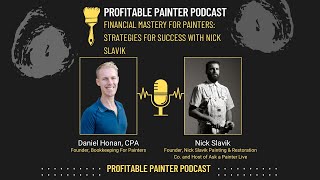
In this interview, CPA Daniel (founder of Bookkeeping for Painters) talks with seasoned painter‑owner Nick Slavik about the financial and operational fundamentals that drive profitability in residential and commercial painting businesses. They outline a set of core benchmarks—materials ≈15% of revenue, labor ≈40%, gross profit ≈45% and a production rate of $75+ per hour—explaining why these ratios matter more than a simple charge‑rate. The conversation moves to how to develop and refine production‑rate estimating, the role of unit‑price estimating, and the importance of gathering real job‑cost data to set market‑based prices. Fixed‑cost overhead categories (office, estimating, project management, shop, vehicles, insurance, marketing) are broken down, showing how they impact net profit and why gross‑profit versus net‑profit confusion is common. They then detail a simple, transparent compensation model: a solid base salary plus a 2‑3% bonus on the top‑line revenue of jobs that achieve ≥45% gross profit, applied uniformly to estimators, project managers, and salespeople. Hiring thresholds tied to revenue milestones (e.g., $400‑500K, $1M) are discussed, as are the progressive steps from sole‑proprietor to adding office staff, production managers, and estimators. Finally, they promote the Painting Contractors Association (PCA) as a hub for training, standards, and community support for painters seeking financial literacy and business growth.
Chapters
This is Daniel, the founder of Bookkeeping for Painters, and today I'm here with Nick Slavik. Nick Slavik is the proprietor of the Nick Slavik Painting and Restoration Company and is the host of Ask a Painter Live. Ask a Painter Live has aired weekly for over 8 years, instructing, answering questions, and championing the trades as an avenue for freedom. His company will celebrate its 17th anniversary this year, employs 40+ people, a leadership team, and operates a full-scale finishing shop. He has been a national and international speaker on topics such as entrepreneurship, craftspersonship, trades reformation, recruiting, harnessing technology for trades business, financial benchmarks, industry standards, and coding science. Uh, Nick has been a craftsman for over 32 years. His company has been awarded more than 17 awards for craftsmanship or the last 7 years, including massive restorations of Victorian mansions. He has created a rigorous apprenticeship program where he finds, trains, and inspires, mentors young people in the craft. Nick is currently the chairman of the board of directors for the PCA, the Painting Contractors Association. Welcome to the podcast, Nick.
Dude, thanks, man. It sounds impressive when you read it. That's awesome.
Yeah, well, it's, it's— I'm excited to have you on, on today because one of the things that you do really well on your Ask a Painter Live is go through like the numbers with folks. And that's a passion of mine. So I'm super excited to jump into things today.
Yeah. And I should warn you, you're a CPA, right?
Yes.
Yeah. So I am not. I took some college courses. I have two minors in it. I have this crazy working knowledge enough to know where my limits are. So I think it's going to be a good conversation.
I think you're selling yourself short. I've watched your, your videos, uh, Ask a Painter Live, and I mean, you're, you're nailing it. So, um, yeah, you, you have extensive experience, so, uh, I'm excited to jump into things. Um, so with that, you know, you've been in the industry for like 3 decades now, right? So do you have like some key financial metrics that you look at to make sure your business is at the right level of health or growth for your business?
Yeah, I literally think you can diagnose anything and I'd be up for— since you're the subject matter expert, please feel free to poke holes in any of this. I have a very rudimentary working day-to-day managerial accounting side of this, but I honestly think you give me any painting business, maybe not even painting business, maybe not even service business, maybe just any business, and you show me their job costing, what are the inputs it takes to make a dollar? And I can come up with some very quick diagnoses of what's going well and what's going wrong and then potentially even a path forward.
Mm-hmm. Yeah, it's usually gross profit is like the issue, but usually like when somebody comes to, you know, get that initial consultation, we'll take a look at their profit and loss. It's like, look at their gross profit. And if it's below average, there's probably a pricing issue. And so we kind of walk through, okay, how are you arriving at your prices that you're providing to your customers? And usually there's something off there, like 9 times out of 10.
Oh, listen, without seeing a residential painting company's financials, I'll tell you what's wrong. It's labor. And now it's— people always go over on labor. But like you said, it may not be that labor's taking too much time. It may be that you don't price enough So labor as a percentage of revenue is high. It could be that labor is slower, you haven't trained them well or led them well, but it's— it could be that price, or it could be a combination of both. And that's where the fun begins, right?
Yeah, absolutely. Um, so with that said, do you have any kind of numbers that you shoot for, for your charge rate? Or, uh, looking at the profit and loss, do you look for a certain percentage of revenue for, for your labor costs? Like What kind of numbers are you looking at for to make sure your business is on track or if you're diagnosing someone else's?
Oh, absolutely. This is, this is like the Holy Trinity. It's— well, it might be the Holy Quadrinity of numbers, which is material 15%, labor 40%, gross profit 45%, and charge rate. I get a production rate of $75 an hour plus. When people say charge rate, like when I see residential house painters talk about, well, I charge this, That is like, to me, it makes me irrationally angry. It like, it makes me clench my fist up. It doesn't matter what you charge, it matters what you produce. Because if you're 4 times slower than me, I can charge 4 times less than you and make the same amount of money. So for me, it's like I have this irrational pushback towards charge rate versus production rate. But I do understand that with production rate estimating and your charge rate, that is a way to come up with a number, but that's not what you're making.
We, we know that. Yeah. So just to recap the, the percentages you threw out there. So first was the materials, 15% of revenue.
Yep.
Um, and then we have the 40% for labor as a percentage of revenue. So let's just to take an example for anyone listening, like if you have a $10,000 home that you've charged the customer, you're looking for your labor to be about $4,000, your materials to be around $1,500. And so that's going to leave you with a gross profit after you pay for those direct costs of around $4,500. So that, that makes sense to me. That's definitely what we encourage our folks to shoot for, at least 45% gross profit. If you're under that, you're probably below average. Something's not right there.
And we should probably throw in that asterisk too. One person, single sole proprietor, 10 painters, 40 painters. The numbers might be different, not that much though. Once you get past, I don't know, you, I would be looking for a data point from you, which is once you get past about $400,000 or $500,000 in revenue, those numbers hold pretty true. When you're a single sole proprietor, the materials go up because most painters don't pay themselves, so they don't really have a revenue number. So then what the metric I start using is revenue generation per hour, if that's your sole proprietor. So, um, materials go higher, Labor usually doesn't get calculated when you're single sole proprietor, but once you have 3, 4, 5 painters, these numbers and benchmarks really do stick well, right?
Yeah, for sure. Like, if you're sole proprietor, you're the only one working on the job site. If you're looking at your profit and loss, you're not going to see a labor line item, uh, more than likely, unless you did something special there. So you'll just see—
it'd be nice to— it'd be nice to, at least in your job costing, allocate something for your own time. But certainly you're probably not paying yourself a W-2 check, right?
Yeah, so you could do some— if you're doing job costing like you said, you can definitely assign yourself the market rate of what you would have to pay someone else to do the same work. And then, then you in your job costing track your hours, multiply it by what you have to pay someone else, maybe add in some payroll burden there. And, and then so you'll know when you make your first hire, like you have the margins in there. And that's the whole thing with not just— was that—
yeah, you, you get used to seeing that number if you start treating yourself like an employee, right?
And then you can take that same idea further and, you know, for a production manager, for a salesperson, making sure you have the right margins built into your pricing so that when you bring these folks on, you already have the margins built in. Uh, so what, what I often tell folks is like, when you're when you're doing everything, you should be making the most money as a percentage of revenue. You should be making like 65+ percent of revenue should be going to you because you're doing everything. And then each percentage point is, you know, for different hats that you're wearing. So, and then as you take those hats off, those percentage points would be going to someone else. But yeah.
Dude, that's the best advice ever.
So, so we talked about production rates and the importance of production rates. This is often the root of what's going on. I think from what I've seen, why folks are not pricing correctly, they're maybe just doing a ballpark. But could you go through what production rates are? Why is it important, you know, to implement into your, into your painting business?
Oh yeah, no, absolutely. The one of the hallmarks, I think, um, of the 8 main steps to professionalizing your business that me and the PCA have come up with, I think literally step number 2 or 3 is a production-based, a production rate-based estimating thing. So you're not doing, you know, finger in the air, finger in the wind estimating. So production rate estimating is nothing more than How much square feet of wall can you paint in an hour? And then applying a charge rate to it so that when you go out to your next estimate, we know that we can do 223 feet, square feet of finished wall space inside a lived-in house every hour. And if you times that times your charge rate, at least $75, you can come up with a charge rate for that particular thing. So you're not constantly just guessing. Asterisk on that whole way of doing it. Now, having said this, I'm going to give you an asterisk and an exemption, but this is the way to do it. Like all big professional companies have this, and the bigger, the more you rely on this. If— asterisk— if you have a consistently producing labor force. If you have a whole bunch of people who've never done it before and a whole bunch of 20-year veterans and then a whole bunch of subcontractors and then a whole bunch of part-timers, not every person is going to produce the same. So you just have to be careful that in aggregate, when you job cost your jobs, you're hitting a total aggregated profit 'Cause some jobs might be here, some jobs might be here. You have to keep an eye on that because not everybody's going to paint the same in your company. We all know that. And that's one potential flaw you'll see in a production rate-based estimating system.
Yeah. One thing that when I recommend, you know, implementing production rates, sometimes folks don't know where to start. And I believe the PCA has a Volume 2 of the Estimating and Production Rate Volume 2, I think, has like a bunch of production rates that just given like average painter and someone took the time to actually go through all these different surfaces. Is that a good starting point or should I be recommending someone to go look somewhere else or should they be measuring like, you know, getting with their team and saying, okay, paint this fascia and I'm going to time you. What's like the best way to get started with production rates?
The best way to get started is the easy button thing, because one of the biggest— I'm sure you've seen this in your clients and business owners— where if there's a little bit of friction at the start, people hesitate or stumble when they go to start a new process. So honestly, if you go and buy— I think it's $120 maybe for this Part 1 and Part 2 estimating guide. Part 2 has all the tables from the PCA. They're probably not going to be perfect for your company, but my God, are they a good place to start. So literally, like, we'll spend $1,200 on a sprayer with nothing and then take pictures by it and be like, hey, look at this cool new toy I got. But sometimes we have a hard time investing $120 in something that will literally lay the foundation for all profitability and estimating for the next 20 years in our business. That's the easy button. And then the way to actually make it right is to use that as a starting point. And then you need to start measuring what you do in the field and comparing to that to see where the anomalies are. Are you faster? Are you slower? If you're consistently right or left of that, you have to consider why. Is there something you need to change, or is your rate or their rate the right one? Constantly looking at that.
Do you find— so in your company, I'm assuming you have a pretty good set of production rates for your team. Are you reevaluating those production rates? Like if the estimating looks off, are you going back or is your team about bottom-up refinement? Like, hey, I think your production rate is off on this. Or is there a process that you have in place to refine those production rates as as you implement them?
This is going to be the most unsatisfying, unhelpful thing I'll probably say all day, but we don't really use production rates outside of commercial painting. It's not that we never have. It's just that we are built on the decent human being theory where our company is basically built out of people who've never been in the trades before and our production rates are wild. I mean, as a, as a master craftsperson, I can produce $150 to $350 of revenue an hour. A brand new apprentice will produce $20 of revenue an hour. Now, having said that, what we do do is we've moved beyond production rate estimating into unit price estimating where we don't look at it as how many, how many linear feet of baseboard can we prep in an hour? What we do is we look back and we say when we price a $32,000 trim job based on the combinations of master craftspeople we put on it, the support they get and what we priced it. Was it profitable? If it's profitable, now we look at the unit price for what do we charge for passage doors, 6-foot-8 passage door, what do we charge for a casement window with a clad sash? What do we charge for the bedroom equivalent of baseboard, which is 150 linear feet? And we look at that in aggregate. So when people get started off, there is no better way than production rate-based estimating where you literally, you paint the walls in a bedroom, measure the room, measure the time, measure the revenue, and come up with how many square feet of wall. The problem is when I do that, of all my people, there could be 40 different production rates. And so when I take a step back from it, I just look at of all the wall projects we do, number one, we have to charge as much as we possibly can. We have to have a full schedule. And when we produce it, we have to be able to produce it profitably. For me, I actually come up with— that's what I would call a market rate based estimating system. And we do it by units because I honestly don't care anymore how much stucco my guys can paint outside. What I'm looking for in the market is for a 5,000-square-foot stucco home in the southwest suburbs of Minnesota. What's the most I can charge and still fill my schedule? And so we've taken one level of sophistication past that where we've aggregated our job costing, searched it and queried it by type of job. And if we see that 5,000-square-foot stucco homes are not profitable, we need to look to the processes and the painters. Or what we charge, and sometimes both, to change that. And I look at it in aggregate like that. So long-winded, potentially unsatisfying, but that's how I— sometimes you can get too close to the data, and sometimes when we have this many people doing this many wild things, we're too close. So I, in order to get a, um, an accurate estimating thing, I had to actually take a step back, glump up some of those things, and then look at it to make an accurate decision, if that makes sense.
Yeah, that's interesting. So you can actually have a database of what you've charged previously that you have your estimator or whoever's doing the pricing that they can actually refer. Okay, what have we charged in the past and did we win it? And then compare that to what the production rate. So it's like a, what can we charge successfully in the past and what the production rate would be and kind of figure out what the best price would be for this.
This time, even better. I am that— I am the AI of my company. I get fed very simple amounts of data. Well, maybe organic intelligence. I'm the OI and I get fed all this data. I track some very simple things. It's nothing more than some job costing and some pricing data. And then I come up with a price bible. And so it's not here's a span of things that we can charge. I go out and say, hey guys, for this summer season, We have 13 prototypical types of houses. These are the 13 price points for these houses. This is what an extra-large residential home with stucco looks like. If you're standing in front of this house, this is what we need to charge, give or take. And then you put in some modifications of lots of prep, lots of landscape and move it up and down 10%. But to me, I think people hyperfocus in too much on if only I have the perfect price for this project, I'll always be profitable, I'll sell every one. And honestly, our consumers are so irrational. We have sold the same house for $26,000 as we have for $12,000, and it was a mistake on our end. But that just tells you there's a huge irrationality. There's not a rational consumer out there who weighs all the things and then makes a good decision. So for us, it's more of like we need repetitions. We, we know what we need to charge to make sure that this company stays alive. But after that, now we have to price it as high as we can because that's what a good company does while still filling our schedule.
Mm-hmm. Yeah, it reminds me of folks that are doing commercial, like new— I'm sorry, new construction work. Very like same— they're in the same neighborhood. A lot of these neighborhoods, all the houses are the same, very similar floor plans. And there are folks coming out of that niche are often just doing square footage because that's what they're used to, where you just get square footage of a place and then, and then that's giving you your price, which you can— that can work because they're very similar houses, some similar floor plans. But to get to the, the true— I think to your point is to, to, um, to be able to do that, uh, abstraction of using the square footage of the house, you have to get to the source at least initially to understand what is all the surfaces and do the production rates initially to get a good foundation understanding of what it will take in terms of time for your team. And then once you kind of have a model for what that looks like, you can then apply it broadly with some discretion in there. Is that kind of— does that— am I repeating it back to you in the right manner?
I think so. And I'm going to attempt to do the same thing to you. You tell me if I understand correctly. We're starting a new process in my company. We're going after a very specific type of commercial job and we don't have a developed data set for it. So basically my instruction to my guys is, hey, what do we charge for square foot? It's like, number one, it's not up to us most of the time. These numbers already exist and we'll never know until we get data points. So I took my two estimators and I said, you guys need to drag me back something to chew on. I need some data points. So just get a yes. You systematically take your price down until people say yes. And then we get on site and we measure time, we measure area, we measure paint usage and revenue, and we start forming our data set. And so every yes, every job that we complete, we get a yes which says, okay, somebody thinks there's value in this. We job cost it to see if it's profitable. If it's yes and profitable, then we can start moving the price up until people say no. And then we can find the ceiling. We can also find the floor where we say yes and then we job cost it and it doesn't work. And then we start to find the bookends of it there. So it's that the best advice is you need data points. You're never going to guess what the right price is until you do a job, measure it all, track it, job cost it, and then figure it out from there.
Yeah, that makes sense. So for the listener, if you're not using production rates, start there. Then when you're— you've mastered that, then you can move on to, to seeing what the market can take by increasing your price. To see until you start getting nos and then, and then maybe back off the price a little bit. And so you keep getting yeses.
And it's, it's really interesting that now our painting standard operating procedures are beautiful and simple and perfect as long as the humans comply with them. For us, we focus less on getting the perfect price than to just getting more estimates out there. And I say this because if you have a unit based pricing process. If you walk into my house right here, we have a price per clad sash casement window. You don't need to measure these windows. We don't even measure walls anymore. We just say if it is a standard bedroom, plus or minus 10%, we charge this for walls, this for trim and other things. So now instead of an estimator sitting in a house and if you have a 5,000 square foot house and want ceiling, walls, trim, cabinet, everything painted in there, that could be a 5-hour estimate if you're measuring everything. For us, we go in there, we look at, we list the rooms, we count the doors, count the windows, baseboard equivalent. In 40 minutes, we can have a completely itemized estimate for the client. A year of doing that will actually win you more jobs than taking 5 hours per estimate. So there is this sort of meta discussion about, yes, you can hyperfocus on price, but at some point I tell my guys, if you have the choice of doing double the amount of time with each estimate or doing double the estimates, my guys will be like, you give me double the estimates. Because we close at 47% for time and eternal. And if you give me twice as many estimates, I'm going to bring back twice as many jobs. It's the price is only one consideration. And when somebody hires you, so.
Yeah, no, that's cool. Super interesting. Yeah, it's interesting to talk to people who do this on a high level because you always learn something new. I was just at this conversation. Plus, I was just at Jason Phillips. He had Contractor Freedom Summit, and very successful painting business out of Dallas, Texas. And, you know, they're doing $10 million plus per year. And he, you know, he shared with everybody, you know, the numbers that he's shooting for, and they're shooting for, you know, 65% gross profit margin, which is amazing. And the reason why they've been able to figure this out is the years of figuring out what the market can take in terms of pricing, dialing in that sales process. So, you know, when I think you and I are recommending the 45% to start off with, that's where you start, but you always, you know, work towards improving the business, improving the sales process, improving your production process so that you can command those higher gross profit margins.
Yeah. And with all those things too, Jason is one of the most rigorous contractors out there. You always have to put a couple of asterisks on, which is he does some carpentry, he does some home improvement. He's not exactly a res repaint 4700 thing. He's been in business for decades and decades. He's a very thoughtful guy. So it would, it would be your advice is best, which is start at a very good margin, but then keep your eye on those higher ones. But if, if next year I set out to get a 65% gross margin, all my people would quit because I'd have to ride them so hard going from 45 to 65 in one year. So you just have to be a little careful. And as entrepreneurs, sometimes we can be like, hell yeah, 65 is the new way, we're gonna do this. And if somebody— like, imagine your two project managers and two estimators every week do not hit their goals. Pretty soon they're just going to say, this stinks, I'm out of here, you know. So you got to be a little careful with that.
Oh yeah. Yeah. No, not a 45 to 65 jump, but definitely, you know, if you're at 45 now, maybe you can get it to 47 next year and kind of push it up and tweak it. And I'm sure that's how I don't, we didn't go into the details with Jason, but I'm sure, you know, he's, he's been in business for decades, so I'm sure that it was a per, a gradual process for him going through.
And he's a hell of a leader. Correct. If you want to get the most out of your people and take somebody from a 45 margin team to a 65, you got to be a special human like Jason. I mean, that— there's just no— you're not gonna spreadsheet that into existence. You need to be a, you know, a unique 1% leader too. Yes.
Yeah. All right, awesome. Um, cool. Well, let's shift gears a little bit. So I know we talked about job costing, production rates. Are there, uh, and we talked about kind of the, the key numbers for your— where you're looking at your profit and loss, like 15% for materials, 40% for labor, you're at least a 45% gross profit margin. Um, are there any other numbers or anything that you, you like to track in the business, or anything you want to dig into deeper, uh, or common mistakes that you might see painting businesses make that we could dig into further.
Oh, 100%. Here's the litany. We can list these off and we can dig in as far as deep and wide as you want in any of these. But those— the numbers we talked about, the material labor and the gross profit, those are only the variable expenses in your business. You draw a hard line under gross profit and now you have the fixed expenses. Those are— listen, a little bit of accounting terms from college that I remember. Those are about the only ones. So don't ask me any more questions about that. But, but when you get into the fixed expenses down below, that's basically people's overhead and some basic round metrics for residential painting contractors in the US are you're going to have project management, estimation, and then you're going to have all your stuff in there. And what I would consider the two big fixed expenses are going to be your leadership team. So you're going to have maybe 3, 3 to 5% for like office coordination, 5 to 7% for estimating, 5 to 7% for project management. And then you have, I don't know, somewhere between 10 and 15% for the rest of your overhead. And these are your shop, your vehicles, your insurance, your marketing. These are all going to be low single-digit numbers that just add up to somewhere between 8% and 15%, give or take. And yeah, that'll leave you with the most beautiful number on earth, net profit. And a lot of times people mistake gross profit with net profit. And it's a, it's a pretty tough discussion to have with some people sometimes.
Yeah. So a lot Uh, you got, you got to slow it down for the accounting. You're, you're, you're like speaking in zip files. Um, so let me, uh, I'm a little slower. Um, I'm an accountant, so let me, uh, go back. So you said 3 to 5% for office, so around 4% for office person, um, 5 to 7% for a production manager. And I think you said 5 to 7% for a salesperson too, right?
Yep.
Is that right? Okay, cool. Yeah, very— yeah. And then the rest of it, which was— was it about 10— another 10% for everything else? Was that right?
Yeah, you can, you can play around with these single-digit numbers, but in the end, my company goal is 15% true net. So that gives you about 30% to play with in overhead between coordination, estimating, project management, and then the stuff, you know, the shop, the vans, the—
yeah. Yeah, that makes sense. Okay. Yes. So, uh, and I agree with you on the, the confusion with gross profit and net profit. And there's also further confusion because some people will say margin, but they mean— some people are referring to gross profit margin, some people are referring to like a contribution margin where they're including production managers up above the line. So yeah, there's a lot of confusion for sure. So it's hard to communicate sometimes unless you're getting the definitions, you know, solidified between the people that are talking.
So how it was, how I learned to have to explain it to people is because I know just enough about accounting where I can, I can dwell in variable versus fixed expenses and understand that. But the easiest part is what costs are directly associated to a painting project versus ones that are direct— not directly associated. So when you think about paint and labor, they're called variable expenses because you don't incur them if you don't have work. You literally will not have a paint expense or labor expense if you have nothing on the schedule. But you will have van, shop, insurance, marketing. That's overhead whether you have jobs or not. That's on there. So that's how the industry seems to consume and digest that better when you say Paint and labor are direct costs for a job. The other stuff is in support of your company and that job, but not directly tied to it.
Yep, that makes sense. All right, so, um, one of the— so, you know, just looking, thinking through the progression of a painting business, you know, you initially, you're working on the job site, you're doing everything, and then you might bring on a crew or someone to help you. And so you're looking to basically, if you're getting off the brush, as they say, you know, you're looking to give away about 40% of your revenue to your team to produce the work. And so that's gonna obviously cut into what you're gonna be making, but hopefully you'll take that extra time and grow the business by focusing on sales and marketing. And then, so you'll need to have, in, in, at this point, I think folks can get to around between $500,000 and $1.5 million at the super high end, where they're just doing the production management, they're doing the sales themselves, and they have crews that are, uh, producing the work. And then at some point, they usually get an office manager in there, somewhere around $500,000 to a million. And so if you're looking for that first like office person to help you, you know, answer the phone, that kind of thing, you're looking at paying them around 4% of whatever your revenue is. So if you're doing $1 million in revenue, that's like $40,000 budgeted for them. And then so you have your office person hired and then maybe usually folks, I think from what I've seen, trying to hire a production manager or salesperson somewhere between $750K and $1.5 million. And again, you provided that 5 to 7% of revenue. So if you're at $1 million again and you need a production manager so that you can focus on sales, that around 6% of that would be $60,000. Do you, so that's the big picture budget, $60,000.
That's where those benchmarks come into play. When can I hire? When can I afford an estimator? Well, if you go by those benchmarks, $1 million will give you about $50,000 to $70,000 to play with, which is entry-level professional person.
Mm-hmm. Do you have any compensation packages that are— you think are good ones for a production manager? Maybe. Do you just like to do salary or do you like to have some sort of incentives tied to gross profit or maybe customer satisfaction. Do you have any thoughts on that?
Yeah, I've done all that. I have. So I love things that are simple, and especially when you deal with comp plans. I'm a true believer that a comp plan, whether it's for a painter or an owner or a project manager estimator, should be simple. It should be transparent and it should be predictable. So the, the worst things that I see my fellow business owners do is come up with all these cockamamie, complicated Rube Goldberg things where at this level you get this and then a percentage of this, but then at this level you get this and this. It can all work for the right personality. But most people, what you want is a comp plan where if they work really hard and get really good results, they get a bigger thing. And it should be a 1-to-1. If they felt like they killed it and they didn't get a very big reward, it doesn't matter if your comp plan's perfect, they're leaving you and they're going to feel not supported. So I believe I've come up with a super simple way to do this, to align all the core values of the company and align incentives. I pay the exact same bonus structure to my estimators and project managers so that we align their incentives. In my job costing, there are two columns. There's columns of jobs that hit 45% gross profit and columns that— of jobs that don't. And at the end of every quarter, every single person on my leadership team gets somewhere between 2 and 3% of all the revenue created by the good job costed job. So if every job that hit 45% GP gets over here, if it was a $10,000 job, they get somewhere between 2% and 3% of that job. And that's how we pay. Actually, I just finished my job costing for the quarter. I'm calculating their bonuses now and they directly feel that they know how many jobs they completed a week. They have access to the job costing and the bonuses go up when they do better. And it's total comp package. I like to start my team with a pretty hefty salary. Then we do benefits, company vehicle, health insurance, retirement, 4-day workweek, PTO, all that other stuff. And then I layer on a 2 to 3% bonus over that total comp. I want to push my people as close, if not over $100K apiece. And these are people who've never done this before.
Gotcha. And you probably said this and I missed it. 2 to 3% bonus of, of the job that, that was over of, of the, the top line, or is this of top line revenue?
Yeah. So this is, this isn't of the gross profit, this isn't of net profit. I'm a firm believer that people should be bonused on what they can control. My project managers and estimators control paint and they control labor, so they in fact should get a hold of the gross profit or the top line revenue. If I were to bonus my estimators on net profit of the company, they have no say in overhead. I could go out there and buy a brand new Ford Super Duty and say, hey guys, sorry, no net profit this year. And they'll be like, well, that was a unilateral decision. And in fact, you used all of our profit and our bonus money to buy a truck. I feel unsupported and I'm leaving. So I want them to have direct control. If like I have one project manager who literally is the, the cheapest paint buyer on the face of the planet, he meters out paint to within a 10th of a gallon on every job and he single-handedly has taken it from a 15% budget down to about a 9 or 10, and he's buying himself margin. If labor goes over 5%, he's under 10% on his material budget. He's, he's under 15%. He actually drives up jobs that if the, even if the labor goes over, he gets bonus on because he brought it up. And that's a winning org structure. He can unilaterally change his budget by being good at his job.
That's awesome.
Yeah.
Okay. Cool. So that's a very simple production manager bonus or compensation plan. So basically they have a salary and then you do job costing on every project. If it's over 45% gross profit, they get 2 or 3% of the revenue. And that's the same for your production manager and your salespeople as well.
So, yep.
Okay. So they have a base, base salary and if the gross profit's above 45%. Okay. Cool.
So what it creates is like, what's really interesting in the industry is that I don't know if you have found this too, but estimators and salespeople make way more than project managers. But for me, project manager is a way harder job. And so for me, it's like if I had to, if I had to choose, like if I knew nothing about this industry and decided comp plans, I would pay project managers or at least consider paying them a lot more. It's so much client interaction and it's where the relationship gets weird. But in the end, when you make a human soup of all these leadership team and coordinators and everything else and you put them all together, I love the favored nation sort of thing, which is everybody has basically the same comp plan. If somebody wins, we all win as a team because it starts with scope and price with estimator. It ends with material, client, and labor with project manager. They're all together and they're all looking at each other for support. And I feel like when you put it all together, I may have an oversimplified comp plan, but it is delightful to operate and our people love it.
Mm-hmm. Yeah, it seems like it would be very powerful when everyone is focused on getting the gross profit over 45%. So I'm sure that's a huge— if everyone's moving in the same direction, that's usually a good thing.
Hyper— and so honestly, and this is one of those things where I push back a little, but I am violently against a pure commission on sold revenue sort of thing because it just causes so much problems. Now, there are companies that I respect that do that sort of thing. But if I were to send one of my sales guys out there and say, you just get 5% of everything you sell, he's going to drag stuff back that we couldn't possibly produce profitably. And now my, my project manager is looking at me like, what do you want me to do with this? You know, if they're, if they're incentivized by gross profit. So you have to have those things aligned so you don't have a disaligned incentive like that.
Mm-hmm. That makes sense. Awesome. Cool. Well, You've been super generous with your time and this was, this was super awesome. Like going through the details of your thoughts on metrics and compensation plans. This is great. Is there anything that you like have asked for the audience or anything you have coming up that you like let folks know about?
Yeah, I do. I'm the board chair of the PCA. It's a 140-year-old nonprofit. I am literally talking to you because of this organization. Like, it's the great connector of humans. The reason I have a business that looks the way I do and I am sane at this point is because of the PCA, its education, its standards, and the humans there. So, uh, if you're wondering about training for painters, training for business owners, financial literacy, podcasts, events where you get together, and humans to help you, it's literally all at the PCA. And I know you're a big fan and supporter of the PCA, and I thank you for that. and you espouse our core values out there with us. And I would urge people that if you're feeling alone, if you're feeling like this is hard, if you're frustrated, if you're having those white-knuckle steering wheel moments in your driveway saying, what the hell did I get myself into? I've had those. You've probably had those too. And the people at the PCA are here to help. You're not alone in this thing. And I'm here today because of the humans in the PCA. So look up the Painting Contractors Association. We have some events this fall. We have training. Get out there and get connected. We're here for you.
Absolutely. Yeah, definitely check out the PCA if you haven't already. I know there's Women in Paint coming up in a couple of weeks. There's— next week. Yeah. Is it next week already?
Yeah. So there's probably going to be a delay in this putting out. Women in Paint was great, Daniel. It was awesome.
Yeah. Then we have the PCA Residential, PCA Commercial. So those are all great events. Awesome. Well, I appreciate your time today, Nick. I really— I learned a lot. So any last thoughts to leave anybody before we let you go today?
No, I was going to say I felt like me with a rudimentary knowledge of accounting and you with a deep, rigorous knowledge of accounting, I felt like we skipped over the waves of financials in contracting. And so anytime you want to take this conversation a little bit deeper, maybe even under the level of the water, I'm here for you because I love this just as much as I love the craft of painting.
I'm down for it. So let's do it. All right. All right. Have a good one, Nick.
More from Daniel







What’s REALLY Holding Your Painting Business Back? (Find Your Bottleneck in 5 Minutes)



