Financial Mastery for Painting Contractors: Insights from Bezos, Jobs, and Munger
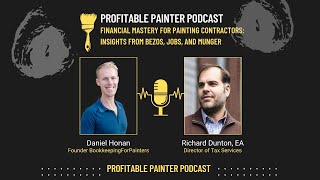
In this episode of the Profitable Painter Podcast, host Daniel (founder of Bookkeeping for Painters) and tax director Richard walk listeners through seven financial and business principles drawn from the biographies of iconic founders such as Jeff Bezos, Warren Buffett, John D. Rockefeller, Steve Jobs, Charlie Munger, Brad Jacobs, Walt Disney, James Dyson and Sam Walton. After a brief disclaimer that the show provides general guidance—not personalized advice—the duo explains each tip, illustrates it with a founder’s story, and translates the lesson into concrete actions for painting contractors (e.g., taking larger deposits, negotiating vendor terms, leveraging credit cards, adopting estimating software, focusing on a single core service, over‑paying for A‑players, and protecting the business entity and trademarks). The conversation is conversational and instructional, peppered with personal anecdotes about upcoming beach trips and reading habits. The episode ends with a recap of the seven tips and an invitation to discuss them further in the “Grow Your Painting Business” Facebook group.
Chapters
Welcome to the Profitable Painter Podcast. The mission of this podcast is simple: to help you navigate the financial and tax aspects of starting, running, and scaling a professional painting business. From the brushes and ladders to the spreadsheets and balance sheets, we've got you covered. But before we dive in, a quick word of caution: while we strive to provide accurate and up-to-date financial and tax information, nothing you hear on this podcast should be considered as financial advice specifically for you or your business. We're here to share general knowledge and experiences, not to replace the tailored advice you get from a professional financial advisor or tax consultant. We strongly recommend you seeking individualized advice before making any significant financial decision.
This is Daniel, the founder of Bookkeeping for Painters, and this is Richard, tax director.
How's it going today?
Oh, it's going good. Um, we're getting ready, we're going to be gone for a couple of weeks on vacation. So we're, we're excited, looking forward to a little bit of rest and relaxation. How about you, Daniel? We—
I'm not going for a couple of weeks, but we are going this weekend. We're going to the beach. That'll be nice. We're hitting up Clearwater Beach area in Florida. And so that's going to be a little bit of relaxation there. And then we're going to come back on Sunday evening. So, um, one of the things that I've been doing the last several months is reading a lot of biographies. And one of the things that keeps coming up is just different financial tips from founders like Steve Jobs, Sam Walton, Jeff Bezos, et cetera, et cetera. I thought it'd be cool for us to go through a list of some of the top recurring kind of financial advice from, from the founders coming out of these biographies.
Awesome. Now, is this all like, like beach reading? Are you going to take these books to the beach with you, or is this, uh, mostly—
Yeah, I, I will definitely, uh, be reading along every, every evening. I've been trying to do a book a week, so it's a pretty aggressive reading schedule. So yeah, definitely do some reading.
Well, I love the idea of learning from what other people have already figured out. And, you know, certainly the people you mentioned are those who are doing something right. They've got something figured out. So cool. I'm excited. Let's, let's jump in and figure out what we can learn from, from these financial gurus.
Yeah. So we got 7. Financial tips. The first one is focusing on cash flow management. So this one, a lot of them do this, but I'm just going to take a couple highlights. First one being Jeff Bezos. He's big on something called free cash flow. Uh, one of the kind of weird things with Amazon in the beginning especially, they didn't really show a profit. They were losing their negative income for this first several years. And that concerned a lot of investors initially, but Jeff Bezos has this thing about cash flow. So even though they're showing negative income, they're actually positive on the cash flow, on the, on operating cash flow. And the way they were doing this is, you know, you go on Amazon, you buy whatever you want to buy, so they get the money right away from you, the customer, and then they have vendor agreements where they, they have favorable terms, so they don't have to purchase the— give the money to the person that posted their, their item on Amazon for a little bit longer. So there's a gap where they get the money, they have it for operating use, and then they pay their, their vendors later. So they had a positive cash flow business that, um, you know, could sustain having negative income. So they didn't show any income, but they, they're positive on cash flow. And this is something that, as having a painting business, you can take the same idea, making sure you're taking deposits on the jobs that you're doing. You know, well, all our clients, a lot of them are doing 50, uh, deposit, 50% down to get on the schedule Obviously there's some rules, like California, there's a limitation, you can only take $100 as a deposit, but you can still use that same idea and then do like a progress payment like as soon as you start the job. So you get that cash flow coming in as quick as possible, and that's going to really help you. I think a lot of people underestimate how, how much that can impact the cash flow in your business. You're getting money, uh, quickly in, that will help you meet payroll a lot easier. Um, and, and just a lot of worry will go away once you start taking a higher deposit.
Yeah, trying to keep that AR, accounts receivable, as low as possible, uh, getting paid up front. I love it. And then there's the opposite side of that too, right? Because you mentioned that Amazon was getting paid up front, but then they were also negotiating favorable terms with their vendors so they wouldn't have to pay their expenses right away. I know some of our clients have been able to do that with like their Sherwin-Williams or their Benjamin Moore accounts. They may have like 30-day or 45-day terms where they don't have to pay for the materials until a month or 2 months later. And that again opens up that cash flow for things that can't be pushed off like, like payroll. If you don't pay your employees for 30 days, you're probably not going to have any employees Uh, so it's about prioritizing how you spend your cash.
Yeah, a good point. Using those vendor credit lines with Sherwin-Williams or Benjamin Moore, they give you 30 days interest-free. And then if you— a pro tip— if you want to even extend that even longer, you could use your business credit card to pay down the Sherwin-Williams balance and then get another 30 days interest-free. So you get up to 60 days interest-free on your materials if you stack that credit.
But it's like the Russian nesting dolls of credit. We just keep pushing it onto one card, onto one card.
Yeah, exactly. And that can make a big difference in your cash flow, you know, not having to pay that big Sherwin-Williams bill, especially if the longer-term projects that will really help.
Awesome.
The next one is maintaining a long-term perspective. So instead of focusing just on the short-term profits, think of, think of the, have a long-term perspective for your business. And so this, this idea comes from Warren Buffett. You know, he's, he invests with a long-term strategy. And he has a long-term perspective on building wealth. And I think that idea can be translated into your painting business by, you know, not being so caught up in the short term. Because you should be, when you start a business, you should have a long-term perspective. It's hard to start a business and get quick success. I think a lot of people have that like, how do I make money fast or easy? Fast and easy is not really a— in reality, it often does not work like that. So I think just having a longer-term perspective, and I think Alex Hormozi, uh, he's a, um, owns acquisition.com. I think he talks about this a lot as well, where you want to, um, he says something to the fact of when you talk to folks that make, you know, millions of dollars or billions of dollars, the longer timelines they talk about, you can kind of tell with the way they speak. If they're talking in terms of decades, they're usually a higher wealth person than someone that speaks in like months or years. So if they're— if you— so it's almost like a mind shift, a mind shift. If you think, zoom out, it's like, hey, I'm going to start a painting business and over the next 20, 30 years I'm going to dominate this, you know, my territory, my city, whatever, this region. You're more likely to have success than if you're like, hey, over the next 12 months I'm going to try to hit, you know, $200,000. And that's like my big goal. Like, having that different mindset where you're focused on the long term and that, that will help inform your decisions over time to focus on brand and quality instead of just making the quick buck.
Yeah, I like, you know, you mentioned Warren Buffett and I thought it was interesting because I believe Buffett kind of had to learn this himself and he had to have a mind shift or mindset shift. You know, when he was first investing, I know he talked about looking for what he called cigar butts, like companies that, you know, just have a little one or two puffs left in them that he can get for next to nothing. And it was his partnership with Charlie Munger when he started to think a little bit differently. And Munger would tell him like, hey, it's okay to pay a fair price if it's a great business because we're not looking for that cigar butt with the one or two puffs. We're looking for something that's going to last. For decades. And so I think it's cool how he kind of changed his thinking on that, and obviously it's, it's been for the better. Uh, you know, the idea of get rich slowly, it's not quite as sexy as get rich quick, but it's a lot more attainable, and you have a much higher chance of actually doing it. So there's nothing wrong with, with getting rich slowly.
Yes. Yeah, that's a good point. Um, The next one here is be frugal within controlling your costs. So an example here is Rockefeller. He actually started out as a bookkeeper. That was his first job. And so, uh, but he, he went, went on and ended up just dominating the oil industry. And, uh, and then I think Theodore Roosevelt had to end— ended up breaking— requiring him to broken up his, his, uh, entity that he created, uh, Standard Oil. And, uh, but he, he just completely dominated that industry. And he was very big picture oriented, um, but at the same time he was very frugal. And like, he, he would take huge risks with debt, um, getting financing from banks. We would just take on a whole bunch of debt and make a big bet on a certain thing. But at the same time, he was also super, super frugal. So it was a weird dichotomy he had going on where he was willing to make big bets on himself, on accomplishing great things. But at the same time, he was a penny pincher. Like, he really looked over his costs. He came from that bookkeeping background and looking at ways to cut costs. So he had, he had an interesting dichotomy going there where he was taking huge risks, but also at the same time really paying attention to those details and those costs. And that's something obviously all of us can, can learn from is, is, you know, willing to bet big on ourselves and what we're trying to accomplish, but at the same time, pay attention to the details because you don't want to, you know, die from 1,000 or 1 million paper cuts, you know. So you got to, you got to pay attention to your costs.
Yeah, I think especially as your business is growing and scaling, it becomes important to do that. You know, when you're small, a $10,000 expense might be 10% of your revenue. You're going to notice that. You're going to be very careful about that. But, you know, when you're big, that same $10,000 might only be 1% or less than 1%. So it's easy to kind of like not really worry about it, right? Because we've got all this revenue coming in. But, you know, $10,000 is $10,000. And like you mentioned, Daniel, you get enough of these little paper cuts and all of a sudden your, your profit margins are going down and you've got money coming in. Top line revenue is great, but your bottom line profit isn't. And that's where, you know, businesses live and die. So, you know, you don't have to be Scrooge McDuck, but— or Ebenezer Scrooge is probably a Yeah, I don't know if we're gonna talk about Walt Disney today or not, but I'll leave that one out. But, uh, but yeah, I mean, keep an eye. Are we overspending on certain things? Do we have unnecessary subscriptions of software that we're not using anymore? Have we become too loose on our time tracking? So, you know, things are slipping through the cracks. Uh, that's, you know, there's a lot of, of, uh, expense that can be avoided if, if we just kind of pay attention.
Yep, absolutely. All right, going to the next one is embracing innovation. So not being afraid to invest in innovation to stay ahead of the competition. A good example of this is when Steve Jobs came back to Apple in the late '90s. So obviously Steve Jobs founded, uh, Apple, was it back in the late '70s? I think it was. And then he, he got kicked out as CEO and he went and started Pixar, became a billionaire. And during when he was gone, Apple basically went downhill really fast. They stopped innovating. They had really crappy products. They had a bunch of products, first of all, a bunch of products that nobody— and just losing market share. Nobody liked them. I remember when I was a kid, we had a Macintosh and it was like from 1994 and it was just, it was a, it was a piece of crap. I mean, and then, then Steve Jobs came back in, was it '97, '98 and back as the CEO and he basically looked at what products Apple was selling and they had like 20 different products and he, and he was like, so asking basic questions like, why do I buy this one versus this computer versus that computer? And like nobody can give him like an easy answer on why one versus the other. And he was like, okay, we're getting rid of all these products and we're doing 4 things. You know, we're doing 4 different products. We're doing the mobile product and then the desktop product for Pro and for And he like, for like the standard user and the pro user or something like that. And so he really dialed in the products and then he also focused heavily on innovating. And this is when, when he came back, that's when they did the iPad, or I'm sorry, the iPod, iPhone, and iPad in that succession and just started dominating those industries and grabbing huge amounts of market share during this period. And so He was really focused on innovation. So I think we can apply the same idea into our painting businesses. If you just think about all the changes that have had, that have occurred over the last just short period of years in, in forms of, uh, technology. And if you can take that technology and implement it into your business to make your, your experience better for your customers, that's going to put you ahead of the competition that are just kind of resting on their laurels or Maybe they're, they feel they're too big to make those changes. Really taking the new technology that's coming out, it seems like every day at this point, and implement it and implementing it into your business and creating that unique and great experience in your business can, can get you, you know, more, more business, more market share and, and set you up for the long term.
Yeah, I was thinking of some examples. I've seen, you know, painting business owners invest in new CSMs where potential clients are getting text messages, emails within seconds of filling out their contact form. They're making it very easy for people to pay through like online portals. They're using estimating software that, you know, not only accurately estimates the project, but also presents a really nice presentation to the client. Some of them are even, you know, printing it right there inside their van and presenting the proposal to the client before they leave the house. And it's just, it's just different ways of leveraging technology and innovation to give that incredible customer experience. You know, get that speed to lead, help them make that decision so that you don't lose the, the prospect. And these are all things that we couldn't do maybe 10 years ago because the technology didn't exist. So, you know, the word of caution on that is don't get shiny object syndrome and go out and buy everything out there. But if you can see something that can be leveraged and used well in your business to, to improve in these areas, don't be afraid to embrace that because that's going to set you apart from everybody else. And if you're just doing what everybody else is doing, then there's really no reason for someone to choose your business over the other guy. But if you can set yourself apart through a better experience, that's going to help you get more market share.
Yeah. Yeah. And our next one is kind of to your point about not getting shiny object syndrome. Our next one is don't put your— go ahead and put your eggs in one basket and then watch that basket very closely, which is— might be counter from what you've heard in terms of some of the advice is you know, don't put your eggs all in one basket. This advice is exactly the opposite. Put all your eggs in one basket and watch that basket very closely. This is from Charlie Munger, an idea from Charlie Munger where the idea is basically to make wealth, to get wealthy, you need to focus on one thing and do it for a long period of time, be really good at it. And that's how you build your wealth. Uh, once you're really wealthy, then you can diversify to protect the wealth that you have. But to actually get wealthy, um, you, you need to focus on one thing and do it really well for a long period of time. And so that's, that's the investing, um, approach that Charlie Munger and Warren Buffett take. But that, that can definitely apply to your painting business. So I see this happen a lot where painting business starts out, they start doing well over a few years, but then they kind of get— I don't know if it's bored or they get shiny object syndrome where they see, oh, I could do this other thing because I'm— I've been doing so well in my painting business, I'll jump into this completely other different venture and then split my attention. And now I'm doing two things instead of doing one thing really good. Now I'm doing two things, you know, Okay. And now I'm making less money. So I just see that happen over and over again where, you know, and it's, I've done it myself as well, like where I go off and start doing something else and then realize I need to just focus on one thing. Because it's almost a little bit arrogant to think that you can do multiple things better than other people who are doing one thing. Like just think of your competition in your city. Like you, your painting business in Orlando, Florida, there's probably dozens of other painting businesses in Orlando. So, uh, if you're running a painting business and also, um, you know, have a, an, a donut shop or whatever, something else going on, what's the likelihood that you're gonna be running a better painting business than someone who is just running a painting business? And that's That's their sole focus. You know, so I think people, you know, don't realize that and don't think of it that way. So I think per Charlie Munger, putting your eggs in one basket, watch it closely to build that wealth. And then once you're super wealthy and maybe heading into retirement or something like that, then you can start diversifying and then like, you know, protecting that well so it can be you know, um, support you in retirement and then pass it on to your, to your children or whatever you want to do.
Yeah, I kind of think of it as being like an inch wide but a mile deep. And you don't know everything, but you only know a few things, but you know those few things so well and you do them so well that when people are looking for for a residential house painter, you're the person because you know it better than everybody else. Uh, so yeah, I, I think that is good advice, especially when it comes to the, like, the operations side, uh, when it comes to the business side. Uh, I would say that if, if you're interested in diversifying, if you're interested in these other things, you can maybe passively invest in some of these things, either through, like, like buying stocks or making passive investments in, in other companies when you have the money, that can be a part of your overall financial plan. But I like what you're saying, Daniel, about don't, don't get your attention distracted. Like, focus on what you know how to do and become an absolute expert on it. And that's what's going to earn you the most over the long, the long run.
Mm-hmm. Yep. And the next one is overpaying for top talent. So this is an idea that comes up over and over again. It's probably maybe one of the more important ones on this list is you need to have a really strong team. At one point, Steve Jobs was talking about like startups. I think it was during an interview I saw on YouTube or something like that. But he was saying, like, when you're a small company, having the best people is even more important than when you're a larger company. Because when you're just starting up, let's say you have 4 people, you and 3 other people. Well, each of those employees is like 25% of the company, especially for service. If you're providing a service, they're doing 20% of the— 25% of the work. And so the, the, your customer is experiencing, you know, 25% of their experience is coming from that employee, the quality of their work. So if you have 2 bad employees of the 4, that's gonna be a really bad experience that your customers are gonna experience, or even just 1 of the 4, that's a huge proportion of your employees. 25% of your employees is, are, are not any good. So, you, so thinking of each employee, especially when you're smaller, but even when you get larger, Steve Jobs also talks about the bozo effect, that if you get, start getting like poor quality people in your organization, those poor quality people, when they are in management, they're going to hire even poorer quality people. So, then you have an abozo explosion is what he calls it. So Brad Jacobs, he is the founder of United Rentals and several other billion-dollar companies. He just says that you should overpay for talent, for top talent. And he puts overpay in quotation marks, like, because he doesn't really think you're overpaying for top talent. Like if for A-players, like folks that are just killing it and you have complete trust in what they're doing, it's hard to overpay them because they're usually, you know, Pareto's law is 20% of the population is going to give you 80% of your results. So your top employees, the top 20% of your employees are probably doing 80% of giving you 80% of the results, like 80% of the word of mouth referrals or whatever you know, your metric you want to use. So he, he really thinks that you can't really overpay your top, your top talent, your key employees, because they're the ones that are really driving the company forward. Um, he also has a really cool thought experiment that I've, I've talked about on the podcast before, but it's the A player, B player, and C player thought experiment. Uh, and I know you've heard me talk about it several times, Richard, So, um, at the risk of being, being redundant, um, I'm gonna do it again. So he says that A-player is, uh, if you do the slot experiment, you, you imagine one of your employees comes into your office and says, I'm quitting. Just evaluate what your emotional reaction would be to that person telling you that they're quitting. Um, an A-player, your reaction would be something like complete panic and wondering what, what happened. And, you know, having extreme dread that you won't be able to ever find another person that will be able to replace them or do as good a job as them. So that's an A player. A B player would be like, oh, that, that really sucks. This is gonna be very disruptive over the next month or two. I'm gonna have to find somebody else. I probably, I might be able to find somebody better. That's a B player. A C player is, okay, that's fine, I was gonna fire you anyways. So that's a good framework to use for A, B, and C players. But for those A players, you know, the advice that I've seen again and again in these biographies is don't be afraid to overpay for that talent.
Yeah, don't quibble over a few thousand dollars or even if, you know, a few tens of thousands of dollars when this person is responsible for bringing in, 10, 20 times as much revenue into the company. The risk of losing them is too great to worry about, you know, quibbling over a few thousand dollars. So no, that's really good advice. I like how it focuses on the fact that people are really the secret sauce in the business. You know, customers want to work with people, not corporations. So your branding might be on point, your operations might be tight, but if you don't have the right people in the right places, it's not gonna work. So once you, once you find that A-player and you're building your team around them, do what it takes within reason to hold on to them because there's probably nothing more valuable than, than a good employee who can, who can really you know, put forward your vision and please your customers and get those repeat referrals time and time again.
Mm-hmm. All right. And so for the last, the last one here is maintaining control of your entity and maintaining control of your intellectual property. And so this is a mistake that I see that folks like Walt Disney, James Dyson, Sam Walton, they've made this mistake. And it's again and again and again losing control of their— the entity that they initially started or the intellectual property that they have. And, um, this is a little bit related to financial, not quite as straightforward financial, but, uh, more, more maybe legal, uh, oriented tip here. The, the, the— so just to go through some of the anecdotes, so Walt Disney, his first company was Laugh-O-Grams before he started Walt Disney Company, and he ended up losing that company. It's all— all employees left him, and they took his intellectual properties, the characters that he had created, and they basically went around him and started doing their own thing. And so he lost that company, went bankrupt. James Dyson, the first company he started— and this is Dyson, the ones that did the, the vacuum cleaner and a bunch of other inventions, but his first company, he did a, a ballbarrow instead of a wheelbarrow. And he started it with some folks. He lost control of the company, became a minority shareholder, and he put the patent in the company. So the thing that he actually invented was in the company, not in his name. And so he ended up losing control of the business and then he got kicked out. And so he lost that, that business and that, that invention that he made and years off of his life doing that. And then Sam Walton is— oh, go ahead.
Oh, and that's why I always tell my tax planning clients, we do not put extremely valuable assets in your S corp because you are not your S corp. And you want to hold on to these things. So if you have a patent or a piece of property or something that you want to hold on to long term, make sure that you have control of that and not the corporation.
But yeah. And then the last anecdote is Sam Walton, his first retail business. He, he, the terms of the lease, basically the, the the lease owner pulled the rug out from underneath them and said, oh, you can't renew your lease. And so, and they started their own store because they saw that Sam Walton store was, was like super successful. And so they're like, okay, you can't renew your lease, and now we're going to do our own store in the same location and basically kind of take your customers. So, um, he didn't, he didn't look into the details on that lease, and, uh And he wasn't really, he didn't have any, he had to start over again, basically. So, um, so the takeaway for painting business owners is one, you want to maintain control of your entity, making sure your operating agreement is tight, especially if you have partners, if you're bringing in people that you have your lawyer look it over and it's meeting your intent and you're not giving up control of your entity. Also intellectual property, you mentioned patents, but also trademarks, like your business name, your brand. You know, it would suck to, if you had Bob's Painting for 30 years and you built up this huge brand in this, your local, your local town or city, And then, then you get a, um, a cease and desist letter for using Bob's painting because there's already a trademark on it. Somebody else created a trademark and they're challenging you and you don't— you never got a trademark on it. And so now you've lost that, all that branding you've been doing for the last 30 years. So that's just like a simple thing for, for branding, which is, which is important for, for painting businesses, making sure you have that trademark. Submitted for your company so you can't get— so you can maintain control of it. You don't lose that, right?
I think the Walt Disney Company definitely learned that lesson. I mean, just try showing a Disney movie and collecting $5 a ticket for a fundraiser. And if you'd like to see what a cease and desist letter looks like from Disney's lawyers, you'll get one pretty quickly. They are hardcore about protecting their brand. And their IP.
Wow. That— I didn't, I didn't know. Uh, so is that something that you saw firsthand happen?
Yeah, it's been so, so not to, uh, not to get too off tangent, but, um, there's been a lot of like schools, daycares, things like that who have tried to do fundraising by maybe showcasing a Disney movie. Or, you know, using Disney's intellectual property in their artwork or murals. And, you know, they're doing this without permission from the company. And Disney's legal team is very quick to send out cease and desist letters. I mean, Disney licenses its stuff constantly, but everything is licensed and approved, and they get their royalty on it. So yeah, that's kind of been in the news, you know, just not using somebody else's intellectual property without permission. Yeah, but you can see, see why they're so aggressive about it.
Yeah. Well, well, those are the 7 tips. And just to recap, you know, focus on cash flow, make sure you have positive cash flow coming in at all times. Maintaining a long-term perspective, you know, don't just be worried about the short term, take a longer view of your business. Make sure, uh, number 3, be frugal, cut your costs when possible. 4, embrace innovation, invest in your company and make sure your company is, is staying ahead of the game as far as technology goes. Number 5, uh, put your eggs in one basket and watch it closely. Number 6, overpay for top talent. And number 7, maintain control of your entity and your intellectual property. And I'd love to hear your thoughts on, on these financial tips from, from top founders. You can head over to our Facebook group, Grow Your Painting Business, and join in the conversation. And with that, we will see you next week.
Yeah, thanks for listening, everyone.
More from Daniel







What’s REALLY Holding Your Painting Business Back? (Find Your Bottleneck in 5 Minutes)



