Hard Decisions and Hiring Right: Scaling Your Painting Business
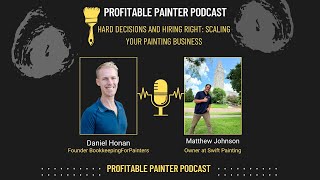
Matthew Johnson grew his Baton Rouge painting company from $200K in 2020 to a projected $1.5-$1.8M in 2024 by building a team, delegating work, and investing in paid coaching. He emphasizes hiring and firing fast, following systems like those from Brian Diamond's Contractor Life Academy, and sticking to one marketing channel until it works.
Chapters
Welcome to the Profitable Painter Podcast. The mission of this podcast is simple: to help you navigate the financial and tax aspects of starting, running, and scaling a professional painting business. From the brushes and ladders to the spreadsheets and balance sheets, we've got you covered. But before we dive in, a quick word of caution. While we strive to provide accurate and up-to-date financial and tax information, nothing you hear on this podcast should be considered as financial advice specifically for you or your business. We're here to share general knowledge and experiences, not to replace the tailored advice you get from a professional financial advisor or tax consultant. We strongly recommend you seeking individualized advice before making any significant financial decision.
Welcome to the Profitable Painter Podcast, the show where painting contractors learn how to boost profits, cut taxes, and build a business that works for them. I'm your host, Daniel Honan, CPA, former painting business owner, and your guide to mastering the numbers that drive success. So let's dive in. And make your business more profitable one episode at a time. Today I am super excited to talk with Matthew Johnson out of Louisiana. He's built an amazing business over there, so we're going to dive into things with him today. Welcome to the podcast, Matthew. How's it going?
Thanks, man. Appreciate it. Uh, things, things going pretty well down here. It's getting, getting a little toasty outside, but that's a perfect, perfect time of the year for exterior painting, so, uh, we're staying busy.
Yeah, whenever I think of Louisiana, I mean, I live in Orlando, so like the weather is always, you know, hot here, which I don't mind. But Louisiana, man, it's just a different level of humidity there.
Oh dude, you're preaching to the choir. It's like when you step out of the New Orleans Louis Armstrong Airport, I've had people say it's like you have a hot wet blanket over you, like immediately.
Yeah, yeah, it brings me back to, uh, I was, I went, I was in the military, Fort Polk, Louisiana. I was there for a while, and the, the weather and the mud, it was just, it wasn't, it was intense for a while there.
I was gonna say, I was gonna say, like, uh, yeah, Fort Polk, I, I actually went over there. We actually looked at some projects over there, and like, that is in the middle of nowhere. Yes, it's like there's nothing, there's nothing over there.
Yeah, out in the middle of the woods. Cool. Well, I'm excited to dive into things today, uh, Matthew. So could you kind of give listeners a perspective of where you're coming from?
What—
how did you get started in the painting industry? What have— what's your journey been like? What are some major milestones that you've hit along the way?
Yeah, so, um, I'm obviously born and raised here in Baton Rouge, Louisiana, right outside of New Orleans. Uh, that's the easiest way to kind of help locate us, you know, in their mind. Uh, Baton Rouge, uh, it's a very large metropolitan area for Louisiana. Um, basically, uh, from the time I was a teenager, uh, my family, my upbringing— I, I grew up in church, Christian background, faith-based. Uh, my dad was in full-time ministry. He was a minister. Um, we grew up, you know, in that type of household. I was homeschooled. I come from a big family. I have 6 sisters no brothers, uh, so that was cool. That was a fun little upbringing. Uh, early on we did a lot of work like renovations, remodels, things like that, because we transitioned. We didn't just move houses. I was about 14. We moved houses and we moved churches, and we were renovating both. So we were renovating our new house on top of renovating the new church that we were going to that my dad was taking over as pastor. Um, so basically my mom and dad looking at an able-bodied 14-year-old and they said, here's a brush and roller, get to work, dummy. So that's how, that was my introduction to the painting industry was like, get to work, you know? And I naturally just kind of picked it up. My very first job, like actual job that I got paid for was kind of a funny story. We're sitting at a little local restaurant here in Livingston. Livingston is technically where we live. It's right outside of Baton Rouge. We're sitting here, And Miss Jeralyn Taylor, she walked up to the table. She's like, do y'all know anybody that paints? And my dad just looks at me and goes, he does. And I'm like, no, I don't. So I was like, what are you talking about, Dad? I was like, I've never, you know. So I made a whopping $500 on my first job ever at 15. I mean, I thought I could retire, man. Like, I had made my $500. I was like, man, I'm set. I'm set for life. I was good, man. So I just kind of did it on the side in high school, just through the years in high school. Didn't know what I really wanted to do with my life, obviously, what, what 18-year-old does. But at 18, around the 2016 flood, like Baton Rouge, this whole area, I don't know if you're familiar with that catastrophe, but like the flood down here in 2016, it was just horrible, just devastating. Thousands of homes just completely flooded, just ruined. Um, so it was a boom in the construction industry there, obviously, with painters and roofers and, you know, sheetrock draw wallers, you know. So it's just a huge boom there, uh, in 2016. I myself personally, I just printed out little business cards that said Matthew Johnson, 225-363— I'm not gonna put my phone number out, but anyway, uh, but just went out and handed those cards out. And I myself, I painted like 8 houses during that time. So my introduction to the painting industry was very hands-on, very school of hard knocks. And that's not even what I wanted to do. Like, I really didn't know what I wanted to do. I thought I was going to go into like communications, maybe like broadcasting or something like that. You know, I got the hair to do it, you know, so, you know, but the smile, you know, the smile and the hair to do that. But I thought I was going to go into something like that. I went to college for one semester. Worked a normal job for 4 months at Hobby Lobby. It was literally the worst 4 months of my life. So worked a regular job, worked, went to college for a whole semester and said, screw all that, not doing that. And so I decided to, decided just to start my painting business because I figured that was the only thing I was good at at that time. So, you know, maybe I'll just do this little painting business thing for a little while and then move on to the next thing. So that was when I was 19 and I'll be 27 at the end of this year. So 7 years later, here we are. So yeah, so from there, 2020 is where I really like formed the LLC, started hiring people, really started to go hard. It wasn't just me anymore. Like I started hiring people, getting crews, started to, you know, got a marketing guy, started, started to put some things together. And like, I kind of ran into different people like Bookkeeping for Painters, APPC, Academy for Professional Painting Contractors, Painting Business Pro with Eric Barstow. Eventually I got hooked up with Brian Diamond. I don't know if you know Brian Diamond with Contractor Life Academy, but got hooked up with him about in 2023. So that those are like the programs and like the different communities that I came in touch with. And so those were all helpful, those, those different things there. But essentially 2020, we did about $200,000 in sales, which I thought was crazy. Like I just thought that was like, oh my God, just unbelievable. Did about— and that's our first year and that was 2020, that was COVID. And I technically didn't get completely like full-fledged started until March. So we technically did $200K in like 9 months. So it was not, not terrible. I mean, dude, I'm 21 years old, 20 years old at the time. It's kind of, you know, kind of crazy, you know. But so yeah, 2021. Yeah, I was 21, having a business, starting a business like that. 2022, 2021, we did $800,000 in sales. And then 2022, we did a million. 2023, we dipped a little bit. We did right under a million, I think, because I got sick. I was literally sick for like 2 months. Like I had mono, was hospitalized for like a week. It was like, it was terrible, terrible, terrible time, terrible time in the business. Um, a lot of, I could tell you a whole story with that. Um, but then 2024, I started to really assemble our team. Uh, so I have a, uh, operations manager over production, a project manager, a marketing coordinator, which is a sales rep. Our marketing coordinator started to build the sales team. And now I have a client experience specialist, which is our lead handler. So 2024, we did 1.2, 1.1. And then this year we're on track to do 1.5, 1.8 this year as of right now. Just because of kind of a little, we had like a really weird month in April where it was just abysmal with sales. And we were kind of transitioning through some different hires, so I was kind of switching some things up. But yeah, our trajectory, we were at a run rate of like $2 million for this year.
Nice. That's awesome. That's, that's a pretty incredible journey. And so it sounds like you're starting to get things dialed in for as far as those key positions. So you said you had a— right now you have a project manager.
Uh, ops manager, uh, salesperson, uh, and then a lead handler.
Okay. And the lead handler is basically when you, what type of market outbound, uh, are you doing outbound marketing or like door to door or Facebook ads? Like what type of?
Yeah. So I'll work with, uh, Ricky, uh, at Homeowner Marketers. Uh, work with him. He does all of our Facebook ads and our Google SEO. Um, so like our majority of our leads, uh, other than our brand ambassador program and like our referral program, um, majority of our leads come from Google and Facebook right now. Uh, we don't really haven't diversified our marketing channels yet. Um, we're just really trying to dial in the team right now and like just financials and team and, and then we'll start to diversify a little bit.
Gotcha. So your lead handler's doing the speed to lead for those Facebook and then just making sure that, you know, the inbound calls are getting answered. And then your ops is managing the crews and then salesperson's closing the deals, right?
Yeah.
Yeah. Okay, awesome. So you have a pretty good— sounds like you have a pretty good team set up, you know, and you're on track to do $1.8 million this year, which is amazing.
Yeah.
So tell me, tell me about how you, you went from, you know, basically just painting houses on your own, you know, just by yourself, to, to building, you know, what sounds like a pretty, pretty great, pretty great team. And you're, you're almost about on the verge of doing multiple millions.
Yeah. Um, that transition was pretty difficult. If I'm going to be completely transparent and honest, there was a lot of hiccups, a lot of learning curve. If I could go back, I'll say it like this. If I could go back, I would have invested more money in things that really made a difference in the business. Like maybe taking not just the Painting Business Pro basic course, but like get some coaching, really get things set up, maybe like Breakthrough Academy or find somebody like Brian Diamond a lot sooner and get that coaching, that business coaching. If I could go back, if I could go back, I would have invested money and time into stuff that really made a difference rather than stuff that I thought, oh, I'm gonna try this little marketing thing, oh, I'm gonna get the vehicle wrap, oh, I'm gonna go do this, or oh, I'm gonna try this, and oh, I'm— all that stuff really, they were time-consuming activities but they weren't revenue-generating activities.
Yeah, I think that's a— I'm sorry, go ahead.
No, and that's, that, that's where the transition finally started to happen in the last year or two is where I started to let go and put the right people in place. Sometimes you have to take risk in business. You have to take that risk of like, okay, I don't have to pay anybody if I just do this task myself, but you're eating all your time up. You're never going to build the business or be able to work on the business and create systems and processes and documentation in the business. Something as simple as an SOP for onboarding a new salesperson, even if it's just a Google Doc, even if it's just something as simple as that, like you don't even have something like that in place. Oh, I'll just train them and show them around and show them the thing and, you know, let them shadow me. And that's not a documented process. I mean, that's just something as simple as that. That, like, you don't, you don't know that or think that way your first year in business. You're just trying to think, you're just shooting from the hip, just slinging jobs and trying to get money and win jobs, and you're desperate, you know. Um, so it's just, it's just a hard transition, and I think people underestimate how long that takes sometimes. And maybe, maybe it took way too long for me. Maybe, maybe I really was a dummy and just couldn't figure things out. But that stuff, like, that— those steps take way longer than, than people make it seem.
Yeah. And I loved what you said about, you know, you wish you did coaching sooner because before you really had someone to, to kind of run through things with you that had been there before and done the same things that you're trying to do, before that you were doing kind of whatever the shiny new object was, you know, oh, this is a, this is a hack that I can implement into my business and that, that should, and you're just like 100 shiny objects and just getting your attention diverted. It sounded like, it sounded like, but you didn't have somebody to kind of guide you through like, hey, here, here's where you really need to put your focus and not worry about all these, you know, shiny objects, you know, start with this, focus on this, finish that, and then move to this thing. So I think it sounds like once you got that going, that kind of accelerated your, your learning, but also the growth of your business. Is that fair to say?
Yeah, for sure. That, that, that was huge. Um, just trying to transition from that. Um, and, and unfortunately, the only way to solve that problem, that, that lack of experience and understanding, there's a gap there's a knowledge gap from, from a guy that's a year 1 and a guy that's year 15. There's, there's a huge knowledge gap there. The only way you can bridge that gap is a paywall of, hey, let me pay for your time so you can give me your expertise and guidance. And it's worth that investment because think about it, even if it's $5,000 a month, if that $5,000 a month can create $150,000 worth of revenue, I mean, come on. I mean, that, that's pretty simple math there, but guys are afraid to do that because they're thinking, oh, that's eating into my margin. Pay yourself a little bit less and you're going to be able to pay yourself a lot more a lot sooner in the big picture. In the big picture there, guys are afraid to spend that money. They're afraid to invest that because they feel, I'll just figure that out. No, you're not. You actually, you think you can, even if you've got a degree, even if you've, I have 5 years of sales experience at the dealership and I've got this and I've got this experience and I've been a painter for 30 years. A painter and a business owner are two different things. Like I got news for you. Like it's just, so it's something, if I had to go back to my 20-year-old self, I would say, hey, that $10,000 that you have saved up, hire a coach, go, go, go to Breakthrough Academy, you know, go, go find somebody like Brian Diamond, go, hey, go blah, blah, blah, go find a really good yada, yada, yada and learn these things and set the business up right and figure it out a lot quicker, a lot sooner. Um, and, and the other piece of advice that I would tell people too is be okay with making hard decisions and quick decisions. Be okay and learn to be okay with making very hard decisions and having hard conversations. I can't tell you how many times I, I was slow to fire somebody, or I was slow to get rid of somebody, or I was slow to make a change in the business, or I was slow to bite the bullet on something, or I was slow to have that hard conversation with somebody. Yeah, like you can't be afraid, like you can't be afraid of that. Like that's in being in business, you're in a high-risk, high-reward arena where you're gonna have some hard conversations and they're not going to be fun. Like you're going to have some hard decisions to make and you got to make them fast or you're gonna, you're gonna pay in the nose for it.
Yeah, yeah, that's a great point. I mean, as the business owner, you're really— that is your job. You should be making those, identifying what are the hard decisions and making them as quickly possible, because those are usually, you know, no one else in your organization is going to make them for you. They're not going to have those hard conversations, or, and they're not, they're not going to make those hard decisions. So the— and as you grow, they usually get harder, uh, and harder. It doesn't get easier.
Yeah, because you realize that it's going to add a lot to your plate, and you know that it's going to be difficult, and it's it's going to be hard and there's going to be that transition period of like, okay, I got to, I got to replace this person or I got to replace this thing or I've got to pay for this thing. But what, what opportunity cost? What is it costing you in opportunities? What's it costing if you've got a sales guy that you're giving him 10, 15 appointments a week, but he's converting 2 of them? What's it cost? You might as well go run the appointments yourself. While you're looking for a new person that will actually go convert 40% of those jobs rather than 2 of them. You know, like, what are you costing yourself? Like, you might as well go run them. Why are you going to pay somebody else? Pay yourself that commission. If they're not going to close, get rid of them. Start looking for a new person. And while you're looking for a new person and you're putting together a better system and a better training and a better onboarding for the new person or the new hire, Go sell some jobs. Like, like, guys, guys get stuck in their head like, oh, I can't go back. Like, I can't go back. Sometimes you have to. Sometimes you got to go back to the drawing board and retool and restructure because maybe you as the business owner, you haven't evolved to a point for your team to evolve to a point that you need them to be at. So you, you're still here. And you want them here, but you got to go up here so that they can then be here where you needed them to be. Yeah, that's it. That evolution— you've got to evolve yourself.
Yep. Yeah, that makes a lot of sense. And one of the things you mentioned earlier was, you know, you got to learn to let go, and you got to put the people in the right place. And It sounds like you've had to— had a lot of learning in this, this realm, and you've had to have those hard conversations. But could you just talk a little bit more about letting go, putting people in the right place? What does that look like for you and your company?
So we kind of have a mindset that I adopted from Brian Diamond at CLA, Contractor Life Academy. Working with Brian these last few years, I've actually got like a culture kind of established now our core values. I've got 5 core values that we've established and we try to live by at Swift. Basically, one of the phrases that we say is build, don't break. And I stole that from Brian, but it's build, don't break. Often we can look at, we can look at conversations, hard conversations, and all we're doing is breaking. It's just negative. But there's a way that you could go about it and say, hey, I really like what you've been doing. You've really put in a lot of hard work. But here's, here's what I'm seeing. Maybe we could clean some things up, blah, blah, blah, blah. And I know that's stupid simple, but you really don't think about it in the heat of the moment when you're upset or you see they didn't send a proposal out, or you see that they haven't been leaving their notes in the CRM, or you see that, you know, they haven't been following protocol or you, you fill in the blank. And so in the heat of those moments, you have to remember and put yourself, hey, this is a crucial, crucial, crucial conversation, and I need to remember build, don't break. What is— what I'm about to say, gonna build them up, or is this just going to break them down? Is this going to create the right atmosphere and culture moving forward? And so those crucial conversations— and there's a book, Crucial Conversations, you're probably familiar with it. Um, I'd say any CEO or any business owner should read that because when you start having a team and you start putting together a team and you start having team meetings and you're in the office and you've got a staff and you're handling departments, sales to production, production back to sales, and say, you know, so all these departments, you've got to make these transitions and these channels smooth and connected and they all have the same vision and goal in mind. Like they need to all be on the same page. And so that's difficult when you're not coming to the conversation the right way. And often you have to be willing to put people in their place, but you can't do it in a harsh way. You can't do it— you're literally gonna break and destroy rather than build up if you're not careful.
So for core values. So is one of your core values build, don't break? Is that one of them?
Or— that's, that's, that's basically one of the phrases or statements we use. Ours are ownership, integrity, excellence, connection, and communication. Okay.
And so what do you Because when I first learned about core values years ago, I didn't quite understand what the purpose of them was. It's like, did you just put a bunch of fancy words on a piece of paper? And yeah, so those are— so what, what are core values actually doing for your, your company? And, and how does it actually impact what you guys do on a day-to-day basis?
So basically what you have to do is, and it's hard to do it with people that already work for you because they're going to say, what type of bullcrap are you on right now? Like, what's all this new stuff about build, don't break? No problems, only solutions. Communication is everything. Excellence in the details. Because on those 5 words, the 5 pillars, I have like a phrase, like there's a phrase that goes with that. Um, uh, excuses— ownership over excuses. So ownership like that, but ownership over excuses. So it's different things. It's hard to do it with people that already work for you when you try to make that transition and you say, hey guys— because what I did was I just, I just inserted it. I just said, hey guys, just wanted to share y'all— share this with y'all, like at a company meeting. I was like, um, I really feel like We already have the heart of these things in— at Swift. We already kind of have the heart of this. But I really want to implement it and make it a part of how we do things here, how we communicate with each other, how we communicate with our clients, how we operate with each other, how we treat each other. I think this is really important for us because I think this will help establish some things that will help us grow and build something positive together. 'Cause I never wanna build an environment where we can't grow and we can't talk to each other, where we can't communicate with each other, where we can't be honest with each other and open with each other. I'm gonna keep you guys accountable to these core values, but you know what I need y'all to do for me? I need y'all to be willing to keep me accountable too. And of course, build, don't break, 'cause you know, I am the boss, but build, don't break. And so whenever we come to the conversation that way, I've already seen the transition. My sales guy's coming to me in a different way. He's not coming to me fussing and complaining and being negative. He's coming to the conversation knowing that I'm going to come to the conversation in a positive way. Because it basically lets everybody take a breath and not have so much tension or realize that things are going to be handled a certain way. They're not going to be handled. Wait, why did you not do that, man? Come on, man. Um, that's not build, don't break. Say, you know, and then if I don't perform, they could say, well, boss, you know, hey, you know, ownership over excuses, no problems, only solutions. And you're like, ah, you're right, you're right, you're right. So it's, so it's basically really just coming forth with it. Now it's easier with new hires you just show them, hey, here's, you know, during the onboarding process, you're like, hey, you know, here's some of our core values and this is how we weave them into our communication. Because every SOP that I create, ChatGPT is my best friend, but every SOP that I create, I, in the instructions, Chat already knows our core values. It knows this is how we build these things out with this in mind. Build this out and what this looks like. Our meeting agendas, our meet— our cadences, our messaging, our templates, our template text, our emails, our debriefs, everything has those 5 pillars in mind. And so whether you're transitioning and making a hard transition, um, with the team that you already have Or you're doing it with new hires, which it's easier to do with new hires. You just gotta, you just gotta implement it. You just gotta put it in and say, hey, this is it. This is what we do now. This is, hey, I was on some bullcrap before and I was trying to figure it out myself, but I hope you guys are willing to come along with me on this new journey of elevating and evolving so that the business and the entity can grow. If the entity and the business can grow, the only way it can do that is if the head honcho decides to elevate and grow, because the business isn't going to do it by itself. I've got to uplift it along with the team. So I've got to bring you guys up to my level. For instance, my operations manager and production manager, they were like, Matthew, we don't know what you're doing. Like, this is just like 2 weeks ago. We don't know what you're doing. Like, what's— you're kind of leaving us in the dust here. You're kind of leaving us in the dark here on like what's going on. You're making all these changes and you're doing all these things, but I don't know what the heck's going on. Like, what are you— like, what are we doing? Like, what's the plan? What's the vision? Like, what's going on? Like, you got to— you got to let us help you. We got to— you got to key us in on this stuff. Like, we don't know or understand. We don't understand. We want to understand. Now, good team members and good hires, people that you may already have, if they care, They want to understand. They want to have clarity on, oh, this is why we're doing that. Because us as business owners, like, oh, we're just doing it and that's how we're going to do it. No, you got to give an understanding. It's almost like children. Like, you got to give your children a why so they understand why it's important and why it matters. Why it matters, why it makes an impact, why it makes a difference. Because they're just going to see— your staff is just going to think of it as stupid. They're gonna— this is stupid. Like, we're doing just fine. We're doing the thing. We're doing business already. What's all this bullcrap? What's all this mess? This is just a bunch of hoopla. This is what's— but, but it means something. It really does make a difference. Because like, as a young business owner, I'm seeing all these guys talking about mindset and mindset this, and I just rolled my eyes at it a lot. Like, like what you did with the core value thing. Like, who wants to— I don't get it. I mean, like, I don't know, but When you're on the flip side of it and you're on the other side of it, you're like, ah, dang, why didn't I have that before? I should have had this. I should have had these things established a long time ago. And that's where the bigger companies and the companies that grow and build a good team, they have that stuff. And it seems lame. It seems like a bunch of bull you know what. Seems like a bunch of bull crap and a bunch of, you know, whatever. But it's really important. Like it really does make an impact. It really does make a difference. Not just in your team, but in yourself. Mm-hmm.
Yeah. One of the things— so your core values are almost like your brand board, you know, those brand boards where it has like all your colors for your logo and your website and all that stuff. Your core values are basically like— it sounds like your brand board for your processes and your— the culture of your team. It's kind of like, here are the ingredients for how we're going to do operations. And that's going to basically communicate the brand, the communicate the brand similar to how your, your brand board communicates that, like how your brand looks, the core values communicate how your brand actually comes across in the actions, the behaviors of the organization and people.
And yeah, and it's, it's, I would say, and not just because I'm saying all this, everything that I'm telling you, I've learned from experience, but also learned from a coach, from Brian. These are things that I have learned and I have paid for this knowledge. I paid for this knowledge. And you can either pay for it with your time or you can pay for it with your money. The knowledge, because there is a knowledge gap. And Daniel, you've built a very successful business and have a full-fledged team. Even from the time that I've watched you and from the time I've observed, like it was just you and maybe some VAs or something, you know, 5, 6 years ago. But like, oh my God, like you've boomed up, you've grown and exploded where it's like you're just nationally recognized and partnered up with all these big guys and these juggernauts in the painting industry. But you, you know just as well as me, like I know you have a coach, I know you have some mentor, some coach, or some program that you've taken to, to get you to that point. You didn't just do that on your own. No offense, I mean, not that you're not capable, but you wouldn't have done it in this short of Right.
Absolutely. Yeah. Having a coach is indispensable. I mean, if you look at my P&L, the— I have my training and education line item. It's just ridiculous. Spend a lot of money on it. So, but it comes back like, like you mentioned earlier, comes back as a return on investment many times over. So yeah, I'm right there with you. One of the other things you mentioned was when you're talking to your team, you always say like what the why behind it. And it reminded me of in the military, whenever you had to write an order to tell soldiers to do something, or even just a verbal order that you give them, you always have to give them the task and intent. So two things you always have to communicate is the task of what you want them to do, and also the intent. And the intent is basically the why. What are you trying to accomplish? So, so if you just tell somebody, hey, go move those sticks from point A to point B, they might do it. But then if they don't understand the intent behind why you told them to move the sticks, it might get lost when they, when something changes. So providing that task and intent really helps people to understand like, okay, Well, if something, you know, he wants me to move these sticks over here because we're trying to build a house. And so we're, we're putting wood in this area. And so we, you know, but if the location of the home changes, maybe I should move it over there instead of over here.
So, well, it gives context, gives context and clarity. Yeah. Yeah. I like that task, task and intent. Yes.
And, and I think there was a, I can't remember. Is there was this company, I can't remember who, which company it was, but basically you always had to put the why of whenever you told somebody to do something else, you had to put the why behind it. Otherwise you were, it was a fireable offense. Like you literally could get fired if you did not put the why behind a task that you asked somebody to do something. So they took it pretty seriously.
Well, yeah, I think as business owners we can get caught up in our own ways and maybe a little bit prideful or feel like it's too much energy to explain. Like how much more— a little bit more time invested in a conversation and giving instructions or giving clarity or giving a clear path on what you want done. You've got to give clarity to that because it's like, this is why. Because I literally saw my operations manager and my production manager as they were sitting on my left side and on my right side here. That's how the light bulbs go off on both of them, really around the same time where the light bulb went off. And I could see the gears going in their head of like, oh, okay. Because all I did in that conversation, they're like, well, you know, we're not trying to come down on you, boss, and we're not trying to break you, you know, we're trying to— I said, no, no, no, no, I said, exactly what I've been implementing and trying to change and shift in the business, you guys just exemplified it and you didn't even realize you were doing it. And so I've accomplished my goal. And they're like, what? And I was like, no, I wanted y'all— I want— the reason why we have these meetings and these cadences and the reason why I've been speaking to y'all in this way is so that you guys would speak to me the same way. And we would communicate the same way. So what y'all just did was not a problem, and I didn't need— I hope y'all realize y'all don't need to be afraid or scared or worried to have that type of conversation with me. We need to have that kind of conversation. And I said, and I apologize that you guys felt like you couldn't come to me before. Yeah. And so it's like, and that right there, as the owner, I was taking ownership and implementing one of the core values, just taking full-fledged ownership.
Yes. No, that's awesome. Um, it sounds like you, you're really building in culture, like intentionally building culture, because culture is going to be there regardless whether you are intentionally building— building.
That's the scary, that's the scary thing is you could accidentally be building a culture that sucks. Like, it is just— it's just terrible. Like, everybody's got a stinky attitude, or everybody's afraid to talk to you, or everybody's afraid to bring something to you or tell you something. And like, they start cutting corners and skipping steps and not doing things the right way because they're afraid, because they're worried, or they don't understand, or they don't have clarity, or they don't even know what the heck they're doing or how they're supposed to be doing it because there's no why. Has been given. The why hasn't been given. The understanding, uh, or how to do things or how to approach things has not been given. And whose job is that? It's not their job. It's yours. Like, it's your company. You've got to build the culture intentionally, or you're going to build something unintentionally that you have to fix or that you've got to deal with. Yep.
Yeah, it's, it is a, it's kind of a culture is like an abstract thing, but it definitely has very concrete impacts on your business. So it's, it's great to hear that you've really crafted that, that culture in your business. And it sounds like it's working because you've, you know, nearly doubled the business, you know, in the last couple of years, it sounds like just from, you know, getting that getting that coaching, so accelerating your learning and implementing, uh, to grow your business very quickly. So kudos to you for that.
Thank you.
Um, cool. Well, you've been super gracious with your, with your time. Uh, would you have any asks of the audience or any final thoughts that you'd like to leave with the audience who, you know, other painting business owners who are trying to grow their business to the next level? Any final thoughts for them?
Yeah, um, I would be very careful on adopting just one ideology because— and what I mean by that is this— there's a lot of programs out there, there's a lot of coaches out there, there's a lot of different paths and structures and different things out there. Either stick to one or take a piece of each one and create your own. 'Cause what will happen is you'll be trying to implement this person's system, this person's system, this person's system, and trying to— you've either gotta take just a piece, like, hey, APPC, their production stuff is amazing, I'm gonna take that. Hey, Brian's sales stuff, amazing, I'm gonna take that. Hey, Painting Business Pro, getting started, they're starting Building Worth Foundation. That's great. Their commercial stuff, that's great. If I had to give people advice, either pick one and stick with it, or if you have the means to do it, take each one. Go, go, go to this camp, go to this community, learn this, learn, and go step by step to fix each problem in your business one by one. Because either most people, this is their livelihood. Or they're either about to get started or they already started. And so you can only go task by task. You can only go one problem at a time. Because what I, what I learned was, yeah, you can kind of fix different departments and do different things, but it's literally focus on this task, get it done. Hey, my sales sucks. Let me focus on sales. Let me hire a coach. Let me, let me go to 7 Figure, 7, 7th Level with Jeremy Miner, whatever, like whatever sales ideology you want to go with, pick one and one that you know works and go with that. Because again, you can get so confused and so overwhelmed with all the different programs and all the different systems and all the different— either pick one and stick with it and do that system and you can make it your own. Or take bits and pieces from everybody. Because it's just really difficult when you're trying to adopt a whole system from somebody and it's just, you've got to make it your own, period. Number one. But that would be my advice. And I know that might be a little bit confusing, but I hope there's some clarity with that. I hope there's some something somebody can glean from that because that's something I've had to learn as well.
Yeah. No, I mean, I think it makes sense because one of the things that I like about that is, you know, there's so much information out there, you— but focus is the key in focusing on the right things specifically because you can get distracted. But if you're figuring out what the main bottleneck in your business is, like if it's sales or whatever, focus on the sales process, you know, figure out either, like you said, go find somebody that's really good at sales that, that can teach you a system because you don't, you don't have to create anything running a painting business, like everything's out there to learn. And so there's no, you don't, you don't need to innovate too much on, you know, be, you can be creative on the way you put things together, but not necessarily like innovating, you know, you don't have to, you could, but because everybody's pretty much figured these things out already. So if you're, if your sales is your issue, go out and find, like you said, a salesperson that, or a sales system that, that works and implement that and fix, focus on that until it's fixed. And then, then find the next bottleneck. Cause there's going to be always be another one after that, but really try to identify what is the most important thing to focus on. Find the resources to fix it, and then focus on it until it's fixed and then move on to the next thing. So I think that makes a lot of sense to me. Cool. Well, I really appreciate your time. I feel like we could have, you know, another 3-hour conversation, but I want to be respectful of your time, Matthew. You know, I really appreciate your time. For all our listeners, with that, we will see you next week.
More from Daniel







What’s REALLY Holding Your Painting Business Back? (Find Your Bottleneck in 5 Minutes)



