Harnessing Mindful Energy Management for Entrepreneurial Success with Rob Dube
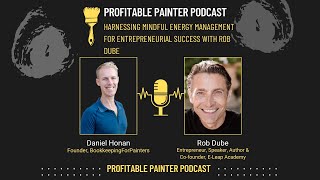
In this episode of the Profitable Painter Podcast, host Daniel (founder of Bookkeeping for Painters) interviews Rob Dubé, co‑founder of Image One and creator of the "10 Disciplines" framework for mindful energy management. Rob shares his entrepreneurial journey—from selling lollipops in middle school, to building a managed‑print services company, selling it, buying it back, and eventually transitioning to coaching entrepreneurs through the 10 Disciplines. The conversation walks through each discipline, offering concrete practices and the rationale behind them: 1. 10‑Year Thinking – shift from short‑term reactions to a long‑term vision that guides daily decisions. 2. Take 130 Days Off – protect weekends, holidays and three weeks of vacation, and truly disconnect from work during those days. 3. Know Thyself (Be 100% You) – drop the chameleon habit, show up authentically in all contexts to attract the right people. 4. Be Still – sit in silence for 30 minutes daily (meditation, prayer, journaling, contemplation) to clear the mind and improve decision‑making. 5. Know Your 100% – define the optimal number of work hours per week and weeks per year that sustain high performance without burnout. 6. Say No Often – use the previously set boundaries to decline requests that don’t align with your priorities. 7. Don’t Do $25‑Hour Work – identify low‑value tasks you could pay someone $25/hr to do and delegate them quarterly. 8. Prepare Every Night – write a brief next‑day plan before bed to free mental bandwidth and improve sleep. 9. One Capture System – keep a single notebook, tablet or app for all ideas, tasks, and reflections to avoid mental clutter. 10. Be Humble (and Grateful) – view yourself as equal to others, practice a daily gratitude pause, and assess humility on a scale. Rob also promotes his book Shine and an online “True Self Assessment” that blends the 10 Disciplines with self‑discovery questions. Throughout the interview, Daniel relates the concepts to his own experience with the EOS system and highlights how the disciplines complement traditional business frameworks like Traction. The episode ends with actionable encouragement for listeners to adopt the practices, read the book, and take the assessment.
Chapters
Welcome to the Profitable Painter Podcast. The mission of this podcast is simple: to help you navigate the financial and tax aspects of starting, running, and scaling a professional painting business. From the brushes and ladders to the spreadsheets and balance sheets, we've got you covered. But before we dive in, a quick word of caution: while we strive to provide accurate and up-to-date financial and tax information, nothing you hear on this podcast should be considered as financial advice specifically for you or your business. We're here to share general knowledge and experiences, not to replace the tailored advice you get from a professional financial advisor or tax consultant. We strongly recommend you seeking individualized advice before making any significant financial decision. This is Daniel, the founder of Bookkeeping for Painters, and today I'm here with Rob Dubé. Rob Dubé is the co-founder of Image One, visionary and CEO of the 10 Disciplines for Managing and Maximizing Your Energy. And co-founder and podcast host of Entrepreneurial Leap. He is also the author of Do Nothing, host of the Do Nothing Retreat, and host of Leading with Genuine Care podcast. Through his work, Rob challenges business leaders and entrepreneurs to look inward with mindfulness and meditation by sharing his own mindful leadership journey. Welcome to the podcast, Rob. How's it going?
It's going great. Thank you for having me. I really appreciate it, Daniel.
Absolutely. I'm super excited to get into this podcast today. We talked a little bit before the podcast. I'm a huge Traction fan, and your co-writer on this book that's already out, Shine, is Gino Wickman, who wrote Traction. And I feel like I'm super excited to get a hold of this book and kind of dive into it deeper. But Could you just off the bat kind of tell me a little bit about your entrepreneurial journey?
For sure. For sure. So, um, the entrepreneurial bug bit me early. I have a feeling like many of your clients, many of your listeners, uh, I started selling Blow Pop lollipops out of my locker in 9th grade with my best friend. And then between that time and when we graduated college, we had all kinds of crazy businesses we were putting together and running. When we got out of college, we realized we were totally unemployable. So we started selling toner cartridges out of my, out of my business partner's parents' basement back in 1991. That evolved into our company Image One, which is a managed print services provider. The two of us no longer run that company, although we still own it, but we have a CEO who runs it. You mentioned traction. So about 8 years into us starting that business, we were tripping over ourselves and you might be able to relate to a certain degree. And we got introduced to this guy named Gino Wickman and he was just getting started in helping entrepreneurs kind of gain control of their businesses. So we brought him in to help us and we embraced what what is now called the Entrepreneurial Operating System or EOS, and, and did it quite successfully. In 2004, we were approached by a public company and sold the company, and 18 months later, we actually bought it back. And I always bring that up only to say that traction and the EOS process was very impactful in our ability to sell at a high multiple because we were really running a tight ship. Um, we're also mentioned in Traction, so if you've read it, you've seen our name. Um, Gino and I, uh, developed a strong friendship along the way. We would get together and talk about life many, many times throughout the year, and business too, but mostly life. And fast forward to a few years ago, the two of us teamed up as I segued out of Image One and finished a succession plan, and we created a company called The 10 Disciplines where we group coaching and, uh, a mastermind, uh, for driven entrepreneurs to help them find more time in their life and protect their greatest asset, which is time, and clear their mind, have a calmer mind so they can make better decisions and ultimately grow their businesses and be better people in the world. Because I think that's what we all want at the end of the day. So that's a little bit about my background.
Yeah, that's awesome. And it seems like, and I haven't read the book yet, but I'm, now that it's on my radar, I'm excited to dig into it.
Cool.
And it seems like it's a good complement to Traction because Traction's kind of like the, you know, here's the blueprint around how to run your business. And this book seems more like, Here's the blueprint on how to kind of like manage yourself, is your, your energy, your impact, your, your inner peace, right? And, and I believe you have like 10 disciplines you go through in this, in this book.
Yeah.
So could you— am I framing it the right way?
Yeah, you are. The 10 disciplines are a framework, a foundation, if you will, a way of running your life. And when you incorporate them all, not one 1, 2, or 3 might— it would be useful. But when you incorporate all 10, it's quite powerful. And this is where we have the opportunity to do what we're here for as entrepreneurs. We're here to make a greater impact in this world because we are driven people and we are the creators, the workers, the doers, the people that make stuff happen. Without us, nothing goes. Okay? So it's important that we use our time wisely. And sadly, we don't. And many of us don't have that framework, that structure in our life to use our time wisely so we can make the greatest impact. And so that's what the 10 Disciplines, which is one part of the book, does for you. And we can dig into those, and I'll follow your lead as to how you'd like to do that.
Yeah, let's, let's dig into the 10 Disciplines if, if we can, just to give folks an idea of, of what it looks like.
So, you know, the first place it starts is 10-year thinking, and this is where we boldly say to you, shift your mind from short-term thinking to thinking in 10-year timeframes. A funny thing happens when you are very clear about what you want your life to look like in 10 years. That is, you start making decision in decisions in the present moment that align with that. But when we're not clear about that, our decisions are made with not much thoughtfulness around it. And we wanna shift that for you. Sometimes we have threats coming at us in business and we react again without not a lot of thoughtfulness because we don't have clarity around our 10-year thinking. Same thing in our personal life. You know, we have threats that come, things that shake us up in our lives. And what we, what it ends up doing is taking control of us in the present moment. But when we know that we have 10 years to get where we're headed, we can know that we can get through these challenging times. Which frees up our energy, clears our mind, gives us peace, helps us to make better decisions so we can get through the rocky time and move toward and ultimately usually become more successful faster than we even imagined. So that's one great benefit to 10-year thinking. And we encourage people to do this in terms of their, the totality of their lives. Not just their businesses.
Yeah, I know I kind of use this, not exactly this, but like just knowing, you know, sometimes I get really like upset or anxious about a certain situation that's happening, like in the moment. And if you just like take a step back, you're like, am I going to even remember this day 10 years from now? Probably not. Or, you know, 15 years from now, whatever the case is. So I think having that perspective is, is just super powerful. Just being able to step back and be like, is this, should I get super upset about this moment? Having a, a longer view in it. And I know Traction has, has helped with my view of my business in terms of goal setting and, and, and coming up with that, that vision. Uh, so I like the idea of, of like putting a different, uh, like having a longer-term vision for your day-to-day. So that makes a lot of sense to me.
Yeah. For, for your life. You know, this part actually isn't goal setting. Not that you were saying that, but I'm glad you said goals because it reminded me to say that, you know, this is not goal setting. I'll give you an example. Let's just say there's somebody really important to you in your life. Maybe it's a parent or a spouse or a really good friend. And when you think about your life 10 years from now, you think to yourself, I want to have a really wonderful life and relationship with that person. Now, with that in mind, that person may trigger you in today's moment, in the moment today, that person might do something, say something that triggers you, and you may want to react in a certain way with an edge or a defense, defensively or something of that nature. But because you know what you want your relationship to be like 10 years from now, you might actually pause and think twice about how you react, because how you react in this moment is— has an impact on your relationship 10 years from now. And that's the way we want you thinking. We want you to use your 10-year thinking, your vision, What do you want for yourself in, in this life? And bring it back to the present moment. So you start aligning the two, your actions in the present moment, because the present moment is all you have. So this is where we get to show up at our true human best. And keeping that front of mind helps us to do that.
Yeah, just reflecting while you were talking, like if you have a frame that you're walking around and you always have that frame of 10 years perspective, it's gonna, you know, really prevent some of those like knee-jerk reactions and, and probably moments where you, you're not proud of.
Exactly.
So yeah, that's, that's a good, that's a good one.
So the second discipline is take time off. And this is where we boldly say take 130 days off each year and don't think about work the entire day. So I have a couple things that I like to share for context. The first is if you took every weekend day off, every US holiday, and 3 weeks vacation, that's about 130 days. Okay. So, but most people that I work with in the entrepreneurial world, they're not taking their weekends off. Maybe they try to take one day off, but oftentimes they're not. So this is still a struggle, even when I reframe it in those terms. But the harder thing for people to wrap their minds around is not thinking about work the entire time. So examples are, even on the weekends, we carry around our devices and we can't help but just checking our email. It's almost like second nature. If we're standing in line at the grocery store or something, we pull it out and see what's going on. We're looking for that dopamine hit. But sometimes we see something, uh, on that email that, that gets our minds all worked up. So we just went from having this nice, peaceful, re-energizing weekend to something that's now clicked in our head and we can't release it. And there's nothing we can do about it because it's the weekend or it's a holiday. The other thing that I see is somebody works their tail off all year to, to be able and be fortunate enough to go on a wonderful trip to a tropical island or go skiing or whatever, you know, go to Europe or whatever. And what do they do when they're there? They're checking their emails. They're calling into the office. They're bringing their business books. How come you can't get away from it? What is going on? How come you can't turn it off? I ask you all to consider that. What's going on up there in that mind of yours that you can't turn it off? Yeah. Okay, so that's one aspect of this. The other aspect of it is if you believe that there's some level of mind-body connection, which is— you, you can learn more about this on your own time— you understand that when your mind's worked up, your body reacts to it. Your body gets exhausted and it needs rest. And we do go to sleep and some of us try to get as much sleep as we can. Usually when you're an entrepreneur, you wake up at 3 o'clock in the morning and you can't go back to sleep for 90 minutes or something like that. But, you know, if you're normal.
Yeah.
So we try to get sleep, but that's just what our body does. Like, I don't know if you've ever woken up in the morning and looked at your bed, but you're not exactly you know, resting peacefully. It's all like mangled and, you know, so we have to rejuvenate. We've got to take time off and clear our minds and let our bodies rejuvenate. And trust me, and you all have felt it at some point in your life, when, when you start to feel like what I say, back to normal, and you come back from a trip or come back from a place where you didn't really think about work much or at all, And all of a sudden you're thinking more clearly, you're seeing things more clearly, your, your body feels like it has more energy. This is the power of taking time off. Now imagine if you just created framework in your life where you protected that for 130 days. How much more productive would you be? You don't actually have to hustle the way you think you do. You just have to be smarter. And this is part of it.
Yeah, I feel like you're calling me out right now. Like with all the things that you're listing, I'm like, man, is he following me around? He knows my, uh, like I'm working on the weekends, uh, checking my phone when I shouldn't be about work. And it's exactly what you're saying. Like, you know, I, I had to stop looking at my phone at a certain point after like in the evening because I would see an email and then my mind would just go crazy like the rest of the night about, you know, solving that problem. And then I ended up getting up and like going to my computer and like trying to solve the issue or whatever and just destroy like the first few hours of my sleep because my mind is racing. So it's like all the things that you're saying are just like, like really hitting home right now.
Most people that read the book say, I thought, I think you were talking to me when I read it. So I think that's what you're saying right now.
Exactly. Yeah.
So discipline number 3 is know thyself. And that's where we boldly say, be you 100% of the time, 24/7, 365. We like to say lovingly, let your freak flag fly. But what we end up doing in our lives for some reason is we turn into chameleons. And so we show up in different ways, in different scenarios, and we're not always true to ourself. And people pick up on an inauthentic energy. And, and when you're not your true self, that's when— this is when you've met somebody and you have a conversation with them and they walk away and you say to yourself, oh, that person had a great energy, I really like that person. Or sometimes they walk away and you kind of, you're like, that person had a weird energy. People are doing that to you because you're not being authentic and they're picking up on your energy. And so we want you to be fully you. If you're silly, be silly in all scenarios. It's okay, even in business, you know. If you're not a coat and tie person, don't be a coat and tie person. You're not a coat and tie person, you know. Be you. Like, I'm looking at you, you, you know, who Bookkeeper t-shirt? No, I'm sorry. You're supposed to be, you know, no, you're being you right now. I love that. You know, it just in terms of how I can outwardly see you. So this is really important because it's freeing. And when we're free and very comfortable in our own skin, it gives us peace. And as I say, people pick up on that. And when they pick up on that, they want, they're attracted to us. And when they're attracted to us, if you, if you're thinking about it from a business sense, they want to do business with us. If you're thinking about a non-work life, it means you're going to attract really wonderful people that, that you're surrounded with in your life that bring you joy and you bring them joy. We always like to ask, think about the people you're surrounded with, you know, are they fully themselves? You know, are they bringing you joy? Because usually like attracts like. So these are questions that we ask everyone to consider when we think about these disciplines and creating this framework in our life. So set yourself free, be your true self. Mm-hmm.
Yeah, that, that's a, that's a tough one for me. I, you know, uh, as well, man, I, I gotta get this book. So it, because like you're saying, you know, there's different contexts in your, in your life. At least I have the tendency like, oh, this is, I used to be in the military and like, this is my military. This is how I act in the military. This is how I act in my business. This is how I act with my family. Like, I feel like I'm very, you know, have all these different personalities almost like I'm schizophrenic almost.
You got it. That's what happens. Yeah.
Yeah.
It's like, who am I going to be today? And how exhausting is it to be different people in different parts of the day? Just show up and be you. People love you. They do. They love the real you. That's all they want. That is all they want. So we encourage that, obviously. The next one is discipline number 4, which is be still. You and I were talking a little bit about this before we started recording, and this is where we boldly say, sit in silence for 30 minutes every day. And we recommend 4 ways of doing this, but I'm sure there are more, but we're just trying to keep it simple. And if there's— you might find something different. So we just want you to sit in silence for 30 minutes a day, however you do it. Now, some people find prayer very impactful. So I don't know a whole lot of that about that personally, but prayer is something important to people. So that's one way of being in stillness. For 30 minutes every day. Meditation. That's something that I do. I'm a, I'm a regular meditator. I have a daily practice. That's another way. Journaling. Journaling is a great way to take all that stuff that's up, that craziness up in our mind and get it out through our bodies, through our arms, through a pen onto a piece of paper. And the last one is contemplation, where we just sit in wonderment. With questions that don't— we don't have answers to, but we're perfectly okay not having the answers to. Sometimes people will take 10 minutes and do one of those, or do— they'll take 10 minutes and do 3 of them. Uh, they might pick prayer, journaling, and contemplation, something like that. So you can combine them. We just want you to be still for 30 minutes. Now what we find is this is very hard for driven entrepreneurs. They're very busy. They're always on the go. Their to-do lists are so long. They're running from this to that to the other thing. And the idea of sitting in silence for 30 minutes, A, seems like it's not productive, like it's an absolute waste of time. And after about 2 minutes, they start thinking, what am I doing? I have a million things to do. I don't have time to sit in silence. Okay, so there's a favorite quote I have from a person by the name of Anne Lamott. She says, my mind is like a bad neighborhood. I try to never go there alone. And so what I'm encouraging you to do here is yes, to sit with those painful feelings, the feelings like I gotta get up right now, I gotta go do, I gotta go do. Sit with it. Let them settle. Give it time. Your body will begin to settle. It just needs a little bit of time. When you do this every day, what ends up happening is back to Take Time Off. You're rejuvenating your body in a much different way than sleeping. You're giving it time to catch up. It's allowing your mind to clear. So all that stuff you got rolling around up there. It begins to settle like sand in a jar of water that has been shooken up, and you can't see through it because all that sand is swirling around. And you settle it down, the sand settles, it's clear. Now your mind is clear. How much more productive will you be? How much, how much better will your decisions be when you have a clear mind? How much better of a person will you be to the important people in your non-work life, like if you have a spouse or kids or a parent or a sibling or a best friend, or maybe how you treat somebody at the coffee shop. How much better of a human will you be when you're walking around settled, grounded? Much better. And you'll also be a better leader at work for all those amazing people. That are showing up each and every day and busting their tails for you. They want a leader who's grounded, who they can look to and know that you got them, you're fully present for them. So these are some of the things that be still does for you.
Yeah, this is one I've, I've definitely— a few years ago, I didn't do it all. And I, I tried to really put effort into it for about a year consistently, and it's, it's definitely a hard practice. You think it's like easy, like, you just sit here for 10 or 30 minutes or whatever, like, but it's very difficult. It's kind of strange, but it, it, it almost like builds a muscle for being able to like let things go in your, your mind, at least from what I've tried and experienced a little, I can a little bit better monitoring my emotions, like letting things go in my head. If, if something pops up in my head, I can kind of let it go and not let it like become my reaction to things. It's like almost like a workout for the mind. Like if emotion comes up in my, my thoughts, I don't automatically feel like I have to identify with that emotion and then act on it. I can kind of just like let it. It's not that I'm, uh, perfect at that by any means. It's definitely— none of us are still, right? But, uh, I feel like it's when I'm doing it consistently, I can— it's like I'm kind of working out that muscle of being able to manage my reactions to things.
You got it. You got it. And that's how you show up as a better human being. There's a great saying that from Viktor Frankl, there's that moment between stimulus and response, and in that moment you get to choose your happiness. And that's when you notice that emotion. It's a millisecond for us human beings, and it— and our reaction to our— in our— in— within ourselves harms us, and outside of ourselves. So sometimes we react to others, you know, in a business context. Let's say you're in a meeting and somebody says something that triggers you, and you want to react to them, or you react internally. Imagine that you've worked the muscle that you've just shared. That description is so perfect. And you know how to handle that, so it sort of dissipates very quickly and no longer has a hold of you. And so it doesn't have that same quality. That's called inner peace. Mm-hmm. But it does take commitment and discipline. You, you, you have— this is something that needs to be done every day. Okay. Discipline number 5, know your 100%. Here we boldly say, decide on and commit to the perfect number of hours per week and weeks per year that you will deliver your value to the world. This is your work container. Okay? Many entrepreneurs are constantly working. And I'm not against work. I'm all for it, actually. But we have to know where 1 hour too much is exhausting us and pushing us to, toward burnout. And 1 hour too less, we don't feel fulfilled. Like, we want to keep going. And so there's an art to this. You have to really play around with it. You know, so for example, for me, my perfect number of hours per week is 35. I can't work an hour more without feeling exhausted. But if I work an hour less, I want to keep going. And 40 weeks a year, that's how much I want to work. The rest of the time, the 12 other weeks, I, I need time off. I need to be away. So that's just where I am in my life. When I started my business, you know, I was 70 hours a week and barely 2 weeks, uh, of vacation. So 50 weeks a year. So that's where I was when I was 21 years old and starting a business full, full force. So as your life changes, your perfect number of hours per week and weeks per year will change as well. But you have to bring awareness to it. That's why you have this 10 Disciplines framework, because you always have to go back to it and you're always paying attention because when you know your perfect number and you don't let the boundaries get blurred, you have maximum energy to do your best work and you are better at the work in that, within those boundaries than you are when you start going outside the boundaries, your productivity decreases. It's a downward spiral. So you might be putting in the hours, but you're not doing as good of work. So it's better to do better work in less amount of hours than average work in more hours. Mm-hmm.
Yeah, that makes sense. Uh, I'm sure this is protecting yourself or this, you know, if you're pushing yourself too hard. And you're not giving your 100% because you've just worked yourself in the ground. This is me talking from some experience. It's, it's, it's not good. You're not getting good results. People don't wanna be around you as much. And got it. It's, it's, it's just not a, a good thing. So this makes, it's like, it's pretty, you know?
Yeah.
It's kind of common sense, but it's like, never thought of it.
Nobody does it.
Yeah. Nobody does it.
Yeah. So they don't set their boundaries. You know, you can do things like, team, I start at 8:30 AM and I end at 5:30 PM. I'm just making up business hours, but you, anyone listening, you pick your numbers. You let your team know. And by the way, between 12 and 12:45, I eat lunch and go for a walk. To reset. Now your team knows, it's clear. Do, do they not trust you because of that? Do they not believe in you because of that? Like, do you have something that you have to prove to them and the rest of the world by going 80 hours? If you became an entrepreneur, you did it because to some degree you wanted to be free. You were, you realized you weren't employable. And so you said, I can do this on my own, but that didn't mean to create a life where all you did was work. You, you, you did it to create freedom for yourself and you're not giving yourself the freedom. And when your team sees the way you manage yourself, they're inspired by it. And as you said, you show up better for them anyway. And so this one's an important one and to, to keep playing around with it. So discipline number 6, I'm gonna move on to, which is say no often. And so when we think of those first 5 disciplines, you say no to anything that doesn't fit into them. So your, your listener will go back to each one of them cuz I don't expect them to remember them at this moment. But once you're clear about the boundaries with each, Now you're clear about anything that comes your way that requires a decision, yes or no, which, by the way, as an entrepreneur, you're making 10 times more decisions than a regular person. Who to hire, who to fire, what market to enter, how to grow your business, you know, how, what, uh, what to pick up for dinner, what to, you know, get to your kid's game, et cetera, et cetera. You know, you could go on and on and on and on. So you get really clear about this. And what ends up happening is we don't understand our boundaries. So people come to us, it could be a team member. Can you help me with this? Well, you don't wanna disappoint them, so you say yes. You just took on a project that you didn't anticipate. You, you have somebody in the community who needs your help. You say yes. There's nothing wrong with helping in the community, you have to be clear about your boundaries. Does it fit into your 100%? Is this something you're passionate about? Is this something you're good at? Is this something that brings you joy? If so, yes. If not, no. Oftentimes as entrepreneurs, we want to be the hero. It's part of something that happened to us along the way. We want to show people we can help the, we can help you. And so we end up saying yes to things too often. We get more opportunities the more successful we are. And they're exciting. And so we start to say, oh yeah, that would be interesting too. And oh yeah, I want to do, oh, I can fit that in. But you have to know you're 100%. So guess what? If you have the opportunities, you have to make really tough decisions. And saying no is just really hard for people. It's just, I ask audiences all the time, how many of you have a hard time saying no? And literally 100% of the hands go up. And so I wanna give you permission. Please hear me, each and every one of you. It's okay to say no. It's not selfish, and you can do it with grace. So in other words, you might not be able to help somebody, but you might know somebody who might be able to help that person, and you can connect those two people and they can take it from there. It'll take you 5 minutes. Okay? Or you might have a resource that you can suggest. Or maybe you have nothing other than a really busy schedule that's clear, that has clear priorities and boundaries, and most people really respect that. And you can also learn to not feel FOMO, fear of missing out, because if you're successful, you're gonna get tons of opportunities. So don't worry and know that people are very— they respect people actually that have the ability to say no. And it actually has them looking at you in a different way. Like, that person, they're clear, they know their stuff, they're busy, they're focused. I like— people like that. That's a good energy. So please say no often.
Yeah, it reminds me of Charlie Munger and Warren Buffett, they kind of—
there you go—
use this framework, you know, to deals. They basically said no to pretty much everything except for a few things. They made a couple of, or a few, a handful of really good investments, and, and that set them for life and then some. Yeah, but, uh, and in which you said about the opportunities as, as you grow in your entre— you know, go along your entrepreneurial journey, there's all these opportunities. And I've been guilty of chasing those, those opportunities when I should have just stayed focused on the thing that I was doing that was working. And I was like, oh, this looks cool, let me go over here and do this. And then that just distracts me from what I'm supposed to be doing. And so I think this is like a— this is— I mean, these are all important, but this one definitely Makes a lot of sense to me. And like, it's a lesson that I keep having to learn.
Yes.
Looking back is like, I gotta stay focused on one thing and, and, and say no to everything else.
You got it. You got it. Keep working that muscle. It isn't easy. Discipline number 7 is don't do $25 an hour work. And this is where we boldly say, never do anything you could pay someone $25 an hour to do. And so there's nothing wrong with $25 an hour work, by the way. There are amazing people that want that work and are great at that work. It's just that as an entrepreneur, I don't think you took this leap to make $25 an hour. I don't think you did that. It's a lot of pressure and risk that you put on yourself. You wanna make 6 figures plus. I know that's why you're in business. It's not all about money, by the way. I know that, but you didn't do it to create a job for yourself. And so for you, to be able to elevate within your business, you need to take a close look at all the work you're doing and you need to start delegating it one thing a quarter. Get one thing off your plate that's $25 an hour work every single quarter, every 90 days. Within 5 years, you would have, you will have delegated 20 things. And I promise you that will rise you up and help you make better business decisions that grows your business, grows your bottom line. So the ROI is a no-brainer. But for some reason we think, oh, I, I could do that. You know, I don't, I don't want to ask somebody else to do that. That's your own internal stuff. And for you to really rise up, you got to get past that and you have to start delegating. And I even encourage people to don't— to get to a point where they're not doing work below their pay grade. So I say, take your annual compensation, divide it by the number of hours you're working per year, and look what your actual hourly rate is. Now you can tell when you're doing work, you can ask yourself, is this in alignment with my hourly rate? It'll also tell you something else, by the way. It'll tell you that if you are making, you, it will tell you you're probably making a lower hourly rate than you thought you were because your, your, your compensation may be a cert— let's just say it's $150,000, but you're working 80 hours a week. You know, when you do the math on that, which I can't do it real fast in my head, it's gonna be a much less hourly rate than you, you might imagine. So I, yeah, so anyway, that's something to think about. It's a really enlightening exercise to do.
Yeah, that makes a lot of sense. Yeah, it kind of goes back to the other disciplines, you know, setting aside a time, setting aside, setting aside time for yourself. But if you're not doing that and you're just constantly working all the time, those are all hours adding up throughout the year and now you're working 80, 100 hours a week. That's right. And okay, you're making maybe 6 figures, but when you divide it by all the hours you've put in, it's not going to look good.
That's right. And your hours include the times you're at the grocery store looking at your email, even if that's 5 minutes, you have to include the time it's spinning around in your head and all that kind of stuff. It isn't an exact formula, but keep that in mind when you're blurring your boundaries, when you're getting outside those boundaries. That's work time, and we want you to have that time back. Your time is your greatest asset, yet you keep giving it away freely. Okay. The next two are really simple, but super powerful. Discipline number 8 is prepare every night. So before your head hits the pillow every night, simply document the next day's plan. Take a look at what you got going on, write it down. It's that simple. It takes 5 minutes. And when your head hits the pillow, you'll sleep better. Hmm. Your subconscious will be doing work while you're sleeping. Have you ever woken up and got your day started and you go, oh, I got it. It just came to me. No, it came to you last night while you were sleeping, actually. You know, people say, oh, I get these ideas in the shower. No, you got them actually while you were sleeping. Then you got in the shower and it came out in the shower as you were waking up. So you also get out of bed and wake up and you're really clear about what's up today. Your mind doesn't have to spend any time on what's happening. You just are ready to hit the ground running, and that includes You know, depending on different, different people, you know, they get up, they have a workout, they, you know, then they, uh, might go, you know, have a meeting after their workout, then come back and shower and then come back. It's, it's your entire day is, is mapped out from start to end. And so you're really clear, you're clear about your boundaries, you're 100%, you've said no a bunch of times, so it's all good stuff. Wouldn't that give you more energy if that's the way your days were set up? Yes, of course it would. And then you'd make greater impact and you'd be doing it with some peace. That's what we want. So the next discipline is number 9, which is put everything in one place. And this is where we boldly say, pick just one place to capture every idea, commitment, thought, action item, and promise as you make your way through your day. Examples of a one place could be the good old-fashioned yellow legal pad. My, my good friend and business partner and co-author Gino Wickman uses the good old-fashioned yellow legal pad. It never needs a battery and it just takes a pen with some ink in it and it always works. And he's got that thing by his side each and every day. I'm not as smart of him, so I use a tablet called a Remarkable, but there are other types of tablets that are out in the market, and it allows for me to write, and I like that. And that's what I carry with me throughout my day. Some people use their phones, like the, the note-taking thing on their phones or their computers. You know, there's different apps for that sort of thing. You know, there's a million of them. I don't care what you use, but just pick one because what you don't realize is you're letting people down. You're letting people down in business and you're letting people down in your personal life because you're not as organized as you think you are. And I can't tell you how many clients we've had who say, I'm the, I'm the only one who understands my organizational system, but I do, but I understand it. No, you don't, because it's not organized. It's all over the place. And when your stuff is all over the place, Your mind is jumbled, so you have to take time and energy to find it. Where did I put it? Is it on my app? Is it on my note-taking thing? Is it on my journal? Is it on the Post-it note over here? You're trying to find that note. It could be right in front of you on your OnePlace. We also want you to use your OnePlace to pause at different points during the day and write down how you're feeling. Because our days ebb and flow. We might feel a lot of energy at certain points. At other points, we might feel kind of low energy. We may have had a situation that kind of caused us some angst. We may have had a situation that we were at a high, high, just closed a new deal, whatever. And so you might say, you know, at different intervals, you might write down each one of those feelings. At the end of the day, when you're closing up for the day, getting ready to, uh, go to your non-work life, you might just take a look at how you did throughout the day and how you were feeling and notice the ebb and flow and notice that, wow, there seems to be a common theme. I feel really tired after lunch at 2 o'clock. I'm like drained for like an hour and a half, 2 hours, and I'm, I feel like I'm no good. Well, that's a great data point for you. You might change a habit that you have. Maybe it's your diet, maybe it's something, I have no idea. Might go work out at 2 o'clock to bring your energy back up. I don't know, but these are data points to help you be— create more impact, be stronger throughout the day. You also have all your information, promises you made, so you can follow through on those promises, tasks that you need to take care of, etc. And so you know where it is. You don't have to spend any energy looking for it. So both of those very powerful, very simple, but very powerful. And people tend to overlook them.
Yeah. I just read a biography of Sam Walton, I think actually autobiography of Sam Walton. And he's doing just this, you know, he was the founder of Walmart. He would have the yellow pad and he would take that with him everywhere and just prioritizes what he's focused on and, and travel, travel, travel around to the different stores across the United States. And, and just, you know, he'd had everything in that yellow, yellow pad. So, yeah, he's doing it. It must be something to that.
Let me give you a quick example and then we'll move on to the next one. So don't do $25 an hour work. At some point, I'd love for your listeners to consider hiring an assistant. Could be, could be 5 hours, you know, a day. Could be 2 hours a day. Could be a full day, whatever. They can manage your email. Okay, so this is don't do $25 an hour work. The other thing they could do for you is when you're done at the end of the day, you take all that stuff on your yellow legal pad or your tablet like I do, or whatever you're using, you touch base with your assistant and that person helps disseminate where it all needs to go. They keep you organized. If they kept you organized, you wouldn't have to spend time being organized so you can spend time on growing your business, being a better father, whatever the things are within Know Your 100%. So you see how they all tie together.
Yeah.
And they're very impactful if you're truly committed to growing your business and having inner peace while doing it. So you're a better person. In both, in the totality of your life. Okay, so let me do discipline number 10, which is be humble. Simply stated, view yourself as an equal to every person on the planet. Now, some people think that humble, being humble is a weak trait, and so they end up becoming what you might think of as arrogant. Because it feels like it's strong, but it's not. Arrogant is not strong. Humble is strong. People want to be around humble people. You want to be around humble people. When you're humble, you actually attract humble people. And when you have humble people around you, life's better. And I never met somebody who wasn't humble who didn't have a daily intentional gratitude practice, literally 10 seconds a day. Is all it takes to pause and think of one or two things that you're grateful for within the past 24 hours. It takes nothing, but it really frames your mind. It puts your mind in the right place about what matters most. Because usually we're getting caught up with stuff that does not matter, and we forget about the stuff that we should be so simply grateful for. And when we're grateful, we— it brings that humility out of us. So they kind of go together. We could have called it Be Grateful, but we ended up calling it Be Humble. So that's discipline number 10. Now I'm going to leave your listeners with an exercise to do. It's a little bit of a challenge. I want you to draw a line where on one side it says humble, on the other side it says arrogant, and I want you to place a mark on that line. Where do you fall on that mark from humble to arrogant, or on that line from humble to arrogant, put the mark. If you're brave, go to the 5 people closest to you in your life and ask them to rate you on that same scale from humble to arrogant. See if it lines up. You might be surprised. Hmm.
That's a good exercise. I'm going to, I'm going to give that one a try. Awesome. It's a little, a little scary, but, uh, it is scary.
Yeah. You have to really let your guard down, but it's worth It, people, it is so worth it.
That's awesome. This is, this is amazing. I, I appreciate your time, Rob. Um, so the, yeah, the book is Shine, right? And it's out now. You can get it Amazon, wherever books are sold, pretty much, right?
Wherever they're sold. Yes. Going like gangbusters. It's really resonating with people. Yeah.
No, I'm definitely picking up my copy today. Because this is, this is, this is gold mine. So, um, was there anything else that you'd like to leave the listeners with before we, uh, let you go?
Yeah, I would love to just share, you know, if you go to thetendisciplines.com, we have an assessment. It's called the True Self Assessment. This is 20 questions that incorporate the 10 disciplines and then 10 questions 10 questions out of the 20 incorporate the 10 disciplines, and the other 10 have to do with freeing your true self. I encourage you to go on and take that and see where you land, um, on the 10 disciplines and freeing your true self. Being your true self, as I mentioned, discipline, uh, number 3. It's a great exercise. It shines light where area— in areas of your life that you need to shine light on, and it will be a tremendous tool for you moving forward. So please go and do that. I encourage you to do that. Awesome.
And I'll put the link to that in the show notes as well as a link to the book as well. Well, I really appreciate your time, Rob. You've been super generous with your time.
Thank you, Daniel.
And I look forward to reading the book.
I look forward to reading it. I hope it has an impact on you and to everyone listening who picks it up or checks out the assessment. You know, we, we truly hope that we have some impact on you in some way. Thank you for having me, Daniel. I truly appreciate you.
All right. Thanks, Rob. Have a good one.
You too.
More from Daniel







What’s REALLY Holding Your Painting Business Back? (Find Your Bottleneck in 5 Minutes)



