Harnessing Real Estate Investment to Secure Your Financial Future with Nic DeAngelo
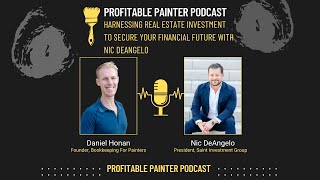
In this episode of the Profitable Painter Podcast, host Daniel (founder of Bookkeeping for Painters) interviews Nic DeAngelo, CEO and founder of Saint Investment Group, about why real estate—particularly fixed‑income, asset‑backed real estate—is a superior wealth‑building vehicle for small‑business owners such as painters. Nic argues that the stock market is shrinking and over‑valued, while real estate historically delivers higher returns (≈12‑14% vs. ≈9% for stocks) and offers tangible, inflation‑hedging assets. He outlines a practical entry point: achieve at least $250,000 in net annual profit, then allocate excess cash to real estate, preferably through trusted mentors or funds rather than direct ownership. Nic explains Saint Investment Group’s focus on institutional‑grade assets, especially single‑family mortgage‑backed cash flow and industrial/distribution properties in the southern U.S., and highlights demographic trends (43.2% of U.S. homes owned by baby boomers) that shape supply dynamics. He discusses risk mitigation (location, property type, partnering with trustworthy operators) and broader macro themes—persistent inflation, recession sentiment, and a belief that real‑estate opportunities now rival those of 2008. Listeners are directed to saintinvestment.com/resources for free webinars and to consider the firm’s 12‑14% fixed‑income fund.
Chapters
Welcome to the Profitable Painter Podcast. The mission of this podcast is simple: to help you navigate the financial and tax aspects of starting, running, and scaling a professional painting business. From the brushes and ladders to the spreadsheets and balance sheets, we've got you covered. But before we dive in, a quick word of caution. While we strive to provide accurate and up-to-date financial and tax information, nothing you hear on this podcast should be considered as financial advice specifically for you or your business. We're here to share general knowledge and experiences, not to replace the tailored advice you get from a professional financial advisor or tax consultant. We strongly recommend you seeking individualized advice before making any significant financial decision. This is Daniel, the founder of Bookkeeping for Painters, and today I'm here with Nick D'Angelo. Nick D'Angelo, widely recognized as the fixed income GOAT in real estate circles, leads the discussion with a blend of economic foresight and real estate expertise, with a portfolio exceeding 2006 million, Nick delivers exciting value-driven insights. He operates by two core beliefs: real estate is broken— or excuse me, Wall Street is broken, real estate is the cure, economics tells the future. As the CEO and founder of Saint Investment Group, Nick leads a veteran team acquiring institutional-grade real estate assets across the country with a portfolio spanning over 20 states 24 projects, 500+ loans. Saint Investment Group is on track to raise over $100 million annually, reflecting their strategy-driven success. Welcome to the podcast, Nick.
Daniel, great to be here. Great catching up with you beforehand. And yeah, I'm excited to jump in today.
I am too. This is a topic that is of a lot of interest to our listeners. You know, I work with obviously a lot of painting businesses and this is always the thing that they get into once they hit a certain level of success. They're like, okay, where can I put this extra money that I have to make it grow even more? And real estate is like often the go-to is like buying a real estate property or something in the real estate realm. So I'm excited to dig into things today.
Yeah, me too. I think it's great and I think you hit the nail on the head, which is at a certain level, right? Because you're running a business, you find success, you have a lot of decisions to make at certain stages. And one of them is when you are having good income and your business is in a successful state, what do you do with that? You reinvest in the business. Do you invest in other things outside of the business? So yeah, I think it's a great topic and I'm excited to dig in.
Yeah, absolutely. All right. So for business owners who, who might not have experience in real estate, why is real estate such a powerful investment vehicle compared to some other options out there?
Yeah, I'll give you a few. I'll give you a few answers that, that kind of give the modern-day vision of real estate and why it's— I think it honestly, it's the best. To me, it is the absolute best investment tool that exists in the market today. First is historically stocks and bonds were considered traditional investing. The issue that I'm seeing with stocks today, particularly stocks, is the stock market has changed dramatically. The stock market has changed more than we realize over the last 3 decades. In fact, the stock market that we see today is actually shrinking and nobody's talking about this. The value of the market continues to go up as we have huge things like inflation or overvalued companies by wide margins of their price-to-earnings ratios, etc., things that are easy to quantify and track, right? We see that they're overvalued. So then how is the stock market shrinking? Well, the number of companies going public and the number of companies in the stock market has shrunk by over 40% in the last few decades. Okay, so what that means, right, for us the investors, is that, you know, your, your, your listeners, you, Daniel, all all of us, what that means is that we are limited to what we can invest in and what companies we have access to through the stock market. That's one. Two, I like real estate better simply if you just look at the returns. Stock market historically is around 9.2%, depending annually, depending on which time period you're looking at. During the same period, real estate's returning 14.2% on average. Right? So let's just say loosey-goosey, about 50% more per year going through real estate. Might be 5% with the 9 to 14, but that's a 50-ish percent increase from 9 to 14, right? Just to quantify, or excuse me, clarify those numbers. So that's 2, is the returns are much better. 3, real estate really hits more value boxes. It checks more boxes than stocks by a pretty wide margin. And there's so much opportunity in so many different asset classes and different places in real estate. So between all that, I mean, I'm super biased. I'm so biased, in fact, and such a believer that I went full-time in real estate, right? But, um, I— so I'm all in on that category. All that to be said, I still have stock investments. They're very simplified. I don't bet on individual companies because of all those fears. The market in a handful of days recently lost $2 trillion. The New York Stock Exchange volatility is expected ahead. We're not even sure what the Federal Reserve is going to do with rates. Now, rate cuts, which is the discussion we're having today, don't always benefit the stock market. As a matter of fact, that is not a direct correlation, and that's something that we have seen many times, that stocks don't directly respond positively in rate cuts in the past. Real estate, it's a little more, um, it's a little more direct, the correlation between rates, because there's so much financing involved in purchasing properties and, and other things in real estate that, that's more direct. So yeah, if you, if you ask me my reason for having serious concerns about the modern stock market, Daniel, or serious pros to real estate today, I'd tell you that Everything on that list is a contributing factor.
Mm-hmm. Yeah. And so how can a painting business owner, how can they get into real estate? Like, where should they start looking? Because it can be kind of overwhelming. There's so many different ways you can invest in real estate, whether it's commercial, residential, if you want to do short-term rentals, long-term rentals, and there's a whole bunch of different things. So what, what should like a painting business owner, if you have a painting business, what are some things that you should consider if you're trying to dip your toe in?
So I was always jealous of painters. I got my start, my very first job, I was a mason, right? So I saw the painters, they were in that AC'd house, you know what I mean? They seemed like they had a very smart path that they were choosing to not be a dummy like me outside building walls with a bunch of, you know, heavy blocks. What I'd say if someone's running a small business, I was an entrepreneur, I grew up being an entrepreneur. You know, I'm very, very passionate about the entrepreneurial space. This is what I'd say. First order of business is you got to be profitable, right? Running a small business, that's the number one thing is all efforts, all focus, all everything should reach that profitability. To me, it's about $250,000 net, right? When you hit that with a small business, because now you can have discussions about employee expansion or areas or or strategic discussions could be had north of about $250,000 net a year. But beyond that, you kind of alluded to it, Daniel. I think the discussion goes, is it reinvestment in the business or is it investment? And you actually take profits, which is so important and so many people don't. And then an event like COVID happens and wipes out successful businesses nationwide. They were killing it beforehand, thousands of businesses, and something completely outside of their control completely destroyed, you know, thousands of businesses in the U.S. I don't like seeing that happen. And that's, you know, something that's very real, all these black swan events. So to me, once you reach the threshold, you got about 250+ in the green of a business. I'm looking to invest in real estate like you're saying. I choose real estate. I think they should be investing in whatever they think is the most compelling or most advantageous for their situation. For me, it was real estate. So when I was running businesses, we were— when I was running more operational heavy, you know, things that were in real estate, more on the operations side, as far as we were dealing with distressed assets, we were dealing with city and code things, we're dealing with entitlements, we're dealing with a lot of construction and things on that side. I was completely tapped out. I was working 80, 90, 100-hour weeks. In those businesses before we sold them. And I woke up one day and I just said, I can't do this. This isn't sustainable, right? So how can I make this work and keep adding to my success instead of working myself to having health problems and no relationship with family and friends and all these— this is pre-kids. I couldn't imagine doing this today, Daniel, right? I got 3 kids. You and I were talking before. Congratulations on your 4th, by the way, Daniel.
Appreciate it.
But, um, so I would say my advice is making a decision to diversify and take your profits as a business owner and be placing them in whatever you think best. I think real estate's going to be the best option for that, and I think the best start for many real estate investors early on is going to either be investing with someone that they deeply trust, that they know the person knows what they're doing, right? So that can be a mentor, that can be a friend that has experience. It could be a fund. Saint Investment Group, we have funds. We work with a lot of small business owners on that side. So working with somebody that they trust, and I would lean into fixed income out of the gates because if the market conditions are high and low, etc., if there's a lot of volatility that affects a small business, having fixed income, having a return that you can rely on is what saved our businesses at that period of time. So it's great to have things that benefit from market conditions and have higher returns. And when things are great but dip when things are bad, that's called, that's called appreciation investing. To me, if I'm in a small business and it's ramping up and I'm looking for my first investment, it's going to be fixed income and it's going to be real estate, which is asset-backed. It has an asset, it has homes or a building or something real and tangible that back up the cash flow.
[Speaker:RYAN] Yeah, a lot there. So first thing, I love how you say you need to be hitting $250,000 in net income, bottom line net income before you even consider, you know, doing something else besides making your business profitable. So I love that because you see this mistake a lot where you have a business owner and then they get the shiny object syndrome and then they're chasing another business, and oh, I'm also doing real estate, and then everything turns unprofitable because they're looking 20 different directions. So I love how you're, you know, so first take care of your, your main business, get that profitable, $250,000 in net income or more, and then, then start taking those profits and diversifying to, to, you know, get some return on that money. Um, and then you, you, you touched on the, uh, the fixed income, uh, which is asset-backed. And can you kind of dig into that a little bit more? And, and what, what are we talking about here? We're talking about investing in funds. Can you just, like, for someone that doesn't know anything about it, how does that work? And could you just give us a little background on that, please?
That's a great question. So The reason I highlight asset-backed, it means that there's something. So when you invest with like, let's say a fund or you go buy a house, right? It could be any, you know, anything within that spectrum. You're buying an asset, you're buying a hard physical real asset. You're buying something that benefits you because it has four walls and a roof. It's tangible. You can touch it, right? You can see it, you could smell it, you could, you know, it's there physically. Physically. The reason I say that is because there's so many things in finance that I don't trust because they're not tangible, right? So, you know, things like you're buying a, you know, small percentage of a company, you know, like the stock market, and people make decisions in rooms that you're not in, right? That you don't have a vote. You don't have a real vote when you're, you know, surrounded by billionaires who are also making votes. Or they're in an office having discussions that you're not privy to, etc. I don't trust that. Not with my nest egg, not with, you know, a lot of, you know, my years of hard work. That's not where I'm putting my money. So when I say tangible, the reason is that if we're talking things like inflation, right, that we've been dealing with for a handful of years since, what, 2022, we were at 9% inflation. Thank God it's gone down since then. To today, right? We're in the, you know, mid-2s roughly for inflation. But inflation had a very real impact on nearly everything in the economy, and it will, and, you know, continue to if it rises again. What inflation does to assets that are real, like a building, is oftentimes, most oftentimes, those actually go up in value. As things inflate, the value of those real assets, those real physical things that you can own go up, right? So in inflationary times, it's great to hold real estate. In times where it's a rougher market, it's often very beneficial to buy real estate because rates go down, right? Interest rates go down. So you can buy that same asset with cheaper cost on your money, right? You're paying less towards your mortgage each month towards that. So I think In this environment, we're talking about rate cuts. That's good for businesses, especially businesses that require lines of credit, right? That means your credit line's going to get a little bit cheaper. That means a lot of things will be better on that side. And investing in real estate should also have higher returns because less money is going to pay the mortgages every month. So that's what I mean by fixed assets. It's something real that generates a real value to the investor. In the case of real estate, that's two things. Typically it's cash flow. You receive rents and you as the investor receive a portion of those rents or all the rents. That's one. The second is appreciation. That property goes up in value most commonly. I mean, pretty consistently if you look at the history of real estate. And that is the case where you get to benefit from that equity that's in that asset, in that property. So those are the way that I like real estate in this environment and kind of a little bit about a hard asset versus a stock or something that's more conceptual. It's more of a, you know, a contractual finance versus a real hard tangible asset.
Yeah. So with the, the Saint Investment Group that you have and you have this strategy of acquiring institutional-grade real estate assets, Can you explain what that means and how this approach differs from like typical real estate investments?
Absolutely. So on our side, we're looking for what the biggest and the best and the smartest players are doing, right? We're blessed to know a lot of those. We're blessed to know a lot of, you know, bank CEOs at this point and have an amazing network of great people. I've been in real estate for, you know, you know, 15 years. So I've had the opportunity to meet a lot of great people on that side. What I'm seeing today consistently as the best two real estate opportunities, and this is what we focus on at Saint, this is what we do. The first is the single-family home mortgage market. Okay. So on the mortgage side, the benefit to that is the cash flow that mortgages put off after being backed by, you know, arguably the most sustainable, the most rock-solid asset class, which is single-family homes. Right. So you're, you know, your, your listeners probably know this better than anybody, right? Homeowners are, instead of moving, more often staying in their homes for longer and longer periods of time. A huge, huge, huge portion of ownership of, of single-family homes right now is the baby boomer demographic. I think they own something like I know I have the exact number here on my quick notes, but it's something like 40% of the homes, 38% are owned directly by baby boomers that have no interest in moving in the next two decades, meaning many of them plan to retire and pass in those homes, live out the rest of their lives in those homes. Right. Also in the United States, we have a very strange single-family home market that is unlike the rest of the world because we do 30-year fixed mortgages. Those two things are unique in the entire world. We don't see that anywhere else. 30 years of knowing exactly what your payment's going to be. That's something like 98% of mortgages fit that category, right? So it's overwhelming. Also, the government takes, you know, takes place in 20-something percent of mortgages in the U.S. So it's a very supported market. The single-family home side. The second place that I really like investing in real estate, and I see the biggest promise in real estate, is industrial real estate. So the single-family home market, particularly mortgages, I think is the huge opportunity right now. And the second is industrial real estate, whether it's manufacturing or particularly distribution, particularly on the border of Mexico. So southern US industrial real estate, I love right now. Lots of manufacturing going on in Mexico. They've replaced China as our number one trade partner. Okay. And the opportunity there, I think, is great. So having access to those for, you know, for listeners, you know, they could, they could look into buying an industrial building. Often they're very expensive. They could look into buying a single-family home and running it themselves. But I think the biggest question for a successful small business owner is Do you want to be the landlord or do you want to invest with someone else and they do all the work? So do you want to run a real estate business or do you want someone else to run it for you and split the profits with you? Right. So if they, you know, they get to make that decision on their side, which is where the, where the funds come in, correct?
You know, potentially look at an industrial fund if you want to take care of, take advantage of that trend or residential type fund. One of the things you said about the baby boomers owning 40% of the residential homes, something like that, it just— and they're going to be dying off, you know, in the next several decades. It seems like that would greatly increase the supply of homes on the market because baby boomers— and I'm not a real estate expert by any means, I'm just there's so many baby boomers and there's the next generations are so much smaller. Seems like there would be a lot of supply coming onto the market in the next several decades.
Great question. So I have the exact numbers for you because I hate misquoting stats. Baby boomers today, right this second, own 43.2% of residential homes in the United States.
Wow.
Okay. Gen X, the generation after the baby boomers, owns 33.2%, and millennials own 13.23%. Okay. So that's just the breakdown of, you know, the, the older 3 generations in the US, right? Gen Z is probably an ultra minority of that. Gen Alpha after that, that's our kids, own approximately 0% of that right today. So let's answer your question directly. Boomers currently own around or currently own exactly 43.2% of residential real estate in the US. Interesting stat. Okay. Boomers were the largest generation we've ever had. They're also the most wealthy generation, the most amount of money in one generation in US history that we've ever had in the US. Okay. What's interesting is not, you know, the sad part is we're losing our boomers. The good part is there's an amazing, amazing transition that they are you know, creating within the US economy today, even though the boomers were the largest generation we've ever had, they passed— they've started to pass away over time. Now the millennials are the largest generation we have in the United States by sheer volume. Okay. I believe I have these numbers also. I believe the current number of millennials is 78 million in the US and the current number of boomers is 76 million. I do need to verify that one, but millennials are actually larger than boomers. The good news is, even though sadly we're losing our boomer sisters and brothers in the U.S., it's over, you know, 20, 25 years that we're looking at this period of time. So absorbing that inventory on the housing side, not to, not to be, you know, overly analytical about people passing away, but absorbing that inventory in the home market is not something overly concerning that I see, because as it goes through a period of time and those pass through— but that is the right question. And then the next question is, well, what happens? You know, what solidifies or backs up a lot of that? About 20% of the mortgage market in the U.S. is government-backed. So it's directly U.S. gov supported to some degree. And again, you know, the vast majority of of the market is non-boomer owned, right? 60-ish, almost 60%. Hmm.
Okay, cool. I guess what, what risks should a small business owner like a painting contractor be aware of when investing in real estate? And how can they mitigate these risks?
Yeah, I would say that the, the number one thing that a small business owner, you know, a painting business owner should be looking for is if they're doing it on their own, that they're choosing the right property. Right. The old real estate joke is location, location, location. Okay. Yes, very important. But also property in the location. What kind of property are you buying? I think many people in the painting space are likely more handy than the average American, maybe a little bit more understanding and knowledgeable about things that they can do to improve the property. That might be a pretty good opportunity. Right? Maybe not a classic fix and flip, maybe a classic fix and flip, but a property that they could get a discount on, purchase and rent out or do an Airbnb like you kind of alluded to earlier. Those are good models if you want to be really hands-on. Those are, you know, you can directly put your sweat equity into the deal and get some return on that. I think that's great. The second is if they want to be more passive, and they want to invest with somebody that does the work for them and get, you know, the majority, the lion's share of the returns, they got to invest with somebody they trust, somebody that they vibe with. They understand the business model. You know, it can be simplified so that they get each step in the process and not become some giant, ambiguous, you know, confusing investment model. And if they understand the investment model, they understand what the operator is doing, and they trust the person that's actually doing the investing, then I think that's the opportunity that they should be looking at.
Yeah. And you had mentioned, uh, as far as a benchmark they should be shooting for or expecting, somewhere around 15% return on any money they put into real estate. Is kind of that kind of the benchmark compared to like 9% for the stock market?
Yeah, I would say in today's market, 12 to 14% is the striking distance for for real estate. That's the passive real estate investor range of returns. There's going to be things that are, that are higher than that, but they're projections, they're not actuals, right? And it might take 5 years to get your money back, which is fine if you have that, uh, time horizon or that expectation. You'll probably get a higher return, right? But on the fixed income side of real estate, you're looking at 12 to 14%. And then on the, um, you know the kind of longer term, like 5+ years, you might find 15, you know, like mid to high teens, 15, maybe even 18% return. So it's typically going to be a lot more than the stock market and typically a lot more stable. I found.
Mm-hmm. Okay. One of the things you've mentioned is Wall Street is broken and real estate is secure. And that's kind of what you're why you say that is because just the returns, the volatility in the stock market, and real estate is kind of better returns, not as, and not as volatile, and it's just overall a better investment. Is that kind of, does that sum up your kind of thesis there?
Yeah, I think so. We, we touched on some of it, and you, you're hitting the nail on the head on that piece also. I'll say this. I think the future of the market, the future of the country, the future of the US is not going the direction of Wall Street. Okay? I think Wall Street was this amazing period of time where businesses could go public and the general population, the general, you know, us as the consumers could invest in a great way. And I think that was amazing. And a lot of people made a lot of money. I don't see that as the core foundation for wealth building. Or for growth of your net worth in the US moving forward, especially for, you know, if you look at small to mid-sized businesses, it's one thing if you're the CEO of NVIDIA. Yes, you want to go public because you want to get some cash, right? You want to sell your company but still retain, you know, the leadership of it. And it's like there's all kinds of reasons if you're a huge business, but for the medium guy, for the small guys out there right now, I don't see Wall Street as the biggest opportunity. The volatility has exceeded what we're seeing and expecting moving forward. Right. It's just not— it doesn't have the same degree of, of gravitas or like draw or appeal. I mean, if you look at the American economy right now, I have these exact numbers, right? These are, these are up to date. I think this is within the last week. 59% of Americans believe we're in a recession right this second. Okay, so the majority of Americans believe we are in a recession right now. 39% of American families are having significant problems paying their basic bills, their everyday bills of living their life. 37% was the number for the global financial crisis. Okay, so 2008, we had a 37% of families having major problems. Right now it's 39. So the majority of Americans believing we're in a recession, that's because they're not dumb, right? There's many things that are clearly pointing to that. We're in a recessionary environment if we're not in a technical recession. So, I mean, people are cutting travel plans, people are cutting all these things back, you know, for the holidays, etc. And, you know, it's over half of families in the U.S. are making deep cuts to their lifestyle overall. Just to survive and get through. So then you take a look at the stock market dropping, you know, almost 10% in a several-week period or in a few days dropping trillions of dollars or major, major investment publications, Investor's Business Daily saying to reduce the number of stocks that you hold by 20 to 40%. Right. So all that we are already in a tough economy. And then you have the biggest players that usually are the most pro-stock market saying that you should be reducing how many stocks that you have. So all that to be said, all that to be said, I just don't see it. I see a shrinking stock market and I see small business owners being in the right place at the right time. People that are in the trades especially are killing it right now. They have all the opportunity where we have, you know, an interesting college system for the last 20 years. That was disproportionate. I think there's a lot of opportunity in trades and for investing in things that benefit those businesses.
Mm-hmm. Yeah, I definitely agree with that. A lot of opportunity in the trades right now and you're starting to see it with the business owners that are coming in now, like they're a little bit more business savvy. They're starting to realize, oh, there's a whole bunch of opportunity here. And I also agree with you with the, uh, what appears to be some sort of slowdown in the economy just from the painting businesses that we work with. Like, they're seeing the, the market seems a little softer, uh, demand doesn't seem as high. And so there's something going on there for sure. Uh, so that makes complete sense to me. Um, we talked about, uh, the, the baby boom, the baby boomer trend and also the industrial trend with more investment into the industrial side, which will likely increase the value of those types of buildings over the next decades. Are there any other big trends that small business owners should be aware of?
Yeah, I see here the big 3 that I see overall in the entire market. I see that this inflation thing is not resolved. I think we see inflationary pressures. Yes. Thank God for all of our sakes, inflation's dropped down to the mid-2s. That impacts small businesses a lot because think about this. If your margins 20% as a small business and let's say 2020, right, and you don't raise your prices in the last few years, in the last handful of years, you're underwater today. Does that make sense? Yeah. Because if cost of things are— I think it's up almost 40%, that means you're losing 20%. So if you just today raised your prices 40%, then you're cutting even to where you were 4 years ago, 5 years ago. Yeah, right. So the inflationary pressures and the inflationary shakeout, even if inflation today is at 2.5%, which is about where it's at, the pressures of inflation, of the US government printing so much money so many supply chain disruptions, so many other things going on, we're not out of the gates. Even if they start dropping rates, which could be tomorrow, Daniel, right? That's— the Federal Reserve meets tomorrow to have that decision. Even if that starts tomorrow, I think we're looking at a long period of time before we have a balanced market where rates are at the place that they should be, employment's at the place it should be, etc. I think that's a while. The second is I do think— here's the good news— I'm super bullish on the US. I'm super, super positive about the US. I'm a big fan of what we do, even though politics can be a mess quite a bit at times. We won't go into that whole subject, but I'm just saying our country can bend a lot before it breaks. Unlike many countries in the world, we have, you know, the strongest economy by far in nearly every metric that you look. Global— like, globally, the US is such such still the world leader, I think we're in for a soft landing and not a crash. That's the second thing I'd say is that I'm not talking about the sky falling. I'm critiquing, you know, pieces of the, you know, the, the economy for business owners to hopefully take smart action and do the right thing on their side for their businesses, for their investments. And then the third thing I'll say is in the environment we're in today, I think we have more opportunity to invest and more upside than we've had since 2008. I think that we're in a position today where if you look at how the market's poised, a lot of things readjusting, a lot of things rebalancing rates at a place where they're probably going to start ticking down the stock market at a place with a lot of uncertainty. I think real estate particularly— again, I'm very biased, but the investment world that we live in today has more opportunity than I believe we've seen since 2008. So those are the big 3 things that I'm looking at in the economy right this second.
Nice. Awesome. Well, this was like super informative. This is awesome. As we kind of wrap things up, how do folks learn more about Saint Investment Group? How can they learn more or get involved with that?
Yeah, absolutely. So The two best things. First off, we, we geek out on economics constantly because the decisions that we make for our investments are economic driven to the core. Every single decision we make is economics driven. So we do huge amounts of research and we put them together in live webinars that we give away all the information for free because we want people to understand what's going on in the world so that small businesses, so that investors can make the best decisions for them. People can find new webinars, live webinars, and our old webinars for free, and all of our videos and all of our data and research that we do at saintinvestment.com/resources. So I think that's the best next step. They will clearly see opportunities to learn more about how to invest with us. We have a fixed income fund right now that's based 100% on real estate. Pays 12 to 14% on the higher end. So it crushes things like CDs at the bank and it's real estate backed, which I love. I just put $100,000 in myself when an investment paid off. So those are the two best ways. But SaintInvestment.com/resources and you can get it all for free. Everything that we do and put time into.
It's awesome. I'll include the link to that in the show notes. This is awesome. I really appreciate your time, Nick. Any last thoughts or asks of the audience before I let you go today?
I would say that if you're a small business owner and you're in the trades or around the trades industries, I think you're in the most opportune time that you could possibly be in the US today. So I, I'm pumped for your listeners. I'm pumped for small businesses. They're the backbone of the US. That's my background as well. So just kudos to, uh, your audience. And, uh, yeah, it was fun today, Daniel. It was good catching up with you.
Absolutely, it was great. Have a good one, Nick.
Yeah, you too.
More from Daniel







What’s REALLY Holding Your Painting Business Back? (Find Your Bottleneck in 5 Minutes)



