Harnessing the Power of Soft Skills-Guide to Emotional Intelligence & Leadership Dev't w-Art Snarzyk
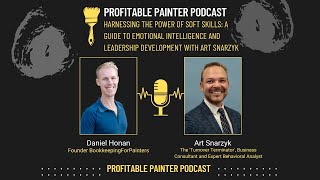
In this episode of the Profitable Painter Podcast, host Daniel (founder of Bookkeeping for Painters) interviews Art Snarzyk, known as the "Turnover Terminator," about the role of soft skills and emotional intelligence (EQ) in building high‑performing painting businesses. The conversation begins with a disclaimer about financial advice and quickly shifts to personal development. They discuss how behavioral styles (DiSC) shape a leader’s natural tendencies and how "bolting on" soft skills—such as empathy, accountability, negotiation, and strategic thinking—can be trained like a muscle. Using Steve Jobs as a case study, they illustrate how low EQ can limit a leader’s impact and how improving self‑awareness, self‑regulation, social awareness, and relationship management (the four EQ quadrants) can lift a whole team’s performance. Art explains common emotional triggers (saboteurs) like hyper‑rationality, hyper‑achievement, and hyper‑vigilance, and outlines a practical framework: identify the trigger, arrest it, regulate the emotion, then choose to accept or change the situation. The framework is supported by a proprietary 8‑week coaching program and a year‑long mobile app that delivers quick PQ (Positive Intelligence) exercises, tracks progress on 25 measured soft‑skill competencies, and gamifies EQ development. Listeners are invited to contact Art for a free PQ assessment, tip sheets, and enrollment in the program. The episode closes with a call to "know, grow, and show"—measure where you are, decide who you want to become, and demonstrate that growth to the world.
Chapters
Welcome to the Profitable Painter Podcast. The mission of this podcast is simple: to help you navigate the financial and tax aspects of starting, running, and scaling a professional painting business. From the brushes and ladders to the spreadsheets and balance sheets, we've got you covered. But before we dive in, a quick word of caution. While we strive to provide accurate and up-to-date financial and tax information, nothing you hear on this podcast should be considered as financial advice specifically for you or your business. We're here to share general knowledge and experiences, not to replace the tailored advice you get from a professional financial advisor or tax consultant. We strongly recommend you seeking individualized advice before making any significant financial decision.
This is Daniel, the founder of Bookkeeping for Painters, and today I'm here with Art Snarzek. Art Snarzek is known as the Turnover Terminator, has been involved in management and hiring since 1996. He has considerable experience in corporate America and spent 9 years running a successful painting company, which provides him with an understanding of the challenges involved in hiring quality employees. He advocates for a scientifically tested method to attract, hire, and retain top talent, moving away from reliance on intuition and subjective assessments. Welcome back to the podcast, Art. How's it going?
Uh, really good. Good to be back, Daniel. Thanks for inviting me. Appreciate it.
Absolutely. No, we had such an interesting conversation the first time. Wanted to get you back on and talk about personal development and developing those soft skills and emotional intelligence, which I know that I severely lack. And so this is mostly just, you know, a therapy session that I'm recording and putting on a podcast. But hopefully it might be useful for someone else as well. But yeah, I'm excited to get into things.
Me too. And, you know, we can always talk about people stuff. It's always intriguing, of course, to me, but I think to everybody because we're always dealing with people. So all of, all of this therapy, I'm glad you're recording it. I like to say that all of my research is just me-search. So hopefully all the stuff that I found out about people I can bring to your guests.
Yeah.
Yeah.
I was, I was, I was telling you right before the podcast, I've been reading biographies. One of the ones that I recently read is the biography on Steve Jobs by Walter Isaacson. And Steve Jobs has this clear character arc where when he first starts Apple, he's pretty much a huge jerk. He's a, has a lot of creativity and he can, develop products really well, but he does, he can't run a team and he ends up getting kicked outta Apple and he's like, he runs a couple other businesses. One of 'em doesn't go too well. He ends up coming back to Apple many years later and he had learned all these lessons about managing teams, mostly done at Pixar where he worked with someone named Ed Catmull who was like really good at managing people. And creative teams. And he came back to Apple where he had still his skill for product development, but he also had the skill of team development and running high-powered teams. And that's where he really just took off with, with Apple and developing the iPad and the iPhone and all that stuff, that great stuff that came outta Apple while he was, took over that second time. And I think the, One of the things that changed, the big things was, although he was still abrasive in the end, he's a very intimidating person. He did learn how to, he learned some soft skills that allowed him to take a team and get the most out of them, which I think as entrepreneurs, that's really what we need to be able to do is take a team, lead them, and take them to another place.
Oh, I like it. And it fits in with all that we're talking about with, uh, personal development and soft skills. You know, uh, I think I'm known for the assessments that I use, and some of those are DISC and, and our motivators and some— and soft skills. And we have a certain behavioral style. Steve Jobs is a very direct person in the DISC model. He's going to be a high D, probably some C, for anyone who understands that stuff. But that's very direct and, and fast moving. And when we talk about skills and bolting on soft skills, We're not talking about softening a person or that the skills are soft. We're just talking about the distinction between hard skills and soft skills. Hard skills being program that computer or paint that house or estimate that job. Soft skills being talk to Mrs. Jones about how things are going, right? Or some of the ones that we specifically measure that are soft, that are super hard and heavy hitting, are things like empathy, How about personal accountability? Do you take accountability when things go wrong, or do you blame, you know, the world around you? So when we're talking about these behavioral styles and a high D, a very direct person like Steve Jobs, he bolted on skills such as understanding others, teamwork, probably diplomacy and tact. Those are just some of the 25 soft skills that we measure in our assessments. And interestingly, I think that we— our DiSC styles, we form those when we're young. We have a behavioral preference of how we like to show up. And we can kind of make little shifts throughout the day. We don't want to adapt hardcore for a long period of time. But we can bolt on skills. And skills are like going to the gym. So the more you use them, the more you build them. If you want to increase your negotiation skills, go negotiate more. And if you stop going to the gym and you stop negotiating, and then you get flabby in your negotiation skills. So know that there are things about you that won't change— your preferred style— and there are things that can change, and those are those soft or even hard skills that you bolt on to your style.
Yeah. And just for folks that may not know what DiSC is, um, could you kind of quickly just define that and Um, and also specifically the D portion of it, because if you're listening, you don't know what DISC is, and D is— it stands for dominance, I believe. And, and that's usually what entrepreneurs are, that they're very driven and trying to accomplish things. So if you're listening, you're not sure, you're an entrepreneur, you're, and you're driving to get results, you're more than likely a D or something close to that. Um, but could you kind of just give a quick rundown of DiSC?
Sure. DiSC is one of the assessment tools that people use to help understand themselves. And as we talk about personal development, I really think that the key takeaway from all development is first you have to know yourself. Having an assessment done of certain things, whether that's a self-assessment or one of those cool online tools that I use, or if it's a therapist's or your wife's assessment of you, understanding where you're at with things first. So first know yourself, so then you can grow yourself, and then you show yourself to the world. And it's kind of a continual process. DISC is one of those, uh, assessment tools, uh, that I use, the variety of those. And it just measures how we like to interact with the others. And DISC is D-I-S-C. Just for really quick reference, the D is about being direct. High Ds like being direct. Low Ds are not as direct. They like to kind of wait on things or be more reflective. Is are very influential or interpersonal, fun-loving. And the S is about being steady. And the C is about being compliant. So we all kind of have our own styles that we enjoy or that we prefer to show up being. And we're not locked into that. And I think another good example of a behavioral style with cool skills bolted in is a high I, a fun-loving, exciting, optimistic, talkative person who has the bolted-on interpersonal skills is a fantastic human being, just somebody you want to be the megaphone of your company, somebody who's great and engaging to be around. But I've met high Is with low interpersonal skills. And I often say that they remind me of a puppy who pees when the doorbell rings. It's like, I want to be with people. I'm just not good at it. I'm going to lick your face. And, you know, so my preference and if I'm good at it are very different things. Sometimes it shows wisdom. You know, a high S behavioral style, a very steady routine person who likes things to, to be the same and doesn't want to change things just for the sake of things, kind of the anchor of reality in the company. You know, somebody who builds on a lot of flexibility skills and adaptability skills— those are soft skills— onto a style that says, I don't like to have to change. That shows me somebody who's aware of themselves, bolted on some skills to adapt when things don't meet their style. So that's why we need to just add more skills onto who we are. Let's be a more skilled version of the person we want to be.
Yeah, that makes, that makes complete sense. So we need to bolt on skills, some of these skills being soft skills. And I've actually heard someone, I think it was Alex Hormozi, uh, business, uh, I guess influencer online, he was talking about this on soft skills and he was saying that using your distinction, the distinction between soft skills and hard skills, soft skills are hard to define and they're not as hard. So, and he was saying that soft skills, you could actually define them, you know, you could say, you know, you could train someone to, for example, stand up every time someone comes into a room, you know, smile and shake someone's hand whenever they meet somebody. It's just, there's a long list of those like little micro things and interactions that could improve your soft skills. So even though they are soft, like we call them soft skills, they're actually specific behaviors. You could— this is what he was arguing— you can specific behaviors that you could identify and learn and repeat, you know, in your interactions with people.
Yeah. And it's, they are skills. I think that sometimes business owners get thrown off by something being too soft or being emotionally intelligent. That sounds a little mushy. I've got a business to run and bills to pay, right? So, uh, well, skills— these are measurable skills. We know if somebody's good at it, and we can tell whether somebody has empathy for others or not, right, based on their behaviors. Um, and there are tactical, hard techniques you can put on there. If you want to learn some interpersonal skills, you go find some Dale Carnegie classes and learn how to win friends and influence people, right? So, uh, I think it really comes down to first know who you are, take an assessment, and find out which skills would like to build. You know, I measure 25 skills and most of the assessments that I use on a given individual, and not everybody develops all 25. Most people don't. And we don't need to beat ourselves up for the skills that we don't have developed. You know, sometimes it's about leveraging your assets or your superpowers, the skills that you're already good at, instead of trying to like beat yourself up about some skills that fall at the bottom of your skill hierarchy. And there are some skills you don't need to have in order to be successful in your day-to-day life. So it's important to go through that list, say, what is it that's important and I'm not good at, so I can focus in on that. And when I learn which skill it is, if it's interpersonal, then I'm going to Dale Carnegie courses. If it's planning and organizing, well, I might go take some more strategic leadership courses or something like that.
Mhm. So, so what are some of these soft skills that that you, you actually measure and evaluate?
Yeah, so I mentioned a few. They usually boil down into kind of 3 groups. I've learned achieving skills, and those are things like personal accountability, goal achievement, time and priority management. These are things, you know, you wish you people would put on their resume before you hired them. Are they good at these things? So those achieving skills, there are some thinking skills like conceptual thinking, Are you good at learning? There are some people that are very passionate and driven to learn. They're curious people, but they're not continuous learners. They're not good at it. So they might be curious and they ask you the same question next week. But people who are curious and have bolted on continuous learning skills, they learn those things and retain it. So other things like futuristic thinking, Steve Jobs scored very high in that. Imagining the iPhone before, you know, the iPod was even created. So really creative thinking. And then the last one, thinking, achieving, and then people skills, soft people skills such as empathy, understanding others, coaching and development, negotiation, persuasion. Those might even sound like salesy things, but negotiation and persuasion for your admin assistant. Can she present you know, an idea and persuade the team into doing that? Or can she present and persuade the owner into a fantastic new cost savings idea? So it can be pretty helpful. My favorite, of course, is emotional intelligence, which kind of fits almost into a category of itself. And that's really EQ, or it's the ability to control your own emotions, understand what's happening to you, control that, and understand what's happening to other people so that you can help moderate the conversation. It's really when we get hijacked throughout the day with all the things that happen to us, can we settle down and get back to making good decisions? Everybody in every business needs this. You need this at home. I'm, I'm a super advocate of it because it's so helpful. The more EQ you develop, it's proven, uh, that leaders at higher levels all demonstrate that they have higher levels of EQ. So, um, even though it might sound like emotional intelligence and a little bit fuzzy stuff, it's really just awareness. Do I know that I'm stepping on your toe? That's it. And there, again, there are hard tactical things and easy practices to put in place to increase those things.
Yeah, yeah, that makes sense. And It made me think of on Steve Jobs' biography, going back to Steve Jobs again, there was a point where he was at Pixar. So he got kicked out of Apple because basically nobody liked him. I mean, he was just very abrasive and, you know, so he got kicked out of Apple and then he ended up starting Pixar or taking it, buying Pixar and growing that. And leading that team, and Ed Catmull was actually kind of running the day-to-day operations with the Pixar team. He was the creative. Steve Jobs was kind of just funding it and providing a little bit of feedback and doing negotiations with external parties. And I think Ed Catmull had said that Steve Jobs didn't realize how he was affecting other people. Like he would go into a room and he would just say like obscenities about if something he saw that he didn't like about the product or whatever it was, he would just say, oh, that's, you know, that's, you know, explicative, that's whatever, XYZ. And then he would afterwards wonder why that person was like upset with him or was acting weird. He like didn't realize, oh, cursing someone out is You know, that will upset somebody and they won't want to work with you anymore. So, uh, he, he kind of figured it out eventually. I guess his time at Pixar, he saw Ed Catmull kind of handling a team the way you're supposed to do it. And, and, and he kind of learned that and went back to Apple the second time and, and he did great things, like I said before. So it seemed like he was probably pretty low on that emotional intelligence. Um, which I think I'm also kind of low on that, uh, I'm not naturally high on that. So, and it sounds like from what you're saying, this is having a high emotional intelligence is crucial for, for leaders, cuz they gotta know how are things affecting them emotionally so they can regulate themselves. And then also understand how their actions or how other things are impacting others so that they can, you know, make sure things are going on, keeping, keeping on track with their team and they're aware of what's going on.
Nailed it, Daniel. You just summarized the 4 quadrants of emotional intelligence. And I think Steve Jobs, you know, that first one, awareness of self, he may or may not have scored high in which emotions he knew he was feeling. Now, his regulation, step 2, you know, it sounds like he scored low. He didn't, he didn't care to regulate that and say, whoa, I just got triggered off of that phone call, and now this is going to happen. And Uh, it sounded like he scored low in step 3, which is understanding the emotions of others, you know. So, and then step 4, everybody was angry with him. He had to score low because he wasn't good at like making everybody kumbaya. So it's not, um, these soft skills are really about understanding and regulating your emotions. They, we've found that there are more and more studies are showing that a team will never increase beyond the EQ level of their leader. So it's super critical if you want your people to be able to sober up from stressful events really quickly. You want them to have less analysis paralysis or anxiety because they're worried about things that are going to happen, or if they're too controlling. You've seen those people that don't want to give you all the data, and they're just— they won't move because of that. These are all the hijacks that happen that make us dip into our EQ bag. And if they're equipped to do that and deal with these emotions quickly and effectively, then your whole team runs a whole lot better. But it's, it's never going to exceed the, you know, the limit of the leader. So developing your own as you develop your team is, is really critical. And I think that's maybe what happened with Steve Jobs. He had that good example, that leader that showed him a different, higher watermark of how you can handle people and your own emotions better.
Yeah. So that's, that's really, so, so basically if you're hitting a ceiling in your business, it might be you. It probably is you. And it might be this, it might be the fact that your emotional intelligence is not as high as it can be. And once you improve that, unlock that, that might get your business to the next level because your team will improve and then you know, and, and especially in this type of business, the painting industry is all about people. You know, you're, you're not selling, uh, widgets. You're, you're, you're selling a service that people are executing. So, um, even more so than, you know, Steve Jobs is running, you selling iPhones, uh, obviously people are involved in that, but you know, in our, in the painting industry, you're actually, people have to do the work, do the service. So it's even more important. So what, what are some, like, red flags that we should look out for in ourselves or that we need to improve emotional intelligence? Is there any kind of things that you typically, we can flag in our mind, like as we go through the day or typical pitfalls that maybe what you see entrepreneurs make? Um, the folks that you work with, I don't know.
Yeah. So, um, understanding whether your EQ is high or low, that really is going to come from like, how much stress are you feeling? Because really, as your EQ, uh, raises, you're able to sober up from these events throughout the day. Not enough money, poor sales call. I got a call from John. He needs more paint, all the stuff, right? There's just things happening. I have to pick up steak for dinner tonight on the way home. All the things. So the higher your EQ goes, the better you're going to be able to deal with those, all those different kinds of things. And the red flags that come up is you're dealing with those stress, those stresses for too long of a clip. You know, I got stressed out and I, it took me 3 hours to sober up. I went home and had to kick the dog, right? Strong EQ is almost going from like, uh, you know, the old Jedi term, the dark side to the light side. We call it sage perspective. Having— when you're clear about who you are and what you want, and you're feeling good about yourself, and you're making great decisions, and it's before you get a horrible phone call from a client who's upset, that sage perspective— what, what would they do before they got hijacked? So how often are you outside of that Sage perspective and how long are you out there? Those will be good indicators of how you're feeling about your EQ. Also, the feedback you get from other people. If people often are acting confused around you or you, you know, you hear wind that maybe people are upset after a meeting because you said it the wrong way, well, those are some just opportunities for you to check out the tools that it takes to learn a little bit better EQ.
Yeah. So if we're seeing those, uh, those indicators, we're feeling stressed, we're getting feedback in meetings that people are not happy with what we said, what is the first step? Like, what do we do from there? How, how, how do we know how to, what to improve and, and how to do that?
Yeah. Um, so it's a, these are deep questions, Daniel. What a podcast you have for these folks. But, um, there, there are tactical things, whatever you get stressed about, you know, the different things that happen, there are tactical things you have to do to overcome that. You know, if it's a banking problem, you got to learn some mortgage stuff or whatever that is, or a painting problem, you got to fix that. But the internal, the intrinsic problems to solve is how do I not let this screw up my day or make me, uh, have bad decisions or, you know, fire off and do the wrong things. Um, so the real tactics are understanding when you get triggered, what are the— your specific saboteurs. There, we've identified about 10. There are 10 that trigger us. Um, one of them is like the hyper-rational, like everything has to make sense. If it doesn't make sense, then I get a little bit anxious, right? Or the, uh, A lot of business owners are hyperachievers. It sounds like a good thing. All of these things have served us in the past. I wanted to achieve things to, you know, build my future and to have good self-worth. But now, if I didn't do everything on my list, I feel like a bum. Or if we didn't hit those numbers, you know, are we worth it? Are we a good enough company? You know, those self-doubts. So we each have these saboteurs that we kind of, I don't know, that we gravitate toward our favorites. So understanding which ones those are so you can arrest them really quickly can kind of help you understand your emotions, understand how to regulate those really quickly, but really just arresting those mean old saboteurs that pick on us in our head. You're not good enough. You're not achieving enough. This is too boring. Go find something more exciting. Get distracted. You know, those, those kinds of things. But it's really going to be too much on my plate, not being able to say no, um, not being able to effectively handle my challenges and problems because these saboteurs are bothering me.
So it sounds like first we need to identify what those triggers that are making us super stressed or causing us to lash out in in those scenarios, in the meetings or whatever we're having. And maybe for Steve Jobs, maybe it was a hyperachiever trigger he had, like where he, because he was so meticulous about every little detail about whatever product it was. It, it was every line of code, every, you know, surface, the color, the font of everything. It is just ridiculous. So he probably had that hyperachiever trigger. Yeah.
And if I could add one more, I think he also comes with the hypervigilant, which is somebody who's, you know, that person in the office always on the lookout for what could go wrong. You know, they, they, to the point where they're not as effective anymore. So I think he had that and maybe that controller, like he needed to make sure he, that it went his way or else, you know, things are going to go wonky. And, you know, our guys in the field have these triggers happening to them each day, just like Steve Jobs. Go on. Sorry to interrupt a couple of—
No, no, no, it's good. So we identify what, what our triggers are, and then from there, once we know what our triggers are, it makes it easier to regulate ourselves. So we kind of recognize it, you know, once we name, name it, like, okay, it's this thing, you know. I don't— so now that I know that I'm gonna get triggered when we're not hitting our sales numbers because I'm, I'm hyperachiever, you know, trigger triggered. So from there I can kind of downregulate my emotions and, and just take a breath and let that emotion pass before I start reacting to whatever happened. Is that kind of the idea?
Yep. You regulate that emotion. You don't even have to argue with the trigger. Or that saboteur. You don't have to say, well, I know I worked really hard last week, so this week we don't have to negotiate. We just have to say, oh yeah, that's what's happening to me again. That's what always happens. I'm judging myself pretty strongly about that. So now we're just going to go into this perspective of transition. Do I want to accept this situation? I didn't get everything done on the list, or do I want to change it? Really, these tactics are simple. There's a lot that goes in underneath it that some really cool tips and easy tricks to make it come together for you. But it's, do I want to change it or accept it? And if you accept it, I only got 8 out of the 10 done on my list today, then you go home, you close your computer, and you don't think about it the rest of the night. You just fully accept it, right? Or if you want to change it, I need— I really wanted to get those 10 things done. Now there's 5 Sage approaches, attacks, tricks, tactics on how am I going to figure out how to get What are the ways I could change it? Maybe I'll explore different ways to change it. Maybe I'll use the, the innovate. I won't explore ways that I know in the past. Maybe I'll innovate a new way to get this done by morning. So, yeah, I'll call a VA to have it done or a friend I know. So there are different tactics. Those are two tactics we use when we want to change. But like you said, Identify so you can arrest, then regulate your own emotions, and then switch into these PQ tools, which is accept or change. And then if it's change, do one of these 5 things. I'm making it sound very simple, but like everything that's simple, it ain't easy. It's, it's a practice, and yet you'll have to do it a few times. But, uh, I think that's what's cool about, uh, the program that I'm offering and having a great time with is there's a, a cool app that reminds you to take a a quick PQ exercise throughout the day. So instead of one long meditation in the morning, which are fantastic for folks, it reminds you like after lunch, why don't you take a 30-second PQ break, do 2 exercises. You'll handle your next sales call much better with those ongoing reminders.
So this is like a, an app that you have on your phone or something, or?
Yeah. Yeah. I didn't talk much about that, but I have a program that includes assessments on where your emotional intelligence lies. If you wanted some more of your soft skills. Of course, we assess all sorts of things, but a really cool program about what are your top saboteurs, and then, um, how do you arrest those, and what— learning those techniques to keep those at bay. And it's a week, kind of a boot— boot camp program to go through and learn some of the fundamentals while an app guides you and kind of gamifies it a little bit. So it says, you know, you get some points for doing that, you get some some muscle built to show that you're increasing your EQ. And I'll tell you what, it's, um, every time I use it more consistently than I, than I do regularly, I see just betterness in my relationships, really my ability just to deal with life. The same money problems don't bother me as much when I'm very skilled and routine with my PQ exercises.
Okay. That's awesome. So basically you, you'll take an assessment to identify what your triggers are and then it customizes like, hey, these things might help you overcome these triggers. And then it gives you reminders like throughout the week.
And that's exactly right. Plus during the first, and that's a year-long app subscription, uh, included with that, plus 8 weeks of talking to me or a colleague of mine that works really closely with me and talking about these concepts and how to apply them and how it's going.
Hmm. That's really interesting. How can someone learn more about this program?
Well, thanks, Daniel. Send me an email, art@innerviewadvisors.com, innerviewadvisors.com, or send me a text, 636-448-5751. Say, tell me more about that, or, hey, give me that free PQ assessment you offered to Daniel's group members, and I'll send you out an assessment where you can identify your top 2, top 3 saboteurs that are getting in your way. And I'll send you some tip sheets. Yeah, you know me, Daniel. I'm not too busy. I want to help some folks, and this stuff really helps you make clearer decisions. We got a lot of stuff going on throughout the day, and this, this helps me and helps so many folks.
Yeah, it will put your email in the show notes if you want to grab that, uh, email, email Art to, to learn more about this, this program, 8-week program plus a year subscription to the app to help you improve your emotional intelligence. It sounds like something that I need to sign up for, uh, because I think I'm, I'm lacking in some areas for sure.
Well, I might need some bootkeeping, Daniel. Yeah.
All right, cool. Uh, well, is there any last thoughts that you wanted to give the listeners before, uh, we let you go?
Uh, we came in with personal development. Let's close it out with that. I love that idea of know, grow, and show. Measure who you are and where you're starting from, and then decide who do you want to be in life, and then build that, build that, and then go show that off to the world because you're wonderful. The way you are and just, just keep continuing to look at that again and then build even more and then go show that to more people and inspire them and do life on your terms.
Well said. Well said. All right. Awesome. I really appreciate your time today, Art. And for the listeners, we'll see you next week.
More from Daniel







What’s REALLY Holding Your Painting Business Back? (Find Your Bottleneck in 5 Minutes)



