Hire for Culture, Train for Skill: Secrets of a $3M Painting Business
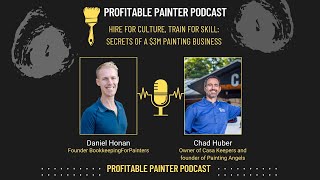
Chad Huber built Casa Keepers to $3M with 12 people by hiring for culture and training skills. He uses Patrick Lencioni's Working Genius to match people to roles, and just launched Painting Angels, an all-female painting company designed to bring women into the trades.
Chapters
Welcome to the Profitable Painter Podcast. The mission of this podcast is simple: to help you navigate the financial and tax aspects of starting, running, and scaling a professional painting business. From the brushes and ladders to the spreadsheets and balance sheets, we've got you covered. But before we dive in, a quick word of caution: while we strive to provide accurate and up-to-date financial and tax information, nothing you hear on this podcast should be considered as financial advice specifically for you or your business. We're here to share general knowledge and experiences, not to replace the tailored advice you get from a professional financial advisor or tax consultant. We strongly recommend you seeking individualized advice before making any significant financial decision.
Welcome to the Profitable Painter Podcast. My name is Daniel Honan, the founder of Bookkeeping for Painters. I help Painting Businesses Know Their Numbers and What They Mean and Save Big in Tax. And today, I'm super excited to talk with Chad Huber. Chad has a very successful business in Texas. And today we're going to dive into his journey, what he's accomplished, and what things he has for the future. So super excited to have you on the podcast, Chad. How's it going?
Thanks, Daniel. Doing well. Thank you. Thanks for asking. I'm glad to be here.
Awesome. Let's, let's get into things. So you've had quite the journey in the contracting industry. How did that journey begin, and what have been some of the most defining moments along the way?
Well, let's see, my journey in, in contracting actually started as a customer. Uh, I was, uh, had an optical store that was relatively successful and enjoyed doing that and decided that I would flip some houses on the side. And the more contractors I dealt with, the more frustrated I became and how they ran their business. You know, I figured out if I ran my optical store like a lot of contractors ran their business, I would be out of business. So through the years, started doing a little more myself and put together a little team and figured out I enjoyed it. And so we're, uh, 20-something years down the road, a couple of adventures in different ways, but I've been doing it for about that long. So I came into the business of contracting not as a carpenter coming up off the tools, but really just seeing the need in the business and enjoying doing it.
Okay, so it sounds like you— because a lot of folks, especially in the contracting industry, that's kind of how they start, is they, they had a skill. They had their carpenter, their painter, drywall, whatever skill that they had. And but it sounds like you, um, you basically, you came at it from a business perspective, correct?
Yeah, I grew up, uh, one of two children from a single mother. We had, I think we had a pink toolbox in the house maybe with a, you know, screwdriver and a hammer and a tape measure and a set of Allen wrenches. That was about my tool education as a kid. But growing up and in my late teens and early 20s, I did kind of enjoy tinkering around and, you know, making a few things, but never in carpentry as a career. Not until I was in my, I guess, late 20s and early 30s when we started flipping houses that did I even own a saw.
Yeah. And, and so That must have been a pretty intense interaction that you had with the contractors. Because it's not often like, because that's a common thing, you know, with having that bad experience with contractors. A lot of folks, to include contractors themselves, have had those bad experiences. But you actually took it to another level by like, hey, I can do this better, I'm going to actually solve this problem. So folks don't have to go through this. Um, so that you really took it into your own hands. So what happened? Like, what was so bad that made you actually start another business and, and solve that, that issue?
So keep in mind, this was back before everyone had a cell phone attached to their hip all the time. And I had— I would, I would leave my, my profitable job and I would go meet a contractor. So they would say, hey, we'll meet at this house at, you know, Tuesday at 8 AM or Tuesday at 9 AM. So Tuesday at 9 AM, I would leave and I would go drive to the house and I would wait and I would wait and I would wait and they wouldn't show up. And maybe a day or maybe 2 days later I would hear from them and they would say, yeah, I got tied up at another job. And, uh, no, no notice, no, no heads up, not even a stop by. This was again a long time ago, so you might just pop in. They knew where I worked, I was there all day. And it was just that lack of communication over and over. I can remember having projects that were supposed to have a defined end date, and maybe I had a house I needed to put on the market, and we would go a week before that date only to be told that they were still 5 or 6 or 8 weeks out. No communication in the middle, really. The business aspect was what was very frustrating. I enjoyed seeing the homes get transformed. That's still my favorite part of the process, is the before and after. But, uh, just seeing how poorly, uh, contractors ran their businesses was the frustrating part for me as a customer.
So it sounds like that experience was very stressful and had a lot of bad communication in it.
It did. Very disrespectful. Yeah, I think that's, that's part of the, the issue that we fight as all trades, you know, whether it's painting or tile or carpentry or general contracting, is being able to be good communicators and treat people just like we're in any other industry that requires us to keep somebody updated. I tell clients these days, when you take your car in to be serviced, the mechanic will take a video of what he finds in your car and send it to you in a text message to your phone so that you can tell, you know, what their progress is on your repair. And yet sometimes in the construction industry, we expect people to go 2 or 3 or, you know, 4 or 5 days, even a week before they have an update. So it's, it's just a different world.
Yeah, it, it sounds like— so actually getting those updates to clients can really enhance the experience because they when there's no communication, that's when folks start to feel like, okay, is anything getting actually done here? Do I need to, you know, dig into this further? It's increasing the level of stress when they don't hear from someone they've hired and paid money to, to do a job. And I noticed one of the, you know, you're the owner of Casa Keepers out of Texas. And one of the core values, actually, You have two core values, three core values. Looks like on your website you have low stress, like your promise to your customers is that they're going to have a low stress experience and also you're going to have good communication. And it sounds like in that, that bad experience that you had with contractors that spurred you to start your business, it translated into your kind of your promise to your customers that you weren't going to have them be stressed out or communicated in a poor fashion. right out the gate.
Yeah, that's well said. Feeling the pain point, I think that's what helps us be different, is feeling the pain of a customer going through that process, uh, you know, the client journey several times and being frustrated with how it happened. I think that, that helped us to develop a company culture that's different on purpose.
Yeah, and that's big because it's easy, I would say, you know, if you're a sole proprietor or someone that's doing a solopreneur that's doing everything, you might be able to have those those values and be able to execute that, you know, okay on your end if it's just you. But you have a pretty large team over there at Casa Keepers. Where are you now in terms of your business? Like, how big is the business, Casa Keepers?
So we're about 9 years old. I think we just crossed our 9-year anniversary this past month, and we've got 12 people on the team. We are— we run in the construction world what you would call like a lead carpenter model. So we have one person who's assigned to a project, even in renovations, from start to finish for that communications-centric ability. So we have one person assigned to deal with that particular client. We're about $3 million in total revenue is our goal for this year, and it should— looks like we're on track at the end of April to get there. Excellent.
Excellent. And, and having that larger team at $3 million, 12 carpenters, You know, 12 people, that's entirely my sales staff, myself.
That's 12 people on the team.
Okay. 12 people on the team. Excuse me. You know, having that larger team, um, it becomes a challenge to ensure that the thing that you think is important, that you feel is important, like providing that low stress experience, having that communication, that cleanliness. How do you ensure that that gets filtered down to your team, that everyone's on the same page? Providing that customer experience?
We do take culture very seriously. That's something that we talk about often. We, you know, skill, I believe, is something that can be trained more easily than culture. So we try to hire people who understand our culture, who feel like treating someone's home with respect and conversing with someone as a professional is kind of who they are. You know, they want to be a place that they would feel comfortable working. And then whatever skill they may have or not have is kind of secondary is whether or not they get it. So, you know, the old saying of getting the right people on the bus and the right people off the bus and the right people in the right seats on the bus. So we don't fight culture very often because we hire for it.
So you, you hire for culture first. That, like, that's the most important thing, it sounds like. And skill is kind of a secondary thing, kind of might, may or may not need it, but you're really focused, it sounds like, on making sure folks have the right culture fit for your organization.
Yes, we are. That's, that's fair to say. And also, one of our core values is that you kind of be a lifelong learner, that you like, you know, you don't get stuck. And so if you hire somebody who doesn't have a particular skill or even has never done a particular job before, but they like to learn, then having the right person, the right culture who can learn a skill, that's, that's golden.
That makes sense. So that's kind of how you compensate. Like, you hire for culture, and part of the culture is that they like to learn and they are open to that. And so that's how you kind of make up for the fact that they might not have all the precise skills that you want them to have. But if they're, you know, have the intelligence and the desire to learn, they can easily get caught up and on track, it sounds like. Absolutely, yes. Yeah, I think that's, that is a really cool way to approach it. And how do you actually, you know, what we're saying, hire for culture? Some folks listening might be like, okay, how do I hire for these kind of abstract ideas? How do you actually implement a hiring or recruiting process that will get somebody who is really good at communication and likes to learn? Like, how do you pull that out of folks and screen for that as they move through the recruiting and hiring process?
I think it all, for us at least, begins with an ad that sounds like us. You know, when we place a help wanted ad for whatever position, it has all of those words already in there. You know, it kind of describes how we work, you know, and the tone. I said the tone of voice. You know, in marketing we have a thing called a tone of voice. Well, in hiring you have the same kind of thing. It's a tone of voice. And so if somebody's very rough and, you know, it's kind of a gruff personality, they will probably find our ads and our website and our materials not to their liking. They will self-filter. You know, we do the same thing with clients. We want clients to feel a particular tone when they look at our business. And so some people just self-filter out if that's not a good fit for them. So that's our beginning, is just we write to the people that we want to hire and to the right people. It kind of resonates.
That sounds like very similar to what you might learn on the marketing side of things. You, you kind of have your client avatar, you know, like your who do you want to, to reach out to in your, your marketing copy and you who do you want to speak to? And so you're doing that the same thing on the recruiting side. So like, who do you want to speak to? To identify like who's going to be a great fit for our team. And then you develop that, that copy or the, you know, the kind of the recruiting copy, I guess you could say, and make sure that it calls out to that, that candidate and that they feel attracted to this position because you're saying all the things that they, they also value.
Yes. Yes.
Awesome. So, and so you have the recruiting posting or the job ad, and so you're calling out those things. And then I'm assuming in the interview process, there's like questions about culture as well, or like how do they react in certain situations? Is that how you kind of determine based off their responses if they're a good culture fit?
I would say we'll do, you know, we've all done the interview questions or most of us have done the interview questions, you know, name a time when you've had conflict. And how you resolved it. And I think that's— it's less helpful in reality than it seems on paper. So conversations are number one. We also try and offer something to talk about. So we use the Working Genius personality assessment for workflow. And we hire by that Working Genius. A particular position may require a different set of working geniuses, of skills and natural aptitudes. And so in discussing those things and discussing maybe past work experience, It helps us to get a feel for whether someone, whether someone would fit the needed position in a way that both fulfills them and fits the position goals. So it's a lot of questions, a lot of stories. I wish that there was just boxes that we could check. But, you know, people to people, it's, it's hearing about their story, maybe how— what they've done in the past and what their goals are for the future. And if those align with what the position needs. Okay, cool.
So it sounds like you're using Working Genius. There's a book, I can't remember who wrote it, but it like outlines the 6 types of Working Genius. Is that, is that the framework that you're using?
That's it.
Yeah.
Patrick Lencioni, The 6 Types of Working Genius. Okay. And we use that for both our client journey and our hiring to make sure that we're fitting all those pieces to the widget, as they call it, to get the process just right for people in the right place so that they feel like they're natural gifts and abilities are also at use in their job.
Okay, so it sounds like you use it for the recruiting hiring process but also the customer, uh, experience as well.
Yeah, we do. So the idea of the Working Genius is basically, you know, you can come from a— they use the airplane analogy a lot, you know, 30,000-foot view, a 15,000-foot view, a 12,000-foot view, and then you're on the ground. And projects go from that, you know, a client first kind of wonders what they could do, and then they have to filter down to the things that they actually can afford to do or may want to invest in doing, and then they need a plan to integrate those things. And then they need the, the person, the galvanist, to put things together to actually make a work plan and make it happen. And then we need the attention to detail, which is our tenacity at the end in the Working Genius model. So we try to have the right people with those internal natural giftings in that position so the client feels like their journey is seamless, and then all those pieces have been involved and they don't realize it, but it's just part of mapping their journey for them.
Hmm, that's really interesting. I never heard of anybody doing something like this before, so that this is super valuable stuff here.
What—
where did you— did you come up with this idea, or is this kind of something you learned through reading the book and other resources through The Working Genius?
We have a local Working Genius coach, a good friend of mine named Wes Henson, and he's walked with us since the book came out to, to really implement those process— processes and to look at our business holistically because there's so many different personality styles and management style books out there. I think where, where business owners, or at least entrepreneurs like myself, tend to get themselves in trouble is chasing after the next shiny object, the next new seminar or management method. And so what we've tried to do instead of that is instead of being very wide and scattered, we've tried to go very deep in that one thing that I do think works really well. And, and our Working Genius Coach has helped quite a bit.
Excellent. So you, you've really taken the idea and gone really deep with this one idea as opposed to kind of picking and choosing through different methods. Um, yeah, that, I think that's a, a great move cuz you, that's probably where you get most of the value is going deep on something than just taking like a, a, the surface level.
Yes, we had a carpenter. One of my favorite examples, we had a carpenter whose working genius was wonder. So wonder is somebody who loves a blank piece of paper. They just like to think, you know, what could be in the world. That's a terrible gift for a carpenter. You actually, you're way, you know, you're not 30,000 feet in the world of being an entry-level carpenter. You know, you need to be in tenacity. We got to make sure that the nailing pattern is correct and the door's plumb and square. And, and so we actually coached him into another position with a different company. I love him, he's a great guy, but it was not going to be something long-term that he was going to enjoy. And, uh, and now he's somewhere doing something else and, and doing kind of more of what makes him come alive.
So that's, that's awesome. You actually coached him into a different position at a different company, which, you know, I think that, that says a lot because, you know, most of the time I think most people would just pretty much fire them or something like that and say best of luck, but you don't— you don't fit here. But you actually took the, the extra steps to, to get place somewhere else, which I think is really cool. And so, was he identified as a Wonderer or a Wonderer working genius before he came on board, or was it like you implemented it and then realized this person on my team is in the Wonderer status? Not great for a carpenter.
So he was already on our team, but he was an apprentice. So he's a really young guy who came on as an apprentice while he was getting out of school. And so we didn't at that time do the Working Genius assessment with, you know, kind of the really truly entry-level positions. So then when he moved up into a full-time carpenter and became, you know, essentially a career— looking to be a career employee— is when we did that. And we all kind of stood back and went, that's not going to be great long-term, you know, not going to be great for him, not going to be great for us. And nobody wants to go to work every day and be frustrated with what you're doing.
So Yeah, that— yeah, definitely. Um, no, I love it. So, so you've, you've had Casa Keepers for many years. You've built this company to, you know, about $3 million with a, with a solid team using Working Genius. Um, and I know you're, you're trying to, uh, add another company to your portfolio and get into the paint and finishing industry. Could you tell me a bit about what you're doing there? Absolutely.
So, uh, Painting Angels is the name of this company that we are starting. We should be putting paint on walls in about 30 days, so maybe when this podcast hits, might be our first month of working with clients. But basically, Painting Angels is an idea that, that is born out of, of my life story. It's an all-female painting company which is odd because I'm not a female nor a painter. But I am the child of a single mother, as I mentioned earlier, who by the time she found herself as a single mom to, to two of us, had kind of lost the ability to on-ramp onto a career that could do anything but help her just survive and feed the kids. So that, that theme has kind of been worked throughout my life. My wife and I served as missionaries to orphanages in Mexico. And one of the things that we ran into over and over down there is quite often an orphan was an economic orphan. It wasn't a physical orphan. This wasn't a kid whose parents had died or, you know, left them. It was typically the case where it was a single mom and they couldn't work enough hours. They didn't have enough skill to be able to support a family. And so the kids would have to go to a children's home or an orphanage to be cared for. and, and the mother didn't again have kind of an on-ramp into a way to get out of that poverty mentality. So fast forward several years, and, and I'm in a residential general contracting environment, and one of our pain points is always painting and finishing. It's both a thing in my region that tends to go to what I would call a high labor but low skill workforce. Folks, painting companies in my region tend to hire whoever can show up with a brush and put them on, you know, in an occupied home. And so we, we have a breaking. We have a lot of opportunity where that's broken with our brand, with our brand promise, where my painter may have said they'll put quality people in the client's home, but then the reality is that hasn't happened. So it's caused us to have to reel that back in. And as I thought about those two things, I thought, you know, I've known some phenomenal female painters through the years. What if we had an all-female crew? And what if that all-female crew could serve both markets, could be a reliable, detail-oriented, professional, kind of a low-stress solution for painting occupied homes, and at the same time offer an on-ramp into the trades for women who may not have another way. You know, painting is a, is a high profit margin if you do it well. It's a really good profit margin business in the trades. And if you can bring in a lady who's never painted before but has a high drive to succeed and bring her all the way from— this is how we tape off, this is how we, you know, cover floor to how we go all the way into cutting in and faux finishes and make it to a point where she has a pathway to begin earning an actual career, you know, real income. I think those two things go together very well.
Yeah, and I think there'd also be— because there— the— these women would be focused on interior painting as well, right? Yes.
So the market is actually just interior painting. Um, preferably interior repaints, but probably some new construction as well, but just interior and cabinet finishing, faux finishing, uh, hopefully murals. I have a local muralist that I think she's going to be able to work with us part-time.
So, okay. And, and I would think, you know, most the residential repaint market, the, the, the client avatar is probably the, the wife oftentimes. You know, where they're the ones kind of taking care of the interior space of the home and ensuring that it's, you know, beautified. And so I think it might also appeal to the client avatar, you know, having, having someone where they feel more comfortable, you know, instead of having a bunch of, you know, rough, roughnecks coming in into your home you know, you, you have that female touch and that might be a little bit more, uh, you know, digestible and, and make those, that, that client avatar feel more comfortable. Um, I would, that would be my hypothesis. And I think I was at the Women in Paint conference, uh, for the PCA Painter Contractors Association. And, um, that was actually brought up as well as that there, there are some female painters that run businesses and they, they feel like that is an advantage, that being a female and working with, you know, those, those, uh, uh, female client avatars actually kind of helps, you know, especially doing that interior work.
Yes, you've said it, said it very well. That's exactly how I see the market as well. When I describe the concept to other builders or to people who are maybe clients but educated clients, you know, we have a lot of our clients who've turned into advocates, you know, they understand our business, and I've kind of explained it in my goal And, and when I tell somebody, you know, let's say I'm going to tell you as a client, Monday morning, Daniel and Chad and Bert are all going to show up to your house at 8 a.m. We're going to paint for 8 hours and we're going to clean up and go home. Or I say Monday morning at 8 o'clock, Sally and Betty and Karen are going to show up to your house. They're actually going to show up after they drop the kids off at school. They're going to paint for 6 hours, then they're going to clean up and go pick up the kids from school because they have daycare. You know, nobody wants to pay for daycare when you're working a full-time job. You kind of internally who's going to probably be cleaner, who's going to clean up better, and how much more efficient a group of moms could be, let's say, in a 6-hour workday versus you and I in probably an 8-hour workday. Anybody I think who's been married more than a couple of years doesn't have to have that explained to them.
Yeah, yeah, definitely. Um, I'm the messier one in, in my, uh, relationship. My wife is definitely a more cleanly person. I think that's generally true, and it also makes sense. Like, if you've ever had a house cleaner come over, it's almost never a guy, you know. Like, and, um, if it's also nicely into your core values over at Casa Keepers, you know, because you have that cleanliness core value, and, um, so it just makes kind of sense women painters will probably be more focused on cleanliness than, than a male one.
And it's not— I feel bad every time I explain this, especially is when I'm talking to painters. I know fantastic, you know, male painters. There's not a— I'm not digging one in order to promote the other one. I'm just saying I think there's a market out there that, that is underserved in that residential repaint with the brand of number one, being stress-free. It does relieve stress to have women in your house. I have 4 kids. When my kids were younger, if I knew that there were going to be 3 guys in my house for the day, it's an entirely different feeling than 3 ladies in my house for the day. It just is. And then you're right. I think if I, if I personally was going to finish work for the day and I can set my ladder and my bucket and my wet rag off to the side and forget about it until I'm going to come back the next day. I don't know too many women who can do that. They're actually going to clean up the whole thing and put it all away for the next day. But I know a lot of men, painters and carpenters, we, we kind of compartmentalize, and we will be happy to leave our mess sitting right out if we're just going to get back to it tomorrow. And that's not a good image in an occupied home.
Yeah, yeah, absolutely. It makes sense on, on many different levels. Well, while you're, you're talking, I was just thinking like, because we do occasionally have house cleaners come over and you mentioned kids. I have 4 kids and one of my, my daughter, she's 5 and she loves one of the cleaners that comes over every week and is excited to see her. And, you know, the, and the, you know, the cleaner is just a young lady. And, you know, I just feel like females are typically more inclined to talk to kids and like, build that little rapport, you know, and then just enhance that experience, which I think is what you're aiming for, you know, enhancing that overall experience for the customer. It's just those little things. I think that females are probably more suited to handle inside of the home.
Yeah, I agree. So maybe we'll touch base in a year and I'll tell you how it went.
Yeah.
Yeah, and yeah, no, I think, I think, I think it will definitely, uh, it makes, it makes too much sense to not, to not work. But, um, where are you kind of at in the business? You said, uh, next month is, is kind of the launch, the official launch.
Yeah, so we have, we have all of our IP in place. This idea is about 3 or 4 years old. It took me a while to actually decide that, that now was the time, you know, just family related and kids heading off to college and all these things going on. So So in January of this year, I decided this was going to be the year that we launched it. So, uh, got all of our logo and branding and waited out a website purchase so that I could get the domain name that I wanted. And, um, we should have our website live in the next couple weeks. I've been putting out feelers for, um, for painters for the last 6 or 8 months. So I have a good kind of a small crew of locals that are going to help us get off the ground, and then we'll begin the hiring process to be regional. And so I'm really thinking our goal for this year, uh, we're gonna say May-June start, we should do about $360,000 is the goal for the rest of this year. And almost all of that will be plowed back into marketing and growth as we, we try and get regional bite in our area of Central Texas.
Nice. And are you going to keep similar kind of core values that you, you have in Casakeepers for this, uh, new painting venture?
Yeah, very similar. I mean, you know, they say a small business tends to look like the owner, right? You know, it kind of takes on your flavor whether you like it or not. So that is part of— it's part of who I am, it's part of the company that we build at Cosmic Givers. That's what we'll do with Painting Angels. The main difference will be, at least in, in the branding and marketing, and then how the work is done, is we really want to place a very big emphasis on the social impact. Not to keep hearkening back to this, but we are facing two big crises in America at the same time. One of them is we have a lack of people coming into the skilled trades, the skilled trades. They say the average age of a tool-wearing professional carpenter, plumber, electrician, professional painter right now is 56. They're retiring at a rate of 5 a year and we're only replacing them with 2 people per year. So sure, we have a lot of bodies. You know, I think we've seen that in my region of Texas, a lot of, of unskilled or, or foreign labor coming in to put their effort but not raise the skill level, you know. And so I think we're going to be able to train into that skills gap in painting so that we can do a really good job, make it, make it a professional trade in our region. So we have— we're facing that, and then we're also facing inflation. You know, it's very difficult for a single mom to make ends meet on what an entry-level or an admin or maybe a restaurant job pays. And so my goal is that we, we meet those two and be able to have painters making, you know, qualified painters making $60,000, $70,000, $85,000 a year, enough to support a family.
Yeah, no, I think that makes a lot of sense. Um, so along with the keeping the core values from Casa Keepers, you're, you're also So seeing that gap and trying to make that social impact and solving that issue, again, you solving problems, that's like a big thing. It should be a big thing for entrepreneurs is you finding a problem and trying to solve it. But the problem of lack of skilled tradesmen and tradeswomen and getting those folks trained up, having an on-ramp for them and getting them trained up. And, and provide— to allow them to provide that, uh, provide for their families and, um, you know, to keep up with inflation. So I think, I think you're doing a lot of amazing stuff, Chad. I mean, this has been a great conversation. I mean, what, where would you like, uh, do you have any ask of listeners of, um, if they want to reach out with you or learn more about Painting Angels or whatever you got? Is there anything that you'd like to, to ask the listeners?
That's a really good question. Um, so they can reach out, you know, at our website paintingangels.com or to me, chad@paintingangels.com. Uh, and I think the main, uh, probably the main helpful things that would be really nice to know is where have my peers found solid training to take someone from, you know, never having held a brush to being to being put in and brushed rather than just putting them out in the field. So we're looking at the PCA's training, and we're probably going to start with there. I think that's a really solid place. But if there are any other options or programs that I'm unaware of, I would love to have some help on how to help more women learn how to do this well so that it elevates the trade of painting in every place we touch.
Yeah, yeah, definitely. That makes a lot of sense. Uh, PCA, I know, has some resources like you mentioned, and then the I know a lot of folks have tried doing the charity paints, especially it's kind of like a dual role, train your painters, but also get some positive PR. But yeah, that's a great question. So listeners, if you have any feedback for Chad, definitely reach out and, and, and we'd love to, to hear more from the listeners as well. If you go to the Facebook page Grow Your Painting Business, you can definitely join the conversation, ask questions there as well. We'll pass them along to Chad. And, uh, I really appreciate your time today, Chad. Um, and for the listeners, we will see you next week.
Thanks, Daniel. Appreciate you. Thanks for having me on.
More from Daniel







What’s REALLY Holding Your Painting Business Back? (Find Your Bottleneck in 5 Minutes)



