How One Painting Company Generated $4,000 Jobs for Just $100 in Marketing
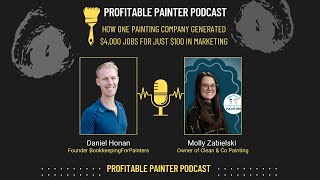
Molly from Clean and Coat Painting built a residential painting company to 200+ customers in under a year by spending just $100 per customer acquisition. She used Facebook and Instagram ads with personal founder videos, integrated lead forms with CRM automation, and achieved a 39% close rate on $4,000 average jobs.
Chapters
Welcome to the Profitable Painter Podcast, the show where painting contractors learn how to boost profits, cut taxes, and build a business that works for them. I'm your host, Daniel Honan, CPA, former painting business owner, and your guide to mastering your numbers that drive success. So let's dive in and make your business more profitable. Welcome to the podcast, Molly. How's it going, Molly?
Good. How are you? Thanks for having me.
Yeah, I'm excited. I'm super excited to dive into your story. I think a lot of folks are going to get a ton of value. So I'm super excited today. And Molly, can you just kind of give me the rundown of what your journey has been in the painting industry? Like, how did you get started and what are some key milestones that you've kind of hit along the way?
Absolutely. So my business partner Jacob and I started in the industry actually working for more of a corporate franchise company when we were in college, and we grew a love for working with homeowners, which translates into now our primarily residential company. Um, but we, when we were working for that previous company, we saw a lot of opportunity for growth within the industry. So we decided to start Clean and Coat Painting in August of 2023, and we've had the opportunity of working with about 200 customers, homeowners, since then. And, um, social media has really been the driving presence for our company up to this point.
Awesome. You guys have had a, a really strong start. This is pretty impressive. And Um, you mentioned a corporate, uh, company. Was that like College Works or College— one of those, uh, internship programs?
Yep. It's super similar. Student Painters or Young Entrepreneurs Across America. Um, but it's super similar to College Works.
Okay, cool. And so you started with that internship with them and it sounds like you did like a, uh, a summer internship and then you're like, hey, this would be cool to do on, on your own? Is that how it kind of worked?
Or— yep, absolutely. Actually, all 4 years, all 4 summers after college, we were working, um, doing just exterior painting through Student Painters. And again, we saw a lot of room for growth and professionalism within the industry, so we thought, why don't we, um, start, start our own company? And that's exactly what we did in August of 2023.
Okay, so it sounds like you did You actually worked with Student Painters for a few years, is that right? Yes.
Okay. Jacob was technically the branch manager or I guess franchisee, and then I was his production manager. So we both worked very, very closely with the homeowners.
Gotcha. Okay, nice. And so, and then once things were going well there, you felt like you could kind of do this on your own and, and kind of create your own thing? What was like the, the thing that kind of drove you to, to want to set out on your own?
Sure. So they have a pretty decent business model, but they, they really haven't relied on any new technology, softwares, or even social media. And that's definitely a huge thing nowadays. Everybody wants to see that you have a good built-out website. They want to find you on Google, they want to see your reviews. And we— that was something that was really fun for us. Us throughout the process was taking before and after photos and videos and capturing the content. And we started making good relationships with these customers that we thought would, would translate well into our own business and we'd be able to kind of take off running like we did. And we were able to very quickly build a good social media following and presence there to help new clients and returning clients feel comfortable with our work, even though we are a bit young in the industry.
Gotcha. Okay. So it sounds like the Student Painters, they were doing mostly, was it door-to-door marketing type?
Yeah, that's exactly it. Most of our marketing through Student Painters was door knocking and putting out door hangers and yard signs. We did sort of take a little bit of that yard sign approach to keep the community awareness within our new company, Clean Coat. But then we really heavily relied on Facebook and Instagram and Google as well to get our online presence growing.
Gotcha. Okay. So you, you guys probably got pretty good at guerrilla marketing using the door-to-door. And now with the new company, Cleaning Coat, you're taking what you learned there, but also adding on Facebook ads and also just organic Meta awareness as well, it sounds like.
Absolutely.
Okay, cool. And I know you've had some, some real success with you know, Meta ads and, uh, organic type interactions. What have you guys done to, to kind of see the results that you've done? Like, can you just walk me through what are you guys doing now that's, that's seeing success?
Sure. So I would say our first approach, which really helped, was building out the organic side of all of our social media, consistently posting at least several times a week, at this point several times a day, and always keeping our ideal customer up up to date on what our company is doing. So ensuring that the content that we're posting is aligning with the type of customer that we want to work with. So essentially, do they want— does your customer want to hire a team, or do they want to hire someone who maybe is a one-man show? Or do they want to hire someone who really takes the time to prep and clean all of their floor when you're done and cover all of their furniture? Or, you know, is quality maybe not so much of, of an issue for them, I guess, or a value for them, I guess. So we make our content tailored to what we know our ideal customer wants to see, which is a high-quality result and taking our time to deliver all of that. And I guess that's really what changed things for us. I used to just make my content almost looking— everything looked like an ad. It all had lots of words on it and a lot of call to action on it. And I thought that was the best way to move forward with creating the content. But I met with, with some other marketing agencies and they kind of gave me some great advice and told me, you know, keep that to about 10% of the actual content and the rest of it, just try to make it as engaging as possible. So as soon as I kind of switched up and started making my content more engaging rather than ad-like, that's when I really started seeing more followers and people actually wanting to stick around for the future content. Um, and then piggybacking off of that, I do try to organically share my content into Facebook groups. So I will join Facebook groups that are within my service areas and, um, share it daily, sometimes twice a day. You have to make sure you read those rules and, and conform to the group rules, otherwise your page will get less views on Facebook. Um, but yeah, um, sharing into those groups as well really helped us gain a lot of followers. And then once we did start sharing those ads, um, if they click on your page, they have content to see. It's not a blank canvas, or, you know, they don't see something from 2024 and wonder, oh, are they still even in business? Um, they see that we're actively working every single day.
Okay, so it sounds like when you initially started posting on Facebook— and by the way, is this a Facebook business profile, or were you using your personal?
So I use both. Um, I'm, I'm pretty much everywhere on social media, so I post on both my Facebook business page and my personal page, which is really only business related. Then I have a personal and business Nextdoor page, so I post on there each day as well. And then on Instagram, I have our business page, so I post there daily. Um, and then I, I try to post to both Google Updates and to YouTube as well, um, as, as often as I can, but I will say that's not quite daily yet.
Okay, so you're using both the Facebook business and the personal and other accounts as well and post in Nextdoor, and you're posting there almost daily, and daily in some cases. Now, you mentioned sharing in Facebook groups as well. Are you like going using your personal one or your business account to get into the Facebook groups? Because I know, and the reason why I'm asking this is like, I know the Facebook business accounts, like whenever you post, unless you boost the post, you don't really get a lot of engagement. And I'm wondering if— did— have you used your Facebook personal page more? Or is it just like you use one for one thing and one for another thing? Like, I'm just trying to understand how how you're getting that engagement, because like that can be a challenge, especially if you're just using your Facebook business profile.
Yeah, that's a really good question. Um, so I am essentially just using my business profile for the sharing because a lot of the Facebook groups have some pretty strict rules, especially when it comes to businesses, because they don't want to see a lot of, um, basically spam or scamming within their pages and some of their users, um, or people that are part of the groups, they don't like to see a whole lot of business stuff on it. So you definitely need to read the rules and make sure that they do allow businesses. Some of them will allow you to post daily, some of them will allow you to post once a week. So make sure you're following that, um, because once you do start getting rejected from those, that will kind of hurt your engagement. Um, but I try not to post from my personal page for that reason, because they don't know that I'm a business, and I don't want them to feel like I'm being sneaky and then get kicked out of the group. Um, so I do post from my business page. But to answer your question on how to keep that engagement up since it is a business page is I try to keep our employees or myself in almost all of the content. So I will take before and after of just, just the spaces that we're working on, interior or exterior, without anyone in it. But majority of my content has either my face and I'm talking about the project, or one of our team members is within the photo. So people are more likely to pause, take a moment to read it. And if they like what you look like, if they like what your work looks like, then they're going to follow along and hold on to your contact for future reference or potentially share it with other people.
That makes a lot of sense. I've heard somewhere where basically humans want to see other humans' faces and it's more engaging on social media. So it makes complete sense that you're, you're, you try to incorporate yourself or your team members. In those social media posts with video or pictures so that it's just, it catches more eyeballs and gets more engagement. So that makes complete sense. So, so that sounds like, it sounds like the way that you're getting engagement on your Facebook business profile is not necessarily, is more about what you're posting and the types of things that you're using in your posts, like images, videos of your team members, um, rather than anything else. It seems like that might be the primary driver. Is that, is that right?
I would say it's, it's huge. Um, if I wasn't sharing into those groups, I don't think that my page would be noticed nearly as much. And, um, now I'm sharing into like 100 groups or so every day. So it's, it's a lot of, um, but, but Facebook's made it easier. They're, they're allowing you to share to about 10 groups at a time and they do change it often. And it's weird, sometimes it'll be 1, sometimes it'll be 3, sometimes it'll be 20. So it's nice to see that right now they're holding it at that higher amount that you can share 2 at a time. But I do think that our Facebook ad has gained an incredible amount of following in our profile since we started the ad. We've probably gained— and we started this one specific ad that I'm referring to about 2 and a half months ago, and we've gained probably 70 followers just from the ad. And it will tell you Oh, this person followed you based on your ad or based on this reel. So that's how I can track those back to the ad in particular. But this ad that I'm referring to, Jacob, my business partner and I, we are inside of one of our clients' homes that we had done more than one project for. We actually like legitimately jump into the screen and we're like, hey, it's Molly and Jacob with Clean Co. And then we just go into some detail talking about our business, talking about the services that we offer, you know, why you can trust us, and essentially a call to action at the end. And it's just changed. It's changed the way that our new leads are interacting with us. They feel like they know us because they're seeing that ad initially and seeing a very personal side of us. And then they're going to our profile and like you said, they're seeing all of that organic content that has our faces on it. It shows who our team is. It shows exactly what our processes are. And so they, they either follow along until they're ready, or if they're ready, they they reach out to us and they feel like they already know our business and know what we're about. And it's gotten to the point where we're going to these sales calls and we're knocking on their front door and they open the door and they're like, oh, you look just like you do on social media. Or they say, oh, I feel like I've known you for years. And it's great because now they feel comfortable before we've even actually met them in person or even stepped inside of their home.
Yeah, that's awesome. It sounds like you've really built that connection with them ahead of time, which is helping you build that trust, trust to make it easier to close the deal.
Yes. And one thing I will kind of follow up on regarding building that trust is once they do fill out that Facebook lead form, um, and I'll talk a little bit more about the specifics in the form that are important to make sure that you're getting good qualified leads. Um, but once they do fill out that lead form, we are automatically sending them an email and text message through DripJobs, who we're using as our sales software and CRM right now. And I will immediately call them to, to set up the appointment. And that's something that has changed more recently is I've been able to step more full-time into the office administration role to be able to get to those leads a lot quicker. So it's helped with our set rate. Um, but I'll call them immediately to set the appointment. If I don't get ahold of them, they're going to continue to receive those automated follow-ups within 24 hours, 2 days, 3 days, 5 days, 7 days to make sure that we are booking that lead that we just paid for. Um, And then once that estimate is actually scheduled, they're getting an automated email and text confirmation with the address, date, time that it's been scheduled for. But they're also getting a video of me saying, giving an introduction saying, thank you so much for scheduling this appointment with us. We appreciate you putting the trust into us with your home. Here's what to expect with our process and a little bit more about our preparation, more about the painting process, more about our team. So again, they feel like they know us before we even come show up to do the sales pitch. So that's been something that I think has been, been pretty big for us.
Oh yeah, it sounds like it for sure. So to recap, so you have your business, Facebook business profile, and you're creating that engaging content, you're posting that a lot of those posts are going into Facebook groups that are in your area. And you said you have like 100 that you post to, but you you make sure that you're abiding by the rules for the Facebook group so you don't get kicked out. From there, those folks in those groups are engaging with your organic content. And then from there, you've layered on Facebook ads so that with a really engaging video, it sounds like with you and Jacob in the video and helping a client of yours. With the transformation. And so that's getting a lot of positive, um, you're getting a lot of leads from that, but you also have that organic to back it up. So if they check out your Facebook business profile, they'll see like, you guys are posting all the time every day. So, and, and they might be a follower already, or they might follow you then. And then once that lead is submitted, through the Facebook ad, using drip jobs, you're very quickly sending them, you know, getting them scheduled for an estimate, you know, through text, email, and phone call follow-up as quick as possible to try to set them on the estimate calendar. And then once they schedule, then you're doing even further, like confirming the appointment, sending them another video and that sort of thing. And it sounds like this whole thing is just trying to build trust. They get really familiar with you. They, uh, and then you're quickly setting them and then continuing to build the trust through more communication. Does that sum it up?
Yep, absolutely.
Okay. Now that sounds really amazing. And would you mind sharing like some of your, your numbers for your, this, this sales process, like your, your set rate? And, and that sort of thing?
Yep, absolutely. Um, so when we first started looking at the Facebook ads, there's so many different metrics to, to look through, so we got a little bit overwhelmed with that. So we've kind of tailored it back and tried to only really look at our overall advertising cost, specifically, especially through Facebook, because that's our, our number one source right now. And, um, like, our set rate right now through through Facebook. I think the industry average through Facebook ads would be around 30%. Um, we're hovering closer to 39% on the set rate, and I'm hoping that's because of our extensive follow-up process. Um, and for our sales closing rates, um, I, I don't actually know the industry average on this, but we're right around 39% on that as well. Um, so we're our, I guess our closing rate on the Facebook ad source is a bit lower than any of the other sources. However, the job size has gone up more so than any of the other lead sources, which we're a bit intrigued by. I'm wondering if that's because they, these potential customers are seeing our work and seeing similar things that could be in their home and thinking, oh, I might want that done as well. And then when we get in their home and we start quoting, they see how fast we can get through the quote in the presentation that they're like, well, how much would it cost for this too? And that as well. And then they keep adding on. So that's been great to see, to see that average job size go up as well. And then our cost per lead, I've had about 2.5 months or so of this ad to go off of for this number. So obviously it'll go up, but right now we're at about $15 per lead and I know the average is is about $50.
Yeah, that's super low. Yeah, the average is like $60 to $70 per lead. So that's, that's a lot. So $15 per lead. I mean, that's crazy. So, okay, it's exciting. So $15 per lead, you're, you're, you're setting, meaning that when that lead comes in, 39% of the time you're getting them on the estimate calendar. Yep. And so you'll need about, what, 2.5 leads to get an estimate. So you're basically paying like $40-ish to get an estimate. And then, then you're closing, you know, every, at least 1 out of 3, a little bit higher than that. And so your, your cost, your customer acquisition cost, not including the salesperson, is, is like $100. Really? That's super low. That's amazing. Yeah. Yeah. So if you have any cash laying around, definitely just pour it into whatever's happening right now. That's amazing. $100. And then you said your, your average job size is For these, for this Facebook ads, what size is the job usually, or on average?
We were previously, probably around 4 months ago, we were looking at an average job size of 2,500 or so. And now I think we're looking closer to 4,000 for our average job size. Okay.
And a lot of those, that 4,000 About $4,000 per, for each closed job. And that's coming from Facebook around that. Okay. So you're spending $100 to close $4,000 job on average. So that's 2.5%, which is super low.
Yeah.
You had a salesperson, you know, pay a salesperson to close that deal. Your, your customer acquisition cost is probably going to be somewhere around 10% of, of the job, which is very low. And if you have a 50% gross profit margin, you're looking at a 5 to 1 ratio of gross profit to customer acquisition cost, which is— that's super. We, we usually recommend like 3 to 1 at least. And so you're— sounds like with the numbers we just went through, you're on track to do like 5 to 1, which is, which is amazing. And, uh, is, um, yeah, that's, that's, that's awesome.
So we're just hiring is what's, um, what's next on the, I don't know, I guess next step because yeah, we're, we're getting those leads, we're booking them, we're, the numbers look good. Um, but yeah, we, we're booked out right now. We have 6 full-time painters and we're booked out right now through the end of June. So We're just looking to hire more and keep, keep chipping away at the work.
Yeah. Yeah. So now the problem is not, it's not the leads. You have that fixed. Now it's just getting the team, you know, to produce the work and making sure that you can stay on and not, not book out too far and, and, right, right. And keep producing the work. So, yep. That's awesome. That's a good, a good problem to have. Still a problem, but, uh, it's, it's definitely. Better than not having any leads or really expensive leads. So, um, that's amazing. So what else, um, you know, in this journey, like doing social media marketing, Facebook ads, any other like tips that you, if someone's like, hey, this sounds amazing, I really want to do this, are there any pitfalls or things that you've seen that you tried in the beginning that didn't work? Or if you're giving advice to other painting business owner, what would you say?
Absolutely. I, I do have some tips because it was pretty much trial and error for us. So a lot of people don't have a good understanding the difference between boosting posts and creating a Facebook ad, and a lot of the other painting business owners that I've spoke to thought that they had run Facebook ads but they had actually only ever boosted posts. And boosting posts can be fine on its own for an account that's already very built out and already has a large following. But I don't think that they're very effective ways to spend your money when you're looking to get in front of new faces. So you want to make sure that you're not boosting the post and that you're actually creating a Facebook ad. And that way you can customize who you're targeting. You want to make sure that your ideal customer is within that target demographic. Whether it's their age, whether it's their income, whether it's the actual location radius so that your team's not driving too far. You want to make sure that you have all of that target dialed in. And like I had mentioned earlier, the lead form is very important because we had previously set up a lead form that essentially would just take you to our website, and at our website you would then go to our Drip Jobs appointment form. But what we noticed happened, and we wasted a good amount of money on it, is people don't like being taken off of Facebook if they're already on Facebook. So you don't want to send them to your website. You definitely want to send them to a lead form that's still on Facebook. And, um, with that lead form, you want to add in at least 2 or 3 qualifying questions because Facebook automatically will save their first and last name, their phone number and their email address because they've likely input that in their phone a million times. So it will— if they accidentally click the button, if they intentionally click the button but maybe don't have true buying intentions, it's going to automatically fill out that basic contact information for them and just send you the lead. Then you're going to call them. They're not going to answer. They're going to say, what? I never even filled out your form. Why does this always happen to me? So you definitely want to make sure that you include qualifying questions. You want to ask them what zip code they're in. You want to make sure that they're within your, your service area. You want to ask them what service they're looking for. So, you know, I have 3 different options: interior painting, exterior painting, or cabinet spraying. And then again, you want to get their, their first name, last name, their phone number and email address so that you can effectively follow up with them immediately. Once you get that lead.
That's really good advice. Um, so the first one was the boosting of posts versus actually running Facebook ads. And I think Brandon Pierpont from Painter Marketing Pros, he said something to the effect of if you're, if you're using the boosting your Facebook posts, you're basically just giving money to Facebook. At like a charity because it's not going to do anything. Yeah. So yeah, that if it's really easy to give Facebook money is probably not the best route to go if it's like an easy button. Oh yeah, I'll click this button and boost it. But yeah, that, that's, that makes complete sense.
So don't take it back off of that quickly. To anybody who would be looking to outsource this, I definitely would recommend Brandon Pierpont with Painter Marketing Pros or Lucas Jensen with Forward Media Marketing. They've offered me such amazing advice and it's all immediately shown. So that's, I'll throw that out there.
Yeah, no, absolutely. I definitely agree. If you need help, definitely see, you know, one of those two guys for sure. And so don't boost your posts, actually run Facebook ads. And then the second thing you said was the lead form. You want to use Facebook's lead form, not your own lead form, because people get weird if you try to take them somewhere else besides Facebook in your ad. And then, and then adding in some qualifying questions on your lead form so that it's not just the basic name and email and phone number, because Facebook does have those, the autofill feature on Facebook ads. So you'll, you add in a couple of qualifying questions to make sure that they intentionally filled out the form. And they're, they're good leads. And, and, and that's also impressive. You know, usually with your lead cost is so low, $15, I would have guessed that you didn't have qualifying questions. But it sounds like you do. So you're doing the qualifying questions. And plus you're getting really cheap leads, which, which is really good.
It's awesome. Some other things that also definitely pair well, like I mentioned previously, the yard signs. If they're seeing you on social media and then they think, oh, on my drive to work, I saw that sign, I saw a cleaning coat, then they're potentially going to be wondering, well, what did my neighbor have done at their house? Or, you know, can I ask them about their experience? Yard signs are definitely huge for that. But also making sure that you have a Google Business Page with a lot of reviews, reviews that have photos, reviews that have a lot of detail and your employees' names to kind of give people, a more personal feel of what to expect with your business rather than the typical, oh, they did a nice job. And another thing on top of that is you can share essentially social media posts to your Google page. So they show up as updates. That's what Google calls them. And you can share basically essentially what you're, what you're posting on social media, but that'll help with your SEO and that'll help with, again, your overall awareness on Google. So that's been something that we've tried to make sure that we're doing as well.
Okay, yeah, I didn't know about that one, the sharing social media posts to your Google page. That's new. That's, that's, that's, that sounds pretty interesting. I'm taking notes. So in that, that basically, I would imagine that would just boost trust from Google, because a lot about the Managing your Google Business page is about boosting trust with Google so that Google trusts to put you out, you know, as a higher ranking company. So if you're kind of connecting social media with Google and having a lot of pictures, having a lot of Google reviews, that's probably going to boost you in the ranking. So that makes complete sense.
Absolutely. And the more photos that you can have with your company's logo, your company's name, in those photos as well, Google's going to recognize that, it's going to pair it with your business. And again, it's going to try to show you or show your page more. Because like you said, you're building trust with Google.
Yeah, that makes complete sense. Awesome. Well, Molly, this, this has been an episode just packed with value. I think anybody listening right now that wants to do Facebook for their painting business just got hopefully they're taking notes and listening to this podcast over and over again because you just threw out like so many great tips. It's amazing. So I really appreciate you coming on and going through this with the audience. Are there any asks that you have of the audience or anything you'd like to put out there? You know, whatever, whatever you got, any asks of the audience?
Sure. One ask of the audience would be that if you feel like I could offer any additional information or like I could help in any ways, to reach out to me, because all of the help that I've received from other painting business owners and their affiliates within their companies has been so helpful to my company and my company's growth. So I'd love to give back in any way that I can. So reach out to me on social media or, you know, find my website and just, just contact me if that's something you'd be interested in.
Awesome. Great stuff. Well, I really appreciate your time today, Molly. Um, I think this was a really valuable episode and for everyone that's listening, definitely, uh, reach out to Molly if you need help. And with that, we will see you next week.
Thank you.
More from Daniel







What’s REALLY Holding Your Painting Business Back? (Find Your Bottleneck in 5 Minutes)



