Knock Knock, Who’s Profitable Now
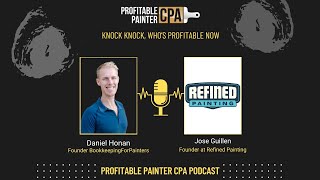
Jose built Refined Painting in Washington State to $1 million revenue in eight months with no painting experience, using door-to-door sales through Trade Launch and a small commission-based team. He charges 50% deposits upfront, sources subcontractors from Facebook groups, and is tracking toward $2 million in year two.
Chapters
Welcome to the Profitable Painter Podcast. The mission of this podcast is simple: to help you navigate the financial and tax aspects of starting, running, and scaling a professional painting business. From the brushes and ladders to the spreadsheets and balance sheets, we've got you covered. But before we dive in, a quick word of caution. While we strive to provide accurate and up-to-date financial and tax information, nothing you hear on this podcast should be considered as financial advice specifically for you or your business. We're here to share general knowledge and experiences, not to replace the tailored advice you get from a professional financial advisor or tax consultant. We strongly recommend you seeking individualized advice before making any significant financial decision. Welcome to the Profitable Painter Podcast, the show where painting contractors learn how to boost profits, cut taxes, and build a business that works for them. I'm your host, Daniel Honan, CPA, former painting business owner, and your guide to mastering the numbers that drive success. So let's dive in and make your business more profitable one episode at a time. Super excited. Today I'm speaking with Jose with Refined Painting out of Washington State. Super excited to talk to you today, Jose. How's it going?
It's going great, Daniel. How about yourself?
Doing well. Excited to jump into the conversation. So just to give folks a little bit of background on yourself, could you let us know, how did you get started in the painting industry? And what have been some major milestones along the way?
Yeah, so I got started in the paint industry as an estimator at another painting company here in Seattle, and I was there for 3 months, 4 months, and I decided that I was ready to start my own painting business. No painting experience ever. I barely knew how to estimate what I was estimating already, and I decided to go take the leap of faith and start my own painting business. Now we're 1 year in. We were able to hit $1 million our first 8 months in business. Now we are a year and a half in and we're on track to hit over $2 million our second year in business.
So you're, you're going to hit $2 million by the end of this year?
Correct. Wow.
So year 2, $2 million. In the first 8 months, you said that you did $1 million in the first 8 months.
Yeah, so we started in February last year, um, and come December we were able to hit, um, surpass our $1 million mark. Um, and then obviously, uh, 2025 we started the fresh slate, and then now we're, um, going to be hitting over $2 million in revenue.
Awesome. And so you're doing residential repaint exclusively?
Yes. Uh, we did do a little bit of commercial to keep our guys busy last winter, uh, but primarily I would say 95% of our work is residential repaints. Okay, cool.
So what— how were you able to, to grow so quickly? Like, what do you attribute that growth to?
I attribute a lot to, uh, I, I was able to come across Justin, um, he owns Trade Launch, uh, where he teaches you how to do door-to-door. I was able to come across him very early on, um, and thankfully majority of our business was driven through door-to-door. Um, so yeah. That was majority of— that's the main reason for our success. And obviously just taking action is also another part of it.
Oh yeah.
Yeah.
That's huge. Um, that's great stuff. So, uh, so you worked with Justin at Trade Launch and for those that don't know Trade Launch, they focus pretty much exclusively on door-to-door, building a door-to-door team that can go outbound and get leads, uh, so that you can grow your painting business that way. And, uh, He's gotten some great results over there. So what did that look like? Did you like from day one just went with Trade Launch and their system or like was there a time where you didn't have that working with them or?
No, I wish, I wish it was like this. Obviously like any painting business, you know, there's like a risk that goes into it and I found out about Justin, I believe in December and I've been following him for a little bit and I hopped on a call, I believe late late January and he was like, "Jose, the time is now if you want to do it." And it was a big risk for me because I've never, you know, paid for any programs or any mentorship. And once I got that going, I was able to hit boots on ground come February. I was able to build my door-to-door team relatively quick. I have a sales background, so it was something easier for me to tackle. And then we just started hitting the doors, building our team up, and then we started getting more work. And obviously now there's referrals and repeat clients. And in Seattle here, Daniel, you can only paint 3 months in the whole year. So it was— we were ready, we were off for the races come June. And thankfully that helped us get to our $1 million mark.
Okay, so June is kind of when you—
because you're focusing exclusively on the exteriors or Yeah, so that's most of our, our business is exteriors, uh, and because we only have a limited time to paint, so everybody's like, you have to fit like 200+ exteriors in 3 months. Uh, it's very hectic, but it's possible. Um, so that's how we were able to, you know, get the business that we got and maximize on it for our first year of business.
So how did you source, um, how many door-to-door canvassers did you source in the beginning to, to help you hit that $1 million in revenue? Like how many Um, how large of a team were you running?
Yeah, so in the beginning it was just me and my brother. Uh, my brother also has a sales background in, uh, with car sales. Um, from then we started building up the team. We got up to a point where we had, uh, 6 door-to-door reps at a point. Um, and Daniel, door-to-door is a difficult job. I mean, you're getting rejection across rejection. So sometimes we would have 4 guys and then we would hire again and then it would be 6, but the most amount of people I've was able to have that were part of my team collectively was 6 people. So, uh, 6 people was our team.
So how did you, how do you deal with the, cause you mentioned the churn is pretty high for door-to-door. What are the things that you're doing to, to keep those folks around as long as possible? Like what have you found that works to keep them motivated, well-trained and to stick around, you know, to, to get some good results?
Yeah, I mean, I think the beginning is we were doing hourly rate, so that allowed us to bring people into the business because you're, you know, letting people get the taste of sales without going the way of— because most painting companies or most sales companies, Daniel, are like commission only and that's it. So we were able to bring in people through an hourly pay, which allowed us to open up the demographic to applicants that were applying for us. And then from there we were just hiring, we were offering higher commissions. And then Justin has a thing where it's like an A lead, a B lead, and a C lead, which is a type of lead that your door-to-door reps are getting. And we would pay significantly more for A leads. We were paying the most in all of Seattle. So I think that was also what allowed us to get the talent that we were able to get.
Yeah, I think, is it like 6% of what they, of the lead that you—
Yeah, yeah, looking back at it now, it's like 6%. I mean, I know there was times when we were running like spiffs and they ended up being like 8 to 10% sometimes, but yeah, it was averaging 6%. Okay.
So for those A leads that close, they're getting 6% of that. And so that was your average job size, like $5,000 or something or?
No, in Seattle, our extra season, our average job size was $12,000.
$12,000?
Yeah.
So 12— 6% of $12,000 is $720.
Yeah.
So that's, that's a lot of money for— yeah, a door-to-door person. And that's good. I mean, that's like— I mean, because, um, and Justin, we, you know, just at the, the PaintCon, um, listen to Justin talk on this. So, and, and I, I definitely see the same thing looking at people's financials for, uh, for for Facebook, or Facebook's a good example because Facebook is outbound, where you're, you're getting in front of people who weren't thinking about painting, you know. Same thing with door-to-door, you're getting in front of people who may— might not have necessarily been thinking about painting. So it's an outbound type marketing strategy. And so for Facebook, it's not uncommon for folks to pay, you know, 10, 10%, 12%, um, on ad spend you know, to, to get customers. So 6% might sound a lot, if sound like a lot of, uh, if you're used to just sitting back and, and waiting for someone to Google your company or, um, you know, find your website somehow, 6% might sound like a lot, but that's more like an inbound strategy, which is a lot, a lot lower cost. But if you're actually trying to grow aggressively, which you obviously were and did, outbound type marketing costs typically range on the low end, 5, super low end would be 5%, but typically it's somewhere around 10 and maybe even 15% of marketing spend to get, so, you know, for the listeners, like 6% might sound like a lot, but typically it's actually for outbound type marketing is more like 10% typically. So now the 6% commission, were you paying your door-to-door folks like employees or like subcontractors?
[Speaker:RYAN] So I was paying them as employees. I believe that one of the first questions that we would get when we were hiring is, am I going to be a 1099? And the reason why is because they were doing so many interviews for door-to-door that the 1099 was something that got brought up right away. And I want my guys to feel like they're part of my team. Realistic, I mean, they are part of my team. So I don't want them to feel like, oh, you guys are your own entity. So I brought them on as W-2 employees. And another thing that we were able to do to kind of get more talent, Daniel, was we were paying on a weekly basis. A lot of companies often pay, hey, we'll pay you the percentage once the job closes. We are paying you guys, like, sorry, when the job is produced. We were paying them as soon as the job closed. 'cause we had healthy margins and profit for us to be able to do that. So that's why we did it and people liked that 'cause a lot of people were offering like, "Yeah, we'll pay you this much, but it's until that job produces." And it's like, I don't want you guys to sit around waiting 2 to 3 months for your guys' payment. So those two things are what helped us out a lot. [Speaker] Yeah.
So for the employee piece, you know, I think you were right in, because you usually have to train door-to-door folks on how to do it right, train them on the script, show them the neighborhoods. I mean, you can maybe get away with doing pay them as a subcontractor, like if they've done it before and just give them the script and like have them run through it. But I think it could make sense either way. But with the employees, I definitely see, you know, that argument, and especially if you want them to wear your your, your gear and stuff. And, uh, and if— especially if you're growing them to be maybe a future salesperson, uh, like a closer. Um, but, uh, this— so the 6% is what they're getting in commission. It's probably a note to say, like, you probably had to pay payroll taxes on that, so it's really going to end up on your profit and loss as like 7, a little over 7%. Um, but still, even with that, it's still pretty, pretty good pretty low, um, for outbound marketing, which is awesome. Now, the other thing you mentioned was like, you're paying them right after the job is closed. I'm assuming you were doing some sort of deposit, like you're taking a deposit from the jobs that you booked. Is that right?
Or?
Yeah.
And so we were doing 50% deposits on all of our projects. Um, so that allowed us to have 50% upfront. Um, and then Daniel, we run a sub-model. So, um, there's no upfront cost for things that we have with our painters. Cool.
Yeah. So you're, so you're able to get that cash from the customer, use that cash to pay your, your customer acquisition costs, your basically your door-to-door people. So, and I'm assuming your closers as well.
Yeah.
So that makes a lot of sense. So you're able to maintain good cash flow by basically using your customers' money to then pay down your customer acquisition costs, which is your door-to-door people and your closers immediately. So you're reinforcing that win, you know, where they, they got that lead, you know, it was booked a few days later, I'm assuming, on the calendar for an estimate. And then, you know, potentially they got that bonus, that 6% commission, you know, within a week or two on, on a lot of them. Is that right?
Yeah, and it was great. There was times, Daniel, we were doing closing jobs in March and April and we weren't doing their jobs until August. So we had 50% a couple months in advance, which was great. Daniel, one thing I do want to talk about is people sometimes they have in their mind, they're like, I can't get 50% or I can't charge this amount of money. And the good thing that I had, Daniel, is I worked for a painting company that was one of the most expensive ones where they were— I was used to as an estimator or closer to get 50%, and we were one of the most expensive. So when people hear on my average ticket, they're like, that's a high average ticket. And it's because I was already— my mind was already used to selling higher ticket items. So that's also helped us get to $1 million in revenue is because we were selling projects at higher price.
Um, so yeah, this is a good point. So like, uh, $12,000 average ticket, and, and this is mostly because it was full exterior. Did you do like a good, better, best type option or something like that? How did you How did you get the average? Was it just larger homes that you were targeting or were you doing some sort of upsell process there?
It was mainly upsell. I wish I would have had the good, better, best. That's something that we're actually doing now, but it's not something that I did back then. So back then what we were doing is we were just, this is where we're at and we're using products that other painting companies weren't offering. um, were doing, and we would just offer them as an upgrade, and that's why we were able to charge more. So a lot of painters here, they used to paint for body and trim. We're in the rainy state where we get really harsh weather, like right now it's like 40-something degrees, um, and we want— we upgraded them over to Emerald for trim. Those slight upgrades was able to bring in a couple thousand dollars, uh, of a difference. So that's what helped us out a lot.
Nice. So with those upgrades on paint, you're able to basically not really— those upgrades mostly went to the bottom line. So it probably really helped with not only your, your average job size, but also your just bottom line in general, because I'm, I'm assuming those upsells were pretty minimal in terms of the cost to you.
Yeah, our guys like using Emerald anyway, so it worked out as a win-win. So it was amazing.
Nice. Cool. So going— I'm just curious about that. You know, we talked about attracting the door-to-door folks. You had— you paid them weekly, you paid them quickly, you know, after the job was booked, you paid them a very high commission relative to other folks. Did you— did that really kind of solve the churn or did you still have higher churn? Like, I'm assuming, you know, a lot of the challenges that I hear with door-to-door is that, you know, you bring someone on and you might think that they're going to work out, but then they kind of just— they get discouraged because, you know, getting the door slammed in your face hundreds of times, uh, can be, can be challenging to, to deal with. So like, uh, do you, did you learn anything on, I, I, on identifying the right people or, or did you kind of already have a good talent base to work from that these were door-to-door people who were familiar with it and it was pretty much just giving them a new script?
Um, I will. So I want to share something as well. So we did really good, Daniel, with door-to-door, um, in around— no, August. Um, so we had our highest month in July. I'm giving you this for context. Um, our highest month was in July. We did $316,000, uh, in the month of July. And then after July, Daniel, our business went like this. Um, so what happened was they got really comfortable, very complacent. And he was like, I would just hit 316. And the next month we did horrible. And what happened was I did 316, my head just went this big and I became a bad leader. I wasn't showing up like I should anymore and I wasn't giving my guys the training that they deserved. And I ultimately lost my door-to-door team. And it's the reason why I'm getting at this is because when it comes to door-to-door, I primarily was looking after people who had no experience. People usually, uh, people usually like hire people with experience, and I think that's great, uh, for certain roles. But I think for door-to-door, um, you want to be able to have someone who has a clean slate so you can show them, hey, this is what we do, this is why we do it. Oftentimes when you hire people with experience, they already have certain things in their mind, and that's how they do them, and there's no way to get out of that state of mind. So that's my reason why I hire primarily people who never done door-to-door. Um, and I think the reason why I was able to hold my door-to-door reps and have not an insane amount of turnover for the first few months of my business was because I was training every single day with them and I was giving them the training and attention that they deserved. After July, I ended up letting go of the training and attention that they deserved, and that's why I lost my team. I'm very happy to share with you, Daniel, now that in the last month and a half we were able to regain our door-to-door team. So for about 8 months, 9 months in business, I had no door-to-door team. And what ended up happening as well when I lost my door-to-door team is I now had cash flow and I was able to bring on Tritus as my marketing company. And we did really good with Tritus and I let go of my door-to-door team. But I, I now have a door-to-door team. Yeah. Nice.
Well, that's, that's a killer stack there with doing social media outbound and also door-to-door outbound. I mean, so that's, uh, especially if you have both dialed in. So it sounds like you definitely have the experience with running door-to-door team and then adding that on top of your social media, which I know Tritus gets, gets good results. Um, and, uh, so that's, that's awesome. So It sounds like, you know, you have the marketing really figured out, but, you know, with, with the marketing, you know, comes that you, you actually have to produce the work too. So how are you able to ensure that you had enough of a team to actually produce all the work that you were booking?
So I was interviewing people February, um, and I actually landed a job. It was, it was too complicated for me to understand. And I ended up hiring a sub team. For me, this was like a small job, small 2 to 3 day job. And what actually needed to happen was we had to remove all the taping on the ceiling and retape it, mud, texture, and everything. And I came across a subcontractor, his name's Edgar, and Edgar told me, "Hey Jose, I want to work with you. I know you have a lot of potential." This job was severely underbid. And he said, don't worry though, like, I want to build a partnership up with you. And, um, we got along very well. Daniel is a very honest contractor, and unfortunately you don't find many of those. Everybody's just like, uh, and I understand, you know, they want as much money as possible. And we were able to build up a connection, a partnership, and he did primarily all of our production when it came to 2024. And we, we just counted on him and he brought in two, he created two teams. So we were able to get all the work done with two teams. And then we'd have her, we would hire sub teams to help out on our, on our more busier weeks. Uh, but primarily just interviewing them. Justin has a really good system in his group where he shares with you how to interview, what questions to ask for, for your subs to make sure that you're getting the best subs possible as well. Okay.
So you brought in this basically like a production manager to kind of managed the, uh, the crews. Is that right?
No, uh, he was a sub, but his name was Editor, and he was the guy who taught me everything I needed to know about paint. I was production, I was sales, I was admin, I was all that stuff.
Gotcha. Okay, so he kind of just mentored you, and, and then you took those— that, uh, learning and then kind of implemented it from there.
Okay, cool.
Um, so with the, uh So you basically were able to get some mentorship and then also you were screening, you had a screening methodology to screen subs and to get them. So how are you getting those candidates, those sub candidates in? Like, how are you actually, like, what was your channel? Were you posting on Craigslist? Were you using, going to the paint store? Like, how are you actually getting those leads in?
Um, Daniel— or not, sorry, Justin has a thing where he just says, hey, just look up painters in your local, uh, contractor pages on Facebook. Uh, and I went ahead and did that, and thankfully I was able to find a few crews to work with within that group.
Cool. So basically just searching on Facebook and DMing those painting businesses?
Just being like, hey, looking for painters, and Everybody just, I didn't even have to DM anyone. They would just attach their numbers and I would just go through a whole list of people and call them and meet up with them at a Starbucks. It was really funny. I had like 30-minute slots for everyone. Like, I met like 7 subs in one day. Like, one time it was crazy. But yeah, it was great.
Okay, so you're doing a Facebook post in a Facebook group?
Yeah.
Okay, gotcha. All right, so you're finding like a local Facebook group in your area and saying, hey, I'm looking for painters. They're, and then you're giving them like, hey, show up here, this time and location. And then you're just doing like kind of a group interview or like running through, uh, a group interview and going through candidates there. Is that right?
Yeah, exactly. Yeah. Okay. Awesome.
Good stuff. And, and you would just do that kind of periodically or was it just when you needed it or?
Well, we only did it once. Uh, we did it a few times, but I, the primary one was one time and that's how I was able to find. For the sub-teams that I used throughout the year. So it was great. Yeah. Okay.
So it sounds like you're, you're able, that first effort, you know, really paid off because I know some people go through subs, you know, pretty frequently. So it sounds like you found some good, some good folks and, or you had a really good system to make sure clear expectations were on each side that you guys worked well together, that there was good communication. I guess tell me about that. How are you— because you found your 4 main subs on the first try and then you've kept them the entire time. It's been like a year or more.
Yeah. So I think the primary reason, Daniel, is most people see contractors and subs as like, let's pay them the least amount of money as possible. And obviously what's important is understanding what your margins are and what you want your split to be. So for me, I believe in paying our subs well and paying them, you know, a good wage. At the end of the day, you want to make sure you're attracting certain talent. I mean, you have this type of tier of subs and you have this type of tier of subs. The only difference is obviously the experience, and obviously they're going to want more money on this side. So if I can get this kind of sub, an A-player sub, then that would be really great. So we pay people, we have systems in place, we pay them as soon as we got a final pay paycheck, we would pay them right away. As opposed to other contractors would be like, oh hey, we'll pay you 30 days later, a couple weeks later. We didn't believe in that. Like, as soon as you're done, here's your money, which is really great. Out of the 4 teams that we had, right now we currently are still using 2 of the 4. The other 2, we had to split ways for certain reasons, but we're still in communication. So if we ever get busy, we can always reach out to Okay, that's fair.
Awesome. Wow. So you've, uh, you've definitely accomplished a lot very quickly. Um, what would have been some— the biggest, maybe the biggest challenge during this very fast growth over the last couple years?
I think is, um, the biggest challenges has been, you know, being able to hire, uh, certain people, uh, because, you know, Daniel, I was doing everything, and I'm someone who needs to have control of everything, uh, and it was letting go of that initially what was really hard for me, um, and what I would just say, just by finding someone that you can build trust in to let them go and, uh, then do what you were doing before, uh, and I think it's— that's one of the most important things, and then realizing that there are people who are better than you at doing certain things, um, and you don't have to be the smartest, is that you don't have to be the best at doing this. I think that was one of the biggest things that was hard for me to understand, um, and I think that primarily that's the biggest one, um, I think that stayed with me throughout my whole trajectory.
Yeah, so it sounds like realizing that, uh, you're letting go of control, like being willing to let go put somebody that's good to, uh, to take your place and then realizing that you're not the best at everything. Like other people can actually do better than what, than what you can do, especially if they're focused exclusively on it and you are doing 15 other things and, you know, you're just like partially focused on that. So, uh, that makes, that makes a lot of sense. Cool. Um, No, I think this is super helpful for folks, especially who maybe are thinking about getting started, or either started just generally or started on door-to-door. And I think, I think you've provided a lot of cool insights into your process. I appreciate you sharing. Do you have any other final thoughts of running a painting business or scaling it so quickly like you did? Any thoughts or asks of the audience?
Yeah, no, I think the biggest thing that people, a lot of people tend to forget and they get stuck on is you don't have to reinvent the wheel. Thankfully, I was able to come across Justin very early on, and I believe in investing into mentorship. There's a reason why they are where they are, and if you're able to not make mistakes they did and pay a certain amount of a certain fee for that, you're saving time and you're saving mistakes, which ultimately means more money. Um, and then just going out there and taking action. Uh, Daniel, I, I'm not anyone, I'm not big or anything at all, but I do people who reach out to me, uh, on a weekly basis, and I like to help everyone as much as possible. I think I'm here on this world to help others. The biggest thing that I see with everyone is out of maybe 7 people who hit me up in the last week and a half, maybe 2 of them take action. And those are the only things that makes a difference between the other 5 versus the 2, which is taking action. So my biggest thing to everyone is take that risk, take the action. Now is the time. There's no better time. And that's just the only thing that I tell people, just take action and literally reach out to people. You'd be surprised how many people actually want to help you and just get over that fear of, you know, that nervousness of just reaching out to someone.
Love it. Take action. Don't, don't, don't get stuck with analysis paralysis. So makes sense. I think you're killing it, Jose. So I appreciate you sharing your journey and I look forward to seeing what you do in the future. And I appreciate you. Maybe next time you can come, come back on the podcast and talk about how you crossed over $10 million next time.
Yeah, that's great.
So cool. Well, I really appreciate your time, José. And for the listeners, with that, we will see you next week.
More from Daniel







What’s REALLY Holding Your Painting Business Back? (Find Your Bottleneck in 5 Minutes)



