Legal Strategies to Safeguard Your Painting Business with Scott Reib
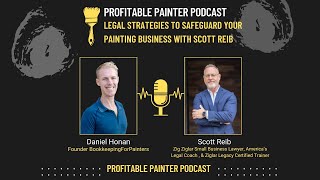
In this episode of the Profitable Painter Podcast, host Daniel (founder of Bookkeeping for Painters) interviews Scott Reib, a small‑business lawyer and author of The Shatterproof Entrepreneur. The conversation frames legal support as a proactive, primary‑care service rather than an emergency‑room fix. They walk through the essential legal foundations for painting contractors: forming an LLC or corporation instead of operating as a sole proprietor; drafting operating agreements for partnerships; creating clear, enforceable contracts and change‑order procedures; correctly classifying workers as employees or subcontractors and the tax risks of misclassification; protecting the business name and reputation with trademarks; and complying with the new FinCEN Beneficial Ownership Information reporting requirements. Scott outlines his “6‑Phase Shatterproof Business” framework, emphasizing solid foundations, documentation, brand protection, and ongoing legal health checks. He also describes his Access Plan subscription model, which offers on‑demand legal coaching, flat‑fee project work, and a Shatterproof Business Assessment. Listeners are directed to resources – the book, a dedicated website page, and an Instagram account – for deeper guidance.
Chapters
Welcome to the Profitable Painter Podcast. The mission of this podcast is simple: to help you navigate the financial and tax aspects of starting, running, and scaling a professional painting business. From the brushes and ladders to the spreadsheets and balance sheets, we've got you covered. But before we dive in, a quick word of caution: while we strive to provide accurate and up-to-date financial and tax information, nothing you hear on this podcast should be considered as financial advice specifically for you or your business. We're here to share general knowledge and experiences, not to replace the tailored advice you get from a professional financial advisor or tax consultant. We strongly recommend you seeking individualized advice before making any significant financial decision.
This is Daniel, the founder of Bookkeeping for Painters, and today I'm here with Scott Reeve. Scott Reeve is America's legal coach and Zig Ziglar small business lawyer, brings over 20 years of legal expertise to entrepreneurs. Known for his Access Plan Legal Service, he aims to make legal advice accessible and affordable, challenging the notion that it must be intimidating. As a Ziglar Legacy Certified Trainer, Scott helps business owners shatterproof their ventures, sharing insights in his podcast and recently released book, The Shatterproof Entrepreneur. He advocates treating lawyers like primary care doctors, emphasizing proactive legal support for long-term business success. Welcome to the podcast, Scott. How's it going?
Great, thank you for having me.
I'm super excited. This is a topic that I think gets neglected a lot, and I think you framed it perfectly, um, when we were talking before the podcast. Business owners need to stop treating lawyers like emergency rooms. Like, there's a perfect way to describe how I think a lot of folks think of a lawyer, like, oh, when something terrible or catastrophic happens, that's when I need to go see my lawyer. But that is definitely not the case, especially in business. Uh, could, could you like kind of unpack that idea a little bit further of what, what you've seen?
Yeah, I've been practicing law since 1996, and I litigated for most of that time. And in 2012, I kind of had this realization that I had a problem. I had repeat business that I shouldn't have— I shouldn't be having. Business owners were making the same dumb mistakes that they made the time before. And it was, they weren't calling me, they weren't calling someone else, anyone to look at their contract and make sure that the contract was enforceable, that it didn't have vague and ambiguous language in it was a big one. Um, or they would set up their company without having me do it or some other lawyer set it up correctly. And so they would, they get a lawsuit in, and then everything was on fire, right? And I like to say that having the right information at the right time is the difference between success and failure. You know, Brandon, if you drove by my house here in Texas and you saw smoke coming out of the roof and you called me and said, hey Scott, there's smoke coming out of your roof, there may be a fire, and we call the fire department and they save the house and save my family. If the same exact thing happens and you drive by and see the smoke and you go on your way And then you call me the next day and say, hey Scott, I saw smoke coming out of your house. Was there a problem? Yeah, there was, Daniel, and my, my house got burned down. It's the same information. The information's accurate. It's just a day late. And in business, and especially from a legal perspective, that day can really make the difference. And so you've got to make a shift, uh, from looking at me as a— me and my law firm as an emergency room to we're your primary care. Even better now, you might be your, your fitness trainer, and that you're spending regular time with us so that we can make sure that your business is legally fit so that you don't make big mistakes. You make— there's only small things happen. I mean, it's not, it's not if something bad is going to happen in business, it's just when things are going to happen. If we've built them in a shatterproof way, you've been proactive and not reactive, then let me blip on the radar and you keep moving. If you don't, if you keep treating lawyers like emergency rooms, you're going to up in the real emergency room because you're going to get hit, uh, hit by, hit by a semi and, uh, knocked off the road.
Yeah, yeah. And I, and I've made, I've made, uh, big mistakes. It feels like you're talking to me right now. I'm like, man, he's right. Made that mistake, uh, not seeing legal advice before like getting into a partnership or, you know, doing your, um, operating agreement. Like it's so crucial. And I'm kind of a biography, biography buff. Like, I read a lot of biographies.
Yeah.
And I'm just thinking while you're talking, all the recent biographies I've read, the first business that they start, like James Dyson, Walt Disney, Sam Walton, all three of those guys, you know, billionaires. But what happened in their first business, they started it without legal advice and they ended up losing that first business. They didn't have control of their patents. The, the lease ran out and they didn't have control over their store, whatever it was. And then they had to start another whole business to, to, to, to make things right. So it's just like this mistake, like you said, keeps happening over and over again, even to the best business owners that we know of in the, you know, 20th, 21st centuries. So this is like, I think, something like an afterthought, but it really shouldn't be. It should be, like you said, like something that folks are thinking of as they move through their business career.
Yeah. And it's, it's part of the legal foundation of your business. And, you know, we're talking about paint today, but the other part of, of building and construction things is the foundation. And that's at the start of every project is they've built the foundation. If it's solid, then everything works well, everything lasts a long time. If it's not, then you start having problems. You can go back in and fix it, kind of, but it's never really the same. So you really need to get that foundation done at the beginning and done right.
One of the, the most frequent ones— and you might have some other ones, this is just from What I'm seeing, not being a legal expert or anything, but a lot of folks come to us and they, they have a partnership and they don't have an operating agreement set up. And it's not clear on, you know, the contributions and distributions that are going out in and out of the business. And that just seems to be— folks get into a partnership and they don't have a good operating agreement. That just seems like a recipe for disaster when there's disagreement between the partners.
Yeah. And so, yeah, hopefully the partners are putting together an LLC and so they're each owning membership in an LLC because if they're general partners, then basically you're both, both liable for all the mistakes of a business. So step one is make sure you have a legal entity there. And then if you're— what a lot of people will do is they'll go online or they'll use a CPA or an accountant to form their company. Well, they might get the basic part of it done, but they missed that step you just mentioned of an operating agreement. They can't do that. It's a legal document, but it sets out all the rules for how your business is going to work or how it— if it doesn't work, how you get out of it. And if you don't have that in place, it creates a real mess. I've got a client that we're working with that had a partnership for a short-term rental business and they never got to the operating agreement stage, and one of the, one of the members wasn't participating the way they had expected. And so they end up at this impasse, and we finally were able to resolve it, um, with a compromise. But it looked like it was heading to litigation because they didn't have the rules set out. And so you've just got to get that step in place where you have an operating agreement that you both understand, each understand your roles, obligations, and duties, so that everyone's playing on the same playing field.
Mm-hmm, that makes sense. Yeah, yeah. Um, you have this other, uh, uh, framework that you've put together called the 6 Phases to Shatterproof Your Business. Could you kind of give us some insight onto what that would look like?
Yeah, we just talked about one of them, and it's, um, making sure that you have a solid foundation and have the right— have a legal entity in place, at least one. Um, A lot of people, especially painters, are operating as sole proprietors. And what that means is that you've just maybe come up with a business name, maybe it's just your name, and you're out there doing business. Well, if you have— if you create any liability, you're personally on the hook for it because there's no separation. So to create the foundation for your business, you have to form an LLC or a corporation that's going to go be the painting company and then if there's an issue, the painting company gets sued, not you, and you're not responsible for the liabilities of that entity. And that's a, that's, that's the, the first step in shatterproofing a business is to make sure you've done that. One of the other phases is that you want to document every step of the way. And like you mentioned, the operating agreement, but even, uh, even as, as important or more important is that you wanna make sure you have really clear documentation of the deals. So as you're doing a proposal for a painting job, you want to make sure it's really clear, for instance, how long that proposal is good. So it's got terms and conditions attached to the proposal so that you're not stuck with numbers that maybe aren't good anymore. Maybe the cost of paint went way up— like, that hasn't happened in the, in the last few years— and you're stuck with a bid that's bad because you didn't have the right terms. The client accepts it, sends it in. So you want to make sure you have things like that built into your paperwork, and then you have a system of keeping those things on file, right? So you can prove what you sent out, what the client— what the client has signed, so that everyone is on the same page again as knowing what, what the job— what the scope of the job was, what the price was, how it gets paid. Without clear documentation, that can get messy, and then you don't get paid. And there's, there's enough reasons out there already for, um, people in the, in the construction field and painting to not get paid. So we want to make sure that we've, we've done our job up front to make it as clear as possible as to how we get paid, when we get paid, and what those expectations are.
Yeah, that's a huge one, like documenting, uh, getting a contract with your customer, because I know everyone listening, if you had a painting business for any length of time, you've, you've had that crazy customer that's just like, that doesn't want you to ever leave, and they're picking out— they're like using a magnifying glass looking at your— the paint job, and like crazy stuff like that. Um, that's not even exaggerations. So having a solid contract that they signed that specifies like, what is— what are the standards at which you're painting their house? It's not going to be, you know, uh, The quality of the job isn't going to be subject to a magnifying glass. You have to be standing a certain distance away from the wall, like 6 feet or whatever it is, saying that in the contract up front so that they're not holding you to some crazy standard. And then I'm sure, and you definitely would be able to speak to this better than I would, but if this goes to small claims, they're going to likely look at the contract, I'd imagine, and see what it says to, to help you get, get paid for the work that you've done.
Yeah. And I mean, small— it could be small claims, but some of these residential paint jobs are $15,000, $20,000, right? And so it's a real, a real lawsuit. And the contract is what matters. And so if you've put together a really simple bid process, you give them just a quote that has no legal terms and conditions. They sign that quote and accept it. That's your contract. Well, it doesn't have enough detail for a court to be able to help you and help you enforce the terms. So you've not done yourself, you know, any, any good. You need to make sure that you've gone to see a lawyer that understands business, understands how your industry works, and can create a system for you that helps you, you know, get paid and, and helps you eliminate some of these conflicts that can arise. Like you mentioned, you know, inspecting too closely, or, or maybe what you're— when what you're painting, the, the structure is old and there's no way, even with all the prep you want to do, it's that you're going to make it look like new. And so you need to have somewhere in your document where you can have a special provision that, that make— where they're accept— they're, they're saying they understand the, the condition of this property is such that it can't ever look new, and they've said that beforehand. If you have that conversation afterwards, it's not going to go as well. So you have to have those beforehand, and then everything you talk about has to go in that document. You have to document everything.
Yeah, yeah, that makes complete sense. A lot of change orders—
change orders is another big thing that you guys— that I run into with, with painters is that something will change in the middle of the job and suddenly they want another room painted, or They change the color and then you— everything shifts and you may say, okay, that'll be an extra $500. But if you don't get that change order in writing, it didn't happen. There's an old, old saying that it comes from my Medical My Practice litigation days that if it's not in the nurse's notes, it didn't happen. If you don't write it down, it didn't happen. And so you've got to get a written change order that reflects that change of what you're going to do for them and how they're going to pay for it. Otherwise, it's unenforceable. You're stuck with your base quote. And so it's like, it's, you know, you just want to go out and paint a house, but you have a business. One of the, one of the books that started me on my entrepreneurial journey was Michael Gerber's E-Myth Revisited, where I really came to understand all the hats I was having to wear and why I was kind of frustrated. And it's no different. It doesn't matter if you're in a law firm or if you're running a painting company, there's just so many different hats you have to wear. And the— you don't want to be wearing the legal hat yourself because you're, you're just setting yourself up for disaster.
Yeah, yeah. So we talked about organ— organizing your business correctly, documenting, um, with contracts. Another big one that comes to mind is working with subcontractors or even just employees, but especially subcontractors, because usually you engage with them with a contract. If you have a subcontractor, you use— well, hopefully you're getting some sort of at least base contract, I'd imagine. But is that something where you get at least an initial contract with the subcontractor, and then, or do you want to have a contract on each specific project, or does it just matter? On the details.
We do it both ways. Sometimes if you have a sub that is going to be kind of a regular part of your business, they come, they're going to be a part of a lot of your projects, you'll do kind of what a master services agreement that says that this is how we work together, and it would then refer to a new scope of work for each project. Um, but it's also done a lot where you just do a separate contract for each project, so you'd have a subcontract with them But the main thing is to have, to have an agreement, again, in writing that says how that works. The, uh, the, the federal government and, and state governments are getting really picky, uh, about who is really a subcontractor. And so a subcontractor should be a company. It should— they should have— it should be an LLC or an Inc. They should be able to give you a W-9 with their tax ID number on it, not their social. And they're a legitimate company and they're doing work for other people. Or other companies. If they're only doing work for you, then they're an employee, uh, and the government's going to say that every time, and you're never going to win that battle. So you want to make it really clear. One of the ways you do that is with a, with a written agreement that has their company name in it, being responsible for whatever work they're going to do. It's just really important.
Yeah, this is definitely a hot topic right now, is the classification of workers, you know. And it is, like you mentioned, seems to be some states are more focused on it than others. I think maybe California might be one that, you know, having a subcontractor, you have to really make sure that it's— if I'm not mistaken, you definitely correct me if I'm wrong— if something like, if they, if the worker is a substantial part of your business doing the main service of your business, you can't even have them as a subcontractor, there really should be an employee, or they—
that's kind of my understanding. Yeah, they're hyper-focused in California on that issue, and to me, it's— they're, they're— it's a really nightmare. Um, a lot of our, a lot of our clients are leaving California and coming to, coming to other states like Texas to where they don't have to deal with as much regulation. Uh, but the federal government on its own is also like, they re— they redefine kind of their test for how you determine that, and it got much tighter. And my experience in talking with CPAs that have dealt with this issue too, I've never heard of anyone winning that battle. If the IRS agent wants to say that they were an employee, that's what they are, and it's game over. So it's a— and if you're doing enough business, that can be a really significant number. So if you're, if you're really scaling up a painting company and you've got a lot of painters out there, and they're all 1099s, and one of them gets audited for some reason, and the IRS figures out that they were really an employee. Well, sudden, then all the others hear about it, and suddenly they, they want their share. And so they go find a labor lawyer that files a claim against you, and you owe all the, the, uh, all the back taxes for their side, the employer side, penalties and interest, and you can't bankrupt out of it. I mean, you're just stuck.
Yeah, that's, yeah, that's the thing that really sucks with the IRS. You can't claim bankruptcy to get all that, that, that kind of tax debt. So yeah, that's rough.
Um, so it's a, it's one of those proactive things. You need to have a plan. If, if you're listening right now and you've got a bunch of 1099 guys and you're going, oh, I can't believe they're saying this, I'm in big trouble, take a breath, create a plan. For how you're going to convert over time to get them all to have as many people be employees as possible so that only really clearly defined subcontractors exist. Don't panic. Make a plan, be proactive about it, and, and convert them to it. It's gonna— there's, there's a cost to it. I went through it. All of us have gone through it when you start adding payroll tax to your business. But you can get— you'll get used to it, and you're either going to pay on this end or you're going to pay on the other end. At some point you're going to pay. So just do it on your time rather than having Uncle Sam come in and force you to do it later.
Yes. Much better experience to do it on your own time.
Yeah.
Um, so we talked about organizing the business properly, documenting with contracts, with subcontractor agreements. Um, anything else that we can do to lean forward and shatterproof our businesses?
Yeah, and the others, and all, all these strategies are in the book. But let's, let's focus on one more part that a lot of people miss, especially in the trades, is that you need to own your brand. And your brand is, you know, who you are when everyone's talking about you, right? It's your— it's the company name, it's the reputation. And the way you protect that is with trademarks. And here's the problem, is you, you build a painting empire over the next 20 years. So you've climbed the ladder of success and you get to the top and you figure out that your ladder is leaning on someone else's building because you hadn't taken the time to make sure that you could own and dominate your, your painting company's brand, the name. And so you get a cease and desist letter saying you can no longer use that name. You have to rebrand your 20-year company, and, and then you lose all this momentum. All the name recognition that you've generated over the two decades because again, you didn't do a foundational step, which is make sure you own your brand. First you have to identify it, but you have to— then once you've identified who— what your brand is and what needs protecting, you've got to file that application with the United States Patent and Trademark Office so that you know for sure you own it. Even more helpful is when you go to sell your company, uh, then you've got an asset that you can prove you own that brand and that they don't have to worry in the future about there being a liability because you haven't secured it. So it makes your company much more viable for, for purchase, not necessarily an acquisition where someone's going to take over and rebrand it. But if someone wants to come in and take over a turnkey painting business and it's trademarked and you can show them certificate, it's going to add great value to yours compared to other businesses.
Yeah. I mean, selling it, or even just, even if you just want to have someone else run it and you're the passive owner, uh, either way, like you said, like having that brand secured and you're not having to change your name. I can't imagine the, the pain of that, like the situation of you've been in business for 20 years and then you can't use your name anymore. Just think of all the name recognition you have in your, your area just goes down the toilet. Uh, that would be terrible. And so it seems like filing a, uh, you know, a trademark for, you know, might take you the afternoon, um, seems pretty, pretty simple decision there on which one you should do. So yeah, that's, that's a great, a great point. I think a lot of folks are probably not thinking about that.
Yeah, that's why it's so important to find a small business lawyer that can work with you in a holistic way so that they're looking at all of that stuff, not just, hey, give me a contract, hey, set up my LLC. It's like, hey, this is how we operate our business. This is our business. This is our goals and dreams. Help us protect it as we go forward. And we're building a legacy for the future, for the future generations. And the only way to do that is to have a relationship with that legal team so that they, they've got the pulse on your business. They know what you're doing in life. So that they can help you minimize the risk so that you can be successful in growing, growing whatever it is that is your, your dream. Because I believe that your small business is the best vehicle to achieve your goals and dreams. But it also can turn into a nightmare if you don't take some of these foundational steps that Daniel and I've been talking about and that he talks about on his show all the time. You can just get in trouble. So you've got to do these things right. You— it's not You know, it's, it's a real business and you got to treat it that way.
Yes. And what— and I think a lot of folks are, you know, familiar with the lawyers that are transactional, like you had said, like, hey, can you put together my operating agreement? Or, hey, can you do XYZ? But, uh, I don't think most folks are familiar with a lawyer that would, would do what you described. So what would that look like if if they were to come to you, um, or your team, what is— how does that— is there some sort of diagnostic review or something? And then like, what does that process look like?
Yeah, we have a Shatterproof Business Assessment that we can put everyone through. But then once you, once you come in and we decide if you're a good fit, then we have something called the Access Plan that I created in 2012 that gives our clients on-demand access to a team of legal experts to help them be proactive with all these things that we've talked about. And so there's legal coaching calls every month to talk about what's going on in the business, what's going to come up, so that we can make sure that everything's being done. They have access to create legal projects so that if they need a contract, they can ask for it to be created by a team that already has done other business for them, so they understand holistically how it all works together. And then you can just ask stupid questions because stupid questions prevent stupid mistakes. I've heard too many people say there's no such thing as stupid questions. Well, I've been around long enough to have heard a lot of them, but, uh, if you ask them and get them out of the way, you might, you might hit one that isn't stupid, or you'll just get to the next thing, uh, and you'll feel better for having asked it. But traditionally, lawyers charge you by the hour, and so no one wants to ask those questions. And so we created a subscription model where you have a monthly investment that. So you're in, and then you get to ask us all those questions, ask for documents. We become your, your general counsel, and it lowers your anxiety, gives you some peace of mind that you have someone on the other end of that phone that understands what you're doing and can help guide you through it. I'm not the only lawyer that works that way, but it is a new, new model, even though we've been doing it since 2012. But it just It eliminates that hourly conflict of I can spend as much time on your project as I want. And you don't know if I, if I spent more than I should because it's a set amount. The other thing that we do is work on flat fees. So there's some things that aren't included, like trademarks. So you bring your brand to us, we show you how to protect it with a flat fee proposal. If it takes us longer than I thought it would, then we lose money just like painters do. It should be fair. And so that's how we work and been doing that way for a little over a decade.
Nice. One thing I thought of that I feel like I would be remiss if I didn't ask about this, just because it is a big change for folks, is the beneficial ownership information reporting that FinCEN requires. That's a big thing. That folks need to pay attention to, especially in the next 6 months. Uh, can you just give us like the, the big takeaway that, uh, should we be worried about this? What do we need to do? Kind of thing.
Yeah, you should be worried about it because it has some really hefty penalties attached to it if you don't. The, the kind of the bigger picture, because I'm not an expert on, on this regulation. But you, if you were an existing business, LLC, corporation prior to this year, prior to 2024, then you have all of 2024 to file this report, this Beneficial Owner Interest Report with the, with FinCEN. If you form a new LLC, you don't have that long. You need to file it immediately. I think it's 30 days, but just immediately file it. And you, and you may have problems finding someone to help you with it because almost all the professionals are saying we don't want to do it. Because if you mess up, there's going to be penalties. Uh, I, the, I thought the instructions that they offer on the site are pretty good, and the, it's a nice easy form to fill out, uh, but you, you need to go fill it out and do it timely. And it's, it's, uh, there's some litigation going right now that might make it go away, but, um, and there's a restraining order issued for certain areas but not the whole country. And so right now, most of us are still subject to that regulation. I'm hopeful that they— that we can get some relief and maybe it goes away because it just seems like a big— an awfully big information grab to me and just a big burden on small business that just, just doesn't need to happen.
Yeah, it is. I've filled out the form myself. Pretty invasive. I mean, you can definitely do it on your own. Nothing. You don't have to submit blood samples or anything, but, you know, it's definitely just another thing on top of the tax returns and all the other things you got to worry about. So, but yeah, you heard it. So make sure you're— if you don't know what beneficial ownership information is, just Google BOI FinCEN website, should come up. Basically, if you have— if you're a small business owner, you're likely have to file that this year.
Cool.
Well, how can folks learn more about working with you or your firm, or how can they get a hold of the book that you wrote, get more information about shatterproofing their business from a legal perspective?
Yeah, the— you can get the book, The Shatterproof Entrepreneur, on Amazon. I'd love you to get the whole book. But just for the listeners of the show, we're going to set up a special page for the Profitable— it'll be reiblaw.com, reiblaw.com/profitablepainter. And when— if you go to Profitable Painter there, then we'll have a link where you can download chapter 1 of the book for free. Give it a read. It's going to talk about the legal entities and the stuff, some of the stuff we've talked about today in a little more depth. And it's important for that foundation of the business. And if you like it, then go to Amazon and buy it. That's going to be number one place to contact me. Number two would be go to Instagram @thescottreeb, and we release reels almost every other day with legal tips and tricks that you guys can use in your businesses.
Awesome. And we'll include the link down in the show notes. So if you want to grab that first chapter, definitely do so. And, uh, I really appreciate your time today, Scott. Uh, I think it's super informative. Is there anything, any other last thoughts you want to leave the listeners with before we close this one out?
Remember, no, just be proactive. Don't be scared. Find a, find a lawyer that you are comfortable with and that you want to spend time with, because the more you share with them, the more they can help you.
Awesome. All right, and with that, we will see you all next week.
More from Daniel







What’s REALLY Holding Your Painting Business Back? (Find Your Bottleneck in 5 Minutes)



