Leveraging AI Voice Technology with Charlie Felker
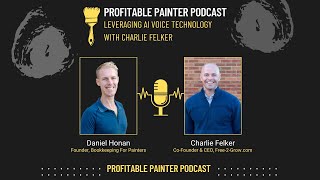
Charlie Felker pivoted his outsourcing company Free2Grow to an AI voice platform for home-service businesses in early 2024 after a viral Facebook recording. The system integrates with ServiceTitan and other CRMs, handles inbound calls with customizable scripts, and he recommends painters start with after-hours coverage to capture missed leads.
Chapters
Welcome to the Profitable Painter Podcast. The mission of this podcast is simple: to help you navigate the financial and tax aspects of starting, running, and scaling a professional painting business. From the brushes and ladders to the spreadsheets and balance sheets, we've got you covered. But before we dive in, a quick word of caution. While we strive to provide accurate and up-to-date financial and tax information, nothing you hear on this podcast should be considered as financial advice specifically for you or your business. We're here to share general knowledge and experiences, not to replace the tailored advice you get from a professional financial advisor or tax consultant. We strongly recommend you seeking individualized advice before making any significant financial decision.
This is Daniel, the founder of Bookkeeping for Painters, and I'm here with Charlie Felker. Charlie Felker is the co-founder of Free to Grow. Business started in 2019 and over the past several months has pivoted to exclusively using AI voice. Fritigro has built a proprietary AI voice tool supporting painting and other home service businesses. Welcome to the podcast, Charlie.
Daniel, pleasure to be on. I appreciate it, and, and thank you for those that are listening.
Excited to have you on today. I was— we were talking before this, and I was just on the website like listening to the clips, and you're like, that's not even the most up-to-date stuff.
Yeah, yeah, it's, uh, it's, uh, AI voice. I'm sure we'll get into it. Is, uh, is a quickly changing field. Um, a lot of updates, you know, just recently, uh, Google came out with their Gemini AI product, and, and, uh, as you mentioned, we have our own proprietary AI voice tool. Um, you know, we— I used to own my own home service business. Um, I was focused on aging in place and keeping seniors living at home, and I used to install those stairlifts that you see go up, going up and down people's stairs, and ended up selling that business in 2019 and then started Free2Grow shortly thereafter. And this story is relevant kind of because it kind of gets us to the AI component. But we were a very human-based outsourced CSR company. I had, you know, up to 14 CSRs answering phones for painting companies, HVAC, electrical, taking calls, fielding calls, you know, going through a company script, booking within their CRM. And then doing outbound calls and happy calls and kind of follow-ups. But I'd always been interested in AI voice. We were kind of had feelers in the waters about 6 months ago and the technology wasn't quite there. What really prompted this though, our big pivot was like early April, we heard a recording on Facebook through some home service group and my partner and I looked at each other like, okay, this is probably coming. And so we went out and essentially acquired the intellectual property of our now Chief Technology Officer, Jerry Yee. And we said, hey Jerry, you know, Nathan and I have a lot of relationships with painters and plumbers and all these home service companies. You got the technology, let's marry up here. And we did. So we had the tough task of going to all of our clients in April who were very used to having human CSRs answer the phone, say, hey, We'll give you a demo, we'll give you a trial account, we're gonna ease into this, but we're going down the road of AI voice. We lost half our client base. And what was interesting was the clients that left us didn't even have, didn't even wanna listen to the demos, right? There was no interest. They were just very focused on having their one person answer their phone and anything else was kind of, you know, not interesting, but the clients that stayed love it. And we've never looked back. We've certainly made up, as far as lost revenue, we've made up all the business that we lost just with new AI voice clients. And, and we've been working with clients that probably wouldn't have entertained working with us in the past. Um, you know, as you've said, the technology is constantly getting better. Yeah, we do have some call recordings on our website, um, but our developers, we've got Jerry Yee and Ben Breamacomb, who these are our developers. We don't kind of white label anything. We, we listen to a lot of calls and take customer feedback and improve latency and response time and interruptions. You know, there can be a lot of awkward pauses when you're talking to AI, at least, you know, now. And I think that's part of the cons. So we're constantly improving the technology, Daniel. So yeah, it's been, it's been an interesting road and we're looking forward to, to the road ahead.
Yeah, it's, it's crazy how fast this AI, uh, trend has just taken over. I mean, and you know how the speed at which things are progressing is ridiculous. Like, just, you know, a year ago, I think OpenAI came out, like, is it now a year and a half ago? We were kind of really hit, and but since then it's just been, it's just a mind-blowing pace on how fast things are progressing. And, uh, you know, like I was saying before on the website, like, it sounds really good. Like, you can't tell that it's an AI person, you know, like AI, you know, tool that's actually responding to these live calls that you have on your website. But it's even better now from what you were saying, and it's just a game changer because, you know, there's so many painting businesses out there that sometimes they don't even have anybody answering the phone that just goes to them. And so they're not even picking up the phone to begin with. And so they're missing leads, they're missing customer calls. And so that's the first problem. But then they might eventually get an office person that doesn't always have, they're not always in the office, they're not always answering the phone. And this is a big advantage of AI voice where there's no, they could call at 2 in the morning to book a painting estimate or whatever the case is. So like, I feel like this is going to like take over really quickly. And I think the folks that take advantage of it are going to be a step ahead.
Yeah, there's, there's probably several buckets to your comments. And as far as users and implementers of AI voice across every home service industry, there's, there's ones that are all in, right? Let's go. We know this is where the trend's going. And then you get people kind of dipping their toe in the water. So say, okay, let's, we'll start with after hours or overflow. And then you kind of get this bucket like, ah, I'm not, I'm never doing that. I'm okay missing calls. I'm okay for the call to go to voicemail. Maybe I'll get back to them in a week. And I frankly, I think those, that kind of mindset, you may be left behind. You know, looking in my crystal ball, I think with how fast the pendulum swinging I think this time next year, most home service owner operators are going to have demoed, tried, implemented AI voice. Okay. Right now, you know, we take a lot of calls and there's kind of like this pros and cons list, right? Where yes, you can have calls and a homeowner can have a call and kind of figure out they're talking to AI. Okay. And there's some problems with the technology. I mean, there can be interruptions. Um, sometimes with certain conversations, inflections can be a little awkward, pauses can be a little awkward, et cetera. But look, like I said, we had 5 years. I used to own my own service company and I've listened to some pretty egregious calls myself from humans taking calls, right? Mm-hmm. So the cons of that are, you know, you've gotta have somebody in a seat. They've gotta be there. They gotta show up to work. Teaching them to stick to the script can be really tough, right? Not gonna talk back to customers, you know, mistakes, inconsistencies. So right now I feel like the pros probably outweigh that. Okay. And as the technology improves, you know, I think where the improvements are gonna be is on latency, the speed, the realness of it. And then the big thing is customizing it to your business. Right. If you listen to some of our recordings, we spend, you know, weeks with, you know, clients, you know, with a script they like, you know, scheduling how they like it in windows that they like it, you know, call escalations, how they want it forwarding, how they want it, you know, booking within their ServiceTitan or their Housecall Pro or Sarah or Jobber or ServiceMinder, all these different CRMs that we're integrating with. You can make this very customizable over time. I'll share an article with you and you feel free to share it with your audience. We work with a big HVAC company called Fire and Ice in Columbus, Ohio, and we've spent like a month with them before we even went live tweaking it to how they wanted it, testing it. Let's, let's change this script. Let's update this. This is how we want this booked in our CRM. And now the system is running, right? And they've set it and it's there and it's constantly learning and getting better. Um, and I think over time home service owners are going to really see that. Daniel?
Yeah, yeah, it— and I think at a certain point people are going to call hoping that it's AI because, you know, the AI, it's, it's more— I think it's getting to, if it's not there already, and you know better than I am, but understanding the, uh, the caller and being able to to quickly, I know you said there's some latency, like pauses, awkward pauses, but they, they're not gonna forget the script or like go kind of sideways. Yeah. Yeah. So they're gonna follow the process pretty concisely and the, the way that AI works, you know, they're gonna, you know, for example, they say, can you gimme your email and spell it out for me?
Yes.
And it's gonna be pretty accurate, like I would imagine that it's going to be very super high, like 99% accuracy. I don't know what the numbers are, but I would imagine it'd be a lot higher in accuracy than a human doing it the way that I was listening to those calls.
Yeah, I appreciate that sticking to the script because I distinctly remember with my CSR running around, you know, with the phone on her headset, taking notes with her notepad. Can you, you know, can you repeat that name for me? And yeah, half the time that being wrong. You know, forgetting to put it from the piece of paper into the CRM, which is how we wanted to track everything. And that's all being done in real time. I will say this also. I think over time, the homeowner is going to expect, to your point, to be talking to AI. Okay. I think right now, if a homeowner figures out they're talking to AI, they assume it's like an answering machine. Okay. So we've messed around with some prompts. We say, Daniel, this is Joe. I am the AI digital assistant for Integrity Painting. I can book your call in the next 45 seconds. How can I help? Right? Oh, okay. Well, I want to quote an estimate. Great. The earliest we can come out is tomorrow at 10 o'clock. Does that work? Can't do 10. I can do noon. You know what happens? Noon can work. Let's get it booked, right? Quick call, efficient call. And guess what? All that system is now already in your CRM. Okay. So I think you bring up some great points. I think getting the homeowner, the end user, and I do think I agree with you. I think over time they're gonna appreciate a very efficient 1-minute call versus a relatively inefficient 3.5-minute call. Yeah. And I can't tell you how many calls we listen to that aren't necessarily smooth where scheduling can be tough. Right? You know, can't do Tuesday. What about Thursday at 3? Well, can't do Thursday at 3. What about Friday at 10, right? And we used to listen to a lot of calls with a human trying to get into the CRM, figure out, ah, I can't do this or this or this. And those are 4-minute calls. With AI, it's turning into a minute and a half, 2 minutes. Far more efficient, which I think people are going to like and expect.
Yes, because if you think about it, when you're opening up the CRM, you gotta— it takes a little bit of time. There's latency on the CRM so that the human, uh, you know, representative is trying to navigate to the right thing and the CRM's loading and they're like, you know, maybe stumbling a little bit. So I can definitely see how that having an AI where the data is right there for it to access and it's just providing those options. And is, you know, so yeah, that seems like that process would go a lot smoother. And folks are probably gonna be annoyed, like when they get a human, there's like, oh no, I gotta explain this human, you know, what times are available or when I'm available for scheduling this. Oh geez. But yeah, I feel like we're gonna get close to that here soon. Cool. Well, What, what other, so obviously answering the phone and scheduling, are there any other applications that, that AI voice has been implemented in the companies you worked with? Or is it, is it pretty much just the answering the phone calls and scheduling like those leads?
It's a great question. I think AI voice at some point is gonna be a commodity. Okay. I think you're gonna have, it's like the difference between a call center and having, you know, your in-house customizable CSR. Okay, the call center AI, there's going to be a bunch of them flooding the market. There's going to be a bunch of noise in AI voice. We're free to grow. My business is really trying to separate ourselves. One, we're only focused on home services. Okay, two, we're going to integrate with home service, you know, CRMs, which is big. Having the ability to integrate with a CRM is crucial in my opinion, right? For, you know, cataloging, tracking information, booking, you know, following up on estimates. Okay, where I'm going with this is right now, yes, answering the call, answering questions, you know, escalating calls, get— getting a quote or an estimate on the calendar, and then getting that information auto-populated into a CRM is kind of where we are, right? Obviously, core improvements, latency, interruption improvements, you know, response times, tweaking those customizable responses is kind of where we are. But where we're focused also is saying, hmm, what are the painting companies going to be interested on the outbound side, right? On the lead follow-up side, on like recurring maintenance side, like stuff like that that we see a lot of different home service segments focus on. That's where we're gonna be focused on product development. Because I think at some point, you know, you're gonna be seeing outbound capabilities from AI voice. And as people get more comfortable with, ah, okay, yes, Integrity Painting was out there on Thursday. This sounds like a happy call. They're soliciting for a Google review. We're gonna be filling like a lot of those kind of mundane tasks that CSRs do. I think you'll start to see AI voice chipping away at here soon.
Nice.
So that's kind of the next hurdle for us is getting the inbound component really good. And there is a big difference between these call center AI models and what we're doing is it does take time to get, you know, your model how you want it, right? Every company has a little bit way of how they want the call to be answered and booked and scripted. And so, you know, when you do wanna work with AI and AI voice, I would keep that in mind because that's, That's gonna be a big differentiator. It's kind of, you want this white glove AI versus, you know, we can get you up in 10 minutes. And I'm sure you see that in, you know, in your industry where you get some kind of, you know, fly-by-night businesses that say, yeah, we can onboard you in 10 minutes and let's go. I think you gotta be a little leery of that because it does matter.
Yeah. So you're, you're during the onboarding, you're, you're sitting down, help making sure that their, their script is right, the different Yep, things that can be thrown out in that initial call. Yep, or handled.
We took our most senior CSR from our legacy days. She's a 20-year home service CSR. She's probably operated in 15 different CRMs, and she's become our head of onboarding. Okay, so she listens to a lot of calls in a lot of different industries and say, hmm, you know, if I was a painting company, I'd really want my calls to be answered this way. So she runs all of our onboarding, and then you have direct access to our development team for immediate feedback until the system's how you want it. Right. So we, we do often soft demos, like a soft opening. We get a lot of owner operators that call into the AI. They have their family call in, they've got their, their bookkeepers call in and tweak it and make updates. And then they say, you know what, we're ready to go here. And then we can press the live button.
Yeah. So you set it up for them, you, the testing period, you can throw whatever you can at it to make sure it's good to go. And then you can go live. And what does that whole timeline usually look like at this point?
Uh, it depends. You know, we have big HVAC companies with 40 technicians that it's, it's very complex. It can take, you know, up to a month. And then we can have small, you know, residential painting or HVAC or plumbing companies that can take about a week to get it how they want it. Uh, okay. We like to see owners that are engaged. You know, I frankly like to see when I'm opening up an account in there, I see the owner in there demoing it and You know, because they listen to calls too, and they have a good sense of what their customers are going to be calling in for. So I frankly like to see that owner involvement, and those are some of our best clients where you get owners that kind of become evangelicals for us, and they say, man, I really tested this thing out and I feel very comfortable with how these calls are going to be handled. Doesn't mean we're going to have one-off bad calls and improvements. I think that's going to be— that's going to happen. Whether, you know, you've got a stellar CSR or AI at this point. I can tell you, you know, that the AI is going to constantly improve. And when we make improvements, it's kind of set, right? I don't have to go out and spend $5,000 to go reteach a CSR how to do that. It's a big advantage.
Yeah, definitely. Cool. That's awesome. Yeah, I'm excited. This is, this is crazy. Like, and game-changing for, you know, just setting this up, having it answer your phone, you know, first of all, making sure someone's answering it, booking that, that appointment for you and having it done in a sustainable way. And then if there's any tweaks, you can simply just change the scripting and it's automatically implemented. It's not, you know, bungled or anything like that by a human. Uh, so this is, this is excellent. Um, what, what other— what, what else have we not talked about? I guess I know everything's just changing so far, but what else is on the horizon or like happening now that, that we haven't talked about?
Yeah, we're gonna— we're, we're unleashing some really cool, uh, product, you know, very home service specific product releases, and we'll get to those in time. I don't want to get ahead of my development team, but Again, we're so laser-focused, and a lot of our product improvements are dealing with, you know, those in the industry, like, you know, rescheduling, uh, rain delays for lawn care companies, right? I know that's an enormous pain, right? It rains on a Tuesday, and then you got to go through your 8 calls and reschedule. So what I like is our perspective is, is very, you know, with our head of onboarding and our development team, we love that kind of feedback. So when we get deeper here in the painting industry, we're going to be leveraging a lot of that feedback of, hey, can you guys do this for me? And I— we're nimble enough that we'll take a look at that and make those improvements. Most of our product development, product improvements come from current clients that have recommended stuff. For example, we have one of our first AI— one of our first clients to go from our legacy model to our current AI voice model Kevin Long. I'm a West Point graduate, he's a West Point graduate. We got a kind of a connected past. He goes, God, it'd be great if we could have a repeat customer workflow, right? Customer calls in, you know, they— I did a job for them 2 years ago, you can recognize the number, recognize the address, and take them down a completely different talk track. So we've done that, right? And it's nice because I think people get frustrated whether you're talking to AI or you're talking to your, you know, your CSR, you know, you should know who I am. I'm a member, I'm a maintenance member, you know, you painted my deck a couple years ago, gosh darn it, you know. So we've taken some of that to heart and now we've got like a repeat customer workflow that we've built in. Nice. So it's able to pull from your CRM and say, you know what, we recognize this number. Are you still at this address, Mrs. Smith? Yes, that's me. Okay, great. So there's a lot of things like that that we really try to take from the field and implement. But yeah, there'll be constant improvements. I would recommend for any, you know, painter owner-operator, I would recommend starting with after-hours. Okay, the bar right now for after-hours coverage with your generic call center is so dang low. Okay. And you're probably forwarding your number to a call center where it's gonna take 30 seconds for somebody to answer the phone. They're not gonna know anything about your business, and then you're gonna end up dealing with that in the morning, right? So where we get the biggest aha moments is people like, ah, okay, this is pretty cool. Now I'm taking these calls that come in at 7 o'clock and I show up in the morning and they're on my calendar with all the information populated in my CRM. Okay. For a fraction of the cost of what I'm paying my call center. So for anybody that kind of wants to dip in their toe and you're like, okay, I get it. AI's coming. Let's try this after 5 o'clock where, you know, you feel like you still have control from 8 to 5 or 9, whatever your hours are. I would really recommend trying after hours. We've had a lot of success and we've had a lot of clients go from after hours. You know what? I feel really comfortable. Let's now, let's how, let's now, you know, do overflow during the day. Right? Overflow during the day and then all of a sudden a CSR doesn't show up or is on vacation for 2 weeks and our AI model is fully integrated, knows how to answer the phone. And so they say, you know what, you know, our CSR is gone, let's just turn you on from 8 to 5 or 24/7. That's kind of been our progression with most companies.
Makes sense. Yeah, good way to ease into it.
Yes.
And test the model, make sure it works.
Very much.
Awesome. This is awesome. So how do— what would you recommend if someone's interested listening and this seems like that might— this might be a good solution? What do they need to do?
I would go to our website. You can, you know, I'm sure you'll post the information. I would book a demo. So my partner Nathan does all of our sales appointments and we'll get your website and we'll scrape your website and, you know, we'll do a live demo. On a call. You can test it, you know, live. And so we'll pull zip codes, we'll pull, you know, products and services where you go, where you don't go, and you can test it. If you're a painting company in Denver and somebody calls in and says, hey, I'm in Kansas City, AI is going to pick up on that and say, sorry, we don't service that area, right? And so there can be a lot of value in screening those calls too. But I, we, we get a lot of holy cow, this is cool on these live demos and we can tailor the demo and the model to your business pretty quickly. Yeah, so I would recommend that.
Awesome.
Yeah, and I'll put the link to the website freetogrow.com with dashes in between free and to and grow. I'll put that in the show notes and you can schedule a demo right there on the first page. And then you also have some of those samples as well. Which are kind of, which are cool, but I guess they're a little outdated because things are moving so fast that it's even better than what it sounds like on the website. So that's cool. Awesome. Any last thoughts for the audience before we let you go?
No, it's an exciting time, Daniel. Technology is going nowhere but getting better. I know it takes some getting used to. I think ultimately it's, you know, it's getting the phone answered and getting the information tracked and scheduled. Has been an industry-wide problem in a lot of industries for a long time, right? Consistent coverage. And so I think AI is going to be, you know, an important solution to that for a lot of owner-operators. So if you want to give it a try, no charge, we'll do a demo. And, and I, you know, you can kind of try it before you buy it.
Yeah, awesome. Thanks for your time, Charlie.
Thank you, Daniel.
More from Daniel







What’s REALLY Holding Your Painting Business Back? (Find Your Bottleneck in 5 Minutes)



