Marketing Masterclass with Aaron Hockel: Unveiling the Secrets to a Booming Painting Business
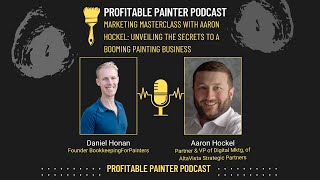
Aaron Hockel of Alta Vista Strategic Partners breaks down marketing for painting contractors by revenue tier. Under $1M, focus on a niche, simple website, and review collection. He shares a case where reactivating 55,000 old contacts generated over 1,000 leads. Above $1M, add yard signs, vehicle wraps, Local Service Ads, and paid search with proper tracking.
Chapters
Welcome to the Profitable Painter Podcast. The mission of this podcast is simple: to help you navigate the financial and tax aspects of starting, running, and scaling a professional painting business. From the brushes and ladders to the spreadsheets and balance sheets, we've got you covered. But before we dive in, a quick word of caution: while we strive to provide accurate and up-to-date financial and tax information, nothing you hear on this podcast should be considered as financial advice specifically for you or your business. We're here to share general knowledge and experiences, not to replace the tailored advice you get from a professional financial advisor or tax consultant. We strongly recommend you seeking individualized advice before making any significant financial decision.
This is Daniel, the founder of Bookkeeping for Painters, and today I'm here with Aaron Hockel. Aaron Hockel is a contractor marketing expert and is a partner and vice president of Alta Vista Strategic Partners. For over a decade, Aaron and the Alta Vista team have worked with commercial and residential painting contractors to grow and scale their repaint business using targeted marketing and digital advertising campaigns. And he has spoke at several conferences to include the 2023 CPIA Leadership Conference. How's it going, Aaron? Welcome to the podcast.
It's going well, Daniel. Thanks for having me on today. I'm looking forward to chatting with you guys.
Absolutely. Glad to Glad to have you. Excited to talk, to dig into things. Before we get into kind of the meat and potatoes, I was just kind of curious about your background. You know, you've had over a decade of experience with working with contractors. What initially drew you to the contractor marketing space?
Yeah, great question. So the quick origin story of AltaVista, we were co-founded in 2011, actually, by two former electricians. And so the business originally got started out, uh, as doing consulting and marketing and sales training and all different kind of services focused on the trades, right? So roofers, painters, plumbers, et cetera. Um, they actually approached me in the fall of 2011. Uh, I was working as a— in recruiting and staffing at that time, and they approached me about doing sales for them and helping them with sales to meet new people. So Really kind of just got involved then. It was a startup, and we've been really just heavily focused on, you know, working with roofers, painters, etc., for the last 13 years now. And my experience has really been very hands-on working for a lot of people. You know, marketing changes so quickly that really what you knew even 2 years ago is different today. So, but that's kind of what It was kind of happening, just happened, right? No real intentional background there for me, but been doing it a long time.
Yeah. And you're, from what I've seen, I'm not a marketing expert, but just looking from the outside in, just the amount of changes that happen in the marketing space, it's ridiculous. I was talking to somebody the other day, they're like, oh yeah, Google Ads, they're pretty much worthless now. You gotta do the local service ads now. Like, you know, that's a recent change apparently, but it seems like every couple of months, you know, Facebook ads are different now and then. Yeah, it's just crazy to keep up with the changes. What are some recent changes that you've seen?
Yeah, it's, we see changes all the time. It's funny you mentioned the local service ads and people kind of saying, oh, we got to get on those now and ditch the regular search ads. So I remember when the local service ads were beta testing. They were rolling out in random US cities. And that was maybe 4 or 5 years ago. So even the idea of like, oh, but maybe they, you know, they open up a new category or they add a new this or Google puts more emphasis on them. So it could be something old that's still kind of new. The changes that we're seeing most recently, Facebook's always changing. We're kind of closely keeping a little eye on what's going to happen with TikTok. We don't do a ton of TikTok. Marketing now, but there are plenty of people who have built really large audiences on there. And if that goes away, really, where's that attention going to shift? People are still going to engage and be looking for content and different things. So does that shift some eyes back to Facebook and Instagram and maybe create another push there? You know, there's Google's algorithm always changing. Interesting one on that front, and we'll probably talk more about this later, is on the review side. Google is now putting more emphasis on reviews than ever before. That's something we've kind of picked up, right? And they can use AI now to more accurately read and understand reviews and better use that information. And so what we're looking at is, well, how are reviews gonna truly start to impact people when they're searching, right? Because we can use that first-person authentic experience content. How does that interact, right? So things are always changing. Those are a couple things on the, Horizon we're keeping our eye on, but I'm sure something new will be right around the corner as well. Yeah.
And I think for reviews, I've heard some folks are, I guess to exploit what you just said, is that they're kind of giving clients almost like a template to use. Like, hey, here's kind of what happened with your project and here's some pictures of before and after of your project. Would you mind doing a Google review? And like kind of providing them like almost like the answer so they can basically copy and paste it into the Google review so that they're getting more robust Google reviews.
That definitely happens. That definitely matters. If you do that every time and everyone looks very templated, just be always cautious about some red flags, right? Like, oh, all these reviews look the same. They all have 2 before pictures, 2 after pictures. What is happening. Um, don't know that that's anything a real warning sign, but that depth of review with the picture, with the comment, right, mentioning employees by name, those are all really key things that do make a difference. Um, there are even softwares now that are really kind of doing more of that outreach to that depth, right, for the review, asking for the review and providing all that sort of stuff can be done. Um, that's definitely Definitely a big one.
Mm-hmm.
Okay, cool.
Well, what would you say for, because it seems like the marketing strategy for a business that is just starting out is definitely way different than the marketing strategy of someone who's been around a while. Do you have any recommendations for someone who's just getting started? They're doing under $1 million in revenue. What should they really focus on? Because there's so much out there and everything's changing. Like, are there some things that they should really just dial in on, dial in on initially?
Yeah, so that's a great question, right? And we look at it of— and we've worked with businesses, um, in the residential home services space and the commercial space. We've worked with people that we've helped get from $1 million in sales to $1 million a month, right? So we've seen the journey, we understand it at various phases and what matters. There are foundational principles that are going to be right that you need to do at $1 million or $10 million or $100 million, quite honestly, right? The first one, I'll give some key pieces of advice here to the person who's under $1 million. One, be very focused on like, who is your customer? What do you do for them? What does that look like? And don't try to chase that next thing. Meaning if you're really good at exteriors, yeah, certainly paint some interiors in the, in the in the wintertime, but don't go chasing deck staining or cabinet painting, right? Kind of be laser-focused and understand where you want to go. Like, hey, our sales are $800,000. We want to grow to $1.1 million and then $1.5 million. The roadmap to getting there is going to be to be excellent at what you do well, right? And having that predefined goal. Once the goal is defined and kind of understanding the who the customer is, what the services are, where— geography is really important, right? I would say get yourself a great mobile-friendly landing page or website. It does not need to be a huge website. It does not need to be super complex. Some really nice, well-designed, even if it's just one page, maybe two or three pages, short, sweet, right? That works really well on a phone. Start there. Everyone's looking on their phones, right? Hey Daniel, who did it? Who painted your house? The outside looks great. Oh, it was Aaron's Painting. You should call. How does that person find it, right? They're going to Google Aaron's Painting, it's going to pop up on their phone, and we're going to look for some ways we want them to go. But if they click to the website, it needs to look nice. So I think that would kind of be a first point of like, there, under a million, if we're saying, hey, we're a little constrained in terms of what we have from financial resources to invest in things, right? Like, oh, maybe we can't afford a billboard or a TV commercial or $10,000 a month worth of Facebook ads, right? Um, look at some really simple things. The reviews are crucially important. Um, you can get business cards made with a QR code. You can make it a process to send an email to every completed job. But really, really focus on the reviews. Um, don't emphasize 100% Google. 80%, 10%. See if you can get that balance of 20% Try and get a review on Yelp. We know they're really tough. Try to get one on BBB. Try to sprinkle into a couple other places, right? That would probably be something that, you know, you can just do it from your email. You can just do it with a business card with a QR code, right? You have a sales guy, incentivize them to get reviews, right? So that would be another big part of it. Get a CRM, get something, get that you can use to just track the customer data. If it's just first name, last name, phone number, cell phone number, email address, street address, right? Having that core information as you build your company and you build your plan, really going to be very, very helpful. Under $1 million, we would emphasize a lot of things that are— what are like affordable resources? That's kind of where I'm going with this. Right. So MailChimp's base version lets you send 1,000 contacts one email a month. There's no charge for that. Doesn't have a lot of bells and whistles, right? But it's free. So if you're building that list of contacts, well, there's a lot of power this time of year in sending an email to 1,000 people you've talked with in the past saying, did you decide on an estimate? Can I give you a quote for your exterior? Right. So that one would kind of be something, but we're not even getting to sending it yet. We're just saying have a process in place to build that data that then we can build off of into the future. Those would be some straight, you know, some really forward, straight ahead things.
All right, so basically get your niche, you know, focus on one thing you do well, whether that's cabinets or exterior.
Yeah.
Number, number 2, you want to have a a basic good-looking website that shows up on mobile well.
Yep. Mobile first, always.
Yeah. And then number 3, you want to have a process and incentives to get, for your team to get reviews on various platforms.
You got it.
And then number 4, we want to make sure that we have just a basic CRM. So we're collecting that customer data and then setting you up for reactivating your customers periodically.
You got it, right? I mean, I talk to people and they've been in business for 10 years and they're like, man, we really haven't done a good job getting emails. And you're like, start immediately, right? I don't care if you're just writing 'em down on a piece of paper, right? Start getting 'em. One of our biggest clients is actually in the fence industry and they're in New England and they're a very well-known name. Last fall we sent out emails to 55,000 people they had previously given an estimate to. Saying, hey, we're having an end-of-year sale, we're guaranteeing installs of white— of these 3 fence styles by November, by November 15th, act now, take 20% off materials, blah, blah, blah, right? Well, that kept them very busy into a time of year when their really activity is declining from people looking to make home services purchases October, late September, October into November, right? So it sounds crazy because, well, that's a lot, right? Yeah, it is a lot. But you don't get to $55,000 if you don't get the first $50,000, right? So trust me, that's the power of that kind of data capture and having that information on hand.
So $55,000, that was sent out, that offer was sent out via email.
Yep.
Okay. What was the response rate on that?
They generated over 1,000 leads.
Wow. So that's over 2% or 2% about. Yeah.
That's really good. They weren't all leads of like, yes, I need to buy a fence immediately. Some of them were like, oh yeah, thanks for the email. We're actually thinking about something in the spring. Or, you know, hey, we don't need another fence, but we'd like to put in a pergola. Or, hey, can you fix this gate? You know what I mean? There were kind of things in there that weren't all just pure, like, yeah, give me an estimate to buy a new fence. but 1,000 people that wanted a conversation. I'll put it at that.
Yeah. Even if it was 1%, that's still 500+ estimates there.
Yeah, it was crazy.
So, okay. And that's something like, uh, what I've seen looking at numbers is when you're doing reactivations is somewhere between 1% and 3% at the high end, but 1-3% reactivation. So if you send out, you know, even if your list is only 1,000 and that's 10 estimates, you know, that you could potentially get that 1% reactivation.
So that's close, 3 of them. And it was free to put their names in Excel. It was free to get the Mailchimp up to 1,000, and it took you an hour to write the email blast and send it out. Well, that's— you put 3 an hour into the marketing, right? I know there's time invested in other places, but you spent a minimal amount of time and effort and you got 10, 10 estimates, and we'll say hopefully 1 or 2 layups in there, right? Um, it's— reactivation is a great word. It's not always about like the time of year and this and that, right? It's sort of that, well, we want to evolve, right? And we'll talk about that journey of like we go from a million or $800,000 to $1.5 million and then beyond. When you find a partner or you hire somebody who's the best cabinet painter in the area, well, now you take your list and you let them know about your cabinet painting.
Mhm.
Then you take your list and you let them find out about your deck and fence staining. Then you take your list and let them know, hey, it's the wintertime, we're doing 10% off all, you know, interiors, whatever it is, right? You're also able to leverage it to create activity in times of year when you might have seasonal dips, right?
Yep. Yeah, that, yeah, that makes sense. I know a lot of folks are doing, you know, reactivations like in the, in the winter for like interior when you can focus on that and that often can be a huge, you know, because a lot of people, a lot of painting business, a lot of painting businesses are hurting in the winter. But if you, if you regularly reactivate, you know, your customers to do interior work, that can really help smooth things out.
Yeah, absolutely. I'm also going to take it a step further beyond like a— what's a— not really a marketing thing, but, you know, plenty of businesses that have that seasonal slowdown into the winter. If you're subcontracting, well, Subs are loyal to the hand that feeds them, right? So the person that's keeping the subcontractors busy in the slower time, they're going to have more incentive. It's really hard to find quality employees, W-2 full-time painters. How do you keep them busy to keep them on your staff, right? Like, there's other intrinsic value to the business of generating interior painting leads in the winter. Yeah, sales and growth and revenue and all the other things, but there's the intrinsic value of Well, you're keeping the subs fed, you're keeping your guys employed and getting 40 hours a week and paid, right? You know what I mean? And that stuff does spread around, right? Because, oh hey, Daniel's Painting is the guy. Well, hey, I was only getting 30 hours a week in December and January. Oh well, I was getting 45. Well, now all of a sudden you have a job application showing up on your doorstep. right? I'm just sharing with you, these are other intrinsic benefits, right? That people sometimes don't always think about.
Yeah, no, it's a good, good point for sure. Because you, you often hear the complaint like, I can't find any good work. Well, if you, if you're, if you're getting the work, you know, and word gets around, you'll, you'll have, you'll have folks knocking at your door to, to work for you. So that's a good point.
Yeah, hopefully. No promises on that one to anybody listening that, you know, more leads, more work. They're going to show up, right? But, uh, I just say that it is kind of one of those intrinsic values, right, that's kind of hard to, hard to fully quantify.
Yeah, cool. So we just went through the, some, some strategies for folks that are under $1 million. What would you say, what should be the focus for a painting business that's doing over a million in revenue?
Yeah, so I think as you start to move over $1 million and we'll look at what's the goal, what's the target, what's the next level, right? Because those all matter to everything we talked about is part of the deal, right? So, oh, you get to $1.5 million and you want to go to $2.5 million. You don't get to stop doing the reviews or stop doing the emails or stop collecting the data. So I think I would put that in there as really some core, some core things. In those phases. And these, these other things I'm going to mention here are also probably things that would stick in the sub-million, but yard signs, old school marketing, great yard signs, guys in t-shirts on your job sites, right? Wrapped vehicle, well, professional wrapped vehicle. I think there's a stat that the service vehicle working 50 hours a week in the Washington, D.C. area will be seen by like 95,000 people while it's traveling on the highways and roads per week on average. It's 100,000 free eyes going to work, right? So don't discredit like, hey, an old, you know, a white truck or van or pickup vehicle or whatever with a magnet. Don't discredit the value of wrapping it Those are little things, right, um, that kind of start to tie in there. Um, outside of those, we'll call those maybe more like physical, real world. I don't know how you want to term those. As you start to move and you want to grow million, million plus, you know, word of mouth starts to dwindle, right? Um, referrals are great, but if you really want to grow and scale, there has to be a growth plan to get the new leads to the business, right? What we look at then is how do people find you? Well, one, everything we just talked about, right? The signs, the trucks, the guys in their t-shirts, right? They're going into Wawa to get a sandwich for lunch. They're running into the Home Depot. People see them, right? This is just the way it works. But how do people go looking and finding? For us, And again, this matters a little bit residential, commercial, new construction, like who are you painting for? What are you doing? What's the expertise? On the resi side, a really strong online presence is gonna probably be the next piece. You know, how do we really dominate the search engines is kind of the, you know, the take. As you evolve and move higher, that investment into those things becomes bigger and bigger, right? I can talk in a little detail on some of those, but, you know, that would be the high-level thing is we're doing kind of that physical world marketing. But then how do people find us, right? When the word of mouth runs out, when this, you know, this guy can only tell so many neighbors, how do we get to the next neighborhood, right? That would be, you know, the kind of talk track that I would look at.
Um, so strong online presence, basically dominating whenever they search, you know, ABC Painting or whatever your name is, that you are on the top, you know, 3-pack or whatever.
Yeah, I'm gonna give you the, the search term that no marketer loves: best painter near me. Near me is the bane of my existence, right? Because near me, what does that mean, right? Um, But so many people look that way. As we look at the internet, right, and we look at dominating kind of that search engine page, what does that mean? How does it apply? The search engine result page, there's a desktop format, there's a mobile format. They're kind of married a little bit. Fundamentally, most home services, most painting, you're gonna get those local service ads that we talked about right at the beginning. You get your map or search ads. So it's ad, ad, map. There can be ads within the map. Then we move into organic. There are some other features on there like Other People Ask, structured snippets, featured answers. They'll intersperse some ads. You know, we talk about how marketing's always changing. Google stole one from the Facebook, Instagram universe where they went to this kind of infinite scroll on Google. You notice how you no longer get go to page 2, go to page 3, go to page 4 at the bottom. That was stolen from Meta and Facebook because you can just scroll through Facebook and Instagram forever. It's true. I think they do tap out at like 7 or 8 pages of results, but you'll get more ads interspersed. When we talk about strong online presence, it's all right, this is my service area. These are my core services. These are the keywords that should make sense for me. How am I showing up and dominating in all areas of that page? Because that's how people are looking and searching, right? I'm new to town. How do I find a painter? Best painter near me. Best— which painter near me has the best reviews? Best painter Baltimore, Maryland, right? You know what I'm saying? I'm just It's how people look. So now what's the investment look like from— what's the strategy look like, right? How do we get into all these places? The LSAs can be a pain, the local service ads, to get the Google Guarantee going because of the background check and the licensing check. But candidly, most people can navigate that themselves and then you just set it up with, with budget. What we find really interesting about those is they work really well in some markets. But they don't work as well in other markets. I don't know what it is. Most people listening will probably be like, oh, we don't like Angie's List. Angie's List has ripped us off, or their leads suck, or whatever. Well, in Indiana, where Angie Hicks founded Angie's List, Angie's List still does extremely well for contractors in Indiana because it was like from there, right? So like, it's just one of those market things. I'm just using as an example.
Right.
Local service ads. Then we look at local SEO to kind of get in the map. Then we look at paid ads to kind of get into the next bucket. And then we look at the organic SEO. And there's marketing strategies that you put in place behind each one. And then for us, it's what makes the most sense for that painter's business. What are their needs? What are they trying to accomplish? What do their markets look like? We then build strategy around, well, let's focus here and here, or let's focus here and here because budget is a factor, right? We target them and then we build strategy. And then for us, it's really about tracking results and outcomes. All right.
So basically you want to improve your, your online presence with getting really specific on what service areas what areas you're in and where you want to dominate. And then also your service types, make sure you're showing up for each of your service types.
Yeah.
And then dialing in your local service ads, your organic ranking, and then also regular Google Ads and make sure you're tracking the success of each of those things. So you know what's giving you the best return on investment so you can pivot as necessary.
Yeah. And look, to figure this out at $1 million is incredible. There's a lot of people that struggle to figure this out at $10 million, right? All of these things are so interconnected. Do you know what I'm saying? And so the tracking and the attribution is always challenging. What we just really believe in is If you're gonna say, hey Aaron, I'm gonna pay Alta Vista X dollars to do these things, well, like, okay, here's what we're gonna do. Here's why we're gonna do them. Here's our expected outcome. And let's track the results so that we can really say, hey, yeah, investing $1,500 a month into SEO and local SEO and these services, right? What did we get out of it? Who called my business? Who filled out a form? How much traffic? How, how's my traffic improved? How many, how's my conversions improved? Right? There's just so many working parts, but at the end of the day, really being able to tie back, here are the phone calls, here are the form fills. We believe came that we can kind of, well, we believe we can really kind of demonstrate came from this channel and this investment. That's how we then make the educated decision of what do we do next? Right? Because we're talking over a million, but there's somebody listening who's 5 that wants to go to 7, then 9, then 11. Right? And those informed decisions matter at every, every jump on the way to wherever you want to go.
So when you guys are tracking, you're, you're helping answer that question of what is your return on investment for each one of those, uh, efforts of whether it's LSA or We, we do our best.
Some of that does come on to the client telling us what they closed, who they closed it with. That's CRM. And we're not— we will consult on CRMs and help with them, but we don't sell them. We don't recommend one. We personally use Salesforce to run our business, but we have clients that use everything out there, right? So, you know, the client having a system in place that they can use to say, okay, here were all the leads. We can do our best to say, yeah, well, we think John Doe called you from— John Doe called you from organic, Jane Doe called you from an LSA, Susie Williams called you from a paid Google ad, right? Well, they can then put in their system lead sources and kind of spit it out, and we can help people get to all this. But unless the customer is diligent about tracking on their side and then sharing it, it's kind of hard to— that's for us to share it. But we're going to try to give the tools and resources so that it can be done.
So if as a painting business owner, should I, uh, what should I be doing to make— making sure I am doing that attribution correctly? When they schedule an— should I be like, when they schedule an estimate asking, how did you hear about us? And, you know, because if somebody says, internet, online, I found you online, Daniel. Right, exactly.
Well, great. We're talking about— we're only talking about Google and we're only talking about LSAs, the map, the paid ad, and the organic. We're not talking about any of those things on Bing. We're not talking about any of those things on Facebook or Instagram or anything, right? So we're not— right, so online is that really helpful lead source. We behind the scenes would really use a lot of like technology and code and different things to insert phone numbers that track and record. We can use things called a UTM source, which tells us where a visitor to our website is coming from. We can use a UTM source to kind of see Okay, this contact form that was filled out by John Doe, their source to our website was Bing organic, right? So there's some things we, from a technology standpoint, from a setup standpoint, we will have more advantage on. But for someone who— let's talk about under a million. I want to DIY this, right? How did you hear about us? Internet. Great. I saw the van. Great. Jane Williams referred me. Great. Even at the most base level, referral, saw the van, internet. Okay, that's still better and allows us to become more informed all the way through, right?
Yeah, makes sense. Um, one of the common things that I hear working with painting business owners is, uh, I hired a marketing company and it just didn't work out. They didn't do anything for me, or, you know, or they don't seem clear. Like, they paid a bunch— oh, I paid a bunch of money, but, uh, I didn't get anything out of it.
Yeah, you know what, I always— yeah, yeah, I, I, we hear that all the time too, right? I always tell people, well, I had a bad— I had a really bad experience with this painter one time, right? So how are you— what are you going to do for me, right? I always make a little jokingly, right? Because every contractor's heard, well, I had a bad experience with this, or this— the last guy did a terrible job painting my my, my kids' bedrooms or whatever it is, right? And so it's almost like the onus of the prior bad experience falls on the next guy, whether you're a marketer or you're a painter. So I tell people to always kind of keep that in mind of, remember that time you got blamed because the last painter didn't do a great job for him, right? That's not my answer to the question. I just always kind of talk anecdotally like, hey Daniel, my last bookkeeper landed me a huge fine with the IRS, right? Like, yeah, okay, well, I'm not going to, you know what I mean? Like, that's not me, right? So the same sort of deal, right? For us, it's really about honesty, transparency, right? And then in-depth reporting. We want our customers to know what they're getting, what value we created. And that for us is about, you know, we do everything like we do live dashboards and you get to see your cost per lead on Google and you get to see your social media interaction stats and you get to see your SEO and how it grows and your traffic reports from Google Analytics, right? So we want to always be demonstrating how the investment into the marketing, what is, what are the results look like? Equally important, if not more important to the core results, we're also going to hit pretty hard on, well, like, what's the lead flow look like, right? Also sharing like Hey Daniel, this is what we did this month. This is why we did it. This was something we did to impact and improve your results. It's not just this is 10,000 people saw your ad, 100 people clicked it, one person called you. Hey Daniel, it's March. We just want to let you know that we updated all of your ads. They're now all using images from spring. They have beautiful outdoors. They show people outside versus people inside the interior things on the landing page for our ads. We changed the incentive offered up $500 off exterior painter, exterior painting versus $300 off interior paint. What are we doing to drive the result? Right. Those are key things that we, we emphasize. I also always share the more I can prove to you that your investment into your marketing is working and what the real results are, the longer I'm going to keep you as a customer. And like any business, my goal is to keep customers, not lose customers and not replace customers, right? So the more I can show you, the more I can demonstrate, that's something I'm always focusing on.
Yeah, that often seems to be the, the issue why folks change is like they, they, oh, I didn't see anything happen. And, and so that seems to be a real focus is making sure you're actually getting results and showing like, hey, this is because of XYZ effort we did.
You got it right. You know, and I'll use that example I just had where we said, hey, this person said, hey, my SEO is really working. And we talked and I said, oh, well, you know, 73% of your traffic all goes to one page. And it's a page about how soon can you sleep in a bedroom after you paint it, right? And they were kind of like, what do you mean 73% of all my traffic goes to that page? I didn't even get into like where that tra— this was a local, this was a, a local painting business, right? Yeah, not, not like this isn't CertaPro, right? This is not nationwide stuff here. This is a local painting business I didn't even want to get into like, oh, I can also show you what parts of the country that's coming from. Because guess what? That's Mrs. Jones, and she's in Miami, Boston, Seattle, Los Angeles, and everywhere in between. That's not 1,100 people from around town. That's a lot of people around the country. So what we're getting at is, yes, hey, but you're getting all this traffic, you're getting over 2,000 visitors a month or 1,500 visitors a month. Well, yes, but are they the right visitors? Are they converting? What's the lead look like? So just a kind of, you know, little story.
Yeah, no, that's excellent. So, uh, how should folks reach out to Alta Vista or yourself, um, to learn more about, uh, getting help with marketing?
Yeah, so anybody who wants to talk to us, we're willing to talk to everybody. Um, we always do consultations, analysis, SEO. We can look at what you got going on and tell tell you what we might, what we see, what we might do differently. Really easy to reach us if you just Google Alta Vista Strategic Partners. We're going to come up number one for our name, right? And so there's that way. Or anyone can also just email me. My email is just Aaron, A-A-R-O-N, it's at altavistasp.com. So, right, Alta Vista Strategic Partners, so it's just Aaron at altavistasp.com. And we can set something up from there, fill out a form on the website, but we're pretty easy to get in touch with.
Excellent. So yeah, if you need some help with marketing, definitely check out Alta Vista Strategic Partners. And, uh, with that, love to hear your thoughts. If you want to give feedback on the podcast, definitely go to Facebook, type in Grow Your Painting Business, join the group, and love to hear your thoughts for future episodes. Or if you want to, uh, ask some questions of Aaron, definitely chime in there. And with that, we will see you next week.
More from Daniel







What’s REALLY Holding Your Painting Business Back? (Find Your Bottleneck in 5 Minutes)



