Mastering EOS Implementation for Sustained Business Growth
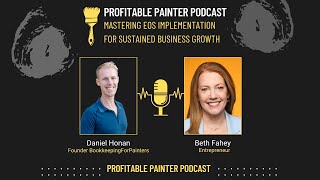
Beth Fahey, an EOS implementer, explains how the Entrepreneurial Operating System helps painting companies and other service businesses gain clarity and accountability. EOS uses five core tools: a Vision/Traction Organizer, Accountability Chart, weekly Rocks, Level-10 meetings, and a Scorecard with 5-15 key measurables. The biggest mistake is cherry-picking tools instead of implementing the full system.
Chapters
Welcome to the Profitable Painter Podcast. The mission of this podcast is simple: to help you navigate the financial and tax aspects of starting, running, and scaling a professional painting business. From the brushes and ladders to the spreadsheets and balance sheets, we've got you covered. But before we dive in, a quick word of caution. While we strive to provide accurate and up-to-date financial and tax information, nothing you hear on this podcast should be considered as financial advice specifically for you or your business. We're here to share general knowledge and experiences, not to replace the tailored advice you get from a professional financial advisor or tax consultant. We strongly recommend you seeking individualized advice before making any significant financial decision. This is Daniel, the founder of Bookkeeping for Painters, and today I'm here with Beth Fahey. Super excited to talk to her about all things EOS and Traction and Beth's career path has varied from working in film to owning a bakery and leading a trade association. In 2014, she came across Traction, a book that profoundly influenced her life. Beth successfully implemented EOS in her bakery and later observed similar struggle— struggles in other businesses while serving as president of the Retail Bakers of America. This inspired her to become an EOS implementer full-time, leveraging her firsthand experience with EOS to assist others. Beth has witnessed the positive impact of teaching EOS across different industries on leadership teams and their employees. Alongside Renee Bower, she co-created the Great Boss Workshops, where she now leads sessions for bosses in the EOS community. Beth is dedicated to nurturing environments where exceptional leadership can thrive. So I'd like to give a warm, warm welcome to Beth. Welcome to the podcast.
Thank you. It's great to be here.
Yeah, I'm super excited to have you. I think we have a similar passion with, with Traction. I feel very similar. I think in terms of, um, Traction has done so much for my business and, uh, it's just one of those books that just completely shifted things for me and, and really got me to move things forward in my business. So I'm really excited to talk to you today.
Great.
Um, so can you get— is, is there anything that you would add to your bio, like in, in your background? Like, could you go through, like, where are you coming from and, and how did you get to this point?
Yeah, I mean, I think like a lot of entrepreneurs, you know, you don't set out in your early 20s to go start a business, right? I mean, just an opportunity presents itself and So people that are natural-born entrepreneurs will just see these opportunities and seize them. And so, you know, that's kind of how I ended up owning a business. And, you know, we did great in the first few years that my sister and I had the bakery. We started as a 2-person operation and just kept adding more and more people as we grew. And we honestly doubled year over year for, you know, like 6 years running. So we ended up going from like a $200,000 revenue business to a $2 million revenue business in under 10 years. And that growth was like significant. Well, you know, as you said at the beginning, I worked in film before I owned a bakery. And so, you know, I went to film school. I didn't have an MBA. I kind of felt like I was out over my skis. I didn't really know what I was doing as a business owner, but you know, you're just kind of plugging along and reading everything that you possibly can in order to get better. And one of the books that I was reading was Traction. And I think in 2012, somebody gave me the book. And what it was for me was a culmination of all the best business ideas that I had read up until that point. And it packaged it in a very usable, holistic system. And it, it just was a complete— it was one of those books, you know, when you outline a book after you read it, or as you're reading it, you know that it's landing for you. And that's kind of how I went through Traction. And I, I see my clients come in and they've got, you know, all these dog-eared pages and Post-its sticking out of their books and everything, because it just really resonates with people because it it just hits the stuff that's frustrating you so much, which is usually people or process. And if you can get that right, you know, that's where the magic is, right? So that's kind of how I came into EOS. And for anybody listening that's on this same sort of entrepreneurial journey, just let people know that they're not alone because, you know, you feel like maybe you're crazy or maybe it's you that the reason that the business is a problem or there's problems in the business. But almost everybody struggles with the same stuff. And that's what I think Traction and, you know, the Entrepreneurial Operating System just address so well is this shared frustrations that we all kind of have.
Yeah, and one of the things I love about the book is it's very— you can— it's very practical. There's not— there's theory in it, but it tells you exactly what to do and how to do it with the templates and everything to, to implement it immediately. So it's not like some business books are kind of heavy on the theory, and it gives you good ideas maybe, but you're still— it's left to you on how to how to actually implement it. This is like no-nonsense book as far as like, this is exactly what you do and how you do it and which— what should it look like. So it's so, uh, practical because there's another book called Scaling Up, which is also a great book, um, and it has a lot of great ideas in it, but it's just not as easy to implement. It's not as straightforward as, as I feel like Traction is more boiled down to give you like, hey, here, here's, here's exactly what you need to do. So that's one of the things I, I love about this book. Um, what, you know, as you've helped folks, I guess, could you give us like kind of like a rough sketch of what is this book actually telling us to do? Like, um, what is the EOS system? What does that actually— what does it having us do?
Yeah, so EOS is just a simple, proven business management system. So if you think of an entrepreneurial operating system, like you would think of Windows in a computer or iOS, sort of running in the background, it's the thing that's kind of holding everything together. And, you know, helps with communication and all that stuff. That's what EOS is. It's not software, although there is software for EOS so that you can run your business on EOS. It's not software. It's more of a philosophy and a way of approaching things by using very simple practical tools that are going to help you do 3 things that we call vision, traction, and healthy. So vision from the standpoint that everybody in the organization sees the vision clearly and is focused on how to get there. Traction is is, you know, coming from the standpoint of all of your leaders are more disciplined and accountable, and they're really executing on that vision. And then healthy just means that you've got a healthy, functional, cohesive leadership team that's really working well together. Because we find most of the time leadership teams or leaders in organizations, small to mid-sized businesses, they're not really working together in a healthy way. There's a lot of ego, you know, sidebars, politicking, all that kind of stuff. And what EOS does is it essentially shines a spotlight on things. You can't hide when you're using the EOS tools. So we have these very practical tools that are going to help you essentially get what you want from your business. And so what I do as an EOS implementer is I work with small to mid-sized businesses, those leadership teams, and help them implement the system. And by using an implementer, it usually helps things go a little faster. And part of what my job is, is to ask the tough questions. You know, the questions that people, you know, everybody knows what the issue is, but, you know, I can be the dummy in the room and just say, hey, you know, do we have, is this an issue? And what that does is it gets people actually talking about it and moving to solve it, which is really the point. And that's why EOS as an operating system just really helps you get the results very quickly, especially, you know, the more you adhere to using the tools, the foundational tools like the Vision Traction Organizer, the Accountability Chart Rocks, Meeting Pulse, Scorecard. By using all those things and really leveraging those tools within your organization, you're gonna achieve your vision probably faster than you thought you might. At least that's what I see happen with my clients.
Yeah. Yes, I, and I think the, what I said before was it's like easy to implement because it gives you everything, but actually reflecting as you were talking, uh, it was, it really gave you the, what you needed, but it does, I would imagine, really help with having an EOS implementer actually guide you through it because when we did it in our organization, I think we were around a million in revenue or something like that. So there was, we already had a team and so it was a little bit of, anytime you're doing change, as I'm sure you know, is like very difficult for the team to accept change. So there, it was definitely a rough period and we didn't have anybody to guide us. We're kind of just basically just using the book. So it would have been helpful for us to probably have you at that point. But are there some, some things that, you know, as a business that's implementing EOS into their, their business, are there things to look out for, common mistakes, pitfalls, anything to look out for as they're trying to implement this into their system?
Yeah, happy to talk about that. And just to set the record straight, 9 out of 10 people that are using the EOS tools are self-implementing. So, you know, only a 10th or 10% of people that are, you know, really actively using EOS are using an implementer. The advantage of using an implementer is you'll just go faster, you know, and you'll, you'll be— you have that outside person in the room. So, you know, you have to decide, you know, based on your budget and things like that. But the, the thing that I would recommend to anybody that's self-implementing or just starting to get their feet wet with the tools is don't cherry-pick the tools. Don't just do Level 10 meetings and not do your accountability chart or not do ROCKS. And that's what I find, especially when I encounter a team that's been self-implementing for a while. They'll just do one or two, you know, maybe a couple of the tools. They're not using everything. The other thing that I see is mixing operating systems. So you mentioned Scaling Up before. There are lots of operating systems out there, you know, EOS isn't the only one. I like to think it's the best one because it's holistic and it's designed for small to mid-sized businesses. But if you start pulling, you know, something from Scaling Up, something from Great Game of Business, it's doesn't— it's not designed to work together. Where EOS is, it's the whole enchilada. You know, it's everything. So if you just trust the process and use the tools, you'll be great. And sometimes, you know, the simplicity of the tools, people that are natural born complicators think it can't be this easy, it can't be this simple. But the design is genius because it is so simple and because there are certain things that are pretty pretty black and white. So for example, you know, when you're assessing does somebody belong in a seat, we have this tool called GWC, right? Gets it, wants it, capacity to do it. And we're looking for a yes or no answer on that. So that's the black and white of EOS. And, you know, and a weak yes is really a no. So, so I mean, like, Using the tools in the way that they were intended without over-engineering them would be my, my main recommendation.
Yes, I definitely, that makes complete sense. I'm just thinking back, like when we first were going through our values, like trying to come up with the core values of the business, which is part of the Vision Traction board. We, we went way over, like, I think the recommended amount was somewhere between 3 and 5, I believe. I'm not getting that wrong.
Okay.
But I, we had like 7 or some ridiculous number.
Yeah.
And because we thought we're like, yeah, let's make it really good. And, and, but nobody could remember the core values. So we just had too many. This is like pointless. I couldn't even remember all, all of them. Yeah. So it was just like, You're exactly right. Like, you just need to— these things seem simple, like coming up with 3 core values or 5 core values, or, you know, having a certain set of measurables. You know, you want to keep it to only the essential measurables. You don't want to have like 1,000 measurables. Right. Keeping it as simple as possible because that just makes it easy for your team to to remember your core values so they can actually, you know, make decisions based off of them. But yeah, it does seem simple in the book. I agree. But trying to keep it as simple as possible definitely has— we've had to learn that. Like, we didn't keep it simple in the beginning, but then, you know, years later, like, okay, let's keep it to 3 core values so people actually remember what our business is about. So that makes complete sense. And, and then actually adopting the whole, the whole EOS system and not just like trying to cherry-pick. We didn't do that. I think we did a decent job. I would say we didn't actually follow the, the recommended way to roll it out. And that was a mistake. Like we, because I run the, the business with my wife and we kind of just we didn't get enough buy-in in the beginning and we had some pushback on the change. So that was a mistake on our end. So I think that part we skipped a little bit of on the actual first implementation. So that was a learning thing for us. That was something we actually made that mistake too. So we did all the mistakes you're saying, I think. But yeah, it's the— that's some really good advice there on how to actually implement and not fall into those common pitfalls there. What part of, I guess, what kind of results or, you know, you said it can be implemented pretty quickly. What do you see with the folks that you work with? Like, are they starting to see like tangible results in their business after like 3 months, a year? You know, what kind of results have you seen?
So I think, you know, this sounds like a political answer, but I mean, every client is a snowflake, right? Everybody's different and they are going to get different things out of implementing the system initially. I know for me and my bakery business, I was really concerned about profitability because we were— it was clear that we were going to be unprofitable pretty soon. When we started the system. And that's usually when I meet people is when they're— when they know they've got to change, that what they're doing currently is either going to tank the business or ruin relationships, you know, or something. And so it really just depends on what you want to address first. For us, addressing the people issues, especially the people that didn't fit our culture that were on the leadership team. That was the biggest bang for the buck. And I would argue that it continues to be the biggest bang for the buck for any client of mine. And everybody's so afraid to make the changes when it comes to people because, you know, you get caught up in loyalty or how long somebody's been with you or their work ethic or, you know, there's a million excuses that you can make for keeping somebody that doesn't fit. And so we have two ways of determining fit. The first is whether or not somebody's a core values match, meaning that most of the time they exhibit the behaviors that you want to see, you know. So in my bakery, our core values, for example, were make the next person successful. Go the extra mile, generate positive energy, and act with reputation in mind. Those were our four. We were very service-oriented organization and very employee-centric. So those core values really worked for us. And whenever we had somebody that didn't fit those core values, they kind of stuck out like a sore thumb. And what ended up happening is people like that turn into a cancer in an organization, and they can actually ruin your entire culture. One person, it's kind of like, you you know, a bad apple spoils the whole bunch kind of idea. And so, you know, what we did initially was deal with those issues that we had, you know, the right people, the core values issues, right seat. Now that's really about our people performing well. Are they doing what we expect of them in their seat? And that's what I was talking about with gets it, wants it, capacity. That's the measurement for that. And so by getting really clear about whether or not somebody is doing well in their seat, that in and of itself will have an enormous impact on an organization. But you just have to be serious about it and be decisive. To be quite honest, you have to just be decisive. And it will change. You know, a culture can change for the good overnight when you rid yourself of people that are, you know, kind of working against you. So, um, yeah, I mean, making those people moves— and that's where EOS gives you the tools so that you can assess and have honestly carefrontational conversations with people. You know, you care about them, you want them to get where they need to be. But some people just can't. And we have to start having those conversations. Then the other thing is process. I mean, that's the other big, you know, EOS is a process, right? So you're implementing a process in your organization. But you're also working on the processes in your organization, trying to get those things done in a repeatable way so that you can grow and scale your business. And so that you don't have to worry that people are doing things the right way each and every time. And so by focusing on people and process, you are going to make a huge, you know, impact on your organization. But that's only 2 of the 6 key components. I mean, people, process. We also focus on data, vision, and traction, as well as getting your issues solved. So those 6 things Really, you know, again, the simplicity of the system.
Yeah. And I like the people piece is so big, especially for service businesses with, you know, painting businesses, they're service, they're not selling iPhones, right? They have people going to the houses and painting them. And even the person that did sell iPhones, Steve Jobs, was like, he was big on having the A-team in place, getting the right people in his organization in the right seats. Uh, and he, he would— I think he, at one point, Steve Jobs was saying like, when you're, when you're a smaller business, it's even more important to get your people right. Uh, because if, let's say you only had, you know, 4 people in your organization, well, if one person is not the right person or not the right in the right seat, that's like 25% of your business now is like bad and your customers are experiencing that pretty directly because, you know, so it's even more important for like the smaller businesses, you know, even though we're not Apple, you know, we don't have thousands of employees, we have, you know, tens of employees if that. Yeah, it's even more important to be focused on getting the right people in the right seats because what our employees are doing is going to have such a huge impact on, on our customer experience and the value that we provide. So I think you're, you're spot on with starting with the people's getting that right because that can, that can definitely screw things up pretty, pretty quickly.
Yeah.
You mentioned the, you know, the people, the process, and then the data component. And could you talk about that a little bit? Because, you know, that might be a scary, like, you know, folks are like, oh, data, I don't, I'm not good with math. Like, could you go through what is that actually to talking about that data component?
Yeah, so when, I mean, obviously, you know, as a business, you have to run certain reports just to, you know, stay afloat, you have to have a P&L and a balance sheet and all those things. And whatever you're doing for reporting to get the numbers that you need, keep on doing that. But with EOS, we talk about two things. The first is to have a scorecard, one at the leadership team level, or you know, at the department. You want to have definitely one at the leadership team level and preferably one for every department. Now, if you're just a, you know, 4-person company, one scorecard is probably fine. And 5 to 15 measurables on that scorecard. So a measurable is just a number that you, one of the employees of the organization, are accountable for keeping on track week over week. And what a scorecard does is it looks at 13 weeks of history at a glance. And why this is so helpful, particularly if you're in a seasonal business or, you know, whatever kind of business that you're in, any sort of, you know, blip on the, on the scorecard should kind of get you to pay attention to what that means. Now, sometimes it's just a blip. It's a one week, you know, the number is going to be off. And so there is a goal for every measurable. And every week, you know, but it's just 5 to 15 numbers. So for example, in my bakery, you know, average ticket price, that was an important number for us. Cash in the bank, that was an important— now those are lagging numbers, but other things that were helping us predict the future, that's kind of what you want to think about when it comes to a scorecard. How do we predict that we're going to have a great quarter? Well, how many wedding cake consultations are you having? You know, the more consultations that you're having, the higher the likelihood is that you're going to book them, right? And if you, if you keep your conversion rate a certain rate, and you can track that and, and so on. So what a scorecard does for you is, is just help you predict the future so that when something's off, you're talking about it immediately rather than waiting for your quarterly financials to come in and you say, oh my gosh, what happened in Q2? So this way you can adjust and adapt a lot more nimbly and get ahead of it.
Yeah. Yeah, that's, that's big. And this is, I know for us, uh, it was a little harder to implement, um, because you gotta one, figure out what metrics in your business are going to be important to track. You gotta make sure you're only tracking a handful. You can't track everything. What are the most important things?
Right.
And then actually consistently tracking it and going through it and like you said, going through those numbers. But once you get into the groove of it, it's actually, from my perspective, it's pretty easy when, especially with your team involved, it keeps them on track with what the, they should be hitting. And once you get in the groove, it's very, don't even notice it anymore. Like that, It's just a thing we do.
Yeah. And some of the pushback that you get, especially because I worked with the same types of folks, you know, we didn't pay like gobs of money. It was physical labor. Usually had people that were, you know, in between careers or something like that. I mean, I don't— I'm making assumptions here, but the people, some people thought that because we were keeping numbers on a scorecard that we were, it was Big Brother, or that we were looking over their shoulder or whatever. The thing is, is that I found accountable people love to be held accountable. So if you've got a level of accountability in the organization, they shouldn't have any problem reporting back what the numbers are week over week. And it also, you know, it just keeps things— everybody starts to then understand how the business works as opposed to it all just being in your head as the owner, right? It gets that sort of ownership thinking too. So yeah, there's tons of advantages to the scorecard. And again, super simple tool, 5 to 15 measurables. Everybody's got a number.
You mentioned accountability and what— and we were talking before the podcast, you have this acronym LMA, leading, managing, accountability.
Yeah.
Could you talk to me a little bit about that?
Yeah. So LMA is a big bucket, right? So LMA, leading, managing, holding people accountable. And when we do an accountability chart— now, an accountability chart is like an org chart on steroids, right? So if you can imagine this, the seats in an organization and how you're structured and what the reporting looks like in a typical company, an org chart is just titles and it shows reporting. But an accountability chart shows the accountabilities, the 5 main things that people are accountable for. And so as bosses, We have this thing called LMA, leading, managing, holding people accountable. That's the first bullet point in our seat on an accountability chart. And what that means and all the stuff that goes into LMA, it's hiring, it's training, onboarding, coaching, mentoring, career development, and eventually exiting people out of an organization. So It's a big bucket, but that's how we keep things on an accountability chart. We wanna have accountabilities, not tasks. And so that's why we don't put training, coaching, mentoring. I mean, otherwise the seat would be ginormous, right? So we wanna simplify by just calling it LMA. And anybody that has LMA in their seat, what that means is they're responsible for making sure things happen in their department. They have to have the tough conversations. They have to, you know, provide the necessary tools for people. They have to assess the team. And when there's a stress crack, you know, do we need to add another seat to the accountability chart? And it's all about setting clear expectations of your direct reports. It's about having the conversations. We have this thing called a quarterly conversation as part of how we train people with LMA. And so there are 5 leadership abilities, 5 management abilities. And part of the training that I do as an implementer is walk people through an assessment to see where they are at. And this is all outlined in the Great Boss book, How to Be a Great Boss. About really assessing, you know, where, where the gaps are. Because honestly, the journey of being a great leader and manager, it first starts with you. You have to kind of look at yourself and say, where am I getting in the way? Or what could I be doing? And a lot of times, depending on how you grew up or what your parents were like, or, you know, what generation you're in, a lot of us have misconceptions about what being a great boss or being a boss is. We think it's about, you know, command and control. But that's not how you actually get the most out of people and make it a great work environment. So, you know, thought leadership is changing on that, but it's slow to change. But EOS is absolutely, you know, ahead of the curve as far as thought leadership on modern leadership.
Yeah, I love that, uh, LMA, like just shorthand for your, for your leaders, you know, that you're leading, managing, you're keeping people accountable, uh, on your accountability chart. That makes, that makes a lot of sense.
Yeah.
And you, you said that, uh, there's certain things that a great boss should be doing. What, what are those things? Like, that are empowering folks to work with them?
Well, so, you know, when it comes to— I mean, I can actually read right from the book, which I happen to have right here. But there are 5 leadership practices and 5 management practices. The 5 leadership practices are really about you as a leader. And a lot of people have this idea, oh, I'm more of a leader than a manager, or I'm more of a manager than a leader. And the thing is, you kind of have to be both. You have to be both a leader and a manager. And so being a great leader means that you're creating an opening, right? And creating an opening is like a seat on the accountability chart, or it's the vision for the organization. You have to be able to translate that. The second thing is that you're providing the necessary tools. Are you providing the resources, the training, the, um, the technology and your time? Are you giving people your time? Um, are you delegating and elevating, meaning are you letting go of some stuff? A lot of us who are bosses, we hang on to things way too long and we don't really need to. And then, so getting really clear about what you need to hang on to and what you can let go to somebody else, that, that is huge. So delegating and elevating, you know, having the, the time to actually think and to have quarterly con— have quarterly conversations with people. That's more in the management side of things, but taking clarity breaks for yourself so that you're, you're actually, you know, keeping your confidence in check and, and really making sure that you're, you know, thinking and working on the business. So that's leadership. Management, on the other hand, is about keeping expectations clear of your direct reports. It's about communicating well, making sure that you're communicating both sides. It's about working for the greater good of the organization. It's about having quarterly conversations with your direct reports. And lastly, it's about rewarding and recognizing. I mean, that's all covered in the How to Be a Great Boss book, which is an awesome book. Again, a very simple approach to being a great boss. And it, it is designed to work with our EOS tools, but you could read the book independently of EOS and still get a ton out of it.
Yeah. So, yeah, I like how you're giving that definition of leadership and management and like actually putting those concepts to the, those words, because we hear leadership a lot, but what does that actually mean? So like how you're actually spelling it out, these are the actions you need to take to be a good leader. So that's, that's helpful. Um, cool. Well, Where can folks learn more about you, either reaching out to you as an EOS implementer? How do, how do they get ahold of the Great Boss book? How can folks reach out to you?
Yeah, so I'm, I'm easy to reach by email. So beth.fahy@eosworldwide.com. That's my email. I'm on LinkedIn. You can ping me on LinkedIn. And, um, as far as, you know, how to learn more, uh, one of the things that I do— I mean, I'm based in Chicago, so I tend to work with people in the Chicago area. Um, but for anybody that's listening to this podcast, if EOS sounds like something that you want to pursue, obviously first read Traction, that might help a lot. But reach out to EOS Worldwide. We actually have a website where there's all of the EOS implementers. There's over 800 of us around the world that are helping, you know, over 200,000 companies get what they want from their businesses. And so it— there's a lot of us out there, and there's probably one in your backyard that you could reach out to. But you can find me on the EOS Worldwide website as well. So it's just eosworldwide.com/beth-fahy, and you can read my profile and connect to me there as well.
Awesome. And we'll put those links in the notes for the show. I really appreciate your time today, Beth. Uh, super informative. It was really great to hear your perspective on EOS. And with that, we will see you all next week.
Okay, sounds great. Thanks.
More from Daniel







What’s REALLY Holding Your Painting Business Back? (Find Your Bottleneck in 5 Minutes)



