Mastering Sales Success: Building Genuine Client Relationships with Allan Langer
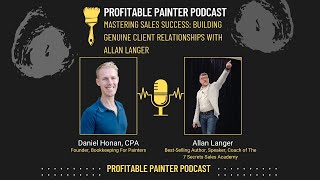
In this interview, Daniel, founder of Bookkeeping for Painters, talks with veteran sales trainer Allan Langer about how painting and other home‑service businesses can dramatically improve their in‑home sales results. Allan stresses that the optimal moment to close a deal is during the first house visit, when the homeowner’s excitement is highest. He explains that success hinges on knowing your ideal customer avatar, which drives higher close rates (around 35% for qualified reps, 45‑50% for top salespeople, and about 40% for owners). To avoid sticker shock, Allan teaches price preparation and anchoring, using third‑party cost data and conversational questions to set a mental price before presenting the quote. He advocates presenting three tiered pricing options (good‑better‑best) to shift the buyer’s mindset from a binary yes/no to a choice among alternatives. Core conversational techniques include asking open‑ended questions, actively listening, and not rushing to sell; this builds rapport and makes the customer feel heard. Allan also recommends the “anti‑salesperson” stance—professional appearance, genuine listening, and positioning yourself as a helper rather than a pushy contractor. He argues that objections should be prevented through thorough preparation rather than handled with scripted rebuttals, and that financing can be used to bridge gaps between expected and actual costs. Throughout, Allan shares concrete benchmarks, psychological pricing insights, and references his 7 Secrets Sales Academy for deeper training.
Chapters
This is Daniel, the founder of Bookkeeping for Painters, and today I'm here with Alan Langer. Alan is a professional speaker, bestselling author, and an award-winning sales professional with over 27 years of experience in sales and marketing. Having sold over $95 million of his product in his career, he has trained over 1,000 sales consultants in close to 100 companies. And offers his expertise in the form of motivational talks, training seminars, keynote speeches, breakout sessions, and one-on-one sales coaching and training programs. His book, The Seven Secrets to Selling More by Selling Less, is a national award-winning bestseller on Amazon, and he has been featured and interviewed on over 100 podcasts and radio shows. He has given keynotes at numerous national conferences to include the PCA, and currently travels the U.S. conducting sales workshops for companies and teams of all sizes. His 7 Secret Sales Philosophy teaches how to implement a people-focused sales system backed by science and understanding human behavior. Welcome to the podcast, Alan.
Awesome, Daniel. Uh, thanks for inviting me. I appreciate it. I'm sorry for writing such a long bio. I'll shorten it up next time.
No, I think it's great. It's, it's awesome. And it, it obviously speaks very well to what your expertise is. And is there, is there anything else about the, your background that you think would be important for, the listeners here to, to—
Yeah, I think the one thing, the one thing that I probably left out that may be more important for people to know as far as credibility is I, I spent, I pro— I, at the last, when I finally did the, the numbers on this, I, I ended up in over 10,000 homes selling. And, and what I was selling was, uh, Andersen windows, the most expensive window on the market. So led the country in, in, in sales for Andersen for many, many years. Uh, so I do have— I'm not like a software salesman who all of a sudden is telling painters how to sell. I've, I've got the, the street credibility in the home for sure.
That's awesome. Yeah, and I know a lot of painting businesses that I've spoke to, one of the things that they struggle with is that in-home sales piece where presenting on the spot. A lot of folks, they'll go to the home, you know, do the estimate, get the bid, and then maybe they'll go back to their, to their house or their home office and then send it via email and not even present, you know, their, their sales— not do any kind of sales presentation at the home and just kind of send it via email and cross their fingers and hope that, uh, the, the prospect ends up, ends up signing. So do you have any like recommendations on how to get over that fear of not wanting to do an in-home consultation?
Yeah, you get over it by, by winning more deals. Um, you have to in, in, in-home sales, unless you're doing gigantic $100,000, $200,000 additions or bath and kitchen remodels, if you're in painting and you're in windows or siding or roofing, the best time to sell a customer is when you're in the house the first time. And you can do that. The pushback I get from that is, oh my God, it's too much pressure. I'm going to be a high-pressure salesman. It's, it's nothing is further from the truth. You can sell on the first visit if you know how to do it properly without pressure. The reason I say that is the most excited time for a customer is when they have all the information in front of them. When they sit down with whoever it is, again, whether it's the, the roofing guy, the siding guy, the painting guy, and they're picking colors and that painting guy's getting them excited about their new exterior job or what the baby's room is going to look like and what the kitchen is going to look like. That's the emotion part of sales. And people buy with emotion, not with logic. They try to justify it with logic, but they buy with emotion. And when you're able to present that price and everything on that same visit and you establish rapport and comfortability with the customer, that's when they are more apt to say yes. What happens when you leave the house is all that excitement, all that ether that is built up, dissipates and you literally just become a commodity. Because what's happening is now you email them the quote and I don't care how nice your quote looks, they're just looking at the 3 other quotes that they got and they're scrolling to the bottom of the email and they're looking at the number. They're not reading anything else. It's human nature. So now what's happening is they see 3 painters and they go, wait, what did this guy say? Is this the guy that has a 10-year warranty? Or is it— now they got to try to read stuff. You know what, let's just pick the guy in the middle or let's just pick the cheapest guy and you become a commodity. So you have to try to get them excited and ask them for the sale, ask them for the order on the first visit. You'll make more money, you'll close more sales, and your customers will be more excited about it.
That makes a lot of sense, trying to close on the spot with, you know, to capture that excitement. If someone that is already trying to do in-home sales presentations and close on the spot. Do you have any recommendation on what their close rate should be in home or some guidelines? Are they doing okay? Should they expect to close 20% on the spot and then the other 20% when, you know, in a follow-up or do you have any kind of rough guidelines or indications that they should improve their sales process?
Yeah, let's, let's back up and look at the qualifications first. If you're just what they call spraying and praying, like just casting a wide gigantic marketing net and seeing everyone under the sun, then your closing percentage is going to be low. Because if you, you need to know, the first thing you need to know, it's Marketing 101, is who is your customer. Now if your customer is someone that just lives in a house, no matter what the house is, you're going to have a tough time closing higher numbers because you're visiting a $100,000 house and a million-dollar house. Those are completely two different customers. So what I implore painters or anyone that owns a company is, who is your customer? Who are you going after? Is it the million-dollar houses? Is it the $250,000 to $500,000 house? Is it ranches? Is it split-level colonials? Who's your customer first? And then gear your marketing toward that customer. So the more you get in front of the customer that is your customer, that you that you can qualify, the higher your closing percentage should be. So let's say you do that. Let's say you market to just houses that are $300,000 to $1 million. Let's say that's your market. Now you're seeing just those types of customers and you're trying to close on the first visit. If you're doing your job correctly, if you're, if you're asking the right questions and the customer gets comfortable with you, you should be at 35%. Or higher. A really good sales rep is going to be about 45 to 50% if you have a sales rep. If you're the owner, you're walking in as the owner of the company, you should be around 40% because people like buying from owners. They're just like, oh wow, I've got the owner in my house. If you're under that 35% range, um, you're probably seeing the wrong— two things are happening. You're seeing the wrong customers or you're not, you don't have a good sales process to present to them. And you're probably, if I had to guess, as you're listening to this right now, you probably are getting a lot of sticker shock. Your customers are probably like, oh my God, I didn't expect that. And if you're getting sticker shock, then, then there's, you know, ways to, to, to avoid that as well.
Okay, cool. So If you're, if you're, you have your avatar dialed in, if you know who you're reaching out to, you're getting the same type of client, same type of prospect, um, you should be getting a 35% close rate or better. If not, then you might need to look at either dialing in your prospect better with your, uh, marketing, or you need to improve your sales, your sales process.
Sounds like correct.
Yep.
Okay. Nailed it.
All right, awesome. Um, and then you mentioned sticker shock and some ways that you might, might be able to avoid it. What are some ways that we, we can avoid that doing in-home consultations?
Yeah, well, I mean, I do a whole training on this. It's, it's a, it's a, you know, I can do a 2-day training on pricing. But to, to wrap it up in a nutshell, pricing is— I want everyone to understand that pricing is 100% psychological. Pricing has nothing to do with numbers. Pricing has to do with the comfort level of the brain when they see the numbers. Okay. So if they're not— the first thing to understand is if you don't prepare that customer for the, for that price that you're going to put on the table, I don't care how good you think that price is. I don't care how good you think your company is. They are going to be— they are going to think it's too much money. Okay. Because that couple that you see or that person that you're seeing, has a number in their head like, okay, my house, I want my house painted. It's going to cost me $10,000. That's in their head. Okay. If you pull up to that house and know that's a $25,000 paint job, I don't care how much value you build. I don't care how great your painters are, how many awards you've won. You get— you put $25,000 down and they're expecting $10,000. You're not selling that job. You have to get them off of that number in their head and you have to prepare them They call it price conditioning. I call it price preparation. Prepare them for these numbers. Once you get the shock out of the way in the beginning, then they can start to digest it psychologically. And then when you get to the end, that number of $25,000 will not be nearly as surprising as it would normally be if you don't prepare them for it. So that's number one, the preparation of the price. And a lot of reps get that wrong. A lot of reps are afraid to do it. A lot of reps are They avoid it. They try to build all this value and, and again, you're building value to the number in their head, not to the number that it's gonna be. And then the second way is how do you present the price? And this is, this is one piece that I tell everyone I coach. I don't care what you sell, you have to present 3 prices. If you're presenting one price, you're, all you're activating in the brain is a yes or no response. And a yes or no is a decision. It's a knee-jerk reaction. So if you put down, here it is, $25,000 for the, for the, for the paint job, and then you sit there and stare at them, literally they're going to say, okay, great, I got to think about it, or I got to get two more quotes. What they're doing is they're relieving the anxiety of making the purchase in front of you. And there's no other choice. That's, that's my choice. Yes or no? But let's say you put down $25,000 for the premium paint, $22,000 for the medium paint, and $18,000 for the rental property paint. Now they're looking at 3 choices and their brain, instead of going to yes or no, their brain is now in a choice mode. Which one am I going to pick? And when you think— start to think of which one I'm going to pick, it gets them closer to working with you because they're picking something. So always, if you can— and again, I can train you on this if anyone wants to contact me— you have to drop 3 prices on the table. And then give them a chance to sit and talk about it. And that's when I normally would go outside. But those are the two things: prepare them for the price and present it in a way where they have a choice rather than a yes or no, and you'll, and you'll, you'll sell more, guaranteed.
Okay, that makes sense. Preparing them for the price and then giving them a good, better, best option when you, when you actually present the proposal. So for price preparation, is that's interesting. So like, do you kind of ask about what their, their budget is and kind of see what they're, what's on their mind? Or how do you go about preparing?
There's a question you can use it. You can do it a few ways. You can use third-party information. So if you have an idea of what a Full House painting job costs in Cincinnati, Ohio, and you get that through the Cost Versus Value Remodel Magazine issue that they do, or any other research that's out there. Um, and you can show third-party information. Just so you know, Mr. and Mrs. Smith, this is the average cost of print— of, uh, of painting in, in Cincinnati. So let them be surprised at that. The question I like to ask at the beginning before I even show any third-party information is, by the way, Dan, I'm just, just wanna see where your head's at. What research have you done? Do you think a job like yours is gonna cost more than $35,000 or less than $35,000. Now that's why I, I know, because I've qualified the customer before I got there. I know he wants his entire house done, so I know as a professional painter this house is going to cost $28,000 or so. I kind of have an idea of what it's going to cost, so I'm going to introduce a price that's higher than that in a very conversational, question-like way. So, hey Dan, just checking Any idea? You know, have you done any research? Do you think your house is going to cost more than $35,000 or less than $35,000? And you say that number twice. What you answer or however the customer answers doesn't matter because you anchored, you dropped $35,000 in the middle of their brain like a seed. Now, normally you will hear, oh my God, I hope it's less, or I have no idea. I haven't looked. Great. No problem. And then you say, 'But you know what, it's going to be up to you. You're picking the paint, you're telling us what you want, you're going to talk about trim and everything. The price is going to be up to you. So let's get, let's get going on that.' And then you just move away, move off of it. But now you planted $35,000 in their brain, so the number of 10 is gone. So then you start building value to the, to the number that you just anchored. And then when you show 28 and he's expecting 35, all of a sudden you'll say Oh, wow. That's what I was expecting. Pretty good price right there. See how that works?
Yeah, that's awesome. That's some Jedi mind trick right there.
It's just it. And I don't want people to think that this is like, you know, underhanded or trickery. It's not. It's just how the brain works. And you want it. You want to get the— you want to get them away from what they're thinking and just drop another number in there from a conversational way. And it just gets them You'll, you'll get a lot less sticker shock that way than if you just present a price at the end of the conversation. Right.
Because they might not have even thought of what it could be and they're just completely blind going into it. So whatever number you put on there is going to be shocking.
Exactly right.
All right. One thing that I was looking through some of your material was What, what makes a great sales conversation? What, what are the components of a great sales conversation?
The, the, the components of a great convers— great sales conversation come down to really the granddaddy of, of all of the components, which is asking open-ended questions. And I know that sounds very simplistic and not rocket science type, but it's amazing how many sales reps or business owners when they're in front of a customer do not ask open-ended questions. The brain itself defaults to closed-ended questions. A closed-ended question is a, is a question that it's a yes or no answer. And when you ask a closed-ended question, it's a conversation killer cuz they will say yes or no. And quite often they'll shut up and they won't say anything else. Now, some people talk a lot, will continue to talk, but you have to ask an open-ended question to get people to tell you more about why you're there. The most popular overused open-ended, closed-ended question that every salesperson uses every day is, so do you have any questions, Dan? I say to you, do you have any questions? What's your normal response?
Nope.
Nope, I'm all set. Even if you have a question, your brain will automatically knee-jerk to no, I don't have any questions. It's like when you walk into a department store and someone walks up to you and says, can I help you? What do we automatically say even if we need help? Nope. Well, just looking, because you don't, you don't like, you, you, you have this, the sales resistance is up and our brain automatically says that. So when you say, do you have any questions? The person's gonna say, no, I don't have any questions. A very simple way to switch that is, hey Dan, what questions do you have? Now the brain is forced to think, wait, do I have any questions? And you'll see an actual person's face pause for a minute and say, Actually, no, I don't have any questions. Or, you know what, I'm glad you asked. I do have a question. And it gives them permission to ask the question. But things like, that's number one, open-ended questions. And this is gonna tie into the second component that so many people do wrong is, is most sales reps or business owners sell too fast. And what I mean by that is, let's say I go to your house, Dan, and you tell me, I want the outside of my house painted. I immediately go, great, well, I use Sherman Williams, I use Benjamin Moore, and I use the Home Depot brand. And these are the 15 colors that you can choose. And I just start selling, right? Instead of when you say, I want the entire, my entire house painted, I should ask an open-ended question. I would say, well, tell me more about why you want to do that. Well, the house has been this color for 15 years and we're getting tired of it. Well, describe for me how it feels when you pull up, when you pull up to a house and it's a color that you don't like anymore. Yeah, kind of, kind of sucked. It's been shitty for 5 years. We don't like it. And you just get all this valuable information from the customer. And this is doing 2 things. You're getting good information, but the customer is now feeling heard and understood and listened to. And you're asking questions that no one else asks, and you're not selling yet. And then at the end, when you ask 2 or 3 open-ended questions and you separate yourself from the other people who didn't ask the questions, Now you can actually start to sell the product because they're going to ask you to like, all right, show me what you got. So those are the two main components, open-ended questions and don't sell too fast. Stop selling too fast and ask more questions to get more information, to get them more comfortable with you.
That makes sense. Asking those open-ended questions, get them talking, and then use the information that they tell you in your, your sales presentation so that you they feel heard, and, and like you're not just trying to sell them, you're trying to help them, basically.
Exactly right, 100%.
Okay, awesome. That makes, that makes a lot of sense. So asking— so making— the way to have a great sales conversation is basically to ask those open-ended questions and not get sucked into trying to sell too fast. Um, are there any other components that we should consider when trying to have that great sales conversation?
Shut up and listen as well. A lot of reps will ask a question. Let's say they, they remember to ask an open-ended question, but then they don't listen to the answer because they're thinking about the next question to ask. Literally answer, listen to their answer and then ask another follow-up question based on what they just said. So if you start telling me that we've been in the house for 15 years and my wife doesn't like the color anymore, and then I say something like, great, how's the weather been? Or something completely unrelated to what you said, you're going to feel like I'm not listening to you. I'm a typical salesperson. But if I say, wow, what color did your, did your wife like prior to this house? Oh, well, we used to live in a greenhouse and she really liked that color. Well, tell me more about that. What shades of green did she like? And now you're like really getting into the conversation rather than just saying, okay, great, let me show you the greens. Now you're selling too fast. And the more you keep asking those questions, the more comfortable they'll be with you. And people only buy from people they're comfortable with. They're not going to buy from someone they feel is not there to help them or is selfish or just another typical contractor. Because here's the thing that to, to, to really understand people, when they want a job done, they want a painting job done, they still don't want to meet with you. You are a necessary evil. People don't like to meet with salespeople or business owners or contractors. They just— they're the top 5 hated professions in the country is contractors and salespeople. And when you're both, people don't want to meet with you even though they want their house painted. So it's like, oh my God, we got to meet with the painting guy. Okay, so they're expecting typical sales process, or they're expecting the typical contractor with the ripped pants and the beat-up pickup truck and the muddy boots. If you're opposite of that, if you're a salesperson that listens and asks questions and looks professional and has nice, you know, marked-up logo clothes and everything, they're going to do business with you much more than they're going to do business with someone who doesn't do those things. So be the anti-salesperson, be the anti-contractor, and you'll just sell more.
That makes, makes a lot of sense. Um, do you— how much emphasis— because the sales training that I've taken, there's a lot of emphasis on handling objections. Like, this is, this is fast forwarding to, I guess, the close or whatever you might call it, but trying to get them to sign up on the spot. How much How important do you think that part of the sales process is? You know, when they say, when you close, say like you sign here to, you know, sign up so we can get you on the schedule and you do that close and then they might say, well, that's great. I'm getting a couple of other bids, but I'll definitely let you know next week. Have you already lost at that point if that's where the conversation is going or? Okay.
Yeah, I mean, I think the numbers— I'm not sure what it is in the painting world, but in the window and the roofing world, if you don't— if they don't buy on the spot, I think the people who get back in the house and get that job is only about 6%. It's very, very low. So that's why that goes back to what I said at the beginning. When they're excited is the time when they— they're— that's the time to sell them. But let me go back to the objection thing because the objections and closing are are really the two biggest words in sales, that they're buzzwords that all salespeople, you know, look on Google. How do I handle objections? How do I— what's a good closing strategy? It's all crap, to be honest with you, Dan, because here's how you handle objections: you don't get them in the first place. If you get objections at the end, if you get, I gotta think about it, or I— it's too much money, I wasn't expecting it, I get other bids, you messed up somewhere in the conversation. What you want to happen, the only two answers that, that I, if I did a good job on my presentation and, and my average window sale was probably $35,000. So it wasn't chump change. You know, these were people were making these decisions within 2 hours. But if I gave them their three options, I walked outside and let them think about it. I came back in the house. And if I didn't hear, we're gonna go with option 3, that's, that's the one thing I wanted to hear. Or the only other thing I wanted to hear is, I'm sorry, we just can't afford this. We love your windows, we love everything about you, we just can't afford $35,000. If I heard one of those two things, I know I did my job and I was okay with them not being able to afford it. But if I heard, all right, great, thanks for everything, we're gonna think about it, I knew I screwed up somewhere. I knew I went too fast. I didn't ask enough questions. They were not comfortable enough with me to make that purchase. So as a painting— in a painting situation, if they're saying to you, I need to get more quotes, that's simply telling you that they're not comfortable with you. You're just another typical guy that they just got in. But if you ask those good questions and you look professional, and even if you're $1,000 more than the next two guys, they're going to feel comfortable with you. And then it literally— closing is just an extension of the conversation. It's like, okay, you want, you want option 3? Awesome. I can get you on the schedule for 3 weeks from now. You want to do a check or credit card for deposit? That's your— that's it. That's your close. You don't have to do any techniques. You don't have to do the, the sales manager close, the sign on the front lawn close, all these other stupid things that are out there. If you do a good job, you shouldn't get objections and you should literally just, okay, let's get going. When do you want to get on the schedule? That should be your close.
Nice. That's awesome. So basically you got to make sure you're doing that price preparation, you know, so that they're not, they're not shocked. You've asked those open-ended questions so they, they feel listened to and heard and you have a deep understanding of what they're looking for so you can get those good, better, best options for them. And then, and just trying to handle all those objections on the front end. So by the time you get to the close, you know, it's— they don't have anywhere to go. It's either we can't afford you or let's, let's do option 3.
Exactly. And, and here's the key. And many people don't do this, and I've gotten pushback, but I did it 100% of the time and it works. It works all the time to get one of those two answers is when you leave the price on the table, especially if you have both people there, you go outside and let them think about it. The old days of put the price on the table and shut up and stare at them, those are gone. People do not— they, especially partners, they want to talk about financing and they don't want to talk about it in front of the sales guy. Or in front of the contractor. So what I would do is I would put the, the numbers on the table, the options, and I'd say, okay, Miss, Mr., Mrs. Smith, I've got an install going on right now. I'm going to go outside and give them a call just to check on it. So now I sound like a good salesperson as well. I'll be back in in a few minutes. You guys let me know what you want to do when I get back. Basically, I'm assuming the close, I'm assuming the sale. And then I would walk back in and say, which one did you choose?
Mm-hmm.
And they would, then I would get, well, can you answer this question? As soon as they started asking me questions, I knew it was a sale. What do you know between 2 and 3? What is the difference here? Okay, great. Let's go with number 3. Or they would go, it would almost feel like they were just felt bad. Like, oh, I really want these windows. I really want this painting job. I just can't afford $30,000. I just can't do it. And then you're okay. They, they can't afford it. They can't afford it. You talk about financing at that point, you talk about monthly payments. And here's a quick— I'll give you another quick little tip on financing. And hopefully every painting person listening here offers financing to their homeowners. But let's say someone, they were expecting $10,000 and it came in at $20,000. And you get to the end and they're like, yeah, from what you said, I expected $20,000, but we We weren't really expecting to spend that kind of money. Okay, well, what kind of money did you, did you expect? We were expecting the job to be $10,000. All right, why don't we do this? Why don't you put $10,000 as a down payment and finance the balance? It'll be about $89 a month and you can get the paint job that you want. Now they spent the $10,000 that they were expecting to spend, and for another, whatever it is, $100 a month, they get the painting job. Because now they're realizing they're not going to get a good painting job for $10,000. And then you introduce financing and it's a combo and it's— and then you get your deal rather than walking away.
Yeah, that's awesome. I love it. All right, well, good.
I hope everyone listening loves it too.
Well, where can folks learn more about how to, how to work with you or learn more from some of your training?
Yeah, so everything I spoke about today, I, I can do like really ingrained, in-depth, you know, 2 to 3 hour trainings. I can come to your office. I can, I can do them online if you'd like. In person is always better, but just visit me at the7secretsalesacademy.com and it's the number 7. So the, the number 7, 7secretsalesacademy.com and fill out a form and I'll be in touch with you and we can, we can set something up. You get my book there as well.
Awesome. So I will put the link to the website, the 7 Secrets Sales Academy. .com, yeah, in the, uh, in the show notes. So if you want to learn more from, from Alan, definitely visit. Uh, he has some amazing sales knowledge here, and I really appreciate you coming on the podcast, Alan, and, uh, sharing some of that knowledge with us. Um, I definitely learned a lot, so, uh, I'm sure the listeners did as well.
Um, well, I appreciate the invitation, Daniel. I appreciate it.
Absolutely. Any last thoughts for the audience before we let you go?
Any last thoughts? Just be yourself. Don't be a salesman. Be the anti-salesman. Be the anti-contractor. Be the person that the customer is going to be comfortable with. Don't just be going in there trying to sell a job. Go in there to help the customer and you'll do just fine.
All right, great stuff. Thanks, Alan.
Take care, Daniel.
More from Daniel







What’s REALLY Holding Your Painting Business Back? (Find Your Bottleneck in 5 Minutes)



