Maximizing Tax Deductions on Vehicle Expenses: An Essential Guide for Painters
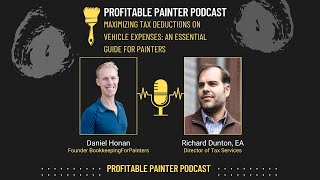
In this episode of the Profitable Painter Podcast, host Daniel (founder of Bookkeeping for Painters) and tax director Richard walk painting business owners through everything they need to know about vehicle-related tax deductions. After a brief disclaimer about the general nature of the advice, they define what counts as business versus personal use, explain the IRS concept of "listed property," and clarify that commuting miles are nondeductible while home‑office mileage is deductible. They compare the two primary deduction methods – the standard mileage rate (currently $0.65 per mile) and actual expense accounting – outlining when each is advantageous and noting the one‑way switch rule. The conversation then moves to depreciation strategies, including Section 179, bonus depreciation, and the IRC §280F weight limits that affect how much can be written off in the first year for vehicles under or over 6,000 lb. They discuss how business structure (sole proprietor vs corporation/LLC) impacts vehicle titling and the use of accountable plans for personal‑owned vehicles. Practical tax‑planning considerations such as timing vehicle purchases, the impact of accelerated depreciation, and the need to recapture depreciation on disposition are covered. Record‑keeping requirements are emphasized, with recommendations for mileage‑tracking apps like MileIQ versus paper logbooks, and a warning about insufficient documentation illustrated by the Hebron v. Commissioner case. The hosts wrap up by encouraging listeners to join their private Facebook group for further questions and episode ideas.
Chapters
Welcome to the Profitable Painter Podcast. The mission of this podcast is simple: to help you navigate the financial and tax aspects of starting, running, and scaling a professional painting business. From the brushes and ladders to the spreadsheets and balance sheets, we've got you covered. But before we dive in, a quick word of caution. While we strive to provide accurate and up-to-date financial and tax information, nothing you hear on this podcast should be considered as financial advice specifically for you or your business. We're here to share general knowledge and experiences, not to replace the tailored advice you get from a professional financial advisor or tax consultant. We strongly recommend you seeking individualized advice before making any significant financial decision.
This is Daniel, the founder of Bookkeeping for Painters, and this is Richard, tax director with Bookkeeping for Painters. How's it going, Daniel?
It's going well. How you doing?
I'm doing good. Uh, here in Northern Illinois, we are finally moving into fall. We've had kind of like that summer warmth sticking around, which has been so nice. And then I woke up this morning and it's like somebody flipped a switch and now it is 50 degrees and rainy and, um, you know, your quintessential fall weather. So I had to turn the heat on in my house for the first time today.
Really? Yeah, it was 80 degrees today. It was beautiful here in Nicaragua.
Yeah, yeah, I imagine that you don't have too much of the autumn thing going on in, you know, down by the equator there.
Yeah, you know, in December, you know, it's still warm. It's like 75, 80 degrees in December, and my kids They're pretty much Nicaraguans at this point, but they, uh, we, for Christmas, we went to this little Nicaraguan, uh, um, like hotel-like place that had like a nice pool area. And, and so we thought it'd be cool because the kids could go and do the pool thing and, and play with other kids while, um us kind of enjoying just, you know, some time outside of the house. And it was probably about 75, 80 degrees, but they were all complaining it was cold. They're all like shivering and stuff. I was like, yes, completely spoiled by this weather. It's not cold at all. Like, it's literally 75, 80 degrees Fahrenheit right now, and they're like all like bundling up, like acting like it's cold outside. So that's, that's the problem I have to live with, is, uh, the kids acting like it's cold when it's 75 degrees.
Yeah, well, we all have our cross to bear, don't we, Daniel? And here in the Midwest, it's 50 degrees outside, people are putting on shorts. It's, uh, it's funny how it's relative. You know what is not relative is taxes. Unfortunately, those are very set in stone. And, uh, today I thought maybe we could talk about one of the best tax deductions out there, and that has to do with your vehicle expenses. So if you're a painting business owner, you are almost certainly using at least one vehicle in your business, and that vehicle is going to be one of the biggest sources of tax deductions for you. So we want to make sure that you're taking full advantage of these and you're not leaving any money on the table, so to speak. So I thought today we could talk a little bit about, you know, what qualifies as a business vehicle deduction. We could talk about the recordkeeping requirements and the different methods for taking those deductions, mainly standard mileage rate versus actual expenses.
Yes, super important topic and it's a topic that a lot of folks don't quite get, partly because— or mostly, I would say, mostly because it's complicated. Of course, we're talking about the IRS here. It's complicated. So there's always all these caveats and exceptions and all this stuff. But it does help just to understand how it applies to you. So we're going to try to lay it out so you know in your situation what's probably the best, the best, you know, route for yourself. But of course, always want to seek professional advice for your specific situation.
Yeah, yeah. This can get a little tricky, especially when you have business entities involved. But, you know, basically the, you know, the IRS or the tax code, rather, the IRC Section 162(a) talks about business deductions that are ordinary and necessary business expenses. And if you have a painting business, then, you know, driving your vehicle to the job site, meeting with customers, picking up paint at, you know, Sherwin-Williams or Benjamin Moore, these are all extremely ordinary and necessary expenses. And you want to make sure that you're getting, you know, your full deduction for things like gasoline, tires, maintenance and repairs. And even just the value of your vehicle. You know, you place a beautiful brand new pickup truck or work van into service and after 5 to 10 years, it's not worth what it used to be. So we want to make sure that we're getting, you know, tax deductions for that. You know, how, how you're going to do this is going to depend a lot on your business structure. So if you are a sole proprietor and you don't have a separate business entity for your company, then you're going to take these deductions on your 1040 Schedule C. That is going to be the most straightforward way of doing it. If you— your company is its own business entity. So we're talking corporation or partnership or an LLC taxed as a corporation or S corp. Then we want to— we can still take these deductions, but we want to make sure that the vehicle is actually titled to the company because in this case, the company is its own separate thing and a company cannot take deductions for an asset that doesn't actually own. So especially if you want to do things like bonus depreciation, and you have an entity, you want that vehicle titled in the name of the entity. Now, if it's not titled in the name of the entity, it's titled in your personal name. There are ways to work around this. You know, mainly you're going to want to use an accountable plan to reimburse yourself for using your vehicle. And that is something you definitely want to talk to your tax professional about, you know, especially if your vehicle is being used for personal and business use. It can get very very hairy on trying to, you know, tease out the business portion and the personal portion. And you might leave some deductions on the table there. So, so talk to your tax pro about that.
Yeah. And I think for most painting businesses between the startup phase to $1 million and sometimes even more, a lot of folks are using their, their personal vehicle registered in their name to do, you know, go into sales calls, checking on production, coordinating. They're pretty much using their personal vehicles in those cases. So they're using— they have a business use and they also have a personal use. So you're basically saying we want to make sure we get the tax deductions from the business use portion. For the folks that are using their personal vehicles. And then obviously, if you have a vehicle dedicated specifically to business, and it's usually for the larger painting businesses, a million plus at least, those obviously are tax deductible. But I think a lot of the confusion is when you have a personal vehicle titled in your personal name, but you're using it for both personal and in business.
Yeah, yeah. And that is, that is super important that we separate the business and the personal because only the business falls under that Section 162(a), ordinary and necessary. You know, if we are taking business deductions for, you know, gasoline that we burned on a family vacation or, you know, even the portion of our truck that we use for personal things that could get us in big trouble if we were to be examined. So, yeah, number one rule, if you've got a mixed-use vehicle, you need to separate out, separate out personal from business. The IRS is very keen on that. They have an IRS term for property or property that can be mixed use, they call it listed property. I'm not quite sure where listed comes from, but it means things that can be used for both business and personal. So they're very well aware of that. And then the other thing is, you know, you need to understand, you know, what constitutes business use and what constitutes personal use. So driving to the job site, going on sales calls, these are obviously, you know, business use, something that is not business use, but feels like it might be would be commuting. So if you have an office space that you run your company out of and you're driving from your home to your office, that's considered a commute and that is not business deductible. But once you leave your office and you start going out into the field to do your sales calls or to, to go to the job site, that would be deductible. If you have a home office, then the minute you leave your house, you're leaving your office to go out into business. So that's kind of a nice benefit to a home office. But keep in mind that you can't have both. You have to have either a home office or an outside one. You can't have both.
Yeah. And I think that's a key point for home office. If you're using an area in your home for exclusively and regularly for business, then hopefully you do have a home office set up. And that could just be a room that's exclusively and regularly used for the, you know, for your business. And so basically that's a cool bonus because, you know, like you said, as soon as you leave your home, you're racking miles for the business as opposed to not having one. Then you can only start the clock for your mile, your mileage, which we'll talk about here in a second. Once you hit the paint store or get to the, you know, the customer's house, whatever it is.
Yeah. And some people have tried to get around this by saying like, well, you know, this is a personal trip or a commuting trip, but I might jump on my cell phone and I'll make some business calls and then I'm going to turn this into a business use. And unfortunately, that doesn't fly. That has been ruled against in tax court. So just, just being on the phone conducting business does not turn your trip into a business trip. Well, you know, you mentioned the standard mileage rate and that sort of thing. So maybe we could talk about the two primary ways that we come up with these business deductions, and that is the standard mileage rate. And actual expenses. So standard mileage rate is a simplified method of figuring out your deduction where you get to deduct $0.65 for every business mile you drive. That $0.65 covers pretty much all of your vehicle expenses. So depreciation, gasoline, tires, repairs, insurance, it's all covered by 65.5 cents. The only thing that you could add to that would be parking fees and tolls. Those could be additional. The actual expenses is just like the name suggests. It is your actual gasoline cost, your actual repairs and maintenance, insurance, and the actual depreciation on the vehicle. So that is going to be a little bit more complicated because we need to keep records of every time we buy gas, and we need to know what our vehicle is worth and how to depreciate it. But sometimes actual expenses can be more valuable, not always, and we'll talk a little bit more about that later. But one thing to keep in mind is that if you like the idea of the standard mileage rate, which in my experience, is usually more beneficial for painting business owners. But, you know, your mileage may vary. Sorry, sorry, bad pun. If you want to use standard mileage rate, you need to do that in the first year, right? We don't start off with standard mileage rate. Once you start with standard mileage rate, you can switch. To actual expenses, but once you go actual expenses, you can't go back to standard mileage rate. So it's a one-way street.
Yeah. So I think the takeaway is, generally speaking, you're— if you have to choose between the two, probably going to— in most cases, it's going to be the standard mileage rate is what you want to go with because you can always switch to actual expenses later when it definitely makes sense. So when in doubt, standard mileage rate. If you're just starting out, that's probably going to be the best solution. The only time I would think, you know, you can correct me if I'm wrong, this actual expenses actually makes sense is when you have a pretty expensive vehicle. But most of the time, you know, painting contractors, especially getting started, it's just an average cost pickup truck that they're putting a lot of miles on. And so that a lot of those miles, you know, that racks up against the standard mileage rate. So most cases, that's going to be the method you would want to go for because it's going to give you the best return on, on your taxes.
Yeah, no, I agree. Generally, if you have a vehicle that has like low to moderate operating costs, so it's, you know, not a gas guzzler, it's moderately priced. So the depreciation on it is, is average. You're not spending, you know, $500 to have the oil changed every 3 months like you might on a, on a, you know, high-performance vehicle. Your standard mileage rate is probably going to be better because standard mileage rate is based on an average. So average fuel costs, average depreciation, average repairs. If your vehicle is a little bit less expensive to operate than average, you're going to do better off with the standard mileage rate. On the flip side, maybe you have a very expensive vehicle. So the analogy or the example I like to use is imagine a doctor who owns his own practice and he drives a, you know, Porsche 911 $200,000 car that gets, you know, 6 miles to the gallon and he only drives it maybe 20, 30 miles a week to his— to his office and back, he's going to do very poorly on the standard mileage rate. His actual expenses are going to be very, very high. That Porsche is going to depreciate like crazy. It's going to— the repairs are going to be very expensive and he's going to have very few miles. To deduct. So he's going to want to do actual expenses. You know, that's kind of an extreme example, but you can see how, you know, actual versus standard would play out with a low-cost vehicle versus a high-cost vehicle. One thing people talk about a lot is accelerated depreciation. So vehicles are one of the most expensive things we're going to buy for our business. And sometimes we want to take that tax deduction as much as we get, as much as we can right up front. And there is some ability to do that with accelerated depreciation. That's where instead of stretching out the value of that car over 5 years, we're going to— we're going to take most of it in year 1. Now, to do that, you do have to use actual expenses. Standard mileage rate will not work for accelerated depreciation. The other thing we want to consider is that the IRC Section 280F places limits on how much you can depreciate in the first year. If you have a vehicle that weighs less than 6,000 pounds curb weight, so that's going to be most of your sedans, you— a lot of half-ton trucks are going to fit into this category. You know, moderate-sized SUVs, the most you're going to be able to depreciate in year 1 is $20,200 for 2023. That number will go up for inflation each year, but it's around $20,000. So if you have a $50,000 vehicle and you want to take $20,000 upfront, you can— you'll stretch the remaining $30,000 over the next 4 years. If your vehicle is a heavy vehicle, so it weighs greater than 6,000 pounds and that's curb weight, that's empty, like say a large work truck or a large work van, then that is not subject to limits and that could be fully— now let me walk that back. It could be your depreciation would be higher. In 2023, we have bonus depreciation. You could feasibly do up to 80% of the purchase price of that vehicle. Next year, that's going to drop to 60% and then 40%.
Yeah, I think this is also a key thing. Like, folks often are under the impression, which they're right, like, oh, maybe I can make a purchase of a vehicle before the end of the year for tax purposes. You know, so buy a new vehicle for the business and reduce my tax liability. And this is, this can't, this, this is true, assuming it's going to be used in the business and you put it into use before the end of the year. The thing to keep in mind is, you know, does it make sense for your situation? Because you're kind of taking a lot of the deductions right away. So if you're, you know, the next year your business grows, there's not much deductions left for that vehicle because you took a lot of it upfront or in that year. So, you know, if you plan— you have— if your plans are to grow or scale quickly, that may or may not make sense, you know, depending on the situation, what you're trying to accomplish from a tax perspective. So that's just something to consider. Yes, you can buy a vehicle and put it into use in the business and get a big deduction if you go with the actual expense method. But that may or may not be the right move from a tax planning perspective.
Yeah. And then one other thing I want to— I want to throw out there is if you do take your depreciation upfront, then you need to consider about how you're going to dispose of the vehicle later on, because depreciation is saying that we're basically going to drive the wheels off this vehicle and it's going to be worth nothing when we get done with it. So if we sell that vehicle or we trade it in or we take it out of the business for our own personal use, we need to we need to account for that value. So for example, $50,000 vehicle, we've accelerated depreciation and we've depreciated it, you know, by $40,000. Now we sell it for $20,000. Well, we've got $20,000 of— I'm sorry, $10,000 of depreciation that we took a tax deduction for. But we didn't actually use up that vehicle, we would have to recapture that. And that means adding $10,000 of income to our tax return. So if you plan on trading in your, your car or truck every, you know, 2 to 3 years, or you think you're going to take this vehicle out of the business relatively soon, you're probably not going to want to accelerate depreciation. Because you'll end up in a situation where you'll have to recapture it later on.
Or in other words, repay it later on.
Yes. Yes. Repay it later on. Yeah. Yeah. So, you know, definitely something to talk to your tax professional about. I, as you can tell, I can get really into the weeds on this sort of thing and running projections, trying to figure out You know, do I want my tax deduction upfront? Is it better to save it for later years when my tax bracket is higher? How will I dispose of the vehicle? Lots of things to take into consideration when it comes to actual expenses. So another reason why I think standard mileage rate is best for folks who have, you know, relatively simple businesses and lower-cost vehicles. But whether you're doing mileage rate or actual expenses, the one thing you're not going to be able to get around is the recordkeeping and documentation. So this is the IRS we're talking about. Everything has to be recorded, and that includes the miles that we drive. So we need to keep some kind of a mileage log to show, one, how many miles we drove in total and to how many of those miles were for business and how many were for personal. So unless you're—
sorry, I was going to say one thing real quick. A lot of folks ask like, what do I actually need to keep in terms of records? Do I need to just keep every single receipt? Is that the— you know, what do I need to be prepared for? There are a few things that the IRS really pays attention to. That you really do need to have put in place. Like, to use an example, if you're, if you're buying things from Sherwin-Williams, you don't need to worry about saving the receipts from Sherwin-Williams. One, because they have a portal that has all the information in there, and then if you're doing the bookkeeping properly on that, it's pulled into your bookkeeping software. So not too concerned about receipts for that, but like vehicles and meals and stuff like that, those are scrutinized more closely because of the component of it, you know, for vehicles specifically, it has that personal component, can be used for personal purposes. So you got to pay attention to the recordkeeping part for vehicles because that's going to be top on the list when you get audited that they're going to investigate.
Yeah. Yeah, especially the personal versus the business. So, you know, when you go to file your taxes, they're going to want to know how many miles that vehicle was driven in total, how many of those miles were for business, how many were for commuting. So unless your business— unless your vehicle is 100% used for business and there is absolutely no personal use, like let's say the vehicle is not suitable for personal use, we're talking vehicles like, you know, work vans that have no back seat or, you know, flatbed trucks or things like that. You have to keep some kind of a mileage log so that you can show the personal versus the business. Now, I know recordkeeping is a pain in the neck and we want to try and make it as simple as possible. If you are doing standard mileage rates, then you can keep track of those miles and not need to worry about receipts for gasoline repairs, insurance, that sort of thing. If you're doing actual expenses, you're going to have to keep records of everything because if we want that deduction, we have to have the paperwork to prove it. One, you know, ways in which that you can track your miles, there's basically, you know, any, any record that you find useful will work. Most people use like like paper logs. You can buy these neat little logbooks from, you know, Office Max or Walmart. You could jot the numbers down in a notebook if you want, or if you want to be a little high-tech, there are some apps that you can use on your cell phone. MileIQ is one that a lot of people like, and it can use your phone's GPS to track your miles for you and then provide you with reports. So that could be a little bit of a time saver there.
Yeah, yeah, I've done both, uh, and the paper logbook is a lot more time consuming than using something like MileIQ. So, and, uh, painting contractors, painting business owners, often, especially if you're between zero and a million, you're probably doing the sales and the production management. You're probably in the car all the time. So I definitely recommend software for this if you're doing any kind of— unless you're just one of those people that, like, we were talking about this before, I guess, Richard, your wife really likes to do the paper logbook, which I think she's the exception to. Not most folks like to do that kind of thing. So unless you're really into that type of thing, MileIQ is probably, or something like that, is going to probably be your best bet. It's because it's going to save you a ton of time. We were just doing the numbers, running the numbers on how much time if you're doing, you know, a few estimates during the day and some production, you know, if you're doing it paper logbook style, you know, it's going to take tens of hours every year, you know. Estimated somewhere around 70 hours a year if you're actually writing and doing it per the IRS guideline. So that's probably not the right way to go if you're doing— unless you're maybe just starting out. If you— so if you're, you know, doing some— any sort of volume, probably need to get MileIQ if you're doing mileage. And it's going to basically is a swipe left or right, personal business, and, uh, it's going to be a lot easier, cut down your time, you know, to, uh, you know, by 80%. So definitely recommend getting some sort of, uh, automation there to, to track your miles.
Yeah, yeah, for sure. Um, you know, there's a few common mistakes that we want to avoid when documenting our expenses and one is, you know, insufficient information. So there's this, you know, kind of famous tax court case, uh, Hebron versus the Commissioner, where, um, you know, Mr. Hebron was claiming these vehicle expenses, and the tax court actually disallowed them because he did not have enough documentation. So we want to have a written log Written is so key that the IRS will actually ask you on your Schedule C, do you have evidence? Yes or no? And if yes, is it written? Because it must be written for it to be allowed. That written evidence needs to have the, you know, amount of miles that you drove, you know, preferably starting odometer and ending odometer. And I think MileIQ does a good job of that. The date that you traveled, and also your business purpose. And when we say business purpose, we don't want to just write down business trip after every log. That has been done in the past and it has been disallowed for insufficient information. It doesn't have to be a paragraph, but, you know, Johnson Project, you know, Mr. Hoover sales call, something like that, to give a little bit of a distinction as to why you were driving, would be sufficient.
So you're saying I can't do eyewitness testimony as evidence of my mileage?
Um, no. Uh, no, you cannot.
All right, so, so written. And when we say written, I think that that does include like MileIQ, some sort of app, it's going to give you that log you can download at the end of the year that meets the requirement there.
Yes, correct. Yes. So, so, you know, all this IRC is written back in the '70s and '80s. In the 21st century, written does apply to, you know, written in an electronic format. So typed written, recorded by MileIQ, those, those would all work just fine. So hopefully, you know, our conversation today has given you a little bit of a better understanding of the importance of vehicle deductions. You know, again, this is— I'd like to emphasize this because of all the business deductions you're going to take in your painting business, your vehicle is going to comprise a very large portion of them. You know, it's probably only going to be, you know, second to say like material costs and labor when it comes to expenses. And we want to make sure that you're getting as much as you can. You know, a business vehicle that drives, you know, 10,000 or 20,000 miles a year, say, say you drive 20,000 miles a year, your tax deduction is going to be $0.65. That's $13,000 that you don't have to pay taxes on. If you're in a relatively low tax bracket of 24%, that's $3,144 that stays in your pocket instead of going to the IRS. So and that doesn't even count your state taxes if you, if you live in an income tax state. So definitely worth doing. Uh, try to make it easier on yourself if you can by using an app, or, um, if you prefer a logbook, there's nothing wrong with that either. Uh, just ask my wife and, um, and she will tell you. Uh, but, uh, we really certainly appreciate everybody listening today. If you have questions or comments or suggestions for future episodes, Daniel, where would be the best place for people to get a hold of us?
Yeah, go to Facebook and type in Grow Your Painting Business, and that will pull up a private group you can request access to. And we'd love to hear your comments, maybe what your questions are about automobile expenses, and I'd love to hear any ideas that you have for future podcast episodes.
Yeah, we certainly appreciate you taking the time to listen, and we will see you on the next episode.
More from Daniel







What’s REALLY Holding Your Painting Business Back? (Find Your Bottleneck in 5 Minutes)



