Money and Vision: Patrick's Painting Business Breakthrough
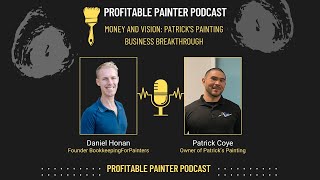
This content was created by balanced-griffin. This content was uploaded by balanced-griffin. This is a YouTube podcast episode titled "Money and Vision: Patrick's Painting Business Breakthrough" (Profitable Painter Podcast) recorded June 13, 2025. Host Daniel Honan (CPA and former painting business owner) interviews Patrick, owner of Patrick's Painting (Northern Virginia) about his journey from startup to scaling a multi-million dollar painting company. Topics include business growth timelines and revenue milestones (growth from ~$600k to $2.2–2.6M and a $3M goal), quitting drinking and personal discipline, books and mentors (Alcohol Explained, Can't Hurt Me, Embrace the Suck, Alex Hormozi workshops, EOS/Traction, BK Live, PCA events), the value of coaching, hiring and retaining project managers (compensation, bonuses tied to net profit, career progression), project management systems (Basecamp/monday.com), operational bottlenecks, delegation and building a leadership team, culture and benefits, and practical advice for other painting contractors on implementing systems and scaling. The episode is conversational in format (host + guest interview) and focuses on practical business, financial, and personal-development lessons for contractors.
Chapters
Welcome to the Profitable Painter Podcast. The mission of this podcast is simple: to help you navigate the financial and tax aspects of starting, running, and scaling a professional painting business. From the brushes and ladders to the spreadsheets and balance sheets, we've got you covered. But before we dive in, a quick word of caution: while we strive to provide accurate and up-to-date financial and tax information, nothing you hear on this podcast should be considered as financial advice specifically for you or your business. We're here to share general knowledge and experiences, not to replace the tailored advice you get from a professional financial advisor or tax consultant. We strongly recommend you seeking individualized advice before making any significant financial decision. Welcome to the Profitable Painter Podcast, the show where painting contractors learn how to boost profits, cut taxes, and build a business that works for them. I'm your host, Daniel Honan. CPA and former painting business owner and your guide to mastering your numbers that drive success. So let's dive in and make your business more profitable one episode at a time. I'm super excited today to, to speak with Patrick from Patrick's Painting up in Northern Virginia. Uh, he's an amazing business owner. I've known him for years, so I'm super excited to have a conversation with him and dive into what has made him successful. Welcome to the podcast, Patrick. How's it going?
Good, thank you so much for having me on today, Daniel.
I'm super excited to, to jump in. Um, could you kind of give the listeners like what's been your journey, big picture? What's your— where did you get started? How did you get started into the painting industry? And what are— what have been some major milestones, uh, since then?
Yeah, absolutely. Well, I would say when I first started, there was no vision. There was just like I had a paintbrush and a contractor's license. And I was like, all right, I'm going to do this legally. I don't know for how long, but I'm just going to get started with it. But I started fresh out of high school. I had a business partner for a little bit. We quickly ended our relationship and I kind of just ran with it. And that was in 2007 and still really unsure what I was going to do with it. Like I said, I got my business license, I got my insurance, and I wanted to be legal if I actually was going to do it. But I realized it, or so I was doing 3 things. I was painting, I was boxing, and I was going to college. Well, one of them had to go and college went. So I was doing business administration and the business administration. Got put on the back burner and I started focusing on boxing, which I ended up having 24 amateur fights, 1 professional fight. So it was a fun time between running the business and boxing. But fast forward to 2014, that's where a big milestone happened for me. I went to my first PCA event. PCA event. I was— where was it— somewhere in South Carolina, Charleston, South Carolina. That's where it was. It's actually 11 years ago, and fantastic. That really opened up many doors for me. I realized there was lots of other painting contractors within the group. They were sharing their success stories, they were sharing their secrets on how they're dealing with customers, how they're doing with production, how they're dealing with how to do the actual work. And from there, I just continued to grow, implement. Uh, fast forward to 2000— end of 2018, when I decided to quit drinking. Um, that's a big one for me. That's when real growth started to happen. I was doing about $600,000 a year up to that point. For the last couple years, I was when I quit drinking, I immediately took it to $1.1 million. Following year, $1.5 million. Next year, $1.8 million. $2.1 million. And then right now we've been doing about $2.2 million, $2.6 million. We're trying to hit $3 million this year. So it, it, it's been a really good growth. But once I eliminated I eliminated the bullshit, to be honest with you. Just, I was realizing where I was wasting my time, where I was wasting my time, what I was doing. And a couple of books came into it that helped me make this transition, which was first Alcohol Explained, just understanding how alcohol affects me personally and how much it really was disrupting my sleep. So that was one of the big reasons why I quit drinking. I was also tired of being tired and I wasn't an everyday drinker. I was more like your weekend warrior. But why would I just sleep for 9 to 10 hours and then wake up still feeling groggy, still feeling tired? Like it didn't make any sense. So alcohol affects your sleep tremendously. And then I listened to David Goggins' book, Can't Hurt Me. He talks about the 40% rule. Most people are only giving 40% of themselves which I took a hard look in the mirror and I was like, all right, where are you leaving this extra time on the table? Realizing you're spending a lot of time watching TV, browsing social media, browsing the internet, and just not using my time product— productively to be able to increase my skill level. So I buckled down, started working a little bit harder, and This is where I'm at now and continuing to evolve every year and just really trying to live up to my God-given potential.
Yeah, that's amazing. And I think a big theme that I've seen with you is that you're always trying to learn. You're going to those PCAs, you're always at a PCA event, I'll see you there. You're going to additional events outside of PCA to just learn as a business owner or even just improve your life generally. And you're reading books, consuming content. Like, that's like a, how much, how much of that learning that I guess you're, you're craving that education, but not only just educating yourself, but you're also implementing. How much of that is responsible for the success that you've seen, you know, going from just no vision out of high school, you know, running a paint business with your, with your buddy to now running like a $3 million painting business with a huge staff that works with you?
Yeah, I mean, knowledge is everything, right? I'm gaining a ton of knowledge from the books, from the podcast, but just consistently listening to people that I say that are smarter than me, listening to very deep, mindful strategic conversations about stuff. And some of the stuff I'm picking up, I'm putting it into play in my personal life or my professional life. And at the same time, not, not just listening to it, but also what's helping is coaching. Coaching has absolutely been huge. You have to pay for the advice of others to get you forward faster. So the coaching standpoint, I've got a financial coach, I've got a business coach, I've got a personal trainer. You You need these different coaches in aspects of your life to help you move forward faster. And yes, you do have to pay for it. And I always say you pay for their experiences so you don't have to make those same mistakes yourself. So coaching and just continuing to listen to this audiobooks, podcasts, and also coaching events where I just went out to California for BK Live. I've been a part of that group. I think about— I joined the Legacy Tribe at the beginning of 2025, which is— it's a group of individuals. We meet every month online. We have a new speaker every week, but every month it's a different subject. Like, one month it's personal branding, the next month it's communication skills, one month it's sales. So every month we have somebody else or a different subject, but every week we have a different speaker talking about something new.
Yeah, that's really cool. And going back to the coaching thing, like you have, it sounds like you have a financial coach, a business coach, and a fitness coach. Did I get them all? Yeah. Okay. So some folks are listening probably like, man, this guy needs a coach for every part of his life. That might seem like a lot of coaches for some folks. And I know for a while I was kind of very hesitant to pay for you know, someone else to tell me what they think I should do. Um, and I don't know if you were at that point in your life at all, but what, what would you say to somebody who was like, man, you gotta pay for all those different support people? Like, was there a time or a moment in your life where you realized like, oh, this is totally worth it? Um, what changed there?
Was there a time in my life where I was like, this is totally worth it? Absolutely. Absolutely. It's just realizing how much faster you can get with yourself personally or professionally by hiring that coach, right? That hiring the coach is— they're going to tell you exactly what you need to do. But I always talk about closing the knowledge and action gap, right? They're going to give you all the knowledge in the world exactly how you should execute. But now it's time for you to close that gap. And create the action and make those things happen. And they're going to save you a lot of— they're going to save you a lot of money over time as well, and a lot of heartaches. Time, time and money, because they're going to give you a straight path to what you should do. A lot of the times you are uncertain with exactly which direction you should be going. Like, oh, I could do it this way and this might potentially happen, or I should go this way and work with him and this could happen. No, they're like, just do it exactly like this. I'm like, cool, that's it. You don't need to go through the hardships, those hard learning curves yourself when you have that coach. And a good coach, a good coach, uh, they're going to tell you exactly from point A to B very quickly and efficiently. Make those learning mistakes yourself.
So basically you're just exchanging some money to gain back your time because you're paying money to the coach and to, to shortcut basically all their knowledge. They have the, the, the way to do it. And so you're paying them to give you that knowledge so you can then implement that knowledge efficiently to save yourself the time of spinning your wheels and doing it wrong, you know, 4 different ways before figuring out the right way, basically.
Absolutely. That's it. That's it.
Yeah. It makes sense. And, you know, I think one thing that probably separates you from a lot of folks is that you're also big on implementation, which you mentioned already. Not just, you know, because you'll see some folks, they'll go, they'll go to the PCA events, they'll go to, you'll see them go to all the different coaching events. And, but they kind of stay where they are, they don't really grow. So they're just consuming information. But they're not really implementing it. And I think that that's what sets you apart, which we can see the results from, you know, how you've grown from startup to, to, you know, nearly $3 million. You know, what, what caused you to focus on that? Because I don't think that's a natural thing that most folks have is to relentlessly implement. So was there a time that kind of, you know, made you really focus on implementation and not just the consumption of knowledge? Or, or have you— is it just that's your personality?
So it's a little bit my personality, but at the same time, I don't want to be my, my own bottleneck in my business. Like, everything runs directly through me. When getting COVID, I realized that everything— like, I had a project manager, but I was doing all the sales myself. So I was like, oh my gosh, I'm like, the sales just completely stopped. I don't want to have everything run exactly through me. So having two project managers, having two sales reps, having a full office staff, that's what's going to allow me to not have to worry about everything falling all onto myself. I don't, I don't want to have everything fall on myself. I want to be able to create, because I think a lot of painting contractors they, they do a lot themselves. Everything runs through them. They have to do the sales, they have to do the marketing, they have to do the project management, and they have to do the work. On top of that, they got to deal with their numbers too. And I just don't want to be— I didn't want to have everything that's ran through me and like my business solely ran upon myself. Now, Nick Slavik always talks about getting hit by the, the turkey truck. Right? What happens if I get hit by the turkey truck? Well, the business comes to a complete stop. And I don't want to be that bottleneck where everything runs through me. I want to be able to create a successful company that doesn't need me in every aspect. And so the ultimate goal for me right now is I want to continue to— I want to get a third sales rep. I want to get a third project manager. I'm gonna get that office staff and then remove and replace myself and get that general manager. Maybe I work underneath the general manager in sales. I work on— I like running company meetings, the leadership of the company meetings, but eventually step away from the business a little bit more. I've gone through a lot of stress and, uh, I just I love the contracting business, but at the same time, I'm working toward an end goal where I can remove and replace myself.
Is your end goal— is it, is it to have a business that, that you're just, you're the owner and you, you're like on the board of directors, so to speak, and like you have a, a CEO running it and you're just kind of advising them? Or do you want to get it to a point where you're, you're actually selling? Or you not really sure.
I'm not 100% sure. I do enjoy sales, there's no doubt about that. I, I, I love the area that we live. I love the community ties that I have, the relationships I've built over the years. I don't want to just totally neglect those. And at the same time, I like— but I do like doing sales. I like leading my team. I like teaching my team. I like handling objections. So I would like to keep the sales standpoint, but it depends where I'm at, uh, in my life. If I'm still in the United States or I've moved abroad and still running the company remotely, just having a fractional role. We'll see how things unfold, but the ultimate goal right now is get that general manager.
Mm-hmm. Now that Yeah, that's great. And, uh, I guess reflecting on, on your journey, what, what would you say was— and you mentioned bottlenecks, you know, you being the bottleneck a lot— I guess what was, out of the time since 2007, what was the hardest bottleneck to fix? Like, was there a particular role that you had to fill that was the most difficult, or period of time where you're trying to get enough leads, or what do you think is— was there any particular bottleneck or constraint in the business over the last, you know, couple decades, almost a couple decades at this point, that, uh, that you faced that really sticks out in your memory?
I would have to say project management. At one point in my career, I was, I was managing $2 million worth of work, and I sold the $2 million worth of work. That was terrible. I made a lot of money, but, uh, my stress was through the roof. So if you are naturally gifted with sales, you're good with talking with people, stick to your sales role. Get a production manager, production coordinator, and develop that role, build that role, find that right person for that job, but have them coordinate everything with what happens within that job. Like that would be my biggest advice. You can do $1 million worth of sales and you can also afford a project manager to, to take on those sales with, you know, project logistics, colors, whatever it may be.
So you were doing $2 million in sales and production management simultaneously. Did you have, you had some office help though?
Oh, absolutely. Yeah. Got a full-time office manager.
Yeah, but that's still—
appointment setter.
For residential repaint, like with the volume that you have to do, that's like incredible. I don't know if I know anybody else that for residential repaint, there's definitely some commercial because you can get larger jobs, but that's, that's so much to, to sell and produce for one person. That's kind of ridiculous.
It, sometimes you just don't know what you don't know. Like, I'm like, I thought this was what I was supposed to be doing. Yeah. So, but thankfully that is in the rearview mirror and my experience has taught me I don't need to do everything myself anymore. You hire that production manager. I've built the job description, I've built the pay scale. We have a project management software that we use, which is our hub for running and managing the jobs. And that's also vitally important. If you're not, if you don't have a project management software, get one immediately. We use a very simple one, Basecamp 2. There's also Basecamp 4. Monday.com is very popular. I mean, I'm sure there's a slew of them out there for service-based contractors.
Yeah. So what was the— I guess what that was the most challenging part was selling and, and producing $2 million at, uh, simultaneously. Was it— did— what was the difficult— did you have difficulty filling that role to get a project manager? Was it, um, and why was it difficult? Was it just because you had never hired like a substantial role before? And then how did you kind of overcome like figuring that out?
Like, yeah, definitely getting the project manager, it was not easy. It's taken— I think I'm on my my fourth one, my fourth project manager, and so far he's great. But I've also realized through past experiences what I need to do to make sure that he's staying on board. Um, that is giving him a clear vision of, okay, what's this next step, right? We're going to turn you into a senior project manager, right? With more responsibility is also going to come more money. You're going to have junior project managers working underneath you directly. So giving him clear guidance, clear understanding of what that pay increase is going to look like and what we're looking to build to.
Hmm. Yeah, that's a good point. Like actually having that, you mentioned it at the top was having the vision not only for the company, but also for what that means for the folks that are working for you. Like having that career progression so they feel that they're growing and they're not just going to stay stagnant in one role for, whoever knows how long. So you, that was something that you, was that something you implemented earlier or took a couple reps to get that implemented?
Took a couple. I think after the third one, I really started, I really started thinking about it fully from their side. Like, what does that person really want? You know, how do I keep that person, keep their vision focused? Or like, all right, cool. There, there is growth. There is. More pay increase. They're okay, there's gonna be more responsibilities, but I'm happy to help this guy build this company. I like him, I know him, I trust him. And also, like, we've also included bonuses directly into their pay, which, which is helpful when you're getting a $6,000 to $8,000 bonus. That's really nice. Oh yeah.
Do you tie bonuses to certain metrics like gross profit or, uh, customer satisfaction? Yeah, it comes down to the net profit.
So they're getting a percentage of the overall net profit, and that's shared amongst office and project management.
Nice. Um, what is the— for the project manager, since you've been through so many— or not so many— 4 project managers, um, what do you think is a good compensation plan that seems to really— because we mentioned Having career growth is important. Is there a good compensation plan that works that you found that motivates appropriately for compensation and bonuses? Would you, would you feel, would you be cool sharing like what, what seems to work for a project manager role?
So for me with my current project managers, I'm just doing strictly salary. A strictly salary with a bonus, and we're doing the bonus every 6 months where they're going to get it in early July and then right before the end of the year. Again, this is a percentage of the net income for the company at the time distributed between the office and project manager. Now, I want to be able to make sure that I'm keeping and retaining all of my people, so It's also what other benefits can we put into play, which this year we're going to be doing a 401(k) for everybody. They can put some savings— we don't have great benefits. We've got paid vacations, pay 7 holidays a year. We don't have health insurance, but I think it all starts with who's leading the company. And we do have a very good culture here.
Hmm. And so is the expectation that a project manager kind of produce about $1.5 million? Because you mentioned you have 2 right now, right? Or do they have—
The project manager should— a lot of it, we put a lot of our— we put a lot of our managing of the jobs to our sub-teams. We really handhold, we do some handholding in the beginning with them when we're bringing on new subs of like, all right, understanding what's a part of your pre-job checklist, what's part of your post-job checklist, shadowing them and correcting at the end of it. Hey, look, you forgot to talk to the client directly about, you know, where you could clean your brushes and rollers. Where were you setting up a workstation? When were you going to be able to, uh, get the job finished to be able to do a walkthrough and get a quality assurance form signed. So they're really teaching them how to run the job. So ultimately, the project manager isn't really focused on showing up to the job sites and doing kickoffs and final walkthroughs, but they've taught the sub team directly how to do that.
That's cool. So, so basically your subcrews are, they're a project manager of one project at a time because they're managing their own project, but the, your project manager is coaching them to, to be able to manage a job properly per, per your processes.
And then when he does have downtime, he's going directly to showing up at the job sites, making sure that the team has handled their pre-job checklist, make sure that the team has put up before photos. They put up before photos of not just the area that we're painting, but are there scratches on the floor? Is there paint drips, existing old paint drips on the brick? Whatever it may be, because, you know, clients look around at the end of the job, oh, you guys scratched my floor. Oh, you guys got excess paint on my furniture. No, we've got a timestamp photo because it's, it's vitally important. I think all contractors, they know that. It's just sometimes we forget that we need to do it, but that turns into a he said, she said kind of thing, and like, where do you meet in the middle?
Yeah, that makes, that makes complete sense. Cool. Uh, well, you know, one of the things that you've kind of mentioned is— we've talked, talked about— is education, like continuing to learn and grow and implement. And you mentioned a couple books and a couple of personal improvement methods like using coaches and going to BK Live. Are there— have there been any really important books, podcasts, anything that, that we haven't talked about so far that, you know, really changed the way you thought about running your painting business? I—
so yes, yes and no. I, I think it all starts with you personally. It starts with you personally first and foremost. If you can be able to execute yourself personally, that's going to trans— transitions over to professionally. Being distant, disciplined, having consistency with your life schedule, well, that's definitely going to play, play over into your business. But I listened to two books this last year that I really enjoyed. Uh, first one was called Embrace the Suck. It's really just about building mental toughness, resilience, and leadership, uh, by facing hardship, uh, instead of avoiding it, right? A lot of us, we, we avoid discomfort because of course it's not fun. It doesn't feel good, but In the book, they also talk about figuring out your personal values. So really locking in your personal values, what is important to you, cultivating anywhere between 5 and 10 values. So that's helped me with the decisions and the person that I want to continuously be. Yeah.
And that, that's, uh, that Navy SEAL, was it Brent Gleason?
Yeah, exactly, exactly. Um, actually, and that he refers to one of my coaches in the book who is Jason Redmond. Um, he's a part of BK Live, Bedros Koulian Legacy Tribe, and he's on every other week.
Yeah.
Something else which I liked in the book is just accountability and discipline. Success demands this of yourself. A relentless discipline over time has to be implemented for you to be that person that you want to be, to go to that next level. Doing hard things when you're supposed to do them, regardless of your feelings. Yeah, like, so just like controlling your controllables, right? What time do you wake up in the morning? Well, first, what time did you go to bed? What time are you waking up in the morning? Are you skipping the gym or are you actually going to the gym? Are you having that meeting with your team even though you've got a bunch of other work that needs to be done, or are you skipping it? Like, controlling your controllables, not worried about what's happening all around you. It doesn't matter. We live in Washington, DC. I hear politics all day. I'm like, it has nothing to do with my life and what I can control. It's about me showing up and doing the things that I know I can control.
I think that's a really good point, especially when it comes to the economy. Like, your folks talk about the economy, can't really impact it, you know. Uh, so the only thing you can really do is do what you do better and be better than your competitors is basically the answer.
The economy is so bad, I don't have any leads. Well, how much money are you putting into marketing? Yeah, control that. You got to spend a little bit more money to bring in some more leads.
Exactly. So the last— sorry, no, no, go for it.
Now I was going to talk about one of the, the chapters within the book, and one of the last points I want to make about this book is where he talks about Temptation Tiger, right? So Temptation Tiger is this guy, all of a sudden you're going out, you're at the bar one night, and you, you meet some new friends, or like, hey man, you know, you should come back over to my house We're going to have a poker game. We're going to have heavy hors d'oeuvres. We're going to have this fine whiskey, some, some fancy cannabis. And you know what? Everyone else who's playing poker, they suck. You know, more than likely you're going to win money. So he puts you into this scenario. And what happens the next day? You go out, you stay out way too late. All of a sudden You lost a bunch of money. You're not doing the things that you were supposed to do the following day. Your body feels like trash because you've polluted it with all these types of stuff. So it's funny how he relates that because as a drinker, I heavily relate to the temptation tiger. But it's like, look, if you can postpone, if you can just avoid that, you're going to continue to set yourself up for success. So I've eliminated my my partying with Temptation Tiger. And since that, I've just continued to evolve. But I like the way that he kind of goes through this scenario because that has happened to me in my life.
Yeah, that makes complete sense. I like the way that that's framed too, because it sounds great, but when you actually do it and the next day, was it really that great because of the consequences of doing all those things. Yeah, that makes sense. The title of the book that you're referring to is Embrace the Suck, which reminds me of when I was in the military. That was what we always said when we had some really difficult training or mission and it was going to be terrible. And then it was just like someone would say, just embrace the suck. It's going to— this is going to be terrible. Just embrace it. Which can be very useful when you need to do something that you know needs to be done. I guess my question is, how do you know, just to go back to that, when you're doing $2 million in sales and $2 million in production management, which you were definitely embracing this, like you were just like, I thought this is what we had to do. Like I needed to do this. Where do you balance that with, well, actually there's a better way. To achieve what I'm trying to achieve if I do it an alternate way and not, not, I guess, how do you evaluate whether you should be doing that thing versus just embracing the suck and doing it because it's hard and you just need to do it anyway? Just like, how do you kind of make sure you're not making the same mistake you did before with maybe make embracing the suck too much with the $2 million in sales and $2 million in production management, where it was almost like taking you away from, you know, actually managing your business because all your time was in, in the trenches, so to speak?
Yeah, um, I was— I would say that you got to be mindful of your life, right? Like, what are your feelings? Are you totally stressed out? Are you hating life? Okay, yeah, I was. But I also had a coach at the time. Well, I don't know if I did— I had a good coach at the time, but I'm sure somebody was like, 'Birdie, you don't need to do this all by yourself. You can hire somebody else to help you.' But I can't remember exactly how that transpired, but I just got fed up with it and I knew, and that's the hard work, like embracing the suck of going, building something that you've never built before of like the job description for your project manager, the pay scale for them, setting up the processes. Like I'm not that guy. I am not process driven. Thank you, ChatGPT. You've helped my life tremendously. Um, setting up those processes and job descriptions, but Yeah.
So it was, it was actually kind of, uh, so you were doing this embracing the suck of what you knew, but you were kind of avoiding the suck of what you kind of hadn't done before or felt like you weren't prepared to do. So in a way, it sounded like you were embracing the suck, but maybe you actually were kind of avoiding the suck that you didn't know, uh, how to, how to accomplish.
That's exactly right. That's exactly awesome.
And then that's— oh yeah, go ahead.
I was gonna make one last point about like the drinking and temptation tiger of— I've realized I heard this saying that really resonates with me of alcohol is the thief of tomorrow's happiness. I was like, oh man, I'm like, where you could phrase it as getting drunk is the thief of tomorrow's happiness. But yeah, that's exactly what would happen with, with temptation tiger.
Yeah, no, I, I completely agree. I, whenever I drank a lot when I was in my early 20s, but once I turned 30, I, I guess I was blessed in a way, was like, I could, if I were to have one drink or even just smell alcohol, it was like the next day I had a hangover. It was just so it was so difficult to function the next day just off of such, such a low amount of alcohol. I had to, I had to stop. So I guess in a way I was kind of, uh, blessed in the sense that I had to quit earlier than I probably would've just because it had such an impact on my body for some reason. Um, but, uh, yeah, it, it totally, from my perspective, was not worth the, you know, the little bit of fun you might have had that, that evening for the feeling of the next day and the lost sleep. It just messes with your sleep. It's just not a good trade at all from, from my perspective. And, um, and from what it looks like in your journey, you know, 2018, you were able to pretty quickly after that, almost double your business, right? Is that—
yeah, exactly.
Which is crazy. Double your business.
Like, literally just figuring out where my time was being spent. I was spending a lot of time in too much entertainment, too much fun. That's plain and simple. Now, it's not to say I don't keep fun in my life still, but, uh, I think you got to have that balance. You gotta, you gotta have that balanced-griffin. I, again, I got from the same group and he categorizes it into 3 areas of your life. Kill, chill, and skill. Killing it is like, all right, you're working hard every single day. You're focused on that one specific task, but you also need to be able to chill. You also need those mental reprieves to be able to give yourself, your body, that break. And skill, right? You need skills to be able to kill it. So working on your leadership skills, working on your sales skills, working on your business development skills, like those three need to go hand in hand.
Yeah, I like it. Kill, chill, skill. That's a good one.
Very simple, straightforward. Awesome.
Well, Patrick, I really appreciate your time today. Are there any last thoughts that you have for listeners, painting business owners, on, uh, on growing your business, um, on overcoming challenges, educating and implementing? Um, any last thoughts you have before we let you go today?
Yeah, it, it's just about figuring out where you want to be first and foremost. Where do you really want to be? Do you, do you want to be a single owner-operator. If you are, cool. If not, hey, look, man, I don't want to do everything myself anymore. There are a ton, a ton of consulting groups out there that can help you scale to the next level. And you also sometimes have some self-limiting beliefs that you need to get past of thinking, well, I can't do this. I'm not tech savvy. I'm not— I don't have a college degree. Screw all that noise. I had the same stuff. It's just about proving to yourself consistently what you could specifically do by actually putting in the work, going out there, finding somebody to be able to work with, finding a consultant, finding a mastermind group to join, and continue to evolve and focus in on that goal of what, what you want for yourself. With small— okay, it's not just a goal, but small actionable steps to be able to make that goal attainable. What are the small actionable— what's the first step? What's the second step? And you already know EOS system is a great place to, to help you figure that out.
Yes, the, the Entrepreneur Operating System, uh, the book Traction by Gino Wickman, amazing book. I— it's one of my top books for sure. For, uh, gives you the written instructions on basically how to run your business, which it's no, it's like a lot of business books are like very theory. I love, I love, yeah, I love EOS. It's great. It's great stuff.
Uh, before I let you go, I got a question for you.
Yeah.
I know me and you are both big fans of Alex Hormozi, but I wanted to get your experience on, on how you went out there and what you took away from it.
Yeah, it was really cool. So I did the workshop with— he has like a general workshop that he runs. Um, and so I did that in July of 2024, so last year. And so that was pretty cool. They talked a lot about the LTV GP to CAC ratio, uh, and growing and using that ratio to evaluate your business and also evaluating the value of your business, like what is the enterprise value of your business, and then figuring out what the constraint is in your business so that you can fix it so you can grow to the next level. So there's kind of like an overall, like, look at that. And then from there, I did the— they have an L2 and L3, what they call L2 and L3. So I did both, which is basically meeting with Alex one-on-one. You sit in a room with him for like 8 hours with, uh, 8 or 9 other business owners, and he gives you feedback on— he like does the research, has their team do research on your business, and he provides recommendations on, um, strategy changes. Uh, and then also the L2 is just basically follow-up on, on progress towards your, your goals. And, and again, addressing those constraints and trying to fix those constraints to unlock growth in the business. So yeah, it was really— I learned a lot. Alex is really— he's like a machine. He— we were in that room for 8 hours. The first 4 hours he was going around the table and he was very prepared, giving recommendations to each business on and then like, you know, going back and forth and like using the whiteboard. It was like watching a video live, basically. For 4 hours straight. We took a 30-minute lunch break where he just had like some chicken and rice and went to the bathroom once, came back and did it for another 4 hours. It was, I don't know if he was wearing a catheter or what was going on there, but he, it was literally like a machine. Uh, I, I, I mean, I went to the bathroom like 8 times during that, that whole process, but somehow he is able to just focus and just deliver value. Like a machine for many hours on end. So it's really, he's really impressive as a person. But yeah, he's able to really dive into many different businesses and really distill what's going on there and what you can do to get to what levers you can pull to get to the next level. So yeah, I highly recommend Um, if you have the opportunity to either go to the workshop or, or do one of those programs for sure.
Oh, he, he, he always talks about his work ethic and what he does to, to make sure that he is fully focused and locked in and it's, it's, it's impressive, but you're just reaffirming that.
Yeah. I mean, he, you could tell he prepared for each, you know, person that was there attending. Um, for the, the one-on-one, or I guess 8-on-1 or 9-on-1. Um, but he knew, he knew your, the, each person's business, like he had done the research and he had, was already prepared with the, the recommendations and then able to like kind of take the new information, that new context that you provided to, to kind of tweak things and work with you on the strategy. So yeah, it was, it was super impressive.
Awesome.
Cool.
Cool.
Well, I really appreciate your time today, Patrick. And for the listeners, we will see you next week.
More from Daniel







What’s REALLY Holding Your Painting Business Back? (Find Your Bottleneck in 5 Minutes)



