Navigating Marketing Channels with Austin Houser: The Art of Promoting Painting Businesses
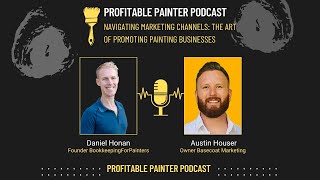
In this episode of the Profitable Painter Podcast, host Daniel (founder of Bookkeeping for Painters) interviews Austin Hauser, owner of Base Coat Marketing, about effective marketing strategies for professional painting companies. Austin shares his personal journey from a college student building websites to running a data‑driven agency focused on the psychology of consumer decision‑making. They discuss how the digital landscape has shifted—organic SEO now relies on authority, reputation, and authentic media rather than black‑hat link schemes; AI‑generated content is penalized; paid search costs have risen, prompting a pivot to new platforms like Bing. The conversation outlines the three core pillars for painters: organic growth (Google Business Profile, local SEO, genuine reviews, unique media), paid social (primarily Meta, with TikTok as a secondary option), and paid search (Google Ads, Local Services Ads). Austin provides concrete benchmarks: $30‑$60 per lead on Meta, $20‑$50 per lead on Local Services Ads, $100‑$150 on Google Ads; a healthy book rate of 50‑70% and a close rate of 35‑40%; and a minimum 10× return on ad spend after peak optimization (typically 12‑24 months). He emphasizes rapid lead response (under 5 minutes) and a 7‑10‑day multi‑channel follow‑up cadence as critical to conversion. For businesses with <$250K‑$500K revenue, the priority is building a strong reputation, generating reviews, and leveraging Local Services Ads before investing in a full website or agency. Once revenue exceeds that threshold, scaling ad spend ($3K‑$5K/month minimum) and hiring a specialist become viable. Finally, Austin advises owners to vet agencies carefully, avoid guarantees of lead volume, focus on bottom‑line metrics rather than vanity stats, and ensure the agency understands the seasonal, premium nature of painting services.
Chapters
Welcome to the Profitable Painter Podcast. The mission of this podcast is simple: to help you navigate the financial and tax aspects of starting, running, and scaling a professional painting business. From the brushes and ladders to the spreadsheets and balance sheets, we've got you covered. But before we dive in, a quick word of caution: while we strive to provide accurate and up-to-date financial and tax information, nothing you hear on this podcast should be considered as financial advice specifically for you or your business. We're here to share general knowledge and experiences, not to replace the tailored advice you get from a professional financial advisor or tax consultant. We strongly recommend you seeking individualized advice before making any significant financial decision. This is Daniel, the founder of Bookkeeping for Painters, and today I'm here with Austin Hauser. He's the owner of Base Coat Marketing. He's a husband, father, business owner. Austin Hauser is a digital marketer, marketer and data scientist with over a decade of lead generation experience managing a results-driven marketing agency for professional painting companies. Welcome to the show, Austin. How's it going?
Good, Daniel. Thanks for having me here, man.
Absolutely. Glad to have you here. Now, Austin, can you tell us a little bit more about yourself and your journey into the world of digital marketing, data science, uh, for painting companies?
Yeah. So I'll go back maybe like 15 years, 2008, I was in college trying to find some beer money, right? And I found out that I can make money off of developing websites for local businesses. So I started that, that quickly spun into a large-scale agency working with big brands, think like multi-million dollar a month advertising budgets, but no real focus or drive. We started collecting painting companies over the years, some, some big names, small little mom-and-pop shops, just identified that we were great at generating results in that space. And I've always kind of fell in love with marketing from the mindset of the psychology behind it. So I went to school, I was a book nerd, you know, computer science, computer security, math and business, went to summer classes, graduated 4 degrees. If I could do it all over again, I would have gone to school for psychology because it's fascinating, the human mind, the decision-making processes that we have, like the journey of how somebody finds your brand and ends up actually booking with them. So the marketing aspect of that was how you make money off of psychology. And that's kind of how I fell into that. We rebranded as Base Coat Marketing a few years ago, brought in that team and really doubled down there. And that's really where we have found that we shine.
Nice. That, that's an awesome story. 4 degrees, man. That's, that's, that's pretty intense.
It's, I'm, I'm just fortunate to have used at least some of them for what I do today. Yeah. I can't feel like most of my friends are, you know, haven't touched their, their degree.
Yeah. And it, it seems like you got your start like right as the economy was going downwards, which a lot of folks nowadays are kind of feeling like that's the economy's going the same direction right now. Where it's kind of going the, you know, going down. And I wonder if, you know, you coming out of college and going into the marketing space when it was going bad, that's probably, I would think, kind of prepared you a little bit for what might, what we're kind of seeing now.
That's a great point. I mean, back then, being a poor college kid and not really like, that didn't really have an impact on me or my clients for that matter. Now, Real estate was not an industry that we were in at the time, but I like to use the mentality of market is outside of our control and I choose not to worry about things that are outside of my control. I look at what the opportunities are based on what levers that we can pull. And I myself, anybody on my team, we will never use the excuse we cannot get you results because of the market. That's just not in our language, not in our DNA. We will find an avenue, an opportunity and make that work.
Yeah, yeah, I think that's an awesome mentality. How has the marketing landscape for painting businesses evolved over the years? Have you seen like changes kind of or trends?
Oh, totally. Yeah, I mean, if we want to look at things like search engine optimization, for instance, I mean, that used to be a big scammy black hat thing where you'd go buy a bunch of backlinks, spit out some content and rank your website in a couple weeks. Google's gotten a lot smarter and really just, you know, for you to rank online well, you have to have authority, authorship, a reputation is a big role in that. And these are all things that are hard to buy and there's strategies that you can implement, but we just find that the best strategy that works today is a strategy built on trust and authority. So trust is the currency, it's the digital currency that gets your phone ringing. If you try to game that system, people are smart these days, they're gonna see through that. So what worked less than a year ago probably doesn't work today. I mean, we are in an evolving landscape. So let alone going back a decade, I mean, Google just last year changed their paid search algorithm from it being great to acquire leads on that channel to now being very expensive. And we've had to pivot our strategy. And I, that's what I always like to say is, guys, just because your agency is doing something for you today, if they're not innovating and looking at the next thing such as advertising on ChatGPT, Bing is becoming a platform now to advertise on that actually makes sense. They're not gonna evolve with the market.
Yeah, I think that's a great point. Things are changing so quickly, like you can't keep up with it yourself. I mean, it's just insane. Like just, just to take one example, the ChatGPT thing, it's used on Bing like you mentioned. I mean, things are moving so quickly, and keeping up with this while you're running a painting business at this point seems just like impossible. So I think leveraging someone that's just focused on marketing strategies for painting businesses makes complete sense, especially nowadays where everything's changing so quickly.
Yeah, it's, it's becoming absurd almost, where we have an entire full in-house team of marketers, content writers, ad specialists. And, you know, our head spins some days and to even try to teach somebody how to run their own ad campaign, it seems absurd because what you learned yesterday, anything printed on a book, hardback cover versus what's online, it becomes outdated almost in the same month, right? So it's an evolving landscape. There's always new opportunities to be explored and you just need to make sure you're looking at those opportunities and trying to take advantage of them.
Yeah. Now you kind of mentioned some of them already, but what are like kind of the main marketing channels now for painting companies? What should they be paying attention to?
Yeah, I mean, the 3 big pillars are going to be organic growth, paid social, and paid search. So paid search, think Google Ads, paid social, Meta Ads, and organic is anything that you're not paying for. Our bread and butter where we like to have our clients generate most of their lead flows from the organic results. We can position your website, your business profile, all of that well optimized within Google. We can reduce your dependency on ad spend, which we know is very seasonal. So I would rather have our clients fill up most of their calendar during the spring and summer off of a lead flow they don't pay for and then throttle up that ad spend to help fill in the gaps during the seasonality between let's say around August and then November through January or February.
So it sounds like the base, the thing that is the most important, would you agree, is the organic, making sure you have a strong organic marketing strategy and then you kind of add on the paid social, paid search on top of that. Is that right?
Totally. I mean, it's the best way to scale your business because if you look at, all right, there are so many guys who talk about hating these different shared lead aggregators out there, right? Low quality leads. You're paying for every single lead, but it's no different than if you were to buy these leads on Google or Meta. You're still renting your business from another business, whether that's Meta or Google, you're paying them. Now, they're fortunately exclusive leads and they're higher quality lead. That's exactly where HomeAdvisor and Angie and all these other companies get their leads from. But on the organic side, That is the highest buyer intent, highest trusting lead that you can possibly acquire. And there are several nuances to that working well. I mentioned reputation, that's extremely important. Proximity, your competition level, what keywords they're targeting. I mean, you could spend an entire month just diving into the organic side, but if that strategy is dialed in, the long-term benefit of that is Irmeasurable.
Okay. Uh, could you, since organic is the most important and you kind of mentioned a couple of the things, so what, what should a painting company have dialed in for, for their organic strategy? You mentioned, uh, reputation and keywords. I'm assuming keywords on the website, so they're tracking on the SEO reputation. Is that like the, uh, Google rankings, like on, on search, like organic rankings, or what does that mean?
So there's, there's two things that we cannot produce for our clients on their behalf, and that is their reputation online. You can't buy that. We can't go out and get those for you. We train our clients on how to get new reviews on that profile. The business profile on Google is where your reputation lies. That's what has you ranking on Google Maps and the local map pack. It's also what impacts your local services ads, which is a whole other ad channel. That's Awesome. I've done several podcasts on that as well. The second thing is media. So Google really looks at authorship and the ability to put a person behind a piece of content based on the media that they provide. AI content is becoming an increasingly large problem with Google. Google ranks the entire internet. We could double the entire internet overnight just by relying on AI-driven content, right? So The problem with AI is it lies. It doesn't know what's factual and what's not, but it can come across seeming very truthful. Part of why we don't use any AI content on organic search. We have 10 in-house content writers. All they do is research and write content. We do not keyword stuff. We, we do target our posts and our pages. Google ranks pages, not websites. So what we look for is targeting what you do and where you do it. What you want to do is write an article or a page about a service you perform, exterior painting in Minneapolis, Minnesota, and then target your content around that. But the important part there is you write helpful content, and this is where most people fail. They write content that is just stuffed with keywords, maybe through ChatGPT and some content spinners. It's never going to rank if it's not helpful. If it's not providing value, it's not going to rank. There are several other strategies out there, but We honestly tell our clients, don't worry about the SEO part of that. Focus on getting new media. So project images, team photos, family photos, personal photos are just as important to build trust and authority. And then dial in that reputation. The frequency of reviews on your business profile is just as important as how many reviews you have in total. We have some clients that have 50 reviews outranking a client with 300, and it's because they just put more time and energy into getting more reviews each month.
And I think this is something that I've heard is putting AI-generated text on your website can actually hurt your rankings in Google. Is that true?
Yeah. So Google's starting to dial in exactly what they consider AI content and what is considered helpful versus unhelpful. So if you look at AI content, I mean, we can go down that rabbit hole. AI content is used all the time. So think of like the weather, sports reporting, that's all AI-generated content based on stats and figures and numbers. Google ranks that because it needs to, right? It's news. But when you're trying to write AI content around your painting service in your target service area, it's very easy to pick up on the fact that's AI content. Now it is getting smarter and Google's eventually gonna have to adapt to that. But what they're doing in the meantime is they're putting an author and a reputation behind that content. And that's ultimately what's going to determine whether or not there's an actual human behind that. And what that looks like is your reputation on your business profile, that website link on that profile tying into your, your websites, that's that tying those two pieces together. And then adding a unique image to your page or your blog post that is tagged or that's marked for that target service area. So geotags, there's a lot of ambiguity whether or not that actually has an impact. But the bottom line is it's a unique image for your business. Google indexes every image on every page and it creates a hash and it can easily model that hash to say, okay, this image was used on 10 other websites, so it's a stock photo. So it doesn't put a lot of credit and authority behind that. So when we look at those two things, We can build an entire SEO-generating lead machine just by having a good reputation and a lot of unique media for your, your company.
Yeah. So the organic side, that's kind of, it seems like that's the, the long-term strategy, right? And that, that kind of sets the foundation. It sounds like making sure you have that dialed in, that those are the basics, basic blocking and tackling of your presence online, your reputation. Your, your solid content on your website. And then from there you had mentioned like some doing paid social and paid search. How, how should you kind of incorporate that into your marketing strategy?
Yeah, it's a great question. So if you look at SEO, that is the long-term business investment you are not going to see a return on investment month 1, 2, 3, even 6, right? I mean, it depending on which market you're in, we love to use the NASCAR analogy of like, if you're just pulling out of the pit stop, it could take you several months to catch up to your competition who've been lapping you out there this entire time. So it can take a while to see results there. And as a results-driven company, it's difficult to justify that return on investment. So what we like to do is, is layer on advertising that gets you those short-term wins that helps justify your reinvestment into the long-term business strategy. We look at our client websites, even our client advertising campaigns as business assets. It's a compounding asset. So all of the results we generate in year 1 on your website, should expect the same results plus everything we do in year 2. On the ad side, again, that's a model that we want to make you less dependent on. So for instance, if they change the algorithm or in our case, in our industry, things are just getting more expensive. There's a lot more competition out there. Our ad campaigns are impacted by the quarter of the year. So for instance, the end of Q3 and Q4, you're in finance. What do your clients typically— what do you recommend your clients typically invest in if they have a lot of tax dollars that they're up against? Probably advertising, right? I mean, It's a good way just to dump a bunch of cash and make up that tax incentive. You know, it's, it's a place where you can go and dump that money, but as a result, it spikes everybody's budget on that channel. So if let's say a big brand like Walmart wanted to dump a bunch of money into social media at the end of Q4, it's gonna cost your local painting company to generate more leads because there is a certain block of advertising spots on any algorithm. So I'm giving you a long-winded answer there because it's important to understand that ads are very volatile and, you know, while they can produce short-term wins, it's very dependent on the time of the year. So this time of the year, we're dumping our clients' ad spend into ad campaigns. About middle of October, we're doing this podcast right now. Come middle of November, it's gonna get very tricky to generate leads at a price point that makes sense. We're going to be really relying on promo-based ads. And that's really what it's going to get your phone ringing. But we're also looking at booking you out through the beginning of Q1. We can get you booked out between now and then you sail through the difficult season right into the spring and summer. So that's, that's the strategy we like to use, just being very proactive with your ad spend, your ad campaigns, and dialing in your ad campaigns to a certain KPI where that math actually makes sense for you.
That's really interesting. I didn't know that. I mean, it makes sense when you explained it. Of course, there's going to be more demand for ads at certain periods of the year, but that could really affect your return that you're getting. If you go on Facebook, start an ad campaign in, like you said, mid-November or something, you could get just terrible results because Walmart or whoever, big purchaser purchases a bunch of Facebook ads and that's going to just really drive up the cost. So that's interesting because, you know, I just see on social media a lot like, yeah, I tried Facebook ads, doesn't work. You know, people try, you know, and they just expect it to like work immediately just in one try or something. But a lot, there's so many factors like just that being one of them, like the time you're trying it. And then obviously the volume, how much did you actually, what volume did you actually try? Did you beta test, do split tests? You know, so that's, there's just so much in this domain that it's like to know, to learn. So that's really interesting. What is your take on like what social media platforms are the best to look at right now? I mean, because I know we have like TikTok's like a thing now and, you know, before it was just pretty much Facebook and Instagram. I mean, is Facebook, Instagram kind of the paid social route still, or are there other things that folks should be looking at?
No, it's a great question. TikTok is something that we've tested in the past. The problem with their targeting, and they've recently improved their targeting capabilities, it used to be by region. And you have to really dial in your creative to exclude anybody outside of your service area. We can get a little more targeted today, but what we found is the amount of effort we put into TikTok, you can get the same results on Facebook and Instagram. And if you think about it, it's in TikTok's best interest to not underbid Meta. They want to kind of compete with Meta around the same price point. And as a result, we don't find any better results over there. It also depends on the market, right? Like it's, TikTok is very much a lower age market. So if you're looking at targeting those new homeowners, that's a good place to do it. But you can also find them on Instagram. Instagram kind of just pulls everything over from TikTok at this point anyway. So yeah, we find that is the best channel to advertise on is Meta. Now social media is very dependent on the content you produce. So as I mentioned, homework assignments, we ask our clients a few different things each month, but getting reviews for your reputation and providing us with new images and videos are extremely important. What's very important to understand about Meta is market saturation. So if you're in a smaller market, let's say somewhere between $250K to $500K, you're gonna reach market saturation within 30 days where roughly every 30 days you have to go recreate that ad campaign, put out fresh media, new creative, new content, because what you, what results you got within a few weeks of launching that campaign, they're gonna diminish over time. People are gonna have seen that ad a couple times, they're gonna have either converted or not. So then you need to figure out, okay, what next? What's the next thing we can do? Now we supply our clients with an entire media library of ad examples that have converted well for past clients. And we have a program called Campaign Boost, which allows us to use ad creative from one account to another. And it's an opt-in program. We don't do this unless our clients give us permission to reuse their ad creative. And we obviously don't overlap service areas. But what it allows us to do is if our client— some of our clients shoot their images on like what looks like a flip phone, right? It's not going to convert well. But we have other clients who put a lot of time and energy into producing some awesome content. And what that allows us to do is take an underperforming campaign and really boost it up. And really, those are the types of strategies you need to get real creative creative on social media or else you're just gonna fall flat on your face. You're gonna spend well over $100 a lead there. We have target KPIs, they are normalized throughout a 12-month calendar year, but somewhere in the $30 to $60 range is our sweet spot where if you get too low, it's actually a bad thing. Like if you ever see a marketing agency promise you $5 leads or $10 leads, we can get you $2.50 leads all day long. But the conversion rate is going to be awful. So I'd rather you spend a little bit more for a higher quality lead knowing that your time is a commodity and that we don't want to waste that time.
So you said the, the KPI for you guys is $30 to $60 per lead, per Facebook lead or per Instagram lead. Is that right?
Yeah. And it's going to vary by market and it's obviously going to vary by seasonality. So as we approach the offseason, that, that might spike in some markets. We have some guys who never see it above $60. Also the market as well. So if you're in a very competitive market, which keep in mind, Meta, Google, they all have a limited spot of ad placement available regardless of market, target audience, industry, whatever. So if it's saturated out there already, we're already gonna be competing for eyes and that's the cost per million impressions. That's really what drives up the cost per click and ultimately the cost per lead. So these are all metrics based on the marketing funnel without getting too technical that you need to keep an eye on. And it's gonna be very market dependent, but that's why we have target KPIs. We know how much we can optimize an ad campaign before it becomes unrealistic to expect better results.
So if you're hitting that KPI, like let's say around $50 per lead, what level of conversion should If a, a paint business owner has a decent sales process, what percentage should they be converting of those leads?
This is such a good question. And I could probably spend an entire day talking about this. But all right, well, we're looking at conversion rates. There's going to be two different parts of that. Obviously, there's going to be the book rate. So how many estimates you actually go on and then how many of those estimates convert into a paying job. Now, the two primary factors that can determine what your book rate and close rate is, is your sales and follow-up process and the quality of lead. If one of those are broken, your results are going to suffer, right? So just target KPIs. What we look for is a healthy close rate is going to be somewhere between— I'm sorry, healthy book rate is somewhere between 50% and 70%. 50% to 70% of the leads that we send you, you should be able to get them on your calendar. From there, somewhere between 35 to 40% is acceptable as far as a close rate goes. That's money in your pocket, close job. Now, on social media, where we see the biggest struggle with our clients is their sales and follow-up process. If you are a painting business owner relying on referral traffic and word of mouth, your expectations need to be reset because that's not— you're not going to expect the same estimate book rate, close rate from those kind of leads online. And that goes for Google as well. But social media, it's a much colder lead. The buyer intent is not there. They're not looking for painting services. They're scrolling through Instagram, Facebook all day long, and we happen to put an ad in front of them. Now, to get them to click on that ad, we need to give them something in exchange, and there's a number of different ways to do that. On Google, it's a much higher quality lead. But it's also a more expensive lead. That's why we like to rely on organic growth. Local services ads, somewhere between $20 to $50 a lead, but that really relies on your reputation and the search volume in your local market. Google Ads, somewhere between $100, $150 a lead is not out of the question, but it's the close rate, book rate, that should all be very easy to acquire on that. It's much closer to referral traffic or word of mouth traffic over there.
Okay, so $50, about $50 per lead. You're conver— you should see a book rate of about 50%, and then hopefully your sales process is dialed in so you're, you're closing around a third of what you're— of what— of the folks that you're giving estimates to. Do you, do you provide like, do you have any thoughts on like the sales process? Like what should that look like? Because I think a lot of folks struggle with, with that part of, you know, like presenting estimates on the spot versus just sending them an email afterwards. Do you have any like strong opinions on, on the sales process?
Absolutely. Yeah. So the first thing is you need to have a time to lead. Dialed in. We really try to get our clients on the phone with their prospects in under 30 seconds. Now that can be tricky if you don't have an office manager. We have some processes in place we can put that help get that under 5 minutes. Like 5 minutes is the benchmark. If you don't get them on the phone in 5 minutes, the chances of that lead answering their phone and being available is going to drop significantly. So outside of that, we also have a follow-up process. So Some leads, if you think of them coming from social media, they could be on their lunch break at work and not be in a position to talk on the phone where that time to lead is not super impactful, but they might forget about that, submitting that form on their lunch break until they get home with their husband or wife. And at that point you need to hammer them. And what you do is you follow up every single day for 7 to 10 days via phone, voicemail, and text. And preferably email as well if you have that. You want to get to the answer yes or no. Until you get to that point, that is considered a lead. And I think that's where a lot of guys fail is they'll try picking up the phone, calling them, and they're like, oh, that was a trash lead. It's like, no, you didn't nurture it. And our red flag for us is when a client comes to us and they're like, you know, our book rate's like around 15-20%, like there's a lead quality issue. And we look at what we're sending them and what their sales process is. And we look at other clients of ours who are closing 50 to 70% or I'm sorry, booking 50 to 70% of those leads. And that's where we start to explore, all right, is this a lead quality issue or is this a sales process issue? And that is the fine line. There is definitely a balance. There's obviously going to be some markets and some campaigns that we run that lead quality is definitely an issue. We are never gonna push responsibility off our plate if we can identify that there is something we can do. But there are certain levers we can pull and certain levers that we rely on our clients for. I think that's where getting that process dialed in, simple metrics can make a big difference.
Yeah, that's, that's really interesting. So basically, after 5 minutes, the lead is worthless. Pretty much it sounds like you gotta be right there ready, have someone ready to to reach out to that new lead, which makes sense because I think I saw a statistic like, you know, there was like the quality, it was like a graph, the quality of response. I'm sorry, the quickness that you can respond to a lead coming in like plummets after a couple of minutes because people are basically just waiting or just reaching out to folks to get it taken care of. And whoever picks up their phone first, basically, or responds to them first, you know, they pretty much go with in a lot of cases. So that's, that's pretty interesting. Um, all right, so conversion rate, uh, or sorry, book rate of 50%, and then you should be closing around 35% or so. So basically it sounds like approximately out of 10 leads you should be booking around 1 to 2. Does that sound right to you?
So out of 10 leads, you should be— yeah, I'd have to do that math, but that sounds about right. So 10 leads, you should get roughly 5 to 7 on your calendar. And then out of that, if we're going to be putting me on the spot here doing some math, we're looking at about, yeah, 1 to 2, see here, 5 to Yeah, about, I would say 1 to 3 of those should be converting into some sort of a closed job. Okay. So just simple math there. If you're seeing numbers that are drastically different than that, like it's one thing if you're around 30% or 45% book rate. We have some clients doing like 85% book rate. It's like you need to raise your rates, man. You know, it's, there are certain metrics that have certain red flags, but then there's also some things that like, you might just have a high level of competition in your area or just might have a low population size, which is another big issue that we run into. So there are certain markets that we succeed and excel in and some other markets that pose challenges, but that's really where we just try to dictate and set expectations up front. That's all marketing is, is setting expectations, and that's ultimately what gets you the best results.
Yeah. Do you have any thoughts on what the business owner should expect or would like to see for the return on investment on ads that they put in, like ad money that they put in? Like if they put in, you know, $1,000, what kind of return on investment should they expect?
Yeah, so our minimum benchmark is 10x. So if you give me a dollar, I should give you $10 back. Now that benchmark comes into play from what we call peak optimization. And peak optimization is going to vary by market and by program. We have certain programs that have more pedal-to-the-metal mentality than others. It depends on your budget, your ability to grow and scale if you use W-2s or 1099 contractors. So there's a number of factors there, right? How long you've been in business for plays a role in that. But to even the playing field, to say like, hey, You know, once you get to that point of peak optimization where we have your ad campaigns through the learning phase, they're fully optimized, your website's ranking well, you know, we have you in that top 3 map pack position, 10x minimum, that should be easy. Like that's, that's a cakewalk. Generally, most businesses should expect that after about 12 months of marketing. So if you start marketing today, by next spring, summer, by next summer, fall, you should expect to see that peak optimization hit. In some markets like LA, Manhattan, Miami, it can take anywhere from, you know, 18 to 24 months where you have guys up there dumping hundreds of thousands of dollars a year into marketing. That's a lot of laps around that NASCAR track that we have to catch up on. So yeah, it's going to vary by market. We have some guys doing 40, 50x return. That is, I would say, unusual. But it's, you know, anything over 10x, in my opinion, you should be investing in that all day.
Yeah, and I definitely agree. Looking at folks' numbers, like, I know some folks have pushed back, like, spending 10% on marketing costs. But yeah, there's plenty of painting businesses that I've worked with where they're hitting 10 or even higher, a little bit higher. but their profitability is still outstanding. And so I definitely agree with that. And that's what we see as well. Okay. So do you have— so we talked about what we should see in terms of lead costs, like $30 to $60, the conversion, or I'm sorry, the book rate. So once you get the lead, what should you— about 50% should be booking. And then the book rate to close rate, you should hopefully be closing around 30 to 40% of that work, and then you should be getting a 10x return on your marketing dollars. Are there any other key numbers that you like to track or that are important to know in this marketing? Strategy?
So I would tell you what not to worry about, I think is more important. So if your marketing agency is focusing on how many impressions your website gets or how many clicks your ad gets, how many likes your post gets, I mean, none of that matters. I don't— we like to use the analogy, you cannot deposit a like in the bank. You know, we just look at bottom line numbers. Our marketing strategy is very holistic. It's just we put more money back in your pocket each month. It's very easy to understand as a business owner too, like marketing online can get very complex and confusing. And that's where the trust factor starts to deteriorate. Because if people are speaking numbers that you don't understand, it's gonna make it hard for you to understand why things are taking so long or why you're spending so much, right? But at the end of the day, if we look at money in, money out, it's a very easy mathematical equation. So What we do not care about is impressions. We don't care how many people went on your website. We care where your website's ranking and for what terms it's ranking for and for where it's ranking. So for instance, we want, we actually track every search term that we know is a high buyer intent, high search volume term in every target service area that you're looking to rank in. And what that can do is tell us where we need to invest our time and energy first. If we just focus on impressions, that could be bad traffic, you know, like I would rather send less traffic to your site knowing that it's gonna convert at a higher rate, very similar to I'd rather send you fewer phone calls knowing that you're gonna be able to convert more of those phone calls. It's all about quality over quantity and that's really where you start dialing in those numbers and you can really build a business asset that you can just throttle up and throttle down throughout the year.
That makes sense. So if you have a painting business and you're kind of working on a limited budget and, you know, you want to grow, but you're just by the, you know, the circumstances that you're in, um, you, you just have a very limited budget. Where, where, what would you recommend a painting business owner to really focus their, their spend on? What, where should they put their money if they're maybe just getting started out or they're just a smaller scale operation at this point?
Yeah, so do not invest your money into a big fancy bloated website. That's not gonna get you results. Do not invest into a website until you're really ready to invest in advertising in some capacity. Again, you want those short-term wins paired with the long-term results. On the ad side, you can invest in social media, sure, but you really want to have an expert driving that wheel. Where we find the best results, the lowest effort, lowest hanging fruit is going to be investing your time and energy into getting reviews on your business profile. So go create one. It's free. It doesn't invest— it doesn't cost you anything but your time. Drive reviews there. You should be getting a review on every single job site. We have an entire article, podcast about how to get reviews on your business profile. So we spent hours documenting all that. Go find it on our, on our website. Basecoatmarketing.com/learn. There's an entire portal there detailing our entire review generation script. The second thing is look into local services ads. Again, we have an entire article on our website. We've done several podcasts about this, about how to go about getting them set up, what to expect, the cost per lead, the results in your market. Those two things paired together would get you, I would say, 50% of the way there. And then at that point, you give yourself a launch pad to hire an agency when you get to that point. So if you're doing between $0 and somewhere around $250,000 to $500,000 a year, you should be handling your marketing on your own. You can easily scale your business to that point with very little investment within advertising. Local services ads in particular are very much based around reputation. It's a pay-per-lead channel on Google. They're exclusive leads to your business, and we see leads come in at somewhere between $20 and $50 a lead in most markets. The benefit of it is you can dispute any leads that are outside of your service area or calling about a service you don't offer. So it's a, it's kind of you're only paying for results over there. So read our article about that. It's fantastic. And outside of that, I mean, really, when you get to that $500K mark, that's when you want to start looking into having somebody else jump in and manage your ad spend. Do not expect it to be cheap. We really recommend budgeting somewhere between $3,000 to $5,000 a month on the low end. We have some guys doing, you know, $10,000 to $20,000 a month. I would say, I would say that's probably like on the mid to high end. So just be prepared to invest. It is getting more and more expensive to acquire calls on Google, but that's really where you should also be increasing your rates. You know, just because it's more expensive doesn't mean you need to stay static as well. Maintain those margins and know your numbers. That's so important.
Yeah, that's awesome advice. Yeah. So basically if you're starting out, you want to focus on your reputation, getting Google reviews, and then the, uh, what was the service ads?
Google service ads, local services ads.
Local services ads. Yeah.
Yeah. So if you guys go to basecoatmarketing.com/lsa for local services ads, so basecoatmarketing.com/lsa. We have an entire article. It's our entire SOP. We've done a podcast about it, walking you through exactly how to go getting, getting those set up, how to dispute leads, what metrics to keep a close eye on. We have some guys pulling in 5 phone calls a day from that ad channel, other guys pulling in maybe 2 or 3 phone calls a month. It's very dependent on your reputation relative to your local market, but it is the most lucrative ad channel that you can invest in.
Okay, that's great advice. And then once you kind of get to that $500K level, I'm assuming, you know, from what I've seen, some folks kind of cap out at a certain level. It might be because of marketing or production size, but, you know, there's certain— if you're doing that strategy with local service ads, you're probably going to cap out at some point. And so when once you hit that level, that's when you might want to look for some help to figure out your, you know, get your long-term strategy and your short-term strategy with your organic and then your paid ads to layer on top of that by working with a marketing pro. Is that, does that sound right?
Yeah. And more so if you think about it like this, marketing is very much about you get what you pay for. So if you are paying somebody on Fiverr or over in the Philippines to build you a website or run your ad campaigns, your results are gonna suffer. Just because it's cheap doesn't mean it's the right thing to do. So when we look at your margins and what you should be investing in, we wanna make sure that as a client of Base Coat Marketing, for instance, we are not your only egg that you're putting in your basket, right? We wanna make sure that we are one component of your marketing strategy. You should have a budget for yard signs, to wrap your vehicles, to do postcards or door hangers. There's a lot of offsite strategies, which we also have in our portal, basecoatmarketing.com/learn, that you can implement. But in order for that budget to make sense, you need to have a margin to work with. And that's really where that $500K, somewhere between $250K and $500K is like the absolute minimum benchmark. From there, it just becomes super easy to scale you up. The clients that come to us with that groundwork already in place are the ones that see the quickest results up front.
Nice. Okay, awesome. Yeah, this is a— this has been a super— I've learned a lot in this conversation. I appreciate it, Austin. All right, what are, um, what are— do you have any final thoughts or advice for painting companies looking to maximize their marketing ROI?
Yeah, I would say just make sure you evaluate your marketing agency, understand what they're offering you. At all costs, avoid any agency guaranteeing you a certain return or a number of leads a month. That never works out. We have one guarantee, and that is we are going to send you leads in the first 30 days. In general, that's difficult enough. I mean, if we're looking at getting all your ad campaigns up and running, your website, 30 days is a good time frame. If we can get you that month 1 ROI, it just gets easier and easier after that. Look at who you're advertising with, make sure that they provide you with references. So anybody, if you jump on a call with me tomorrow, I will send you a list of our clients that have approved that we can hand out their contact info. We'll send you example websites, example ad campaigns, whatever you want. We're an open book. But the bottom line is you, Your marketing agency, whoever you hire, needs to be some sort of authoritative source in the industry. The painting industry has a lot of nuances. It's a premium home service, a luxury home service. It's not like a plumbing or HVAC company where they're going to call you night and day no matter what time of the year it is. It's very seasonal. And as a result, your marketing team needs to know how to interact within that space. So make sure you're hiring an industry expert with a proven track record. That is the number one thing I can recommend for anybody, you know, $500K and above. If you're below that, again, do not worry about investing in marketing. Those are all things that you can scale up. Focus on the things that you can control, your business profile, your reputation, build up that bank of images and videos. Whatever marketing agency you hire in the future are gonna thank you for that. That is really the big takeaways that I can recommend today.
Awesome. Awesome. I really appreciate it, Austin. Where can someone find more? About Base Coat Marketing?
Yeah, so if you guys just go to basecoatmarketing.com, we're on social media, we got a podcast on YouTube. Go check us out, see if we're a good fit, book a call with us. You guys can go to basecoatmarketing.com/call, jump on our calendar, grab a spot. We'd be happy to figure out if you're a good fit for our company. Uh, if you for whatever reason do not fit our model, we're going to recommend a few different partners of ours that you can jump on board with to get you to a point that we can help you. Uh, we will not sell you until we're confident we can put more money back in your pocket each month.
Awesome. All right, awesome. I really appreciate it. I had, uh, I really enjoyed our conversation. And, uh, to all those listening, definitely check out Base Coat Marketing and Austin over there. They're doing great work. And with that, we will see you next week.
Thanks, Daniel.
More from Daniel







What’s REALLY Holding Your Painting Business Back? (Find Your Bottleneck in 5 Minutes)



