Navigating the Art of Growth: Leveraging Biz Coaching for Painting Industry Success w-Austin Houser
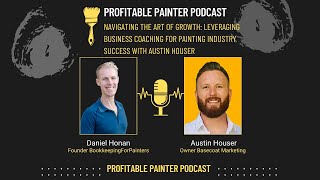
In this episode of the Profitable Painter Podcast, host Daniel (founder of Bookkeeping for Painters) talks with Austin Hauser, head of digital marketing at Base Coat Marketing, about the pivotal role of business coaching for painting and other home‑service businesses. They explore why coaching acts as a shortcut that helps owners avoid the "dumb tax" of learning through costly trial‑and‑error, and compare industry‑specific versus generalist coaches, as well as group versus one‑on‑one formats. Austin shares concrete examples—such as conflicting advice on when to hire a fractional CFO—and explains how to decide which type of coach is appropriate at each growth stage. The conversation also delves into the "Core 4" life framework (mind, body, relationships, business) and Austin’s personal morning routine (cold plunge, workout, meditation) that fuels his performance. They discuss accountability, mistake avoidance, and the importance of a coach who asks questions rather than simply provides answers. Practical steps are offered for finding a coach, including joining mastermind groups, leveraging the Base Coat Marketing "Bible," and contacting Base Coat Marketing for a consultation. The episode blends strategic advice with personal anecdotes (brain‑tumor surgery, Tony Robbins event) to illustrate how holistic coaching can accelerate growth while preserving health and relationships.
Chapters
Welcome to the Profitable Painter Podcast. The mission of this podcast is simple: to help you navigate the financial and tax aspects of starting, running, and scaling a professional painting business. From the brushes and ladders to the spreadsheets and balance sheets, we've got you covered. But before we dive in, a quick word of caution. While we strive to provide accurate and up-to-date financial and tax information, nothing you hear on this podcast should be considered as financial advice specifically for you or your business. We're here to share general knowledge and experiences, not to replace the tailored advice you get from a professional financial advisor or tax consultant. We strongly recommend you seeking individualized advice before making any significant financial decision.
This is Daniel, the founder of Bookkeeping for Painters, and today I'm here with Austin Hauser for the second time. And Austin Hauser is husband, father, business owner, and he's also the, the head digital marketer over at Base Coat Marketing, and I'm super happy to have him here today to discuss the importance of business coaching. How's it going, Austin?
It's going well. Thanks for having me back, man. It's always a good time to chat.
Absolutely. And today's topic is, is a good one, and I think a lot of people go a long time without kind of realizing how important coaching can be. Uh, in your experience, what are some of the most common challenges painting business owners face that business coaching can help address?
I mean, I think the shorter answer might be, what is something that they— a business coach couldn't help you with? So business coaching, I mean, look, we look at any professional athlete, they're, they're hiring a coach. Even Michael Jordan had a coach, you know, and And what a lot of guys get lost on is the fact that, yes, you can take the hard route, but the route that everybody else takes, which is hitting every single speed bump and roadblock along the way. And as, as some people say, you pay the dumb tax by doing that, or you can take a shortcut and instead hire people that have already walked that path. Yes, you're going to pay for their expertise and their time, but on the other side of that, is a path that makes you streamline your business, your operations, your sales, and ultimately your leadership as well. And it gets you a shortcut, right? And I think in business and in life, we all love a little shortcut from time to time.
Did you see The Last Dance, the Netflix special for Michael Jordan?
Yes. So good, right?
Yeah. It was funny because you brought that up and one of the parts of the documentary was the folks that have coached Michael Jordan, that was one of the things they said was like, he was fanatical about getting coached and like really listening and implementing whatever he was, you know, taught by a coach.
So there's a little catchphrase I like to use. Execution is greater than knowledge. You can know to do something but not do what you know. And I think that's really where coaching is kind of a two-sided coin. You need to learn and then you need to implement. And if you don't have the time to implement, it's gonna be hard to learn. Or you're not gonna find the value in that. But, you know, watching that documentary, I can relate to that in only one way, and that is the fact that I hire business coaches for multiple aspects of my personal and professional life. So does everybody else operating at a high level. One coach, you're not gonna find somebody to have all the answers. In fact, it's in my opinion beneficial to find coaches with opposite answers. I'm very much a person that abides by the law of averages. So if you hear enough things from enough people or you get enough perspectives, there's probably a hint of truth and a path for you in there somewhere.
Yeah, that's, that's interesting. So getting actual differing perspectives from, you know, different coaches. So you can kind of, I guess, let that marinate in your head and, and figure out what, what, what works best. Cause there's probably multiple, you know, things that will work in a business. You know, there's different strategies and all of them might work. It's just like which one fits your business and which one fits your personality maybe.
So I'm going to give you an example that you can relate to because I had, this is actually just how it came up recently. I had one business coach tell me the first role in business is to get to a point where you can hire a CFO or a fractional CFO as soon as possible. Like that is your 0 to 60 plan. My other business coach said that in no world do I need a CFO or a fractional CFO for at least until you get to about the 9-figure mark. So those were two very differing opinions, right? And one might be right, one might be wrong, or they might just have two different perspectives. But in your case, let's talk about you because I, as I understand it, you do offer CFO services from a fractional standpoint. What is your opinion on that?
I think it depends on the acumen of the, of the, the business owner. Like if, if you know accounting and you're, you know your numbers and you understand when you look at a profit and loss or balance sheet or statement of cash flows, you understand what's going on, probably could go a while without a CFO. If you don't know those statements that I just mentioned or how they connect and inter— interact, then you probably need some, some more help at an earlier point. And that's, that's what we see, you know, when someone asks me like, hey, should I sign up for the, the top package with this CFO? You know, that's basically my question to them, like, well, do you understand looking through your reports? Do you understand how, what it means and what you should do if you see your gross profit off or if your cash flow is weak on your statement of cash flows? So yeah, I think it's just dependent on the business owner.
Yep. So right there, it's a gray area, right? But most business coaches love to be right because they are coaching you. So they need to have the answers. They feel like they need to. A good coach will ask you questions. In my opinion, a coach that may not be the best fit is the one that's going to be able to tell you the path and the right path that you need to take. I almost treat a coach like a therapist in a way where you got a coach that you know, is going to talk to you about finance. You got one that's going to maybe talk to you about leadership, a life coach to really keep you in line, whether that's physically, mentally, both. But I do find value in having— we have an operations coach. In fact, I have a coach for everybody on our leadership team. So my operations director has a coach, marketing director has several consultants, and a consultant and a coach, I think they're all more or less interchangeable. But yeah, what's, what's your experience with coaching on your side?
Yeah, I, I have a coach as well, and I don't have multiple coaches. This is, this is new to me. I, you've just opened my mind. Um, I just have one, so, but, uh, yeah, like you said, it's not like I'm going to— you kind of get an outside perspective. You kind of know— you don't know what you don't know kind of thing, where I want to mistake avoidance. I don't want to make the same mistakes that maybe he's made, because he's, he's a level ahead of me, and so I'm trying to get to his level. And so he's just like, things I didn't think about before, uh, that I'm able to— oh, I should do that and, uh, avoid, you know, just recently there's a thing about cybersecurity that he pointed out, and I was like, okay, yeah, we probably should dig into that and make sure we're tied up there, because something that he had seen and, and dealt with. So it's just like, I think mistake avoidance and then just getting an outside perspective on, you know, you might not change the way you're doing things, but getting that outside perspective and seeing how other folks have done it in your industry is really helpful.
Mistake avoidance. I, I love that, that analogy. And that's really what you're doing is you're just trying to avoid mistakes. Um, you know, again, you can, you can blaze your own path, but it's gonna be painful and it's gonna be hard and it's gonna be long. But a business coach is, is somebody that should be there to ask you questions and advise you. They're an advisor, consultant, again, whatever you wanna call them. I find the best business coaches, I think that there's kind of a multitude of different types of coaches. I like the ones that are industry specific. So we do have coaches that are specific to the marketing world, right? They know the industry, they know what a business's value, a business valuation's at. They know how to structure a marketing agency. But at some point you're gonna outgrow an industry-specific coach, right? They, they've gotten you to a certain point and you might be going to the next level or looking to be more diversified or, you know, just take your business to that next level. And that's where I find a more generalist coach comes into play. So that's where more of an advisor who's already, let's say, scaled to a 9 or even 10-figure company, Those are the people that are going to understand your small little problems that you'd like to focus your time on. They're going to tell you to stop it and they're going to tell you what to focus on instead. You know, I always look at people that can run these multiple successful, you know, let's say $100 million companies and they do it in their sleep. They make it look easy and you wonder how. And you talk to them and it's that power of proximity. You know, if you put yourself in a room and you're the dumbest person in that room, you're probably sitting in the right room. I never want to be the smartest guy in the room because I'm in the wrong room at that point. I, I can provide value, which I love doing, but I also like putting myself in a position where I can learn and grow. And the only way to do that, in my opinion, is to surround yourself with people who are more successful or who already understand what you're after and how to get there.
Yeah, it, it, it's, it's crazy. I just, you made, made me think of Elon Musk. I just read his biography. By Walter Isaacson is the one that just came out a few months ago. And Elon Musk is running, you know, got $6 billion companies or something ridiculous. And it's just like, obviously he's smart, but you know, there's only so many, so much time in the day. So he's constrained to the laws of physics in that way. Yeah. Where he has to put people in charge of things that execute figure out the details on that. And he just manages that, that team that report to him directly. So, you know, it, it's, it's just funny, like going to a coach and you're, you're like, like you're worried about categorizing, uh, something in your bookkeeping software or, you know, trying to run a, a Facebook ad and your coach is like, what are you doing? You get somebody for that. You need to focus on the higher level activities growing your business.
Yeah. And, you know, it's going back to that, that idea of proximity is power. I was at a Tony Robbins event. I went out to Whistler earlier in February. It was a finance event, ironically, and I was in a room I would consider full of the 1%ers here in the United States where these people have private jets, they own islands. I mean, these people are very successful. And sitting in that room, I was, I was staying at an Airbnb with a guy whose net worth is like $125 million. And it's funny because they have the same limiting beliefs, concerns, problems as we do. They just have them at a different level. So when we're looking at, let's say, growing a business and how to get from point A to point B, most people fail because they focus on the small problems. They're not looking at the bigger picture. And that's where the people who succeed, who these people, you know, there's some very, in my opinion, some unintelligent people out there who are running very successful companies. And it's only because they know what to focus on. They know what the big levers and the big buttons are to push and pull, whereas everybody else likes to focus on the small problems because they feel like they're making an impact when in reality they're just wasting their time.
Yeah, I, I get, I'm guilty of that all the time. Like I'll get, it's like you get a little dopamine hit when you solve those little problems. You're like, oh yeah, I'm, I'm, I'm busy. I'm, I'm getting stuff done. I'm, You know, just, but then you reflect after the end of the day, like, what did I, what did I do today? I just like answered some emails and did some stuff I could have delegated. You know, it's just like, I just wasted a whole day of just busy work when I could have been, you know, working on my business instead of in the business. And so that, that's one that I, I really struggle with. And so I think a coach, having a coach kind of remind you, it's holding you accountable. You know, we talked about mistake avoidance, but also holding you accountable and being exposed to someone that, you know, thinks differently at a different, at a higher level than, than what you might be or what I might be.
Yeah. Look, staying busy is, in my opinion, one of the worst things as an entrepreneur that you can ever fall into. It's not about being busy. It's about implementing your time in the most effective way possible. Having a coach is somebody who should also be, let's say, reviewing your, your time blocks, your calendar. What does your schedule look like? One of my first coaches that I ever picked up, he's a very good friend of mine. His name is Chris Martinez. He always says I give him too much credit, but the guy's awesome. I picked him up as a business coach, business consultant, and he actually turned into more of a life coach for me. He kind of restructured my entire morning routine and it changed the way I run my company, manage people. Because at the end of the day, if you're not focusing on yourself first, whether that's your mind, your body, your relationships, the business is gonna fail. And I think a lot of people love to get up first thing in the morning, open up their email on their phone and start solving problems, right? We're all problem solvers as business owners. But what that does is it's gonna start draining you. You know, it's, I like to look at the standpoint of like you're a battery, you have a finite amount of energy and you start to drain that. There's not going to be left much left in the tank at the end of the day. And if you continually do that where you're not recharging yourself, you're not expanding the capacity of that battery, you're eventually going to drain, burn out, or you're just going to plateau, which is, in my opinion, even worse because a lot of people plateau at a certain point and they're like, I'm, I'm satisfied, I'm content here. But a coach, to your point, is almost like an accountability partner. They're going to be doing those check-ins with you, whether that's every other week. In my opinion, you should be meeting at the very least once a month. But I like having various coaches that I meet, you know, at least once a week, once every other week as a way to check in and make sure we're moving in the right direction. And when we're not, we can identify why and what the plan is and how long it's going to take to implement and who's going to do it. But it's that accountability partner who can actually look at that from a high level, from an outsider perspective, because that's the other thing. I feel like a lot of people look at their business and they're They're in the trenches, right? And there's guns going off, everything's blowing up, everything's on fire. And it's hard to get that outsider perspective if you don't have somebody who already knows you, how you operate, and your business. I think that's where you get somebody in place before you need them. It's going to make life so much easier for whenever you do.
Yeah, that's a good point. When I first got a coach, it was, it seemed like the first several meetings was just me. Just telling them about getting them up to speed. And they weren't, and for a while I was like, man, is this even worth it? I just feel like I'm telling him, giving him all the context for all the things that are happening, but not really getting anything back in terms of good ideas or anything. And he, not to, like, I'm sure that happened, but I just, it wasn't really impactful. But there was a kind of an onboarding period where the business coach was getting the context of where we were and all this stuff. And then, and then that's where the value started coming a little bit later after a couple meetings. So that, that's something that I didn't think of going into a coaching, uh, relationship was that they're gonna not necessarily be able to provide a whole bunch of value right away because they might not know your business well enough to to do that. They might need to, to kind of talk with you a while, understand how your business works, all that stuff.
Yeah, no, it's, it's like I said, it's like a therapist, you know, they're going to go in, they're going to listen to you talk, they're going to hear your problems and then they're going to start asking questions. And again, a good coach, that's how they should operate. And I want to define, there is differences between an advisor or consultant and a lot of these coaching programs out there. So, uh, this is an important distinction. I think a lot of people jump on board to a group coaching session and there is value in those. I do not want to make, I want to make sure I'm not understating, like there's value in the group coaching. Um, where you're gonna get the most of your value is with one-on-one consulting or advisory. Um, so for instance, your coach, he listened to you talk and then eventually started providing some input and value that you can take action on. He can't do that day one because he doesn't know your business. Group coaching, you're not going to get that level of granularity. It's going to be more about how quickly can you implement what they've already discovered works for most people, but it might not work for you. Or again, it's one perspective. So when you get to the point where, honestly, there's no wrong time to hire a business coach, I think once you have cash flow coming in, you need to hire somebody. Um, and again, I prefer starting with an industry expert and then branching out into the more specialty type of roles or a more global type of business consultant that can take you to that next level. Um, but that's just my personal experience and how it's worked for me. But again, I really think that everybody needs to look at a coach outside of just the business realm. Find somebody that you relate to, find somebody that's going to help improve your life, because if you're overweight, not sleeping well, you have a habit that you need to drop, all of that is going to impact how you run your company, right? That's why I wake up at absurd hours of the morning. I put my body through a bunch of pain and torture on purpose in the gym, and I do that consistently because that's what allows me to have the energy to not only run my business, but have the energy to spend time with my family after the day is over.
Yeah. So on the personal side, you mentioned you have a coach on Like, is it for physical, like a life coach or a physical coach?
Yeah. So let me just kind of back up. I'll tell you how I fell into the business consulting, business coaching world. I'm actually now a marketing coach in our mastermind group. It's got— it's one of the largest marketing mastermind groups in the country. So I had a full circle student to now coach aspect over there. So that was super fun. But that was again more of group coaching type of role. So I, this is going on almost 2 years ago, I was diagnosed with a brain tumor and I had to go through the process of getting brain surgery while I was scaling a company, right? So if you want to talk about like shitty timing, there's never a good time to have a brain tumor. But shortly after scaling a company from what was more or less a successful stabilized company into something much larger with much more opportunity and growth, but also more risk. While my wife is at home with my two young boys. You know, that was, that was a lot to handle and I didn't know where the business was gonna go during that timeframe. In fact, we paused sales entirely for like 6 months. So during that process, I fell into Chris, who I mentioned, and he started talking about where I was today, where I wanted to go and how I was gonna get there. All right. It's filling a gap. And that's called gap analysis. There's every sort of coaching program out there should have something similar to that. Because again, your path is not going to be the same as somebody else's path. But during that timeframe, I was introduced to what's called the Core 4 program. I don't think Chris invented this. This is like from another guru too. I think this is kind of a, something that's been passed around out there in the ether for a while. But It all has to do with focusing on 4 things in your life. You have your mind, your body, your relationships, and your business. And the purpose of that is to organize this in a way that you can scale your business by focusing on that last. Because again, your business is going to be, in most cases, what drains you of your energy, your time, and your resources. And in order to scale that, you have to focus on your mind, your body, and your relationships. So just as an example, I'll give you kind of what my morning routine looks like. And I do it in the morning. Because at the end of the day, something always comes up that prevents you from getting into the gym, spending time with your family when you're present, or focusing on your mind. And what that looks like is I set my alarm clock for 4:30 in the morning. It's never fun, but I do it anyways. We have a cold plunge here, so I just put my body through some unnecessary pain and torture. That's my way of getting uncomfortable. It's like drinking my coffee in the morning. I go jump in a 45-degree body of water for 5 minutes, dry off, and I go jump in the gym and I do about a 45-minute workout, get outta the gym, I stretch. That's my body part of the, the day, right? And that's all done by roughly about 5:30, 5:45. Then I lay on the floor and I meditate for about 15 to 20 minutes. That's the mind aspect of that meditation. Something that I feel like a lot of people look at as like a voodoo type of sciency stuff, but there's a lot of science that backs it up and I'll just kind of give you my brief rundown as to why I think meditation's so important. And that is because it resets your, your, your mind to a low threshold. So for instance, you ever like wake up in the morning and you look at your phone and there's some fire that you didn't consider from the day before or that popped up around midnight and your heart starts racing, you start sweating and you're still in bed, you haven't even got your day started yet. Like we're trying to avoid that whole thing, right? So what I do is actually have my phone on, I have an iPhone and it's, there's a setting on there called screen time that you can turn on and you can set what times of the day that you're gonna shut down access to all of your apps that you don't need. And I have mine set from 8:00 PM till 8:00 AM. So 8:00 PM, I only have access to the apps that are gonna help me go to sleep. I listen to podcasts at night, so I'm accessed to my podcasting apps. And I'll just like plug in my headphones, fall asleep to that subconscious thing. And any workout apps that I need in the morning. Otherwise, I can't look at my email. I can't look at Slack. I can't do any of that between 8 PM and 8 AM because there's nothing during that timeframe that is more important than my off time, my rest, my family, my, my health. Right. But in the morning when I'm meditating, I am lowering my mind, lowering that threshold down to a point where no matter what happens during that day, I'm never going to get anxious. I'm never going to worry, never going to get angry, that's for sure. So I can accomplish tasks, I can solve problems more effectively. And again, it only needs 15, you know, 10, 15 minutes of your time, let's say. And it's a lot harder than you think. It's like a workout where, you know, the first time you do it, you're going to lay there and be like, why am I wasting time sitting on the floor listening to this stupid podcast? Or like guided meditations the way that I do it. I use an app called Headspace. And after you do it a couple times, you start to realize that I'm able to shut everything else off. So instead of thinking about all the things you could be doing, you start thinking about being present and you start thinking about times in the past that you had a good time and you, you had fun, right? And when you start your day thinking about a memory from your childhood that really, you know, gave you a smile, again, there's nothing else during the day that's going to bring you down, right? You're invincible at that point. And then finally, After I'm done meditating, I spend time with the family, the wife, kids. We get them breakfast, we get them off to school, we talk, and then, and then I get to work, right? So I've already had, you know, 3 wins for the morning. This routine, again, it's not mine. It's taught to me. It's something that I inherited from my coach, and it's what's helped me scale, succeed in a sane manner where I don't let little problems get to me. I don't let negative clients get to me. And I know how to effectively lead our team as a result of that. And I will be clear, this is literally— we have a Base Coat Bible, as we call it. It is where at the very start of this we explain who we are as a company, our mission statement, our values. Every team member reads that, they live by it. That's why it's called our Bible. And in there we have documented the Core 4, the fact that we are a very fast-growing company, we're going to have challenges. This is how we lead. This is how we effectively manage all of that. So So that's my small way of imparting some of that on our team as well.
That's excellent. I really like that the core 4 and the fact that you included that as part of your kind of SOP on— I read this book called the, I think it's the Dream Caster. It's basically where you help your team accomplish their goals. And so it kind of reminds me of, but how giving them the framework because You know, everyone has their own goals. Like, I want to, you know, grow professionally and accomplish, you know, get a certain certification, or I want to be able to travel abroad. And then that, you know, requires that they make more money or whatever the case is. But you're actually providing, you know, providing them a framework with that Core 4. Like, hey, get your body, your mind, your relationships, your business, your professional life, I guess, in this case together, and here's a way you can do it. And so I really like that where you're kind of, it's not just all work-focused, you're helping them holistically. And I think that would be, I think that I would imagine that that would be pretty impactful and also make them very, you know, connected to you and, and not want to, you know, leave this job. Like, if, if you're helping them, like, make their life better overall from a mind perspective, body perspective, relationship perspective, as well as professional perspective, they're probably going to be all in, you know.
So, look, I mean, that's like Leadership 101. Like, you have to lead your team from the standpoint of you standing in their shoes. How do they look at you as a leader? You know, if you're going to show up every day and demand work out of them, they're probably not going to be happy. They're probably not going to be there for that long. And I will mention that one other thing about the core 4 that was taught to me was you don't tell your team about it right away. You do this for 4 to 8 weeks, about a month or 2, until your team starts noticing a change in the way that you carry yourself, the way that you show up to work, the way that you solve problems. They're going to start asking questions like, what changed? What are you doing? And then that's when you tell them, right? Because if you just go in there with this whole voodoo magic that you're starting for the first time, you might not be consistent about it. They're gonna be questioning it. Nobody's gonna be on the same page. Nobody's gonna do it. But if you show them the way, as a leader should, right? We're not bosses here. We're coaches, as I consider myself and everybody else on our team that leads the team. That's the best way to show people is to actually do it yourself.
Yeah. Do, do you hold them accountable to doing a cold plunge at 4:30 in the morning or?
Yeah, no, that's, that's something absurd that, that, that I picked up from my wife actually, who, who got me into that. But look, if you guys have not done that, I, it's a game changer. It is. It's to the point where if I don't do a plunge once a day, I feel like I'm missing my coffee in the morning. I just feel like something's missing. But it's, You know, there's a whole science thing behind it. I actually do it for the mental challenge more than anything else, because when you get outta bed and you're all nice and cozy and you're shivering, brushing your teeth, and, and then you're like, I'm gonna go jump into a body of water now that's 40 degrees. That changes your whole perspective as to what you can do when you tell your mind there is no negotiation. We're gonna do this cuz it's hard and then we're gonna go get on with the rest of our day. Yeah. So not to mention the fact that it's cold and it's gonna wake you the fuck up.
Yeah. And I think it helps increase your dopamine levels for, for like half the day. Yeah.
I've never, I've never done cocaine, but from what I understand, the science behind it is your, your dopamine levels are on the, on the same as doing like a line of cocaine, but for like half the day, as you said, it's, it's wild how your body is able to warm itself back up. And the science behind it, the whole Wim Hof breathing method is— I could talk all day just about that alone. But I know we're here to talk more about the business coaching side, which again, I've learned all of this from other people. And I don't, you know, there's no way that I can stand here and say that I've come up with any of these unique things in life because in general, there is nothing unique anymore in life, right? We all learn something from somebody else. We all, we are standing on the shoulders of somebody before us. And again, I think that's where consultants, advisors, business coaches all come into play. It's our shortcut in life to get to where we want to go from point A to point B.
Yeah. And so going back to what you were saying about, you know, if someone has never been coached before, they haven't considered it, your recommendation, it sounds like, and correct me if I got that, got this, get this wrong, but basically if you're just getting started, maybe get an industry-specific coach that knows about the painting industry. And that, that can be your initial coach. Get, you know, avoid some common mistakes, get some industry insights that you can, some ideas on how to implement different things. And then from there, as you grow to the next level, whatever that may be for that particular person, maybe start getting some, uh, domain-specific coaches, like a coach for marketing, a coach for sales, a coach for, you know, your, your financial situation, whatever the case is. Is that kind of—
That's exactly the framework.
Okay.
So, and, and, you know, if you want to look at it from like an outsider perspective, they're like, all right, where do I start? If you had a painting business that you're starting today, probably going to need to hire a painter before you hire a project manager, right? Like you need to hire a sub or somebody to actually do the work yourself. So in that case, you're going to hire an industry-specific coach to help coach you up from there. You don't go out and hire a CFO or, you know, a marketing coach at that point. You just need somebody to put paint on a wall. So you're going to hire an industry-specific coach to get a lot of the rough edges smoothed out. Now, again, group coaching, you know, at that point, I think should be fine for 90% of people. But you're going to get to a point, and I know this from experience. You're going to get to a point in any coach's group advisory role, whatever, that you simply outgrow them. You've absorbed most all of the knowledge and expertise as you possibly can. Now, there's definitely some cases that I would say from an advisory standpoint that you could spend an entire lifetime with somebody and never get enough information from them, right? I, I consider Chris my Yoda. I, I call him whenever I have a problem and he's got some sort of story to tell me that makes me feel better about my problem. But it's people like that that I think are just really hard to come by. But when you find them, you hold on to them. And as you go and you start outgrowing these groups, you start hitting their top threshold as to what they're able to offer you. You either turn into a coach yourself to provide value because giving is what ultimately provides fulfillment for everybody. It's just whether you want to give or not. I choose to give as my reward to myself. But from there, your options are getting into more of that specific niche type of coaching. So again, for instance, operations coach, finance coach, marketing for sure. But there's a number of different levels, either advisory consultants, coaches. And in my opinion, if you, you know, as a home service business, as a, as a painting business, the coach you hire could be simply, in our case, let's say a marketing agency. You're hiring almost like a, a CMO, right? It's somebody who can sit at the strategy table, talk about your goals, and give you the path to get there, whether that's directly due to the services we're offering, um, or due to the fact that you're also doing stuff offline as well, which we don't do. Um, and, you know, same goes for finance. You know, there's, there are certain things that you may offer directly or certain things that they can do on their end to get get some ducks in a row. But regardless of what the service is, they should be providing some sort of a consulting type of service for, for you as well. And then from there, yeah, finding a more generalist coach, somebody that you can lean on when times get tough. And these are the hardest to come by. Right now I have a doctorate in entrepreneurship as one of my advisors, super good guy. One of the other clients he manages considered him a contrarian, who's somebody who questions everything, which I love because I will come to him with something that I feel pretty strongly about. He'll question it and then I'll question myself and then we go down a rabbit hole and then I figure out that there's a different path to take that might make more sense. But he didn't just strictly tell me that answer, right? So it's those types of people that you want to look for, the kind of people that have the experience that, you know, you don't have. And that, to your point, are gonna help you avoid those mistakes before they even happen.
Yeah, that's excellent. So I think, I think we— is there anything else about business coaching if somebody's hesitant, or anything else that's that we haven't covered yet that you feel like you want to make sure you hammer home?
No. Again, my main recommendation is to go find somebody today, whether it's a group consulting thing similar to the PCA. I know there's paintergrowth.com. There's a ton of different business consultants out there who are going to help you get from point A to point B. It's a group setting. You can— it's almost like a mastermind, right? You know, we have a weekly mastermind call amongst our clients and sure, we talk about marketing, but we talk about— today we talked about sales, virtual estimating. We were talking about hiring subs last week, how to find people. So you need that community type of relationship with whoever you're working with. Then from there, start to branch out, start to find people that, that resonate with you. Accountability, it's so important.
Yeah. Excellent. Well, how can folks reach out to you, Austin?
Yeah, so we work with painting businesses all across the United States and Canada. Base Coat Marketing, if you've not heard of us, basecoatmarketing.com. Take a look at what we have to offer. If you're interested in jumping on a call with us to identify if we might be a good fit for you and your company, you can reach us at basecoatmarketing.com/call and just book a call with our team. We'll ask you a few questions to see if we're going to be a good fit. If we feel like we are, we'll be happy to talk to you about how we can help.
Yeah, if you need help with marketing, definitely recommend you check out Base Coat Marketing. We have several clients that, that use you guys and they're very happy. So definitely check them out. And with that, we will see you next week.
Thank you.
More from Daniel







What’s REALLY Holding Your Painting Business Back? (Find Your Bottleneck in 5 Minutes)



