Paint, Profits & People: The Leadership Edge
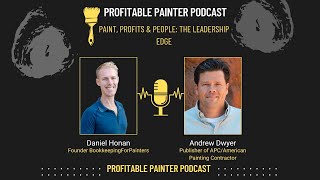
In this episode of the Profitable Painter Podcast, CPA Daniel Honan (founder of Bookkeeping for Painters) interviews Andrew Dwyer, publisher and editor of American Painting Contractor (APC). The conversation explores why many painting businesses fail early and what separates the ones that grow. Central themes include the importance of coachability, humility, and a growth mindset versus a scarcity mindset. They discuss practical tools such as accountability partners, coaching, and habit‑stacking (e.g., using stop‑signs as mindfulness cues). The hosts stress the need for deliberate, paced organizational change—planning, prioritizing one major process shift per quarter, and involving a solid management team. They also cover effective networking, treating networking as a muscle to be exercised, and the value of servant‑leadership. Advice is given on how to prioritize the flood of ideas from industry events (note‑taking, letting ideas sit, then selecting the top 1‑3). Throughout, they reference APC’s free, contractor‑focused media ecosystem (magazine, newsletter, podcast, events) and direct listeners to paintmag.com for resources. The episode blends conversational, motivational, and instructional tones, aiming to equip painting contractors with mental frameworks and actionable steps to scale their businesses.
Chapters
Welcome to the Profitable Painter Podcast. The mission of this podcast is simple: to help you navigate the financial and tax aspects of starting, running, and scaling a professional painting business. From the brushes and ladders to the spreadsheets and balance sheets, we've got you covered. But before we dive in, a quick word of caution: while we strive to provide accurate and up-to-date financial and tax information, nothing you hear on this podcast should be considered as financial advice specifically for you or your business. We're here to share general knowledge and experiences, not to replace the tailored advice you get from a professional financial advisor or tax consultant. We strongly recommend you seeking individualized advice before making any significant financial decision.
This is Daniel Honan, the founder of Bookkeeping for Painters. I'm a CPA that works exclusively with painting business owners, help them know their numbers and what they mean. Welcome to the Profitable Painter Podcast. and today I'm super excited to talk to Andrew Dwyer. How's it going, Andrew?
Man, Daniel, uh, it's great. I appreciate you inviting me on. We, uh, you know, we play in the same sandbox, you and I, our two companies. Uh, I think we're kindred spirits. We have very similar goals, certainly similar attitudes. So yeah, I, thanks for having me on, man.
Yeah, I'm excited to jump into the conversation today. Um, you know, you're over there at APC Magazine. Could you kind of give folks an understanding of where you're coming from, what you do? I know you've had a long journey through the painting industry, um, and become one of the, you know, a trusted voice really of the painting industry. How did that journey begin and, and what are some defining moments along the way?
I appreciate that, man. Um, yeah, amazingly I've been at APC It's largely the only job I've ever had, and it's been 31 years now, um, which is insane because when I started, who knew that was, uh, that was going to happen. But yeah, I was, uh, you know, I was an English major, wanted to get into media, um, applied for the job as assistant editor back when the company was based in St. Louis. Started in '94 as assistant editor, then became editor-in-chief Um, then became publisher, which just means, you know, you're less involved in the, uh, the day-to-day content and more involved in the overall operations of the, of the media company as well as sales. And man, obviously media has changed a ton. We used to be just the magazine. Now we're a magazine and so much more, just like any other media company that is still in business. And so You know, it's the weekly newsletter, it's a podcast, it's video, social media, the website, um, live events. It's, uh, everywhere people expect content to be is where we need to be. Um, and we're, you know, we're a national media company and our, our audience is incredibly focused. It's purely painting contractors. That's, that's all we do. Um, And all of our content is free. All of our revenue is generated via advertising and marketing. So, um, it's, it's really a, a huge win for painting contractors because, you know, we're, we're professional, um, we're professional media people, we're professional, uh, storytellers. We understand how to, how to tell a good story, how to get in touch with the right people. Um, and that's really what we do at APC is It's our job to know interesting people who are doing really interesting things in the painting world, and those are the people we write about in the magazine and we put on the podcast and we feature in the magazine. And because of that, we attract a very loyal audience of painting contractors, and because of that, we also attract, uh, advertisers. And that's, that's how we stay in business, Daniel.
Yeah, you guys are doing great things over there at APC. I mean, one of the things I'm kind of curious about is since you've been around for 3 decades now, what— and you've seen like the trends and tactics and tech come and go— and what do you think separates painting contractors who actually improve their business and, and make progress as opposed to those who kind of stay stuck? Because there was some at this, the last PCA event, there were some statistics thrown around, like the average painting business only has on average is 1.5 people, and that they're only in business for like 18 months. So what, what, what have you seen, you know, be the deciding factor or factors that separate a painting business that actually grows and progresses through the years as opposed to staying stuck or quitting early?
Love that question, Daniel. Great question. Insightful question. Um, so I think the problem or the challenge hasn't changed over the years, meaning the challenge is you need to want to get better as a, as a business owner, in this case as a painting contractor. You have to have that curiosity, uh, that drive to get better. And I, I don't think that has changed over the years. What has changed dramatically is how you can solve that problem. How, you know, it's so much easier to avail yourself of resources. It's so much easier to connect with contractors across the country. There's so many resources out there. Um, but the simple direct answer to your question is the The, the, I think the dividing line is, is drive and desire and curiosity. And so, you know, lots of the people like to talk about how many painting contractors are, are there in the country. And, you know, is it 200,000? Is it, is it a million? A lot of those painting contractors don't think they need any help, and that's okay. I mean, if they're happy, that's great. Then you don't, you don't need any. If, if you're happy, you're satisfied, that, you know, you're charting your course and you're driving your business and your business isn't driving you. Heck yeah. You don't need any help. But there's also so many people who are like, what's going on? This isn't why I got into business. You know, it's gotta be better than this. It's gotta be easier than this. What am I doing wrong? Acknowledging like, man, there's gotta be more to it. This isn't why I signed up. So acknowledging the problem— why don't I don't feel good— and then going to the next level of, you know what, I'm going to do something about this. That's, that's what's wonderful. I think that mindset of things can be better, being coachable, having the mindset that, you know what, there are better options and better ideas out there. I just need to go find them and I'm going to go find them. I think that's, uh, and so whether you Whether you listen to podcasts, which again is like a lot of people would never listen to a podcast because they just don't think they need it. Why would I listen to a painting podcast? I'm already a painter. I don't need to know how to paint. But I think the, I don't wanna say the best among us, because again, if you're not curious and you are happy, excellent, good for you. But if you are curious, if you have that fire burn inside that, oh, I wonder if things could be better. That's fabulous. And go out and you seek the resources because there's so many resources out there.
Yeah, I think that makes sense. There's a lot of folks— I talked to a lot of painting businesses over the last 9 years, and there's definitely some folks where they're very kind of resistant to accepting feedback. And I get it because sometimes I am as well. Like, I, you know, if especially if we're talking about accounting or something like that, like, you know, I'm an accountant. I've been an accountant for years. Why are you telling me how I should run my accounting firm or whatever? So I kind of get it. But at the same time, there's folks that just seem really open to what you have to, you know, recommendations that I would have. And seem really coachable and more open to and humble, really, which is, you know, if you've been in the trades or as a painting contractor for years and years, and you're humble enough to accept that feedback, those recommendations, I think that's a huge thing. And you might, you know, not all the recommendations you get are gonna be good, I think being open to it can, can lead you down a road that you might, hey, learn something and, uh, and be able to take that and run with it.
Daniel, one of my favorite phrases is it takes courage to be humble because to put yourself in that position to acknowledge there's something I'm missing, there's something I don't know, there's something I could learn. And in a way, sort of submit yourself that, you know, yes, I'm gonna seek out others who might be able to help me. That, that's humility, and it takes courage to be humble. And 100%, that's what being coachable means. And certainly in the world of accounting, yes, there are some painting contractors out there who are just really fluid and keen on numbers and finances and all that, but most of them aren't. And so that's, that should be a known blind spot or weakness. For the majority of painting contractors. Like, there's a lot about finance that I probably don't know. And you know what? I'm going to go out and I'm going to get myself an accountant and I'm going to be humble and say, what do I don't know? Look at these numbers. What, what don't I know? What am I missing? And, and that's why it's got to be— you're almost like a counselor, I think, when you're in accounting, Daniel, because, you know, you got to share some bad news to some of these contractors. Or what they may perceive as bad news. Like, you know, here was your quarterly, you know, gross profit solid, but here's why and how it could be better. And if the contractor is not humble and lacks the courage to hear what he might think is bad news, you know, he or she's going to have a hard time growing, right? You need to— I know there's something I'm missing. Daniel, that's why I've brought you on. I'm ready to take my medicine. Hit me with the bad news. Right. Wouldn't you? I would guess, Daniel, that those are the clients that you love working with the most who were like, okay, I'm ready, man. Tell me what I did wrong. Right.
Yeah, absolutely. Yeah. It's, it, uh, I'm, I'm, I guess I'm used to delivering bad news. Um, Well, and I don't even think of it as bad news anymore. I think I'm, I kind of get excited when I find, okay, here's the problems. Cause I feel like we can fix them once, you know, it's hard to fix a problem. You don't know what's going on, but if you know what the problem is, then, you know, it's just a matter of implementing the solution.
Yep.
So in my mind, it's not a, it's not a problem.
It's an opportunity. It's another one of those phrases I love. That you can roll your eyes at, that this isn't a problem, it's an opportunity. Every opportunity starts out as a problem, but once you solve it, it's an opportunity. And I think, um, I also love this idea of, of confidence versus arrogance, where, you know, confidence is this belief in yourself that, you know, I can do it. I can fix this. I'm up to the task. I can rise to the challenge. The, the, the burden, the burdens and the barriers and the obstacles that I'm currently facing, whatever, I'm gonna lean into it. The only way out is through. Um, and so I'm gonna lean in. I have the confidence I can do that. Arrogance is where you think all of those same things, but I don't need anybody's help. I know better than everyone else. I don't need their help. Nobody can help me. Confidence comes from like a growth mindset. Arrogance comes from a scarcity mindset where you're, you're skeptical and uptight and think the worst of people. I mean, that's really what the definition of a scarcity or a paucity mindset is, that, you know, there's not much business out there, there's not much success. I need to grab it and hold it on. And I think that's why when you attend events in this industry, whether they're PCA events or anybody's event, Learning how to network, having that courage and the humility to meet new people, to be honest, to learn what they're doing. That's the confidence that the world can help you get better. 'Cause there's just so many great people out there who love sharing their story, who want to hear your story. That's how we grow together. I know I sound like a, I don't know, a Dale Carnegie tape, but it's just, that's, That's just, I believe in that. Like, now I'm also 55 and it's taken me a long time to get to here, to develop as much faith as I now have in people. And now it's a wonderful thing.
Yeah. I like the way you described confidence versus arrogance. Like the, I've never heard it described like that before, but it makes sense. And, uh, I'm, I'm just reflecting. I'm also feel like this is partly a therapy session cuz I feel like sometimes I'm arrogant and like, yeah, that makes sense.
We all are.
Of course. Yes.
That's, I think that's the beauty of, uh, of mindfulness, which to me simply means, I mean, if you're into meditation, great. Personally, I don't meditate, but that doesn't mean I'm not mindful. Mindfulness just means Being humble, being objective. You know, how did I do today? How did I handle that situation? I'm coachable, which means in some cases I can coach myself. I can say, man, the way I just interacted with my wife was BS. She must think I'm a jackass. So I need to be humble to acknowledge that I failed. Um, and that's how you then improve. Um, that's what, to me, that's what mindfulness is. Yeah.
So I guess in your experience, what do you think business owners that struggle to be coachable, how should they start shifting that mindset? Should it just be a mindfulness thing, like to, to try to catch yourself when you get into those, those traps of thinking in scarcity instead of growth? Is that kind of the way to, to do a 180 from being not coachable to someone's coachable that's growth-oriented?
Again, Daniel, I think I love that question because you really dialed it down to the core. Like, okay, I'm buying into this idea, but now what do I do? I'm a big believer in accountability coaches. Um, you know, we can't all hire business coaches and we can't all hire consultants. Um, but there's this idea that if you say it out loud, it becomes real. If you tell somebody, it becomes real. If you, if you tell people, you know what, I'm gonna read 20 books this year, the more people you tell, the more likely you are to do it cuz you put it out there that people know and now there's this like positive pressure. And of course, again, there's negative pressure and there's positive pressure. Like, okay, I've told people I'm gonna do this, I need to do it. And it can start with just an accountability coach, whether it's a fellow painting contractor, a friend, um, it could be a spouse. Um, I think ideally it's, it's another painting contractor. And you got, you just agree to meet once a month or every 2 months. And so when you see that on your calendar that, oh, 2 weeks from now I gotta meet with Daniel. And of course the whole point of that meeting is to keep each other accountable. I better get to work. Um, that's, I mean, that's it. We all, some of us are blessed with the ability, we're just type A and we just get stuff done and we don't need reminders and we don't need anybody to crack the whip and we don't need a trainer at the gym. We just go, man, that's not me. That's not most of us. Um, So yeah, just start with us, with just one friend who you can, who can become an accountability coach and help keep each other in line. It's incredibly effective.
Yeah, I know coaches, and I've just over the last few years, uh, I ran, I guess kind of ironically since I'm a semi-coach, but, uh, you know, accounting coach, I guess, but, um, just over the last few years, I've really bought into the, the coach ideal because I have a tendency to think I can just do it all myself. Um, there, there, the arrogance thing, it pops up again.
Um, that's confidence, man, that's not arrogance.
But, uh, over the last few years, I've been really, you know, spending a lot on coaches helping me get better on things. And, you know, it can be scary to, to put, you know, some— put money down and actually invest in that thing if you're not used to it. And, you know, it— but it can really open up your mind and just speed up your learning so much when you've— you're working with, especially with somebody who has done it before.
Yeah, that's a great point. You know, one, uh, one quirky thing that I started doing maybe 2 years ago is I, I, on the topic of mindfulness, which again, I think unlocks, this is like a superpower. The, the more aware you can be of the things that you do mindlessly, which we all do. So it's not about being more stressed or more like, why'd I do that? It's just about being more present and aware. That when I would approach, and I know this is not just me, when I would approach a stop sign or a four-way stop or a three-way stop, I think we all tend to treat that as like a race. Like if, uh-oh, two cars are approaching at the same time, I'm gonna make sure I get there first because I, I want to go first. Granted, some of us are blessed and they're super chill and we don't worry about that stuff and we're zen, but I think a lot of us just naturally get sucked in to this, this idea that there's a competition at the 4-way stop, and by God, I'm not going to lose this competition. And it occurred to me, like, what am I doing? This is, this is— I'm just creating stress in my day, and I just don't need it because it's so unimportant. And so then when I started approaching 4-way stops, I would actually be aware of that, and, and, and then I would actually, like, slow down, and I'd be like, you know what, I'm not going to get sucked into this. And yes, I'm going to let you go first. And look at me, I'm such a great guy because I let you go first and I didn't, I can't lose because I'm not playing, which makes me a winner. So, and it sounds so corny and I guess in a way it is corny, but oh my God, it was so effective because I find myself at stop signs all the time. And so that was, you know, 3, 5, 8 times a day. I have this sort of built-in mindfulness check that would just lower my heart rate a little bit instead of elevating it and remind me, you know, let's choose wisely when we engage and when we turn up the pressure. And this is not one of them.
That's interesting. You're anchoring your mindfulness to something that happens throughout the day. Uh, which is pretty cool. I, it's kind of like, uh, reminds me of Atomic Habits, like habit stacking.
Yeah.
Yeah. Where you, if you want to add a new habit to your routine, you just pick a habit that you already do, like brushing your teeth every, every night, and then just stacking your habit on top of that brushing your teeth thing. That's what it reminds me of. I think that's a good idea.
It's a great, that's a great, uh, way, great way to relate it. Yeah, you're right.
Um, now, now with this change, you know, changing your coachability, your mindset, I know that change is, is pretty hard, especially when running a business. Whenever we're trying to change something in Bookkeeping for Painters, it's it's not just deciding on how you're going to change, like, but it's also like changing the organization and everyone's habits within the organization. And it's, uh, it's usually a pain, a huge pain to do any kind of change because there's always all this pushback and people get grumpy over the change. And, uh, it's hard to, hard to get everybody on the same page, but do you have any So, so it's, it's hard enough to do it for, for yourself, like individually, but then when you talk about trying to change other people as well, it's like, just adds an exponential component to it. What advice do you give painting contractors who want to implement improvements without overwhelming themselves or their teams?
Yeah, man. Every, everything requires a plan. Um, I love the concept of, uh, like a lot of times people to talk about a quarterback about how the game was too fast, or, you know, the game is so slow for them, meaning they've got a presence of mind in the pocket, and it may seem like there's a lot going on, but to this quarterback, the game is just slow, meaning nothing rattles this quarterback and they can see things unfolding. And how do we do that? How do we get to that point? Is through preparation and planning. If you're gonna run a marathon, you gotta know what your mile, what your goals are. Like, where do you want to, what is your mile pace? You gotta check your pace. Am I on target? Am I off target? And the same is true about implementing change. Take a breath, figure it out. Certainly one mistake is too much change at once. Businesses really shouldn't incorporate more than one significant process change, probably per quarter or maybe per half, um, because you're just going to overwhelm your people if there's too much change. You as a leader, as a manager, you're not going to be able to manage that much change. So be reasonable, um, be modest. Like, what, what can I reasonably expect to accomplish this quarter? And then Draw up the plan, and then when it's time to talk to your team, you better show up to that meeting 15, 30 minutes early. You don't wanna be rushed. You gotta clear your head. You need to be a clear glass of water, which is another phrase I love that, man, you just, you gotta be at peace. You can't be rattled. You have to have clear vision. Um, so that's it. Don't try to do too much. Plan and prep. And then ideally, you really gotta have a good management team around you. Cuz if we need to be coachable, but we also have to have coaches. And so everybody should have a management team and you rely on that management team and say, look, here's what I'm thinking. Here's what I'm gonna do. What do you think? And you know, it's the leader's job to make the decision, but it's also the leader's job to accept input and hear the input of others. So you surround yourself with a good team who understands what you're trying to accomplish. Be patient, listen to their feedback, give it serious consideration, let it ground you. And then yeah, you can— there's so much change that you can accomplish when you, when you're grounded and, and you've got the plan in place.
This reminds me of coming, coming back from like the PCA event was, uh, the big one, the expo was in February, had like over 1,000 folks there, really great event. Uh, there was so many great presenters, great information. It was, it was like drinking through a fire hose really. And, uh, you know, I feel like probably a lot of people came out of that with, you know, not just 1 or 2 things, but maybe 10 or 20 things that they wanted to change in their business. So sometimes it's, you know, the change is hard and, and if we're only doing one at a time, you really have to make sure that you are picking the right thing to change and, uh, what to focus on, what to, what to change first. Uh, do you have any thoughts on, on how to prioritize?
Well, I mean, I think, I mean, that's the answer. You have to prioritize. And I think that's what a lot of people don't do. And so, um, You know, I'm a big believer in like, I would make my kids watch Apollo 13 because this idea of, you know, we're going to work the problem and let's not panic, let's not make things worse by guessing, right? You got that massive failure up in space, but we're going to— we're facing a challenge none of us have really prepared for and we're not exactly trained for it, but we are generally trained for it. And that's what we're going to do. We're going to keep our head and we're going to solve this problem. It's going to be our greatest What, what some thought would be our worst failure, it's going to be our greatest achievement. And so, yes, when you go to an expo, when you listen to a podcast that covers a ton of ideas and you write down 20 of them and your head starts to race like, oh my God, what should I do? Which again, you got it. There's a ton of great ideas that you will not get to. And so make— take good notes at an event like that, put it away, come back a week later, look at it with fresh eyes. There's gonna be 1 or 2 or 3 things that jump out at you. And I think that because this, again, the idea of like recency bias in the heat of the moment, if you're at like a, an annual convention like that, like PCA Expo, it is overwhelming. And so your, your job there is just to collect all these ideas and write them down and then leave and let there be space. And then come back when you've had a, a chance to relax, take another look, and then it just naturally, one or two or three things are gonna bubble up. It's like, okay, those are the most import— those are the best ideas. And I, and that is, we all have to remember that there's some great ideas. But we're just not gonna get to 'em yet, and that's okay.
Yeah, I think that's right. You know, going to these events, my notepad's always full and it's like, what do I do first? Kind of give it some space, come back the next week, open that notebook again, and it, it starts to be clearer. I think, I think giving it some time, cuz whenever I ask, uh, I always ask this question. When I see folks at the event is like, what's your big takeaway so far? Or like, and oftentimes I think I get a blank stare. Like, it's just too much. I don't know. But, uh, it's hard to, uh, to process all that. But, uh, cool. Um, do you have it? So we've kind of, we've kind of touched on a lot of topics. We talked about Being coachable, like mindset, like what's your, your mindset, your growth mindset should be, which includes being coachable, being open to things, um, so that you can learn more and progress. And then we also talked about change, like how to implement change for yourself, but also for your business, you know, getting that buy-in from your team, uh, so that, and not trying to implement too much all at once. What other things have you seen, um, through your years being in the painting industry? What other things do you think are, are key for painting business owners to, to have that growth mentality, to, to be able to, to lead their businesses to the next level?
So I, I think, um, I think a lot about, and I talk a lot about, um, because I also do some keynote speaking, um, and, and that usually takes two forms. One is simply, you know, addressing people early on in the convention and just trying to get everybody on the same page. What does success look like? What are we trying to accomplish here? And a big part of that is creating a team mentality, that you're not just here by yourself. So we talk about the PCA Expo. We're all in the same business here. And each of our individual growth at this event and individual success at this event is absolutely tied to everybody else here. And so there has to be this, this sharing, this willingness to share. And so it doesn't matter how introverted or extroverted you are, you know, we're all here to meet new people. And so we're going to introduce ourselves, we're going to say What do you do? Because guess what? We all know we paint. And so let's ask those questions and let's, you know, we, the, the, the phrase servant leader, I think is a, is a wonderful concept that, because it really sort of drives home the point that yes, I'm the leader of my company, I'm the boss, but that's not an award, right? It's not a reward. Um, it's not the culmination of something. It comes with a responsibility. Like I have the responsibility and the opportunity to improve these people's lives, including my own life, including the life of my family. And I'm gonna take that seriously. And so, uh, I know I'm getting a little far afield, Daniel, but to me that's, that's what it's all about is staying humble, being curious, asking people what they do. I did a TEDx talk and that was the, Entire point of the TEDx talk was speaking to strangers for 10 seconds because it can change the way you view the world. Um, tell me about you. What do you do? Building that little mini bridge because you get a, you get a hit of endorphin that like, wow, you know, that was fun, or he was funny, or I made that person laugh. And it just, it just peps you up for a brief second. It it gives you a little more energy in the middle of the day, and it, it creates muscle memory, right? And so that when you go to the event, um, you are better able to network. Um, and since the whole point, at least one of my points from the beginning of this podcast, was that we need to avail ourselves of resources such as people, we have to network, we have to be comfortable Talking to other people. What do you do? What's your biggest challenge? How was your year last year? And then listen to their ideas. Um, and of course at this point, Daniel, I've completely forgotten what your question was because I'm so up, I'm so high on my high horse. I can't even remember what it was.
No, just other, other, uh, other things to, for painting contractors, like to, to get that growth mindset, which you, you did answer the question. In your TEDx talk that you did, the intro is funny because you're like, you know, if aliens were to come down and look at humans and then see them in elevators, they would think that elevators were really dangerous because whenever people get into an elevator, they're very just— they kind of shut down socially and just like stare at the floor and just like don't move or talk or anything. And so the aliens must think that this is a very dangerous situation that they're very concerned about. But it's just everyone's social awkwardness to be able to, you know, say hi to someone else in an elevator. So having— and that's a skill that I suck at too, is I'm one of those scared-looking people in the elevator, I guess. But having that skill, like, it's like a muscle, at least for me. I know if once I get in a role, I can, I can do it. But if I stop using that muscle, that like networking muscle or whatever you want to call it, it just goes away pretty quickly. So I think that's like a, just for business owners generally, just having that muscle, like constantly using it so you can, you know, so people know you and you have that when you go to events, you're, you're ready to roll. I think that's really good advice.
Thank you. And, and yeah, I think, cuz I think the elevator thing is just an example of things we do mindlessly, um, which it's not wrong to not speak in an elevator. Um, and maybe you've had a bad day, maybe you've just had a horrible argument, maybe you've just gotten bad news. I'm not in any way suggesting that everyone should always speak in elevators. But we've gone to the other side where basically no one ever speaks in elevators. Um, and so that's something we do mindlessly. You know, how about every once in a while, maybe 20% of the time, we say, wow, I like your shoes, or, you know, you're wearing a Creighton hat. Are you off to the Creighton game? Whatever. Uh, it doesn't, you don't need to bore these people to death with too many questions that are none of your business, but keep it light and it just sort of it knocks the rust off of us. And you mentioned it's a muscle that we have to keep working and it's, it's very useful. Yeah.
Awesome. Well, I really appreciate your time today, Andrew. Where can folks learn more about APC or connect with you? Where should folks go?
Our website is paintmag.com. And again, Everything we do, all the content we create is free. Subscribe to the magazine for free. And so sign up for the magazine. It's every other month. Every single page deals with running a better painting business. Subscribe to the e-newsletter. We've got a podcast. It's, it's great content. And man, again, Daniel, I love what you guys do at Bookkeeping for Painters. You've been on my podcast. We're just, I've just, I love the work that you guys do. So keep it up, man.
Hey, right back at you. I really appreciate everything you do, and you guys now are the only magazine and media company that, that serves just painting contractors, right? I'm pretty sure we've—
that is true. And now, yet last year was our 100th year, which is amazing. It blows my mind that American Painting Contractor had been around, has been around for 100 years now, 101. Um, but yeah, we've navigated all the changes in media, and I, and I think we've done that because we've stayed very focused on our audience, which is purely painting contractors. That's all we do.
Yeah, awesome. Really appreciate the wisdom today, Andrew. Uh, definitely check out APC Magazine, and with that, we will see you next week.
More from Daniel







What’s REALLY Holding Your Painting Business Back? (Find Your Bottleneck in 5 Minutes)



