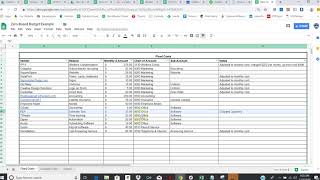
Daniel from BookkeepingForPainters.com shows painting business owners how to build a zero-based budget by examining every overhead expense line-by-line instead of copying last year's spend. The spreadsheet maps costs to QuickBooks, adds variable expenses as percentages of sales, and calculates the revenue needed to hit a 10-15% profit target.
Chapters
This is Daniel from BookkeepingForPainters.com, and today we're going to be talking about budgeting, specifically the zero-based budget. So zero-based budgeting is when you look at your overhead costs, usually your fixed costs, and identify what do you actually need to run your business. And this is— the intent is to whittle down any unnecessary expenses that you have on your overhead for the coming year. And once you— so you basically go line by line through each of your overhead vendors and see how much it costs and what you're paying for, and you determine what is the reason, why am I paying for this, and you put the amount, and this helps you build out a budget. It's called zero-based budgeting, and this is a The other type of budgeting is historical budgeting where you look at your historical, what you've paid for historically, and then you use that as your budget moving forward. But this is more detailed. It takes a little bit more time, but it's a lot better to understand what you're actually paying for and to kind of dig into the details. So I have this spreadsheet that I developed. Hopefully that will help you out a bit to to line item your fixed costs, and also has a couple other features, which I'll show you here in a second. So the main part of this, what you want to do is basically list out all your— everything you're paying for, for fixed overhead costs. So what does that mean? Overhead costs are anything that's not related to the job site specifically. So, non-job site related costs, and then the fixed cost means that they're not variable. They don't— they pretty much stay the same throughout the year, and they don't change based off the production level for the most part. So, now, examples of this would be basically some of the things listed here. So, call answering service, that's a little bit variable, but for the most part, it's more or less the same. Your payroll software, it's pretty much the same. It might change a little bit based on how many employees, but for the most part, it's pretty much the same. Software costs like PEP, TSheets, and some of this stuff is a little bit variable, but for the most part, you end up paying about the same amount every month. Your liability insurance, Workers' compensation, so this is variable based off of the labor you purchase, but— or the labor that you use, but you probably have some kind of premium that you're paying monthly, at least for a year period. And we'll capture the variability of workers' comp in the next tab that I'll show you for projection purposes. So, So, you're basically trying to capture all these costs that are mostly fixed. Now, some of them, like the ones I mentioned, might be slightly variable, but they don't vary too much. And we're going to put the reason why you use them. This is important because, kind of for yourself, do you really need this to pay for this? Is it actually bringing you in business? Is it crucial for your company to continue profitably? So, that's why you put the reason there. The monthly amount is just as it says, what do you pay for it monthly? Some of these on the far right, you'll notice adjusted to monthly cost. Sometimes it's not quite exactly monthly, like obviously Vistaprint, so you might not, you know, it's not like you pay Vistaprint exactly $25 every month. But you might pay $100 in one month and then $0 in the next month, and it averages out to $25 a month. So, you'll need to look at your financials, you run a profit and loss for the past year, and kind of get the average cost for some of these things. And then you have Yeah, so you put the monthly amount, and if you need to average it, put the average. And then this next column is the Chart of Accounts. This is based off of what your stuff is classified to. This is just helpful when you plug it into QuickBooks Online Plus. Now I'll do a separate video on how to make a budget in QuickBooks Online Plus using the budgeting tool. But that, putting this in there just helps out a little bit. It's not required for zero-based budgeting, but it's helpful. And then the next column is for the sub-account of the main chart of account. And then you have any notes in the last column, like if you adjusted it for a monthly cost, like PEP, for example, they charge every 3 months. So, it's adjusted to a monthly cost there. So, you list out all your costs and the spreadsheet will add up the total overhead fixed costs here. And once you're done with that, you have— basically you have your zero-based budget for your fixed costs. So, you're pretty much done. Now, if you want to do a little bit more of analysis, you can move to the next tab and you can plug in your variable cost by percentage of sales. So, if— so you plug in your labor. If you're using subcontractors, you know, maybe it's 40-45%, and if you pay for your subcontractors' workers' comp, include that percentage here. If you're using labor, you know, I recommend you just put the percentage of labor that includes workers' comp and payroll tax burden. So maybe for employee labor costs, it's 35 to 40%. Sherwin-Williams, usually that ends up running 10 to 15%, and then you have your overhead employees like your operations manager, your sales people, maybe mileage is a bit variable based off of the production, so put it there. So you try to capture all your variable costs and you put the percentage of sales. Now you can get an idea of this by looking at your profit and loss and customizing it to see a percentage of income. Down the right-hand side. But you should sort of know your— these items here, your labor percentage of sales and your direct costs, but definitely verify. And so you plug in your percentages here for your variable costs, and this can be direct labor, meaning on-the-job site labor— I mean, direct costs on the job site cost, or it can be overhead variable costs. Like the ones here. So, we're just going to capture everything that is variable based off of the amount of production you're doing. Once you plug in your percentages there, you'll get an output screen that shows your breakeven point. So, how much do you need to produce on a monthly basis or on a yearly basis to break even in your business? What is your 10% profitability, 12.5% profitability, and 15% profitability points for production. And so what this is doing is basically it's adding up— it's taking your fixed cost and your variable costs to generate what you would have to hit in terms of revenue on a monthly or a yearly basis to hit your profitability marks. Now, if you're— something to keep in mind, if you're the operations manager or the salesperson, you need to plug in your salary in here. If it's not a variable cost, like maybe because this is based off performance pay. They're getting paid as a percentage of sales for performance pay. If you're not paid, if you have someone who's paid off a salary or they don't get paid off of performance, you're an S corp officer, you just put your salary here in the fixed cost, since it's a fixed cost, and that will give you your profitability. So, Like, just to take an example, let's say you're the operations manager and the salesperson, and you pay yourself, you know, $40,000 a year. You can plug it, you know, by month, the monthly amount here, and it will add it as a fixed cost. And, or maybe it's variable. Maybe you pay yourself a percentage of revenue, so you can plug it into the variable. It's up to you on how you want to exactly calculate it. And the output, it just kind of gives you an idea of what the profitability of the business— and remember, profitability, this is after you pay everyone, to include the officer of the business. So, you should be an S corp, so you should be paying yourself a salary. If you're not an S corp and you're still a sole proprietor, probably should look into being an S-Corp, but you would want to include the owner draw amount as either variable cost or fixed cost. Alright, I hope that makes sense, and I hope this tool is useful to you, and I'll talk to you soon. Thanks.