Painting Your Way to Wealth: A Comprehensive Financial Guide for Professional Painters
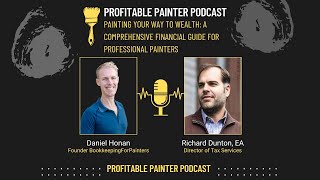
Daniel and Richard break down a four-step wealth plan for painting business owners: scale your income, build a 12-month emergency fund in high-yield savings, pay off high-interest debt, then invest in 401(k)s, Roth IRAs, and HSAs. Solo 401(k)s let you invest in real estate, gold, or crypto.
Chapters
Welcome to the Profitable Painter Podcast. The mission of this podcast is simple: to help you navigate the financial and tax aspects of starting, running, and scaling a professional painting business. From the brushes and ladders to the spreadsheets and balance sheets, we've got you covered. But before we dive in, a quick word of caution: while we strive to provide accurate and up-to-date financial and tax information, nothing you hear on this podcast should be considered as financial advice specifically for you or your business. We're here to share general knowledge and experiences, not to replace the tailored advice you get from a professional financial advisor or tax consultant. We strongly recommend you seeking individualized advice before making any significant financial decision.
This is Daniel, the founder of Bookkeeping for Painters, and this is Richard, tax director with Bookkeeping for Painters.
How's it going?
It's going pretty good, Daniel. How about yourself?
Doing well. The kids are constantly sick and I think it's kind of rubbing off on me finally. So I feel like I have that feeling in the back of your throat where you're about to be sick. So that's fun.
Yeah, 'tis the season for head colds and flu. Yeah, whenever the weather changes, changes up here, it's, yeah, you're bound to get something. So I feel for you. I got to get the chamomile tea, the chamomile tea and the honey and whatnot and try and soothe that throat, right?
Yeah. Yeah.
So we've got kind of an interesting topic today. It's not, it's not home cold and flu remedies either. That would be a different podcast. We're talking about wealth building. So big segue from chamomile tea. Why is that so hard for me to say? Chamomile tea. Daniel, why don't you talk about the topic? Because I'm out.
Yeah. So our topic today is wealth building steps. So Basically, what steps should you take to build wealth? Now, you might be asking, like, why, why would I want to build wealth? Uh, what is— what does that even mean? There might be a lot of questions there. So I think of wealth as kind of different from being rich. And, uh, you know, in our businesses, our— we want to use our, our painting business to help us build wealth. You know, for the long term. So when I think of wealth, I think of like long term. I think of Warren Buffett. Like, Warren Buffett is making millions in his sleep constantly. He's not actively, you know, trading his time for money. Um, when I think of rich, I think of like a doctor, you know, just spending all his time like working 80 hours a week, you know, to, to get he might be making a lot of money, hundreds of thousands a year, but he is just— has no, you know, balance in his life, and he's just running into the ground. And as soon as— and he might be spending all that money, you know, on, uh, fancy cars and big houses and all that. So he might not have any wealth. He might have a high income, but he doesn't have any, uh, any real wealth. So, you know, I think of I think folks should think of their painting business as a way, an opportunity to build wealth in their life. And so we're going to go through those steps of building wealth.
Yeah, wealth is a long-term thing, right? Like, it's, it's what, why we're doing what we're doing so that we can pass something meaningful on to the next generation. You mentioned Warren Buffett. I just gotta give a shout out. Like, I heard Charlie Munger, Warren Buffett's, you know, one of his closest friends and his business partner for many decades, passed away this month. And he is one of the wealthiest people in America because he took a long-term view of things. He didn't spend everything on, you know, He certainly enjoyed some luxuries, I'm sure, but he, he had his priorities straight and he knew how to grow his money. And that gave him the freedom to live the lifestyle that he wanted. So that's kind of our goal in wealth building is putting our money to work for a purpose and making sure that we have enough of it when we need it.
Yeah. And so we'll run through these 4 wealth-building steps. And I, I— we didn't come up with this. I, I got it from somebody years ago, and I, I don't recall who, but everyone has a version of this. You know, if you, if you listen to the financial gurus out there, um, they have some version of this, and it might be slightly different, uh, but this might be a useful framework for you. So step number 1 to building wealth is optimizing your income. And if you're a business owner, which you probably are if you're listening to this podcast, you're also optimizing the processes in your business. So basically getting your business running and optimized to make money. And so here, you know, this is the first step because you want to get this dialed in before you start worrying about investments. Or anything else, because your biggest asset in your life is going to be your income. How much money can you make? So that needs to be your focus, step number one. And don't move off of this step until you have a decent amount of money coming into your, your life through your income. Now, how much that is is different for everybody because everyone has different standards of living, and so One person might feel like they don't have enough money coming into their life until they hit $200,000. Another person might, you know, it might be $50,000. It kind of depends on what your goals are and what your standard of living is and also where you live. So many different factors. So, but step number one is optimizing your income and your businesses and your, your process and your business. Step number 2 is saving up, saving up cash. 12 months is what we recommend, but this could be just a substantial amount of cash basically so that if something goes south, that you can basically fall back on that. Step number 3 is pay off bad personal debt. Step number 4 is invest for long-term goals.
Yeah. So, so I think what I hear you saying, Daniel, in step number 1 is don't worry about investing. Don't try and buy a rental property or, you know, open up a stock account until you are able to secure a steady and recurring income. It's kind of like that. I just saw that joke, like, what's the best way to invest $50? Well, buy a tank of gas and drive yourself to work and you'll make Right. And you'll make a couple hundred bucks that day. So, yeah, our income is the lifeblood of our wealth building. It's not the only part of it, but without an income, we're not getting to any of these other steps.
Yeah. Yeah. I feel like some folks want to skip over this step and then think about the cool, fancy stuff, you know, in step 4. I had a friend recently like start asking me about investing for the long term, you know, putting his money in different assets and fancy tax strategies. And he was asking me for advice, and he had big, big goals for, you know, what he wanted to— you know, he wanted to make millions and all this stuff, but his income was only at like $30,000 a year. And I was like, well, before you start worrying about, you know, how many LLCs to set up and, you know, all this stuff and your tax planning strategies, you don't have any tax liability. So focus on your income first. Get that up. That should be your main goal. Don't worry about all the fancy stuff. Just, you know, the richest people in the world, they are— most of them are folks that they focus on one thing. Like, think of Jeff Bezos. I mean, he built Amazon. He wasn't, he didn't have 15 side hustles, you know, he, he built one thing, he focused on optimizing that. And so most, you know, there's some exceptions out there, of course, but for the most part, people build their wealth on focusing on one thing, optimizing that income in that business, and then later on branch out into other things. But yeah, this one, is doing the hard work and getting step one knocked out before, you know, moving on to the next step.
So if we're a business owner and that's how we're getting our income, part of this step might be, you know, looking at our processes and our business, making sure that we are hitting the profit margins that we need to, making sure that we're efficient in our business. so that we get the most income possible, because that, that's going to be the thing that, that really moves the needle the most. Uh, you know, if we're wasting 15, 20% of our, of our business profit on unnecessary expenses or, or inefficient processes, uh, that's going to affect our wealth building tremendously down the road.
Yeah. Yeah. In previous podcasts, we really dive into this deep on what you should be hitting, like what, what you should be making in your, in your painting business. So if you want more detail on what your income should be in your painting business, definitely listen to one of those, those episodes to kind of dial that in. Moving on to the next step, it's saving 12 months in living expenses in cash.
So this is important because we don't know what's going to happen, right? We, we expect the best, but we want to prepare for the worst. And maybe our good job provides a steady income. Maybe they close the plant one day or, you know, through no fault of our own, we end up losing our job. We don't want a momentary setback to completely derail our wealth building. So this 12 months of cash, this is not an investment. This is an insurance policy. To make sure that we can keep our homes, keep our families warm and well-fed, regardless of what things life might throw at us. So, so generally, you know, as much as I want to put our savings to work and earn interest or earn profit, your emergency fund should be liquid. It should be readily available. Some people like to use high-yield savings accounts, maybe a money market account, as long as you can still get to it. But generally that, that's going to be something that we don't want to tie up in like stocks that we can't sell or real estate that we can't liquidate. We want that to be available in case of a rainy day.
Yeah, I think folks in the finance space call this dry powder. And yeah, and so think of like what happened in 2008, or the dot-com bubble if you were around then, you know, there's times in the business cycle where things just go crazy, all the hell, you know, so you want to be prepared for those, you know, events, but also it just might be something where it's not a global thing, it's maybe that's a local thing. Something happens, you know, in your family that, you know, God forbid something happens to your spouse or something like that, you know, that might be a situation where, you know, you, you need to have some sort of backup, or you get seriously injured and you don't have disability insurance. So, you know, being prepared for those either economic events or those just personal events that might happen in your life.
Yeah. The third one on our list is pay off bad personal debts. And how, Daniel, how would you describe a bad personal debt? Well, is there, is there good personal debt and bad personal debt? How does that work?
Yeah, there's definitely a lot of opinions on this. I think the, the one that makes the most sense to me, if, if you have debt that's not really paying you, uh, giving you some sort of return, and if it's really expensive— so I always think of credit cards, like personal credit cards. Those are usually pretty expensive, and they're usually just for buying things that's you can't afford. So, uh, that, that's what I think of when I think of bad personal debt. Um, but I think, you know, I'm, I'm kind of— I lean towards on the personal side, like, try not to have any debt, you know. Um, the exception may be having a mortgage, but even if you can avoid that, that would be cool. But, you know, especially when we're getting into these higher interest rates now, um, it, you know, having a mortgage I guess a couple years ago or so, locking in like a fixed rate, you know, 3% or whatever was at— that would have been pretty cool. But in this high inflationary environment especially, so that might be an exception, having like a long fixed, you know, uh, mortgage rates, that might be cool. But credit cards, definitely, I would say it's not a a good debt to have on the personal side of things. It's not really, you know, giving you any kind of return on your investment or anything like that. So I would get rid of those for sure.
So it sounds like the, the difference is bad debt is debt that does not earn you money. It just costs you money. There could be some good debt, maybe in like a low-interest mortgage or dare I say, possibly a low-interest business loan so that we can, you know, start our business. But we need to make sure that we're making more money than the debt is costing us. And it can be tricky. It can be like, I don't take the view that debt is evil, but I view it as like debt can be, debt's like electricity, right? It's very useful, but only if it is applied correctly and safely. It's very easy to get burned with debt. So I do like what you're saying, Daniel, about trying to avoid it if at all possible. Should we talk about maybe a little bit about like the debt snowball in case some of us do have some of these bad debts? What, you know, how the debt snowball method could help us get rid of these bad debts, you know, faster?
Yeah, I think there's two main ways to tackle, or two, two ways that I've heard. Like, one, you can pay down the debt that has the highest interest rate. You know, like, if you have— let's say you have some student loans and you have some credit card debt and you have your mortgage. Your credit cards are probably the highest interest rate, so you pay those off first and then move on to the next highest interest rate. Um, the other way that, uh, I think Dave Ramsey recommends to basically pay off your lowest balance, uh, first. So you just rank order, like maybe you have a few credit cards that you have debt on and just pick the one that has the lowest balance, pay that one off first, and then you get like a psychological win from that. And then you go to the next one. So the first course of action, you're— it's more efficient, you're probably saving more money. The second course of action is kind of psychologically feels better because you're— feels like you're accomplishing more because you're paying off balances quicker. So I think either way is good from my perspective. I think it comes down to the person which way they want to try to tackle that.
Yeah, but, but the key with the snowball is once you, once you pay off a credit card, you know, so, so first you figure out however much money you have towards putting, putting towards debt. And once you pay off a credit card, you need to take that card's minimum payment plus the amount that you had allocated for paying off debt. And that's where your snowball starts. And you put that towards the next one. And when that card's gone, you take that card's minimum payment and your snowball gets bigger and bigger until you're finally— until you're finally debt-free. But I'm with you. So it's like, as a numbers guy, I love the idea of highest interest rates because I can make out my little spreadsheets. I can calculate the numbers and But Dave Ramsey is very, very good at addressing like the behavioral side of finances and money. And ultimately, we are humans. We are not spreadsheets or computers. And we need to consider, you know, what motivates us and keeps us going. And because if we, if we stop, then, then it doesn't matter what the interest rates are because, you know, we've kind of fallen off the snowball there.
Yeah, yep, exactly. So that's step 3. Now, as a reminder, you— each step needs to— is recommended to you complete that step before moving to the next one. So you have your 12 months cash, you have some sort of 12 months cash put away, then you start paying off your, your personal bad debt, and then you start investing for the long term, which is step number 4. Yeah.
So when you, when you invest for the long term, you're going to have a lot of different options here. And we tried to kind of put together a recommended, you know, starting point. And then like Daniel was saying, when you complete this step, move on to the next one. So if you ask me, where should I get started? If you work for an employer who offers a 401(k) or like a simple IRA or something like that, and they offer some kind of a match, that's going to be your starting point. You want to get that match because that match is free money from your employer to you. If your employer offers a dollar-for-dollar match up to, say, like 6%, you want to contribute the entire 6% so that you get that dollar-for-dollar match. That's 100% return on your investment. Even if, if the investments don't do much, you start off with 100% return. So that's step one, get that full match. But once you, once you max it out, you know, if it's 6%, you're doing all 6%, jump out of that 401(k). Because there's much better investment options out there than most company-sponsored, you know, Safe Harbor 401(k) plans.
Yeah, so I think this would probably most apply to maybe if you have a spouse that has a, you know, they're not working in your painting business, they, they're working for some other company, and that company has a 401(k) that does matching. You know, make sure that your spouse is contributing all the way up to their match. So that's probably the most common scenario that, that folks are listening might have that opportunity.
Yeah. And so once you've, you've funded up to the match and you've gotten out, then you're going to want to take your money and you're going to want to fund your Roth IRA. Now, you, you may not have a Roth IRA. The good news is, is that very simple and easy to start. You can have a personal Roth IRA at pretty much any bank. Your local bank will probably open one for you, or you can go to the internet where, you know, Fidelity, Merrill Lynch, E-Trade, Ally, you name it, If you can't think of a bank, just look at like your local sports stadium and that the bank probably has their name on the side of it. You can go there, but they'll be more than happy to open up a Roth IRA account for you. Now, the reason I say Roth is because Roths are very special vehicles. You do not get a tax break in the year that you contribute to a Roth. But what makes Roth special is that as the money grows inside of it, that money grows tax-free. And when you eventually retire and go to withdraw that money, or even better yet, pass it on to the next generation, that money will stay tax-free. So for 2024, the most you can contribute to your Roth is $7,000 unless you are 50 years old or older, then you can do $8,000. And both you and your spouse can have a Roth. So a married couple would be either $14,000 or $16,000 depending on their age. And it's okay if, if your spouse doesn't work, you can contribute to their Roth on their behalf. With your earned income. So just keeping in mind, you know, no tax break upfront, but the growth on it is, is exponential. So those are, those are very powerful retirement accounts. The next thing we want to talk about is a health savings account. And if you're not familiar with health savings accounts, they are one of the most tax lucrative things that has ever come out of Congress. One of the cardinal rules about tax planning is that there's no double dipping. You can't take the same tax deduction twice unless we're talking about an HSA is one of the only things that allows us to get a tax break when we put money in and a tax break when we take money out. So they work a lot like a Roth does, except I just got done saying that with Roth you get no upfront tax break. In HSA you do. So whatever you contribute to an HSA, you pay no taxes on in the year that you contribute. That money grows inside your HSA And if you pull it out for a legitimate medical expense, that money comes out tax-free. So that's your double dip. It's pretax savings and after-tax savings. If you're curious what a qualified medical expense is, the IRS has Publication 502, which goes into a lot of detail, but basically anything that involves, you know, doctor's visits, eyeglasses, dentists, prescription meds. There are actually a few things in there, too, that you might not consider to be, you know, typical allopathic medicine, things like acupuncture, chiropractic that also qualify. So if you have a specific thing in mind, check out IRS Publication 502. But if you pull it out for those types of things, it comes out tax-free. A question I get a lot is, well, what if I don't need the money for medical expenses? What happens then? That's kind of the coolest part about an HSA is that if you can build it and then turn 65 and qualify for Medicare, you no longer need an HSA and all that money that's been growing in there comes out to you tax-free. It's like a backup retirement account that is even more tax-advantaged than your, your standard retirement accounts. So, uh, very lucrative vehicle, but there are some requirements around it.
Yeah, one of the main ones being that you have to actually have a high deductible healthcare plan to contribute to it. So high deductible, high deductible healthcare plan is like just covering you for catastrophic. If something is catastrophic, some sort of catastrophic event, you get hit by a bus, you get cancer, that sort of plan, that sort of healthcare plan covers you in those instances. But if you just have a cold or just getting a checkup, you usually have to pay out of pocket for those types of medical expenses. So a high deductible health care plan is usually good for, you know, someone, someone working age that doesn't get sick a lot. It just covers you just in case something crazy happens. So you can get that high deductible health care plan and then that will allow you to get that health savings account with that, with that plan.
And when you do go in for your checkups or your teeth cleanings or whatnot, you're going to pay for those out of your HSA. And so those services are coming to you now at a discount because you're not paying any taxes on that money. And if your HSA has had time to grow, you're not paying any taxes on the growth. If you are a single individual with an HSA, you can contribute $4,150 a year as of 2024. Each year that number goes up a little bit for inflation. If you have a family, then you can contribute $8,300 in 2024. And that's, that's definitely something you want to take advantage of. If you're a business owner, it makes it easier because you can control what types of health care is available. But even if you work for somebody else, you may be able to, to qualify for an HSA through, through your work-provided insurance, assuming that's something they offer. You can get HSA plans through the Affordable Care Act. So we're recording this towards the end of 2023. We're in the middle of open enrollment. Look for HSA plans. And they do— if you qualify for premium tax credit, that government subsidy that helps you pay for your health insurance, HSA plans qualify for that as well. So they're a nice option.
All right.
And then finally, once you have fully funded your HSA, now we can talk about going back to the 401(k) or the, the Roth or the IRA.
Excuse me.
So if you work for somebody else and you're not a business owner, then go back to your company's 401(k) and fund that as much as you can. As of 2023, you can put in $22,500 max. So that's going to give you a lot of ceiling for a lot of retirement savings. If you're a business owner, you're in luck because now you can start your own 401(k) through your business. And you can decide whether you want to be a traditional 401(k) where you get the tax break upfront, or if you want to do a Roth 401(k) where you pay taxes on the money now, but the growth comes out tax-free. And if you really want to take it up to the next level, you can look into what's known as a self-directed 401(k). Self-directed 401(k), for those of us not familiar, is a retirement account where you are the custodian. So actually, let me look at that. You're not the custodian. Someone else is the custodian, but you have control over the investments. Traditionally, you know, if you're, if you're doing a 401(k) with Fidelity or Vanguard, you're looking at, you know, stocks, mutual funds, bonds, the typical stuff. Self-directed 401(k)s allow you to invest in real estate. Gold, silver, digital currencies. You can invest in businesses, you can start a business, you can get what we— I tend to call checkbook control, where you can create a company inside of your IRA and then you have control of that company's checkbook. And as long as all the profits from whatever your investments or ventures are stay inside that retirement account, they are not taxable. So you can see how, you know, a Roth self-directed 401(k) can be incredibly powerful. A little bit of an anecdote for you. I don't know how many of us have seen that movie The Social Network. It came out a while ago, but it was all about the creation of Facebook. There is a famous investor by the name of Peter Thiel, and he invested $500,000 into Facebook when it was still, you know, a brand new thing that was just in the college campuses. But he invested that money from his Roth IRA. His portfolio is now worth more than $6 billion. And because he has done that inside of a Roth, he will never pay taxes on that money. It is— I mean, this, this is the platinum standard, but we can all have dreams, right? Even if we only do, you know, 1% that well in our Roths, we will be— we will be sitting pretty.
Yeah, it's a pretty amazing option, and pretty much nobody knows about this tax strategy, is using like a Roth 401(k) or a Roth IRA, you know, putting that money in there, uh, and, and then using that to invest in something like a business or gold, Bitcoin, real estate, whatever. A lot of the painting businesses that we work with, real estate is kind of a an easy pivot for, for a lot of them because they are often working in homes and they're pretty familiar. They know real estate agents, so they end up getting into real estate. So if you use your, your Roth 401(k) or your Roth IRA to put the money in there, use that money to purchase a house, you know, for, for rental purposes, all that, all those rental payments will go to you tax-free. So that's a pretty, pretty cool thing. Obviously, there's things you got to do to make sure it's set up right and managed correctly, but that can be a pretty powerful wealth-building tool.
Yeah. And something that people ask a lot is, hey, I really want to invest in real estate in my self-directed, you know, 401(k) or IRA. But, you know, how do I get enough money in there to buy, to buy real estate? And there's a lot of things we could talk about here, especially if you have a solo 401(k). And by solo, I mean, you know, you're the only employee, so you can just, you know, max it out, put $66,000+ a year in there. But you could also use leverage. I know we just got done talking about good debt and bad debt, but you need to be a little careful. There's some extra taxes and things that go along with it. But if you're wondering, yes, you can get a loan to buy real estate inside a self-directed retirement account and leverage what you do have into multiple properties.
Yeah, the only thing with that is basically the part that's leveraged would be taxable ordinarily. So the key is really getting as much money into your Roth as you know before you need it. And then once you get to the, you know, build up that Roth IRA or Roth 401(k) as much as you can, and then, you know, try to get it as close as you can to paying for a house right out with, with the Roth money so that therefore it will be 100% tax-free with those rental payments, assuming it's a rental property. Because if you do finance it, you can finance it, but then, you know, the portion that you finance will be— it won't have that tax shelter like the, the cash you contributed into the Roth.
Does, right? The profit on the, on the interest portion. And there are some ways to kind of mitigate that with 401(k) versus IRA. But, but, but yeah, I think that's kind of outside the scope. But yeah, if you can, if you can fund it yourself without debt, that's even better. And, and we probably don't really want to get into like the mega backdoor Roth and things like that, but there, there's, there's steps even above that. I just like saying mega backdoor Roth because it reminds me of a Transformer or something like that. But that might be the cold meds talking. Anyway, lots of great options. But these are— this, like, this is where I feel like most people should start. When you go to invest, matching out of your company's 401(k) fill up the $7,000 into your Roth IRA and your spouse's if possible. Max out your HSA and then go back to either your company's 401(k) or if you have the ability to do a solo 401(k), that's going to, that's going to give you so much capacity for savings.
Yeah. Awesome. All right, well, I hope you all got a good, a good framework for building wealth in your painting business. We'd love to hear your thoughts on your goals, on some ideas maybe you have in building wealth in your, your painting business and in your life. Uh, well, definitely welcome you to join our Facebook group. If you go to Facebook, type in Grow Your Painting Business and send an invite to join that private Facebook group. We'd love to hear your thoughts or ideas for the next episode.
Yeah, absolutely. Appreciate everybody listening and hope to see you on the next episode.
More from Daniel







What’s REALLY Holding Your Painting Business Back? (Find Your Bottleneck in 5 Minutes)



