Privacy Protection Strategies for Growing Your Painting Business
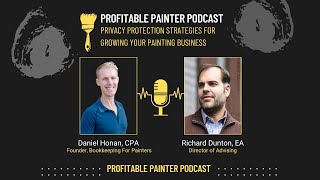
Daniel and Richard explain why painting business owners should protect their personal privacy as they grow. They recommend using a Commercial Mail Receiving Agency instead of your home address for business mail, citing services like iPostalOne and the UPS Store that cost around $15 a month and can scan, forward, or shred correspondence.
Chapters
This is Daniel, the founder of Bookkeeping for Painters.
And this is Richard, the advising director with Bookkeeping for Painters. And Daniel, I'm, I know you're going to ask me how I'm doing, and I'm just going to preemptively say I'm doing pretty good. Uh, my wife and I just got back from a week's vacation. Uh, we took a little cruise out of Miami and went to the Bahamas and Mexico. Was, uh, we didn't have the greatest weather, but you know, I mean, we're out there in the Caribbean, so it can't be that bad. Um, I'm always amazed at like how many people do cruises or, or trips down to, um, like Central and South America. Uh, the scenery's gorgeous, the food's great. Uh, but it reminded me of this, this, um, this story that I was told about a family that had taken a cruise to Mexico. And you know how they do the excursions where, um, you know These guys, I guess they want to do an excursion where they rented some ATVs to a little tour, and the guy was going to pay with his credit card, but the vendor's credit card machine wasn't working. Amazing. They probably don't have great internet service or something like that. So they did an oral agreement that when I get back to the United States, I'm going to wire you the money for the ATVs. And the vendor was okay with that. So they had their fun. They went back home. And they tried to wire the money, but, you know, international transfers are a pain in the neck. Uh, it wasn't, it wasn't going as smoothly as he thought. About 10 days after the cruise, they get this knock on the door, and he goes up there, and there's the tour operator with the ATV standing on his front step demanding that he pay him. Um, which you can imagine was a little tense, right? Um, everyone's a little heated. Uh, they, they calm down, and they got the situation resolved. Um, you know, the family was happy to pay. They were just having trouble with the, the international transfer. But it was just really shocking that, you know, here's this tour operator in Mexico. They had never given him their driver's license or address or any of this stuff. He just had their name, and he was able to use the internet and publicly available information to track them down in the United States and knock on their door and ask for payment.
That's, it's a great follow-up process that he has, the Mexican tour, tour guide.
Absolutely.
Aggressive collection process. Yeah.
Right. So are we recommending that our listeners do this for customers who haven't paid them on time?
That would hit them. The advantage for the painting business owners listening is all your customers are probably in the same town. At least you don't have to go across international borders to, to collect payment, right?
Um, no, I, I don't recommend, um, not, you know, well, I mean, do what you need to do to collect payment, but, um, you know, generally knocking on someone's door is, is the last resort, but It did, it did kind of bring up a really good point. Like, it is scary how easy it is in the digital age for people to find us and to discover not just our address but other personal information that's out there. You know, we might not be renting ATVs in Mexico, but we've got customers, contractors, former employees They might have a bone to pick with us. We don't want them knocking on our door one day and confronting us in front of our families about some perceived grievance that they want to duke it out like men on our front doorstep. So how do we protect our privacy in this digital age? It's so, so important. I thought today, after this unnecessarily long segue, that we could talk about steps business owners can take to protect their privacy and keep themselves hidden from people who might want to find out more than they should.
Yeah, folks that are like super rich, like they have— this is, this is the kind of stuff that they do. Like anyone that has any amount of wealth, you can't find them like through public records or the businesses that they own. They're not listed. Their, their information isn't listed. So if you're starting to become— the wealthier you become and as your painting business grows, the more of a target you become. So this information is super important to pay attention to, especially as you grow in your business.
Yeah, I've heard it compared like privacy protection's kind of like your camouflage. It's not going to stop people. I mean, you know, if someone is attacking you, it's not going to stop the attack, but it's going to make it so much more difficult for them to find you. And it should kind of be like the first of your different levels of protection when it comes to, you know, asset protection, trusts, things like that. So, you know, if you want to protect your privacy, the best time to start is right at the beginning. You know, the steps we're going to talk about today are most effective if you haven't already started giving out your personal information. But even if you have, and I'll admit I'm guilty of it myself, you know, it never hurts to start these best practices to start kind of cleaning up the mess a little bit. And if you ever do move or have a new address, you will be, you know, in a position to keep that new address more private. So the first step is, you know, you never want to use your personal address for business. I know it's convenient, right? Like, we all run our businesses out of our homes when we first start out. Uh, you already got a mailbox out there. Why do I need another one? Uh, but if you can, right from the beginning, uh, don't use your personal address for business. Instead, establish either a post office box or a commercial mail receiving agency to be your official company address. If you're not familiar with a commercial mail receiving agency or a CMRA, this is going to be things like iPostalOne, the UPS Store, different, different companies where you can get a mail drop box and have all your mail sent to them and use their physical address as your official business address. And then you can either go and pick up your mail. Some of these guys will allow you to, you know, click online which letters you want scanned or forwarded to you, or maybe for a couple of bucks they can shred junk mail. You've got some options. And they're not, they're not really that expensive. You know, I use one for myself that cost me $15 a month. So that's money well spent. And then my wife doesn't get quite as upset when I get a stack of IRS notices sent to my, my personal mailbox.
For your clients, right? Hopefully not for you.
Mostly. Yeah, yeah, yeah, yeah. That's actually what kind of prompted me to look into it, to be honest with you. It wasn't so much privacy protection, although that should have been first on my mind. It was my wife getting tired of getting IRS letters. And I said, well, I can't, I can't stop receiving them, but I can move them to a commercial mail receiving agency.
Yeah, yeah, we use Postscan, which no affiliation. I don't get any money for saying that, but Postscan works pretty well. It'll— you have all their— your— you pick out your mailbox address and all your mail goes to that mailbox. And they'll scan it, and then you can just keep the digital copy, and they'll, they'll recycle or shred what you don't want to use. And it's also good for delegating that task to your team. Like, if you don't want to physically be checking your mail all the time, you can delegate that to your admin person. You basically, they would just have access to your online portal and be able to see the scans and, you know, you can have certain rules on what they need to do with each piece of mail.
Yeah, I, I like the, the commercial mail receiving agencies too because, um, you have a physical address as opposed to a PO box, and some companies will not ship to a PO box or they demand a physical address. So, uh, I, I kind of lean towards the CMRAs for that reason, but a PO Box can also work just as long as it's not your personal address. And this goes to, for like your Google Business listing, don't, don't put your home on, you know, you don't need people driving by your neighborhood and pops up, you know, a business is in this house, you know, let them, let them go to your, your post office box or your CMRA instead. So once you got that set up, we're going to want to remove our home address from any state or government filings because these are public record. So have everything from the state, uh, or the IRS sent to your PO Box or CMRA. That includes bills and invoices. I know you got to drive down there and pick it up, and it is kind of a pain in the neck. Um, I just go once a week and just— it's just part of my routine. Uh, it's just so much better than having it come to the house. Another area has to do with your registered agent for your LLC. So I'm sure everyone listening has an LLC in place. When you do that, you have to give the state an official address where they can correspond with you, and that is going to be known as your registered agent. Most of us, we use ourselves and our home address as registered agents because it's convenient. But this means that our home address is now on the state's website. And if anybody wants to figure out, you know, who owns the business, they can just find your name and home address on the Secretary of State's website. That's no good. Instead, we want to use either like a law firm or a registered agent service to officially be our registered agent. In these cases, any correspondence would go to the law firm or the service, and they would then forward that mail to us. So if somebody searches our business, they get the law firm, they don't get your personal address. You know, this is not as expensive as it sounds. A registered agent service costs, I don't know, from $100 to $150 a year depending on where you're at. An official law firm might be a little bit more, but I would say maybe $200 to $250. It's worth it to keep your personal information off the state's website. And if you're going to do business in more than one state, you are required to have a registered agent in each state that you do business. You only live in one state, so you're going to have, you know, a service or a law firm in those other states anyway. Might as well have one in your home state as well. Additionally, you know, people can look up things like your personal assets, your home, your vehicles. They might be able to figure out what your home address is off of those. So this is where a revocable living trust comes in handy. We should all have something like this for estate planning reasons anyway. Keep our, keep our assets out of probate. If and when we should pass away. But for privacy reasons, a revocable living trust can keep your name off of like the deed to your home or the title on your car. You're going to want to name your revocable living trust something that's not your name, right? So, so, so don't do the Richard Dunton Revocable Living Trust because that's just pointing to who owns it. You know, I know some Taylor Swift fans who named theirs the Lavender Haze RLT, some Disney fans who use the Mickey Mouse RLT. You can name it whatever you want, whatever makes you happy that you're going to remember. Just don't have your personal name attached to it. And people, when they look for who owns this property, they're going to find the Lavender Haze Trust. They're not going to find you and your you know, your address. So, um, an RLT is very important for privacy reasons as well. If you've been in the habit of using your personal address, I'm not going to lie, it is going to be kind of difficult to scrub it out of the internet. The internet has a very long memory, but it is worth going ahead and, and starting these good practices. You might not be able to put the genie back in the bottle completely, but you're going to mitigate the damage. And if you ever do change addresses, open up new businesses, gain new assets, those things are going to be protected because you're doing it right from the beginning. So fairly low cost here, fairly low difficulty levels, but it can make a big difference, especially as like you mentioned, Daniel, you know, as your wealth grows, you become more and more interesting to people who want to do bad things. So just a little bit of, of prevention. Was an ounce of prevention— prevention— an ounce of prevention is worth a pound of cure. Taking some steps up front can save you a lot of headache in the future. So I hope, I hope everyone found that kind of interesting and useful. If you have questions, feel free to let us know on our Facebook page, Grow Your Painting Business. Maybe let us know what steps you take to increase privacy in your business and to keep your personal life out of your business. We'd like to, we'd like to hear your tips and tricks as well.
More from Daniel







What’s REALLY Holding Your Painting Business Back? (Find Your Bottleneck in 5 Minutes)



