Securing Your Business Legacy: Estate Planning Mastery for Painting Entrepreneurs
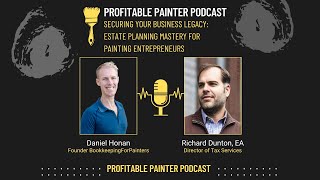
Daniel and Richard explain why painting business owners need revocable living trusts instead of just wills. A trust avoids probate, prevents family disputes, and lets someone manage your assets if you become incapacitated. You need to fund it with your home, life insurance, retirement accounts, and business entity, or it won't work.
Chapters
Welcome to the Profitable Painter Podcast. The mission of this podcast is simple: to help you navigate the financial and tax aspects of starting, running, and scaling a professional painting business. From the brushes and ladders to the spreadsheets and balance sheets, we've got you covered. But before we dive in, a quick word of caution: while we strive to provide accurate and up-to-date financial and tax information, nothing you hear on this podcast should be considered as financial advice specifically for you or your business. We're here to share general knowledge and experiences, not to replace the tailored advice you get from a professional financial advisor or tax consultant. We strongly recommend you seeking individualized advice before making any significant financial decision.
This is Daniel, the founder of Bookkeeping for Painters, and this is Richard, tax director. How's it going today, Daniel?
It's going well. I mean, I don't know, I just It's going okay. I just found out that O.J. Simpson died, so I'm a little, you know, upset about that, but I'll make it through.
Yeah. That was, that was kind of shocking. I mean, I grew up in the '90s and I remember his trial well. You know, it seems like a lot of famous people have been passing away lately. And they say like, what, there's only two things that are really assured in life, and that is death and taxes. So we already talk about taxes on this podcast a lot. Why not talk about death as well? We'll just— we'll just get both sides of the same terrible coin.
Yeah.
But yeah, unfortunately, I mean, that is something that we have to plan for and it's really easy to just kind of push it off and not think about it. But doing so does not set things up well for our families and our heirs. A lot of, you know, business owners, they want to leave a legacy. They want to leave something nice for their next generation. And they might want to have a little bit of control, you know, from beyond the grave, so to speak. And there's ways of doing that that involve estate planning. And, you know, it's not real pleasant to talk about, but it's a really important part of your overall financial plan. you know, understand what's going to happen to your estate. So I thought we could talk a little bit about that today, talk about, um, you know, wills and revocable living trusts and why, uh, it matters, especially when you're a business owner.
Yeah, and especially when you have a family too, you know, you want to set your, your family up for when you pass away and not have to put any extra burden on them. For when that happens. And, and so just reflect on like, if you're just for myself, like if, if I was to pass away and my wife was left with, you know, 4 kids and, and then she also has to deal with going through, you know, dealing with all the stuff that I, that has to now in, in, in my case, when I die, it will probably be pretty straightforward. You know, it goes to her stuff. My stuff goes to her. But, you know, if, if I die, you know, later on and then it's going to my kids, they'll have to go to probate or something like that if I don't have my stuff squared away. So, you know, this is definitely a topic that I don't think most people think about, but it can be very impactful and be a significant emotional event for a family. You know, when you die and then where does your stuff go? How does that get handled is a big topic.
Yeah, I know Dave Ramsey talks about this quite a lot and I appreciate his take because he says, you know, one of the kindest things you can do for your family is to have a will and have this all laid out so that everyone knows what your wishes are and there isn't all that, that infighting. So I thought we could talk about maybe like the difference between a will and a revocable living trust and why you kind of need both. They kind of work together. You know, I think most of us are familiar with the concept of a will. This is what I want to happen after I die. I want so-and-so to have this and so-and-so to have that. And wills are a very important part of your estate planning. But the downside of a will is that it— while it does express your wishes, they can also be easily contested. And so you might have family members or business partners who don't agree with what you've written down, who want to try and fight that in court. A will is going to go to probate and you're going to have a judge administer the will. He's going to decide what parts are enforceable, what parts aren't. And that can, that can be a huge mess after you pass away. Your, you know, your family might not be able to inherit what you want them to for a while. So to help with that, we have the revocable living trust. And a revocable living trust doesn't necessarily replace your will, but it can work in tangent with it to make sure that the assets actually get distributed the way you want. And if done right, you can also help you avoid probate. It's kind of like a shortcut. It's kind of hitting the easy button, you know, after you pass away. The concept of a trust is that a trust exists for the benefit of the trustee. So you have a legal— that's what I'm looking for— like a legal tool or yeah, that you can add your assets to and actually owns your assets. It is managed by the trustee and it is for the benefit of the beneficiary. So for a revocable living trust, you might add things like your home or your business or your retirement accounts. To the trust so that these things can be, you know, managed by you, the trustee, while you're alive. And then once you are no longer able to perform that role, either, you know, you pass away or you become incapacitated, you have to take on like long-term care, a successor trustee who you appoint steps in and takes your place. Manages those assets for your benefit.
So just to kind of frame things a little bit, you know, if you don't have a will, definitely at least get a will. That's the first step, right? Yeah, because if you don't have a will, then you're, you're definitely— your family's gonna most definitely gonna go to probate, and then it gets figured out by a judge, you know. So you want to at least have a will in place, um, to, to at least make things a little bit more clear on what's supposed to happen. Now, if you have a will and you want to make it even easier for your, for your loved ones after you pass away, getting a— adding on that revocable living trust and then putting your assets in it, that's, that's going to make things super easy. Like you said, pressing the easy button, making it super easy for that transition for when you pass away to giving your most valuable things to your whoever you want them to go to. And that's going to give you a lot more control than a will or then obviously not having a will.
Yeah, yeah, absolutely. I mean, there's some, there's some other benefits to the, the RLT or revocable living trust as well. You know, we don't like to think about getting incapacitated, but, you know, accidents happen, old age happens. And if you're not in a position to manage your assets, if you have them in a revocable living trust and you have a successor trustee set up, that person can manage your assets while you're incapacitated. And that is actually more generally more powerful than a power of attorney, because while a power of attorney is authorized to deal with your assets, a trustee or a revocable living trust actually owns those assets. So things happen a lot quicker and a lot cleaner with the RLT. You know, another, another thing we mentioned was trying to avoid probate, and probate is on a state-by-state basis. So imagine someone who owns a business in one state, rental real estate in 5 different other states, and maybe share of a partnership that's domesticated in a 6th state. We've got probate in multiple states. It's, it's going to be a mess. You know, an RLT helps streamline that so that these things can be taken care of without going to these different states. And then, you know, maybe, maybe you've got a great family or maybe your family is more like, you know, the type of family that has an HBO show fashioned after them. There might be, you know, post-death disputes. You know, the kids might be fighting over who gets Dad's Corvette, who's going to run the business. The RLT helps take care of that, right? There's, there's no, there's no arguing because it's all been laid out and there's no legal— I shouldn't say no legal way. It becomes a lot more difficult for, you know, heirs to challenge what your wishes are. So it's, it's another added layer to your estate planning. The one— the biggest mistake we see people make with revocable living trusts is, well, well, one, do you have it set up? It's something that, you know, we don't do them ourselves, but we can certainly point you in the right direction to a law firm that can help you take care of that. It's relatively affordable. It's not as expensive as you might think, and it's relatively quick to get set up. So, so the biggest mistake is not having one to begin with. But the second biggest mistake is once it's set up, you have to fund it. And that means putting assets into the trust. We came up with 4 different categories of assets that you want to consider putting in your trust and how you're going to be able to do that. You know, for most folks, probably the biggest asset you own is your primary home, right? That's, that's the one thing that we always think about, you know, passing on to our heirs. So that's, that's definitely needs to be in your trust. If you have secondary homes, maybe a vacation home or rental properties that you own, those are also things that you're going to want to be in your trust. Because remember, if it's not in the trust, then it goes to probate. So, you know, having it is the first step. Funding it is the, is the essential second step. So you're going to want to make sure that you have a warranty deed that names the trust for these properties. You're going to want to get it out of your personal name and into the name of the trust. The second kind of category would be life insurance. Or investment accounts. So maybe you have a whole, a whole life policy. It pays out $1,000,000 upon your death. Have that in the trust. Why not just name it to the beneficiary? Well, if you're like me, the beneficiary is 9 years old and I love my son to death. But if I dropped a $1,000,000 life insurance policy on him now, he would probably spend it on video games and candy. You know, I want him to have my life insurance proceeds at some point, just not until he's ready to, you know, use them responsibly. And so, you know, by having the trust be the beneficiary with, you know, the knowledge that the successor trustee needs to make sure that, you know, your kids, your heirs eventually end up with the money, you can help have some control. Over when they're going to inherit that. Same thing with investment accounts. If you've got, you know, open market brokerage accounts, investments in, in physical assets like gold and silver, or maybe you've got digital assets like Bitcoin, that's something else you want to have in that trust. The third category has to do with your retirement accounts. So your 401(k), your IRA, things like that, you're probably going to have your spouse as the primary beneficiary. So if you pass away, it's fine. She can inherit the, the 401(k). But what happens if both of you pass away? Then the contingent beneficiary. So the one who comes after your spouse should be your trust. And again, that way whoever your successor trustee is, whoever's going to manage these things for you after your death, can make sure that the right people get the money at the right time. And then finally, and this is probably the most important category for those who are listening, your trust should own your business entities. So most of us who have a business have either an LLC or a corporation as the underlying entity. And if you don't, you should, you're going to want to have your trust be the member of that LLC. So that way when you pass away, it owns your business and then it can distribute your business how you want it to be, to be handled.
Yeah. And I think one of the side benefits of putting all these assets, all your home, vacation home, your, your business, your investment accounts, life insurance, putting all these in the name of your, your trust is that it kind of provides some privacy because there are people out there that, especially if you're wealthier, if you're, if you're a wealthy person, you become a target for folks that want to make a quick buck. And this is a very litigious society, as we know. So folks will target you to, to get a lawsuit and get some quick cash. And so if they can look up all your assets and there's ways to look up your assets online, you know, which— what kind of home you have, what businesses you own. So if you can kind of protect that by putting your assets in the name of your trust so it's not visible publicly, then you have that side benefit of not being a target of folks looking to make that quick buck.
Absolutely. Privacy is one of the, one of the kind of the, you know, underutilized aspects of a trust. So, so here's, here's the key to make that work, right? You don't want to name your trust the, you know, Daniel and Richard Trust, because then you're just advertising who, you know, who the beneficiary is. So you want to come up with some kind of a creative name. You know, the Blueberry Fields Trust dated, you know, 1/1/24, or maybe the O.J. Simpson— no, no, let's not go there. But, but yeah, come up with a creative name for your trust. So when these people are, you know, they see your house when they're driving down the road and they want to know who owns it and they, they go on the internet, it comes up with the Blueberry Fields Trust. They don't know who the beneficiary is. Same thing with your business. Every state Secretary of State has a business entity database that you can access, usually for free on the internet, and you can look up who the owners are. You know, Googling or not Googling, but, but, you know, searching your business would come up with something like, you know, the Blueberry Fields Trust instead of your personal name. So it does offer a decent amount of privacy. I will throw out a caveat. Certain situations, certain counties will require the beneficiary's name to be in there somewhere. So it's not, you know, completely bulletproof, but it does offer another layer of protection.
Well, so it sounds like if we want to get the revocable living trust First, we got to go to a lawyer. They can set it up for us. And you said it's somewhere around $1,500, something in a lot of cases. So not too much money.
Depends on where you go. Yeah.
Yeah. And then, and then from there you then start putting your assets in the trust by deeding your home to it, putting it as the owner of your business, etc. And so now you have that. Now that now the trust is funded, And what happens from a tax perspective? What is anything that happens now that it's in a trust instead of in your name?
Yeah. So we're talking about a revocable living trust, and that is the key word here. I probably should have led with this. Revocable means that you can undo this at any time. So you, if you name yourself as the trustee, which you should, you have complete control over this. The downside of revocable is that there are no tax benefits as far as the IRS is concerned. There's— it's just, well, the term is disregarded, right? They don't, they don't see any difference between you and your trust. So, so this is not a tax saving strategy, you know, that we're talking about today. This is an estate planning strategy. There are other types of trusts, irrevocable trusts that might be used to help you know, get some income off of you into, into an irrevocable trust. That is definitely a different topic. And there may be some tax strategies there. But for our purposes today, yeah, revocable, it goes straight to your 1040 tax return. There's no, there's no stop. It's like, it's like Monopoly, right? Do not pass go, do not collect. It goes straight to your tax return.
Cool. So I think we have a good framework to understand how we can set up our family members for when we pass away, make it easy for them, and then also side benefit of having some additional privacy as we grow our wealth as business owners. Um, are there— is there anything else that— anything other— any other basic items we should consider when thinking through estate planning and revocable living trusts?
I mean, it's a wide topic, and, you know, if you really want to get into it, I would recommend talking to an estate planning attorney who knows the ins and outs and can help you, you know, consider all the different options. Yeah, I just really kind of wanted to get on people's radar because, you know, my opinion is that you know, estate planning is an important part of your overall financial journey. So we talk about business a lot. We talk about tax savings a lot, you know, investing, debt reduction. Estate planning should be right up there with it. So have a will that outlines what your wishes are and then have a trust to be the legal instrument that helps you know, expedite those wishes and ensure that, you know, some judge or some disgruntled family member isn't going to be able to come in after you're gone and change things. So those, those work together. A will and an RLT work together. And I think it's, you know, for 95% of folks out there, I think an RLT is probably something they should consider.
Excellent. All right, well, we'd love to hear your thoughts on revocable living trust. Do you have one? How's it set up? Let us know in the Facebook group. You go to Grow Your Painting Business and, and request access. We'll definitely invite you into the conversation. And with that, we will see you next week.
Yeah, thanks for listening.
More from Daniel







What’s REALLY Holding Your Painting Business Back? (Find Your Bottleneck in 5 Minutes)



