Seizing Financial Control: A Painter's Tax Planning Masterclass
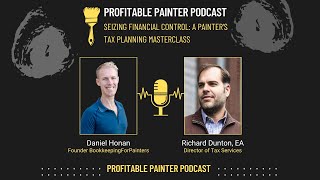
Daniel and Richard explain how painters can cut taxes through planning, not just filing. Start meetings in summer or fall to project income, time equipment purchases for depreciation, and claim credits like the EV tax break. The difference between planning and compliance is control over what you owe.
Chapters
Welcome to the Profitable Painter Podcast. The mission of this podcast is simple: to help you navigate the financial and tax aspects of starting, running, and scaling a professional painting business. From the brushes and ladders to the spreadsheets and balance sheets, we've got you covered. But before we dive in, a quick word of caution. While we strive to provide accurate and up-to-date financial and tax information, nothing you hear on this podcast should be considered as financial advice specifically for you or your business. We're here to share general knowledge and experiences, not to replace the tailored advice you get from a professional financial advisor or tax consultant. We strongly recommend you seeking individualized advice before making any significant financial decision. This is Daniel, the founder of Bookkeeping for Painters.
And this is Richard, tax director with Bookkeeping for Painters.
How's it going, Richard?
It's going great as always. How are you, Daniel?
Doing well, doing well. A little rainy, cloudy today, but, uh, it's all good. I'm super excited about this, this topic we have today, which is tax planning, which most people would immediately start to yawn and maybe, maybe nod off. But, uh, this is actually— I, I love tax planning, and I love what we can do for folks with tax planning. Because I talk to so many people that, uh, you know, every day where they might be working with a CPA or an accountant or tax professional, but they never hear from them throughout the year. They only hear from them to get their tax return done. They don't get any advice. They basically are told, oh yeah, you owe $60,000, write a check to the IRS, and that's they don't have any idea what tax planning is and they don't realize that taxes are not just something that happens to you. You actually have a level of control over what happens in regards to taxes.
Yeah, no, you're absolutely right. And a lot of tax professionals are focused on what we call compliance, which is filing the return, you know, writing the check. And that is, that is good. Like every, every tax professional has to be concerned about compliance. But we also want to be concerned about advising and planning. I— it's like two sides of the same coin, but so many of us just kind of look at the one side. Unfortunately, there's a real shortage of CPAs and tax professionals right now. And so a lot of accountants are just overwhelmed with the compliance side. And they don't, they don't offer those advisory services, that tax planning that you're talking about. But that is, that's kind of where the magic happens, right? That's, that's where we get to exercise that level of control over what we pay. Yeah.
And so today we'll cover what is tax planning, why it matters, when you, when should you do it, and what can you do now to get started. So I guess, Richard, can you just give a sense of what tax planning actually is? What does that even mean?
Sure, sure. I kind of jumped into this a little earlier, but yes, you have the compliance, you have the preparing of tax forms and the filings and whatnot. But tax planning is understanding your financial situation, understanding what your taxes are going to be who's getting paid those taxes, and then empowering you to make decisions to control how you're going to be taxed. There's that, that famous line I think is credited to Benjamin Franklin that the only certainty in life is death and taxes. Yes, taxes are certain, but how much you pay, when you pay them, who you pay them to. There is a— there is— you have a measure of control there. You know, kind of just— oh, I'm sorry, go ahead.
I was gonna say, and that level of control can be pretty big. I just talked to somebody today and he's, he's doing it. He has a great painting business. He's doing like almost $3 million and he is paying— he's still taxed as a sole proprietor. And he's paying, you know, $40,000, $45,000 in self-employment taxes per year, which could be cut by tens of thousands of dollars by just being in the right tax entity. And so this can make a huge difference. Doing some tax planning, make sure you're in the right tax status, can save you tens of thousands of dollars pretty quickly.
Absolutely huge return on investment when it comes to tax planning. And it's a shame that it tends to get overlooked, you know, for the compliance side of it. So I think one of the most basic aspects of tax planning is understanding what you're going to pay. And the way we do that is through projections. We understand how much income the company is bringing in, how much it's putting out in expenses, and we project what the profit is going to be at the end of the year. We take that profit, we combine it with other factors, other jobs you might have, rental income, capital gains from, from stocks and securities, and we determine what we think your tax liability is going to be. And that gives us a foundation to start from. And once we know that, then we can start talking about how can we reduce that tax liability to a number that you're more comfortable with. You know, there's usually not a magic bullet, right? There's not this one neat trick the IRS doesn't want you to know so you don't have to pay taxes. Sovereign citizen does not work. I don't recommend it. But there are— you have options and it puts you in the driver's seat so you can make decisions on how you want to spend your money. You know, it helps too when you start to think about what you could do with that money if you weren't spending it on taxes. If you had an extra $10,000 a year, what would you do with that? You know, would you put that in your retirement fund for a more comfortable retirement later on? Would you put that in your daughter's college education fund? Maybe you would take a really nice and well-deserved vacation with the family because, because numbers can be kind of dry sometimes, but numbers translate into real things that matter to us. And if, if a little bit of tax planning is the difference between going to Hawaii with the family or not being able to afford to do that, it kind of helps us understand the benefit behind it.
Yeah. And sometimes, you know, you do have a level of degree with tax planning. You can figure out how much taxes you want to pay. And sometimes it comes down to do you want to take the pain of paying the taxes or you want to take the pain of implementing the tax strategy? Because sometimes some tax strategies are super easy. Like you just, oh, I just need to file this one form and, and now I save, you know, tens of thousands of dollars in taxes. That can be a thing. But, you know, some of them are— there's some work involved on implementing it, but it can, you know, save you money. And so it's kind of one of those things where you can take the pain of paying the IRS or take the pain of the tax planning strategy. So there's a little bit of— it's not just all magic that happens in paperwork. There are things you would have to do to actually make some of this stuff happen. But depending on how motivated you are to save on taxes, it can definitely be worth it.
Yeah, that's a really good point. And when we think about like how hard we work to make money in our businesses, we should be willing to work at least as hard to save money in our businesses. You know, $10,000 that we don't pay in taxes is just as valuable as $10,000 in profit we make from performing work. So if we're willing to put forth effort to bring another $10,000 in revenue, you know, it makes sense that we'd be willing to put forth that effort to save $10,000 from, from leaving the company.
Right. And, and if you're going to hit any level of, of success in your painting business, taxes are going to be the biggest expense that you have through, throughout your business career. So it definitely helps to pay attention to them and see how you can get those, that expense down as much as you can.
Yeah, absolutely. Just like you'd be looking at your advertising costs or your labor costs and saying, you know, is this the most effective use of my money? Could I tighten things up? We should be looking at our taxes and say, am I only paying what I need to? Are there things I could be doing to reduce this expense? So I think it's important to know when to start tax planning. We pay taxes every year and we tend to not think about it unless it's February or March. Once we get that 1040 filed, it's off our mind until we start seeing the advertisements come up during the Super Bowl or something like that. But if we wait until we're filing to worry about tax planning, it is unfortunately too late. Right, Daniel, you have a great illustration about a person who is having a heart attack and he's in the ER, you know, having a heart attack. At that point, it's too late to talk about fixing his diet and his exercise. So we need to be proactive with it. We need to be thinking about tax planning in the spring, in the summer. We need to be thinking about it in the late fall before the year ends and that window closes. What moves do I need to make now so that my tax liability is less next spring?
Yeah, absolutely. Yeah. You can't wait until March or April to start worrying about the taxes. I mean, you can worry about them, but it's not going to do anything. You're just still a bunch of money. So you definitely got to, you know, start, you know, the year prior start looking at, okay, what can I do? What moves can I make? Do I need to change tax entities? Do I need to start a retirement program? You know, whatever the case may be, those moves need to happen most— in most cases before the end of the year.
Right, right. You know, if we're going to— if we're going to be spending money on something and that's— that's the thing to think about when we file our taxes. Like when we filed our taxes last spring, we were filing 2022 taxes. So we're kind of a year behind when we do it. So that's why we need to think about it now, you know, beforehand. And timing is everything when it comes to taxes. And that's why it's so important to know what our tax liability is and what our tax bracket is going to be. To determine if we want to make moves now. You know, for example, maybe you are thinking of buying an electric vehicle because you, you really want one and you want to get that $7,500 tax credit that makes them so attractive right now. If you don't have $7,500 worth of taxable or a tax liability, then you won't be able to fully benefit from that credit. So if you're having kind of a smaller year now, but you're expecting a bigger year next year, maybe we want to wait until next year to buy that electric vehicle. You know, conversely, if we're having a huge year now and we think this is kind of a one-off thing, maybe, maybe we came into some money that we're not going to have in future years and we're going to be in a really high tax bracket. Well, then this is the time to, you know, ramp up those retirement, those pretax retirement savings accounts. Maybe this is the time to buy equipment for the business that we can accelerate depreciation on. You know, we want to think about how can we take our tax deductions and tax credits and get the most most efficient use out of them. You know, a $10,000 tax deduction is more valuable to us in a 35% tax bracket than it is in a 10,000 or 10% tax bracket. So there's, there's a lot to consider.
Yeah, definitely. So we talked about what tax planning is, why it matters, when should you do it. Basically before the end of the year. Now, what kind of things can folks do now if they're listening, if they are interested in tax planning or they want to get started in some way? What are some of the things they can do?
Well, I mean, definitely talk to your tax professional, see if tax planning is something they offer. It's something that I am doing with our clients almost every single day. Well, I'm not— I'm not working with the same client every single day, but I'm doing tax planning every single day. I recommend with our clients, I like to have at least 2 formal tax planning meetings, one in the summer and one in the fall, so that we can see where their business is and understand what moves we want to make before the end of the year. And, you know, like I said, one of the first things we want to do is we want to project. We want to figure out what their taxes are going to be and is this the right time to make moves? And then we talk about what, what strategies are available. And like you said, Daniel, some are going to be easier to implement than others. I try to pick things that are going to move the needle the most so that we get the most bang for our buck right out of the gate. But some of our clients who've been doing this for a while may be moving on to, you know, the more advanced esoteric strategies. Yes, they require more effort, but, you know, they're still usually worth, worth that effort. I think, though, like, like the biggest benefit for a business owner is that it puts you in the driver's seat. It gives you control over your money so that you are deciding what you're going to pay in taxes and not have the IRS tell you what you're going to pay. You know, there isn't necessarily a right or wrong decision on some of these strategies. It's what you're comfortable with, what you want to spend your money with. And do you feel that it's worth the effort? And then you get to be in control. And I think, I think I come from a viewpoint of empowering our clients to make decisions for themselves. And I think tax planning is one of the most important ways you can do that, you know, when it comes to paying your taxes.
Yeah, absolutely. All right. Well, I think we, we got this one covered. Pretty well. If you have any questions, definitely go to Facebook, look up Grow Your Painting Business, and you can join that private group, ask your questions. If you have any questions about tax planning, what it is, why it matters, how you can get started, let us know your questions on that topic or ideas for future episodes. I would love to hear from you.
Yeah, absolutely. And, you know, thank you for listening, and we will see you on the next episode.
More from Daniel







What’s REALLY Holding Your Painting Business Back? (Find Your Bottleneck in 5 Minutes)



