Tax Strategies for Painting Businesses in 2023
This content was created by balanced-griffin. This content was uploaded by balanced-griffin. This is a YouTube webinar titled "Tax Strategies for Painting Businesses in 2023" (recorded April 21, 2023). It features a hosted presentation by Daniel (moderator) and Richard Dunton (Tax Director for Bookkeeping for Painters and an IRS-enrolled agent) delivering a top-10 list of practical tax-planning strategies for small businesses and S corps—topics include reasonable S-corp wages, health insurance treatment, hiring children, home office and cell phone reimbursements, travel/per diem, vehicle mileage and depreciation, the Augusta Rule (renting your home), and selling a home to an S corp—followed by audience Q&A and links for follow-up consultations.
Chapters
Alright, welcome everyone to the webinar for this afternoon. Appreciate everyone joining us. We're going to get started here in a few minutes, letting some folks trickle in here. Super excited today to deliver some outstanding information. Richard's gonna take it away from me here in a second, but we'll be going over some tax strategies for painting businesses, how you can keep that tax bill as low as possible. The goal is always to get as close to zero as possible, and we thought it would be a good time to go ahead and hit this and I know a lot of folks are probably submitting tax returns and hopefully not getting unpleasant surprises, but if you are, it's okay. There are ways to get around having to pay so much in tax and legally, completely legally. So that's what we're going to be covering today. So just giving a couple of minutes here to let everyone kind of trickle in. But a lot of the— tax planning clients we work with, you know, we're saving, you know, in many cases tens of thousands of dollars. Every— obviously every, you know, situation is different, so some low, lower, and some it's a lot higher, um, you know. So, but we're going to try to give you as much good information today to hopefully get you prepared and thinking about taxes, how you can save as much as possible so you don't have to pay an outrageous amount. So with that, I think we are good to go here. And Richard, if you want to take it away, go for it.
Sure. Sure. I appreciate that nice introduction, Daniel. Thank you.
Yeah.
So my name is Richard Dunton. I am the tax director for Bookkeeping for Painters, and I am an enrolled agent with the IRS. I enjoy helping people do tax planning, tax preparation, and just kind of overall helping people with their businesses. So today we have Daniel. Would it be possible to share my slides? I think you might have to do that. We've got some of my favorite tax planning strategies. I kind of put together a top 10 list because I think it's easier to just kind of see things. I kind of channel my David Letterman here. I don't know if anyone watched him with his top 10 lists on when he was on The Late Show, but these are— I love these strategies because they are easy to implement. They are going to be appropriate for most businesses, right? There is no one size fits all, but I think most businesses can benefit from most of these strategies. And they're things that you can implement right away. So I don't know if you can see my slides. I'm thinking, oh, here we go. I've got, I've got control. So let's go ahead. Can everybody see that?
I can see you, Richard.
Awesome. Awesome. Okay, so let's go ahead and jump in. These are the top 10 tax saving strategies for S corps and other businesses. I left that part out. It is kind of designed mostly for S corps because that is the most popular type of business entity for small businesses. But if you are a sole proprietorship, so an LLC that files a Schedule C, or even if you have a corporate taxation structure, there are still strategies in here that are going to be good for you. All right. There we go. Okay. So These are good strategies. This is good information. This is general information. We have not looked at your particular situation. We are not your fiduciary and we do not give legal advice. So use these for your own benefit. And this is for your educational purposes only. All right. Here is the top 10 list. I figured, go ahead and don't bury the lead. Just go ahead and put them out there. And we will be covering each one of these in detail. Again, these are all strategies that you can employ right away and that will save you real dollars this year in your taxes. So number 1, pay yourself less.
Okay.
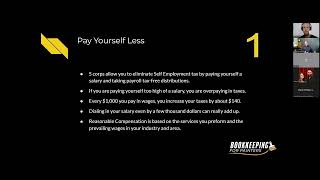
At this point you're thinking, what am I talking about? I want to make more money, not less money. So this has to do when you are an S corp and you are paying yourself wages. So just a little refresher for some of us who may not be S corps yet. When you have a sole proprietorship, when you have that, that disregarded entity status and you're filing on a Schedule C, or if you are a partnership, which is another disregarded entity, every dollar of profit you make is subject to self-employment tax. That is a 15.3% tax that covers your Social Security and your Medicare benefits. It's a very expensive tax for small business owners. And when you elect S corp taxation, you are kind of splitting yourself into two categories. There is the you who works as an employee in your business and you will pay yourself through payroll and you will pay the normal payroll taxes on that amount. And then there's you who is the shareholder and you're going to take distributions from the company as you see fit. and those distributions are not going to be subject to that 15.3% self-employment tax. So if you have a sole proprietorship and you're thinking that sounds like a good deal, it usually is. Rule of thumb, if you're making $40,000 to $50,000 a year in profit, so not gross revenue but take-home profit, I would suggest you at least explore the idea of S corp taxation. It is going to depend on your industry and it's going to depend on where you live and what your goals are. But for most people in that category, S corp is going to be the way to go. And once you've got that set up, you are going to want to pay yourself the perfect amount in salary. The reason is, is that those payroll taxes, they are 15.3%. You do get to write some of that off. So I like to kind of think of it as around 14% surtax after the deduction. So if you think about it, you know, every $1,000 you pay yourself in wages, you're paying about $140 in payroll taxes. That might not seem like a lot, but if it's $10,000 more than you have to, that's $1,400 a year, every single year you're in business. You know, $1,400 put into an IRA, could be $100,000 by the end of a career. So the trick is dialing that in, and that is where all of the, kind of, the secret sauce is, right? The IRS does not give us exact numbers. We have to figure out what that reasonable compensation is. Can't be too low. It's too low, the IRS will say that's no good and we're going to set a number for you and you don't want that, but it shouldn't be a dollar higher than it needs to be. So to figure that out, you need to decide what is reasonable compensation based on the services you perform and the prevailing wages in your area. So don't say, you know, 50% of profits gets paid in wages, or my friend does $80,000 a year, so I'm going to do $80,000 a year. Those are ways that you end up overpaying yourself. I mean, you can do that, but we want you to try and save some money. So what we do is we run very comprehensive third-party reports and we figure out exactly what you have to pay yourself so that you're not overpaying even by a dollar. And that is certainly going to add up to a lot of savings over time. All right, number 2, Deduct your health insurance premiums on your 1040. This is another tip that is going to work for sole proprietors and S corps. If you're an S corp, there's a little bit of a bonus here that I'll talk about, but as long as you're self-employed and you're not covered by, you know, an insurance program from your spouse or from another job, you can deduct the amount you pay health insurance premiums right on your 1040. It's Schedule 1, Adjustments to Income, and it's going to come right off your taxable income. So make sure that you are taking full advantage of that. If you are filing on a Schedule C, that will also reduce your self-employment tax. So that is a good benefit there. If you are an S corp, then, and you want to kind of take this to the next level, you can have your S corp business pay for the health insurance premiums and then give that to you as a fringe benefit. Now, you will have to recognize taxable income on that, but you won't have to pay payroll taxes on it. So how might that work to your benefit? Let's just use some hypothetical numbers. Let's say you dialed in your reasonable compensation and you don't want to pay yourself a dollar over $40,000 a year and you have $10,000 a year in health insurance premiums. You have the S corp pay for those premiums, which will be a deduction to the S corp. So it's $10,000 that's going to reduce the S corp profit and reduce taxes. Then you provide those to yourself. You pay yourself $30,000 in cash, which is subject to payroll taxes, plus $10,000 in health insurance premiums, which is not subject to payroll taxes. You hit your $40,000 mark and you've saved yourself about $1,400 in payroll taxes. So that is a little bit of an extra bonus if you have an S corp. Make sure that gets added to your W-2. And once it's on your W-2, you just wipe it away using the self-employed health insurance deduction on Schedule 1 of your 1040. So it goes on and then it comes immediately off. Yes, it's extra steps. Yes, it's a little convoluted. Welcome to the IRS.
Right.
That's just kind of the way it needs to be done. All right. Number 3, hire your children. This is a very popular tax saving strategy. If you are following any kind of, you know, tax groups on Facebook or TikTok, you've probably seen this brought up. I have seen this brought up many, many times and I have seen it used poorly many, many times. So this can be a very effective strategy if you know what you're doing. So we're going to dive into some of the details. The, the basis of this has to do with the standard deduction. In 2023, the standard deduction is $13,850. So that means no matter how much money you make, the first $13,850, if you're single, is tax-free. So the idea is if you pay your children or your dependents or your nephews and nieces or your best friend, anyone whom you're not married to, you can pay them up to that amount and they won't have to pay any kind of income taxes on it because you're paying them these wages. It's a deduction to you. So if you think about it, like you might be a parent who's in a, in a higher tax bracket, say like 35%, and you would like to get your kids some money, maybe that's, you know, money in lieu of allowance or money that they can put away in a 401(k) or money that they can use for college tuition. And you don't want to have to pay taxes on it. You can hire them to work in your business. They have to have a legitimate role. Now, what that is, is it just means they actually have to do something. What can a child do in a business? Well, maybe someone who's 7 or 8 years old could stuff envelopes. Maybe someone who's a little bit older could help wash the company vehicles. You know, you know what your business needs are and you are creative enough to figure out something that a child can do based on their age. So as long as they're doing actual work and you are paying them a somewhat reasonable amount for that work, This is a legitimate tax strategy. So you send that money to them through wages, you deduct it from your business income, and now instead of being taxed at your 35% tax bracket, it's being taxed at 0% to the child. Now, a couple of caveats. It's not completely tax-free, right? Because we're running this through payroll. So we do have to pay that 14% FICA tax. This is going to be a better strategy for those of us who are in a 35 or 39% tax bracket. Maybe not so good for us who are in a 12% tax bracket. And you also want to be considerate of the state income taxes. So like I live in Illinois. Illinois does not have a $13,850 standard deduction. We have a $4,000 exemption. So only the first $4,000 would be free of Illinois state taxes. However, Illinois state tax rate is only 4.95%. So this still makes sense, you know, even if you do have to pay some state taxes on the money. But just kind of keep in mind, there's a lot of different moving parts here. So generally this will save you money. It will be more effective if you're in a higher tax bracket in a state that does not have income tax. All right. Number 4 is deduct your home office expenses. Now, this again can be used for sole proprietors or S corps. You're going to do it slightly different, but the end result is the same. If you are a sole proprietorship, you're probably familiar with either using the simplified method of $5 per square foot or using a percentage of your actual home expenses. The rules on this is that the area has to be used regularly and exclusively for business. So a dining room table that you occasionally do work on is not going to cut muster, but a third bedroom that you've converted into an office, that would probably be something you could use. Now, if you are an S corp, you're not going to deduct this on a Schedule C. You are going to use an accountable plan. And if you're an S corp and you don't have an accountable plan set up, I would strongly encourage you to do that today. It is very, very simple. They are much less formal than it sounds. And it's basically a— you are agreeing to reimburse people for business expenses by following the IRS rules. A lot of S corps will sign a sheet of paper showing that they are establishing their accountable plan. I think that's good practice, not really required, but I think it's good practice. So an accountable plan lets you reimburse, and we're going to talk about a few reimbursements today where that, that fits in. So if you are an S corp, then the third bullet point here is going to apply. You have to use actual expenses. You can't use the simplified method. That's okay. Actual expenses are probably going to be better for you anyway. So let's just do a little, you know, hypothetical situation. You have a 2,000 square foot house and you have a room that is 200 square feet that you use for business. That room is 10% of your home. So 10% of your mortgage interest, 10% of your utilities, 10% of the repairs to the home and 100% of any expenses directly related to that room. So you pay someone to repaint the room. If you're a painter, you're probably doing it yourself. Well, let's say you put in new carpet or whatever, 100% of those direct expenses would apply. And also depreciation. Make sure you depreciate your home and get the 10% of that as well. Now, this is a reimbursement. So what's great about that is you don't have to recapture that depreciation when you go to sell your home like you would if you were using actual expenses as a sole proprietorship. You factor in the depreciation, but you don't have to recapture it. And when I say recapture it, it's the idea that you've taken a tax break on the idea that your house is becoming worth less and less each year, and then you sell it for more than you paid for it because real estate almost always appreciates. You don't have to pay that tax break back if you're doing it through an accountable plan. If you're a sole proprietorship with a Schedule C, I usually recommend the simplified method because then you don't have to worry about recapturing depreciation either. All right. Let's move on to number 5. Deduct your cell phone expense. Everyone has a cell phone, and if we are in business, we are occasionally using it for business. But are we getting the tax deduction for that? So you own your cell phone, you pay for it with your personal funds just like you normally would. But if you are an S corp with an accountable plan, you are going to reimburse yourself for the business use. If your cell phone bill is $100 a month and you're using it 50% of the time for business, write yourself a check for $50. Take that tax deduction and that $50 is not income to you. It's just a tax deduction for the S corp. It's a reimbursement to you. All right. Number 6, reimburse your travel expenses if you are traveling for your business, make sure that you are reimbursing yourself for the travel costs that you pay out of pocket. Now, you probably used the company credit card to pay for the flights, but when you're at the airport and you're getting that bottle of water, uh, maybe you're paying that checked bag fee that the airlines are all charging now. Maybe you're taking a taxi or a rideshare from the airport to the hotel. Those are the type of things that we tend to pay for out of pocket. and we might not realize that we're missing out on tax deductions. So kind of keep track of what you paid for, write it down in your expense report, and have the company reimburse you through the accountable plan for those costs. Another big one is meals. So we had a change in 2023. Meals used to be 100% deductible as long as they were from a restaurant. Now they are 50% deductible. So if this is a meal that you are having when you're away from your tax home for travel, you don't have to be conducting business during the meal. So you don't have to be entertaining a client. You don't have to be, you know, talking about the next big deal. You just need to be traveling away from your tax home for business and you can deduct 50% of that meal. Alternatively, if you don't want to have to keep track of all these different expenses or, or maybe you've already taken the trip and you don't have the receipts, you can use the per diem rate. And per diem is Latin for every day, I think, per day. But basically it is a simplified way of handling this. So I'm in the Chicago area. I was traveling to the city in January. I could reimburse myself $134 per day for travel. That is what the per diem rate is for the city of Chicago. Other cities are going to have different rates. Even Chicago's rate is much higher in the summer than it is in the winter. Go figure. But you can look these rates up online. There are websites where you can put in the zip code to where you're traveling and they will let you know what the per diem rate is and you can get that reimbursement. So, you know, if you're traveling, say, 10 days out of the year, $134 per day, that really adds up. That's $1,300 in tax savings or tax deductions, rather, that you want to make sure that you are getting. One other point is entertainment is no longer deductible. There was a time when you could write off 50% of your entertainment expenses. That time is unfortunately no more. That went away with the Tax Cuts and Jobs Act. So if you are taking a client out for dinner and a show, make sure you deduct the dinner portion but not the show. If you can get those things separately stated, that would be awesome. So that way you are not accidentally taking entertainment deductions that we're not allowed to do. All right.
Hey, Richard, we got a quick question. What about car rentals?
Yes, yes. If you are renting a car for traveling expenses, absolutely. You know, you— if you are doing the actual expenses, car rentals would absolutely count. If you don't have the receipts for that, that would be part of the per diem. All right. So speaking of cars, reimburse your vehicle expenses. So this, this isn't when you're traveling. This is, you know, your vehicle for your tax home. If you have a personal vehicle that you're using for business, you're going to want to keep track of your mileage with a paper log. Or there are these really cool apps for your phone. MileIQ seems to be a very popular one. I haven't used it myself, but I know a lot of people like it. Every mile that you drive your personal vehicle for business, you are going to want to reimburse yourself at the standard mileage rate of 62.5 cents per mile, or you can use a percentage of the actual expenses. But I will say for most taxpayers, the standard mileage rate is going to be better. And the reason is, is depreciation. So if you have maybe a little older vehicle that doesn't have a lot of resale value, your depreciation expense is going to be kind of limited. But the standard mileage rate has depreciation already baked in and it doesn't change just because your vehicle gets older. So standard mileage rate is going to be your friend if you have an older vehicle or if you have a very fuel-efficient vehicle, because the fuel expense is baked into that $0.62.50 per mile as well. If you have a very expensive vehicle that you don't drive a whole lot, then you're probably going to want to think about using actual rates or maybe even something a little more exotic like a lease, lease to your company. But that's kind of— that kind of gets in the weeds a little bit. One thing to keep in mind is if you do use actual expenses, you can't switch back to the standard mileage rate later.
On.
This is a one-way street. You can start with standard mileage rate and switch to actual, but you can't go backwards. And that's because that depreciation is already baked in. All right. Number 8, maximize depreciation on your vehicles. So this is a situation where the company is going to own the vehicle. So the first situation is really good for if you drive a personal car, you know, 10%, 20%, 25% for business. This situation is going to be really good for if a, like a work vehicle that is, you know, 95%, 100% business use. So in 2023, the maximum amount you can depreciate for vehicles that are less than 6,000 pounds is $20,200. So even if your vehicle is, you know, $30,000 or $40,000, if it's a passenger vehicle that weighs less than 6,000 pounds, you can go ahead and write off up to $20,200 in the first year if you want to. If your vehicle is over 6,000 pounds, So we're talking SUVs, pickup trucks, and Tesla Model X. A lot of people who want an EV are buying Model X because it is the only Tesla that is over 6,000 pounds. Then you can use something that's called bonus depreciation and you can write off up to 80% of the full price of that vehicle. Now, last year it was 100%, but we are starting to phase down bonus depreciation. So this year it's 80%. Next year, I believe it's only going to be 60% unless Congress adjusts the law on that. Keep in mind that in order to do this, that the vehicles need to be titled in the name of the business. You can't depreciate something you don't own. So the business has to officially own the vehicle and it also has to be used for more than 50% business use. If you are a shareholder in an S corp and you are using a company-owned vehicle for personal use, then the value of that personal use has to be added to your paycheck as wages. So what do we mean by that? Well, this is a rule that is kind of designed to prevent people from abusing bonus depreciation and Section 179 depreciation. So imagine a situation where a person owns a business and they buy a very expensive Porsche that they use for 5% business and 95% personal. The IRS says it wouldn't really be fair for them to take a tax deduction on that 95% personal use. So the lease value of that Porsche would have to be added to their check as wages. So I don't really recommend this if your vehicle is going to be mainly personal use. If that's the case, I would recommend doing the reimbursement plan that we talked about in tip number 7. But if you are having a vehicle that is mostly or 100% business use, accelerating depreciation like this can get you some serious tax savings. You know, right in the first year, I have seen people deduct up to $400,000 in, in taxes. Or in taxable income by using bonus depreciation just on vehicles alone. And then just be aware of depreciation recapture. So if you take the full tax deduction in the first year and the next year you sell that vehicle, you will have to pay back the tax deduction on the amount that you sold it for. So you can't get— you can't get something for nothing, unfortunately. But if you're going to drive the wheels off the car, Excellent way to do it. Get that tax deduction upfront. Put that money to work for you doing something else.
All right.
Now we're going to get a little more exotic. Rent your home or someone else's. All right.
Let me— hold on.
Rent your home to your or someone else's S corp. Don't rent someone else's home. That's not nice. This comes out of the Augusta rule. So if we have any golf fans, you know, the Masters is held in Augusta, Georgia. Absolutely beautiful golf course, and the people who owned homes around there figured that they could rent their homes to the spectators. Well, the problem with that is that they were getting taxable income and they didn't want to have to fill out Schedule E and track their rental expense and depreciation. They just want to rent out their home for the 5 or 7 days of the golf game. So the IRS was or actually Congress rather, came up with Section 280A, also known as the Augusta Rule. But you don't have to live in Augusta to use it. It allows you to rent your residence for up to 14 days per year tax-free. And when I say tax-free, you're not reporting the income, you're not recognizing the income, and of course you're not deducting expenses on income that you're not recognizing. So you don't even have to put it on your return as long as it is 14 days or less and it is a— it is your residence. So how might you use this in business? Right. We probably don't live next to a world-class golf course, but there are Airbnb listings or VRBO listings that you could use. Or specifically, if you're in business, businesses need places to have things like corporate events, meetings, retreats, team building, and employee appreciation parties. Whatever your business could legitimately rent a building for, you can rent your home to your business for the same purpose. So why pay the Marriott or the Hyatt, you know, several thousand dollars to rent their ballroom to have a, you know, team building session when you can pay yourself to rent your home. Now, for this to work, again, the devil's in the details. It has to be fair market value and what's known as an arm's length transaction. So by arm's length, we mean that you are not getting unfair or inappropriate benefit. So you need to check Zillow, check around to see what the rental rates are. And it's going to vary depending on, on your home. Now, some people like to kind of hedge their bets, and I think this is a great idea. They find a friend who has a similar business and they say, you know what, you rent my house for 5 days this year for your team building events and I'll rent your house for 5 days this year for my company's events. The money will switch hands. It will be a tax deduction to both companies. And basically it nets out, right? It just becomes a tax deduction. It is not recognized as income to either business owner. So depending on, on your home and your comfort level, this could be a very valuable strategy as well. Or if you just want to kind of go on vacation and maybe rent your house out on VRBO, it doesn't necessarily have to be business related. This works too. And if you have a timeshare, This does work for timeshares as long as you spend at least 10% of the time in the timeshare yourself. So that, that could be a nice little source of income for you. All right. This is rent your home. Number 10 is sell your home to your S corp. Now, don't do this if you plan on, on staying there, but if you are looking to upgrade and buy a new home and you think your current house would make an awesome rental property, you want to handle this in a way that maximizes your tax deductions. So traditionally, if you convert your home into a rental property, then you lose out on the Section 121 exclusion from gain. That's some fancy jargon, but what it means is when you sell your personal residence for a gain, you don't have to pay taxes on the first $250,000 of profit or $500,000 of profit if you're married. But if you convert that to a rental property, it becomes business property and you no longer have that option. So if you have a home that has appreciated and you want to turn it into a rental property, you get around this by selling it to your S corp. You then exclude that gain from your taxes. And so you don't pay any money on the gain, on the appreciation that your house has received. The S corp receives what's called stepped-up basis. So let's just, let's just run some numbers because this can be kind of a tricky one. You bought— you paid $100,000 for your home and now it's worth $250,000. You turn that into a rental property on your own and you later sell that house for $250,000. You will pay capital gains on $150,000 worth of gain. You can't exclude that from a rental property because it's not your primary residence, but if you sell that house to your S corp first, you exclude the $150,000 of gain because it's your primary residence. The S corp's basis becomes the $250,000 that it paid for it. So when it sells it in the future for, say, $275,000, it only recognizes gain on $25,000 instead of $175,000. You just need to make sure the S corp keeps that rental for at least 1 year so you can get those long-term rates. You sell it less than a year, it's ordinary income, short-term rates. You keep it for 1 year or longer, you get to enjoy that 15 or 20% long-term capital gains. And if you have a mortgage on your house, you might want to talk to your mortgage lender. Sometimes those mortgages will become due on sale. So if you don't have other arrangements to finance it, you might not be able to sell it to your S corp and just have the S corp take the mortgage. If there's a due-on-sale clause, you might have to get a new mortgage or you might have to try some other tactics to, you know, to be able to keep that mortgage going. All right. That is my top 10 tips. I hope that you were able to find some benefit from those. I hope that you're able to go ahead and put those into play right away. These are the type of things that I love to talk about with my year-round tax planning clients. These are kind of the basics that I want to make sure that we've got these dialed in and we're not losing any dollars before we move on to the more esoteric, fancy stuff. Simple is good. Simple things done right repeatedly equal big savings. So hopefully you're able to put some of this stuff into practice. And pay less taxes in 2023 than you did in 2022. All right. If you would like to talk more about your personal situation, I am happy to schedule a free 30-minute tax assessment. There is no obligation. We will talk about what's on your mind and what your business concerns are and see if we can't implement some of these programs more directly according to your needs, you can book an appointment with me at this link here, or you can probably just let us know in the chat. We'd be happy to reach out to you at this point. Daniel, I think we have any questions that people are kind of interested in?
Yes, I did put the link in the chat and then we had a question, I think going back to the number 10 there.
Yeah.
Why wouldn't we do that through a 1033 exchange is the question.
Okay. So 1031 like-kind exchange does allow you to defer capital gains. And once you've sold that house to your S corp, if you want to then kind of trade up for another residential real estate property, you can. But 1031 like-kind exchanges are only going to be available to— for business property. So Yeah, you could, you could rent out your home or if you already started renting out your home, 1031 could be the way to go. But again, 1031 defers the taxes. It pushes it off into the future, which is good, but it's not as good as excluding the taxes altogether. So 1031 could be a good tool, but I would say that's more of a supplement another tactic than a replacement for this.
Awesome. All right. Yeah. If you have any questions, feel free to put them in the chat. We do have some time left, so feel free to take advantage of this opportunity. If you have any questions, it doesn't have to be what we covered, anything tax related. You can go and plug it in the chat. Cool.
I know I covered these pretty quickly, so if anyone wants a little bit more detail, or if you're wondering about your personal situation, you know, we could definitely talk to that.
Absolutely. Yeah. And As an admin note here, we're also going— this is recorded, and for those of you that have access to the membership site, that's going to be posted there for reference. So if you'd like to come back and visit some of these items, you will be able to do that here. I'm also going to send out a recording to everyone who registered for the event with the recording as well. But I am not seeing any questions at this time, so I think we can go ahead and wrap it up. I appreciate, Richard, awesome, awesome stuff. And I hope everyone has a good weekend. And let us know if you can— if you need any help with any of this stuff. I did post the link in the chat. Reach out to us and we can get you squared away.
Yes, and thank you very much for attending. I really do appreciate it. We had a good turnout today. All right.
More from Daniel







What’s REALLY Holding Your Painting Business Back? (Find Your Bottleneck in 5 Minutes)



