Uncovering the Financial Impact of Tax Refunds: Pro Strategies for Smart Tax Management
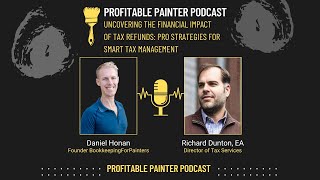
In this episode of the Profitable Painter Podcast, hosts Daniel (founder of Bookkeeping for Painters) and Richard (tax director) explain why large tax refunds are often a hidden cost for small‑business owners, especially painters. They contrast employee withholding with the quarterly estimated‑tax system that most self‑employed owners must use, describing the under‑payment penalties and interest that arise when payments are insufficient. The conversation frames a tax refund as an interest‑free loan to the IRS and introduces the concept of opportunity cost: keeping cash longer lets owners reinvest in marketing, equipment, or high‑yield accounts, potentially earning a higher return than the 8% penalty rate. They walk listeners through practical steps for accurate tax projections, using the IRS Tax Withholding Estimator, understanding W‑4 changes, and coordinating payroll withholding with estimated payments for S‑corp owners. The episode ends with concrete actionable advice—a 25%‑of‑profit rule of thumb, the quarterly payment schedule, aiming for a "sweet spot" of a $0‑$1,000 balance due at filing, and encouraging owners to treat tax planning as a tool for cash‑flow control rather than a forced savings plan.
Chapters
Welcome to the Profitable Painter Podcast. The mission of this podcast is simple: to help you navigate the financial and tax aspects of starting, running, and scaling a professional painting business. From the brushes and ladders to the spreadsheets and balance sheets, we've got you covered. But before we dive in, a quick word of caution: while we strive to provide accurate and up-to-date financial and tax information, nothing you hear on this podcast should be considered as financial advice specifically for you or your business. We're here to share general knowledge and experiences, not to replace the tailored advice you get from a professional financial advisor or tax consultant. We strongly recommend you seeking individualized advice before making any significant financial decision.
This is Daniel, the founder of Bookkeeping for Painters, and this is Richard, tax director with Bookkeeping for Painters. It is a beautiful spring day. And if it's late spring, that means tax refund season, right? Everybody's got their tax refunds and they're looking forward to spending them if they haven't already.
Right? Yes. And you see all the— I still get text messages from Liberty Tax. They're always, you know, get your refund, you know, from like 10 years ago. I'm still on their, their distro somehow. Actually more than that, like 15 years ago. But yeah, refunds are like— people are super excited. Oh yeah, Tax Day, get refunds. But with business owners, it's not really the same type of feeling, or at least it shouldn't be compared to employees. So I think we're going to kind of talk about that today.
Yeah, I thought it'd be fun to talk about the real cost of tax refunds. Uh, and you mentioned especially for business owners, but I think, you know, employees can, can benefit from this too. Uh, it's obviously a lot of fun to get that big check from the government. There's plenty of mattress stores and appliance sellers who would love for you to come on down and spend that. But is that really such a good thing when you get a big refund from the IRS? We're going to kind of dive into that and, and see what the hidden costs are of a big refund. So, uh, I think everyone listening pretty much understands that you, uh, file your taxes and you come up with how much you're going— your— or your tax liability is going to be. And then we can compare that to how much you've already paid in. And there's two ways that you pay in. Uh, one is through withholding on your paycheck. And if you're an employee, that's going to be the primary way. You know, you get your paycheck and there's two numbers. There's the gross pay and then there's what you actually get. And the difference between those two numbers, a lot of it is that withholding that's going to the IRS. And if there's enough withholding to cover your tax liability, then you get that refund check, direct deposit within 2 weeks or paper check within, within 3. If there's not enough withholding, then you have to write the check to the IRS, and that is never fun. But why do we even have, you know, withholding on paychecks anyway? I thought this was kind of interesting. You know, taxes have evolved a lot in this country since its foundation. In fact, for a period there after the Civil War, we didn't even have income tax in this country. It wasn't until Well, about World War I, when, when the 16th Amendment was ratified and that we officially made income taxes legal. But I guess the government was a little concerned that they might not get their money if people had to, you know, hand over a portion of their check. Imagine that standing by the time clock and you get your check and then you have to turn around and hand 20% back to the government. I could imagine some riots going on, at least in some of the factories where I've worked. So in 1943, the famous economist Milton Friedman came up with the idea of income tax withholding. And the— I guess the, the idea being that you don't miss what you don't see. So if it never shows up on your check to begin with, then it doesn't hurt as much. And that is the concept that we kind of want to push back on and kind of poke a little bit because, you know, you spending your money, whether it comes out of your wallet or whether it comes out of your paycheck, is still spending your money. And so to have really good control over your money and understanding is going to help you.
Yeah. And I think, well, one of the things with business owners is they often don't have that luxury of it being withheld at least, I mean, you can have, you know, if you're an officer in an S corp, you have that withholding on your payroll. But usually that doesn't, that doesn't cover enough unless you're really turning up the withholding on there. So often you have to do the estimated tax payments, actually writing a check every quarter, which a lot of folks just starting out don't realize. And then they get hit with a big tax bill. Because the IRS isn't a pay-as-you-go system. It's not a wait until tax time to pay. So you get hit with a big tax bill with some penalties and interest. So that's a thing that folks often overlook.
Yeah, absolutely. And it hurts more when you have to write that check yourself every quarter. So that's the second way that we can, we can give money to the IRS. You know, the first being the withholding. The second way is being the estimated tax payments. Now, Daniel, you mentioned that the IRS is a pay-as-you-go system. So what happens if you don't have withholding or you don't make estimated payments? Well, they, they charge you interest. They, they charge, they charge you interest on the amounts that have not yet been paid in. And there's a lot of nuance to it. We've got the safe harbor, we've got you know, different things to figure out how much that interest is going to be. But right now it's generally about 8% annually. It's going to fluctuate with the prime rate. So if you don't make those estimated payments or you don't have the withholding to cover it, be prepared to pay more taxes when you file your return in April. They've called it a few different things. I think most recently they're calling it underpayment penalty. So there's that. Now, why not just say, well, that's fine, I'll avoid all the penalties. Government, take as much as you know, take half my paycheck or here, let's just write massive checks every quarter. That's an option. And it might make it easier when you file. But do we really want to be giving Uncle Sam an interest-free loan, or is there something that we might be able to do with our money that's more valuable?
Yeah, hopefully if you have a business, you can think of a better way to use your money than to give it to the IRS. I'm hoping.
Absolutely. So I did a tax planning meeting with a client this week and we ran his projections and he is going to owe taxes. But because this is his first year in business, the minimum amount that he has to pay in to avoid that interest is very, very low. So I gave him two options. I said, well, you can either write, you know, some pretty big checks for estimated payments and, you know, the IRS will be very grateful if you do that. Then when you file your tax return in April, you can get that refund and go buy a mattress or something like that. Or maybe you take that money and you reinvest it in your business or put it in a high-yield savings account or do something more meaningful to you. And then just be prepared, keep it liquid, because in about 10 months from now, you're going to need to, you know, pay your taxes with it. And so I asked him what he felt more comfortable with because people, people have different feelings when it comes to the IRS. And I've heard it both ways and both positions are valid. He decided to go ahead and keep his money. I think he's going to reinvest it in his business, but he understands that he's going to have to write that big check when, when he goes to file. And that's kind of what I love about tax planning is that it puts the power in your court, you know, you can decide. I have had other people tell me like, no, I don't want to deal with the IRS. I don't want to have to worry about it. I want to make my estimated payments. And that's fair too. I understand that. Now, as far as you know, what is going to be more financially advantaged, I mean, you can see that obviously you keeping your money longer is probably going to be better for you, uh, if, if you're not, you know, going to suffer emotionally or mentally because of it. Uh, you know, there's this concept in economics called opportunity cost, and, uh, I don't, I don't want to put anyone to sleep with an economics lecture, but basically it's the idea that, uh, having money now or keeping money for longer periods of time makes that money more valuable than in the future. So let me, let me kind of illustrate. People who win the lottery, right, they win the $10 million jackpot. They don't get a check for $10 million. They usually get an option. You can either have an annuity where we pay you, you know, $500,000 for the next 20 years, and that's your $10 million. Or we'll give you a lump sum. And the lump sum is usually like 5 or 6, you know, 50 to 60% of the winnings. Why is that? Because having that money upfront is more valuable than having the same amount spread out over the next 20 years, because you can do something with that money, having that access to capital. You can invest it in your business. If you— if your business is doing well, you might get a 15 to a 25% return. You might invest it in securities and get an 8 to 10% return. You might just find like a really good high-yield savings account or a certificate of deposit. I think those are going for like around 3 to 5% right now. So having your money now makes it more valuable than having somebody else hold on to it and having to get it in the future. And that's the idea of not giving Uncle Sam a tax-free loan. Keep your money, deploy it, make something with it, and then only give it to the IRS when you absolutely have to.
Yeah. And we could take a more— a different example. Let's say you can either pay the IRS let's just use simple numbers and say $1,000 in estimated tax payments, uh, during the year. Or if you can hold on to that $1,000 and not be hit with any kind of underpayment penalty and use that $1,000 to put into your, your marketing efforts and turn that $1,000 into $1,500 or whatever the case is, now you have more money. So when, when, when it is time to pay that, the IRS, the $1,000, you have $1,500 to work with. And so you've net, you've net, uh, $500 on that original $1,000 because you kept it and reinvested in the business and, and, and got profit from that.
Absolutely. That, uh, that opportunity cost of giving the money away is expensive. When there's something that you could be doing with it. So it's a balancing act, right? We don't want to not pay our taxes and then, you know, put a financial strain on ourselves or our business. We don't want to not pay our taxes and pay more than we should because of interest and penalties. But on the same hand, we want to be able to hold on to our money as long as we reasonably can. So how do you, how do you figure it out? Well, I'm a big believer in doing accurate tax projections because if you don't understand what you're going to have to pay, it becomes very difficult to make meaningful decisions about what to do. So the first step is an accurate projection. Know how much you've made so far this year. What the end of the year is going to look like, how much your tax liability is going to be for both the IRS and the state if you live in a state with an income tax, and then understand what your withholding and your estimated payments are going to do towards that tax liability and how much you need to either increase them or be prepared to pay when you go to file. You know, sometimes folks want to make things a little bit easier on themselves. So, you know, if they're set up as a corporation or an S corporation and they're collecting a salary, we might increase the withholding on their paychecks so that they don't have to make estimated payments, or at least their estimated payments will be a lot less than they would have been. Other folks like to get as much as they can in their paycheck. And they're going to take that money, they're going to put it in that high-yield savings account, and they're only going to send it to the IRS when they make their quarterly estimated payments. Either way is valid. But the key is understanding what you're going to have to pay, how it's getting paid, and having a plan that suits, you know, your financial goals, but also like what you're emotionally and mentally comfortable with. Because huge tax bills and IRS problems can break a business. And so we don't ever want to get away from us.
Yeah. And the way to get a projection, obviously you can get a hold of a tax planner and have them do a projection for you. Another option, if you want to do it yourself, you can actually— the IRS has a tax withholding estimator, which not only helps with, as the title implies, with withholding estimating, but also if you're— it has a section for self-employed as well where you can plug in some numbers. You kind of have to know what you're doing a little bit. You have to be a little bit savvy on knowing what you're filling out, but it does calculate your estimated, uh, taxes that you would— you may have to pay or you know, and give you that information. Obviously, you'll have to know how much you've made, like you said, and how much you think you're going to make over the remainder of the year. But it can be a good tool if you're up to the challenge.
Yeah. Yeah. And I should just throw in a word too about W-4s. If you're an employee and you've worked for somebody else, then you're familiar with the W-4. and that is the form that you use to tell your employer how much you want withheld from your paychecks. And W-4s used to be pretty complicated and difficult to understand, and then they revised them a few years ago, and now they're 10 times worse. So if you need help with figuring out your withholding, the IRS tool is a really good thing to use. Basically, you know, you're trying to— it's not so bad when you're, when you're by yourself, but if you have multiple wage earners in your home, especially if, if one spouse makes significantly more than the other spouse, now you're dealing with two W-4s, but you're sharing the same tax return. It's a mess. You know, try to get some help if you can, or that IRS tool on the website. It takes a little while. But it's pretty accurate because unfortunately the forms are there. I'm not going to lie, a lot of people have not enjoyed them and it's really sad because a lot of people think that, oh, I filled it out correctly, my withholding is all good. And then they file their tax return and they were expecting a refund and they're having to pay. And there is nothing that will ruin your day faster than having to write a check to the IRS when you think that you're supposed to get a refund. You hear people say like, I've gotten a refund for the last 10 years, it's X amount of money, I have plans for it. And now all of a sudden, not only is that not coming in, but they're dipping into their savings. It's not pretty. So, and update your W-4 each year because believe it or not, the IRS actually changes the tables. And so if you look at your check and you notice that a lot less money is being withheld, than before, that's a good sign you need to update your W-4. It's easy to ignore it, right? It's nice to get that extra $50 a paycheck, but that is going to burn you more than likely when you go to file. So try to keep up with it if you can. Otherwise, be prepared to, to break out the checkbook.
Yeah. So I guess to kind of wrap things up, what are some actionable steps that folks can take to make sure that they have an understanding of what they should be paying in estimated taxes or if they should or should not? What can they actually do on this topic?
Sure. All right. If you are a business owner and you are just starting out and you don't have any kind of like tax planning or anything like that, Good rule of thumb, 25% of your profit should be put aside for taxes. You're going to want to make an estimated payment each quarter. The first one is due April 15th, second one June 15th, then September 15th, and then January 15th. Notice that those aren't actually all 3 months apart. The IRS has kind of this wonky system. So be aware of what those dates are. Make your estimated payments if you can. Now, if you are a little bit further along in your business journey, doing tax projections to understand exactly what those amounts should be so that you're not putting in any more than you have to and you're keeping as much of your money as you can. Is going to be a big help. If you are an S corp and you are getting a paycheck along with business profits, understand how your paycheck withholding combines with your estimated taxes. Those both go together to achieve the same thing. So you can play with those a little bit, maybe have more withholding and less estimated tax or vice versa. But understand how those work together. And then, you know, the goal, ultimate goal is if, you know, if you get a small refund or even if you have to write a small check, might not be real pleasant. But keep in mind that you have made sure that you have not given the government an interest-free loan. And as long as that check, that balance due is less than $1,000 when you file, there will be no underpayment penalty or interest. So, so that's, that's the goal, right? Somewhere between, you know, zero refund and $1,000 balance due. That is the sweet spot for winning at not giving the government a loan.
Yeah. So you're telling me it's not a $10,000 refund check?
It's not a $10,000 refund check. Refund checks are the government giving you back what is already yours.
Yeah.
So they're fun to get, but you should never have given it to them in the first place, to be honest with you. Now, I get it. I understand.
And there's some exceptions. Yeah, there's emotional, but there are some exceptions. If you're making any kind of money as a business owner and you're getting a $10,000 refund check, it's money that, you know, it's money that is yours. Now, obviously, if you're a business owner that's really struggling and you're getting some sort of, you know, refund from Earned Income Credit or something like that, that's a different story. But we're kind of assuming that you're making some sort of money here.
Yeah, absolutely. So yeah, I mean, we're not dogging on anybody who gets refunds. You know, we get it. We're just saying that if you are consistently getting large refunds, you might want to reconsider. Is that the best use of your money? Even if you're— you know, because some people will say, well, I use it as like a forced savings plan. And there's a behavioral aspect to that that I get. But if it's possible, maybe set up some kind of automatic withdrawal to a high-yield savings account. So that you collect interest, because if you haven't noticed, the government does not always play fair. When you owe the IRS money, they charge interest, but when they take too much of your money, they don't give you anything extra back with it. So we're just talking about maybe playing the game to a little bit of a, of a next level and trying to keep as much of your money in your pocket as we can.
Yeah, definitely got to look out for yourself in this case. Don't, don't rely on the IRS to take care of you, I think is the takeaway here.
Right, right. Yeah. Yep. It's, it's being responsible for your own finances and just kind of understanding, you know, how the game is played. So if you have any questions about estimated tax payments, withholding, how do I do projections, you know, you can drop those questions in the Grow Your Painting Business Facebook page. We'd love to hear from you. Or if you have suggestions about a topic that you would like to hear on the next podcast, please let us know. Otherwise, we really do appreciate you listening and hope to see you on the next episode.
See you next week.
More from Daniel







What’s REALLY Holding Your Painting Business Back? (Find Your Bottleneck in 5 Minutes)



