Unlocking IRS Relief: Essential Tax Strategies After Hurricane Helene & Other Disasters
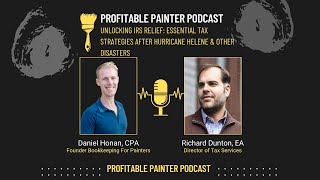
Daniel and Richard explain how the IRS postpones filing and payment deadlines for taxpayers in Hurricane Helene disaster zones. If your zip code matches the affected area, extensions apply automatically; otherwise, call the IRS disaster hotline with your FEMA number. All 2023 and 2024 deadlines shifted to May 1, 2025 for eligible counties.
Chapters
This is Daniel, the founder of Bookkeeping for Painters.
And this is Richard, tax director with Bookkeeping for Painters. How's it going today, Daniel?
It's going well. Fortunately, in Orlando, we didn't have much of Hurricane Helene hit us. It was pretty non-eventful, but that was definitely not the case for folks just to the west of us. Especially Tampa Bay. I know Brandon Pierpont, for example, um, is our friend over at Painting Marketing Pros, was hit pretty hard. His house had 4 feet of flooding, and so they had to deal with that. It's pretty significant. And then obviously the, the folks that were up in Asheville area, I know, were hit really hard. And so yeah, not, not good times right now.
No. And you're originally from North Carolina, aren't you, Daniel? Did any of your family or friends have any, uh, suffer any damage or problems?
Yeah, my, uh, my parents live up in Mount Airy, and so they, they had their power knocked out. Nothing too significant, nothing like what folks saw in Asheville and Hendersonville, that area. Um, I do have some friends that are okay, but in that area, but yeah, it's some folks were not, you know, too lucky with that because from what I understand, just there's mudslides just covered just certain whole little, little towns and stuff. So it was pretty terrible stuff.
Yeah, I read that Asheville had about 17 inches of rain in just a few hours. Basically like 3 months worth of rain consolidated in and, uh, there was significant flooding. I saw the pictures of I-40 being washed away. I guess the river rose about, you know, 6 feet higher than it's ever been. And there was real bad damage. So definitely our thoughts and concerns are with anybody in those areas, not just North Carolina, but Georgia, Alabama, Tennessee, South Carolina. Definitely a difficult thing to be dealing with. You know, we thought that maybe we could talk a little bit about If you are in a natural disaster area, whether it's Hurricane Helene or maybe some of the wildfires that happened in California or some of the flash floods in Washington right now, is there any relief for you when it comes to your IRS and tax filings? You know, the last thing you're thinking about in a natural disaster is I got to file my taxes. And that's good, right? You take care of your family, get your necessities. And fortunately, the IRS agrees, and they realize that, you know, typical filing deadlines and payment deadlines can be burdensome and inappropriate for folks going through natural disasters. So there's actually usually a lot of fairly generous relief available for those people. I know with Hurricane Helene, for example, the entire state of Alabama Georgia, North Carolina, parts of Florida, parts of Tennessee, they received disaster relief for their tax filings. In fact, if you go to the IRS website, they maintain a, a whole webpage where you can search by state to see if there's any areas in your state that are entitled to disaster relief. So we say disaster relief. What are we talking about? Well, they're not going to— unfortunately, they're probably not going to be giving you any cash or supplies, but they will postpone your deadlines for filing and paying your taxes, which can be the equivalent of—
which can be the equivalent of cash. If you end up being late, they'll usually get fees. So essentially that extension can save you money.
That's true. Yes, absolutely. Yeah, I just didn't want to oversell the generosity of the government. This is as good as it gets with the government, right? We won't penalize you as bad as we were planning on. But like with Hurricane Helene, for example, anything that was due after September 24th is now not going to be due until May 1st of 2025. So if you haven't filed your '23 taxes yet and you've got a properly executed extension, your normal deadline would have been October 15th, 2024. Now it's May 1st, 2025. Same thing with your payroll taxes. And your estimated tax payments that were normally due like either, you know, January 15th or at the end of the year, those are going to get pushed off until May 1st. And this also includes your 2024 filings. So if you're an S corp or a partnership, your return would normally be due March 15th, 2025. If you are filing a 1040 like we all have to, the dreaded April 15th, that's all going to be May 1st, 2025 now. But that's only for people who are in these disaster areas. Well, and we're— for the— for generally for people in the disaster areas, we're going to talk about some of the loopholes in a minute.
Yeah, and one of the things that we were just talking on before we started this was, uh, I'm actually in a disaster area, not for Hurricane Helene, but for I guess another tropical storm that apparently Orlando suffered, which we haven't really had anything too crazy happen. You know, we had some storms and I think I vaguely recall a tropical, tropical depression or something coming through, but it wasn't anything too terrible, at least in my area. But apparently, we are in a federally declared disaster area, even though it it was relatively okay here. So you might be surprised. You might be— your area might be on this list even though you might not have suffered anything catastrophic.
Yeah, that's a really good point. I've had a lot of people tell me, oh, I haven't suffered anything, it couldn't apply to me. And I say, you know, go to the IRS website, search by state and look because they'll have a list of the different natural disasters. Click on all of them. And read which counties are affected and you might be surprised. It is funny, like, like, like you're saying, Daniel, Orange County qualifies for relief for Tropical Storm Debbie, but it does not qualify for relief from Tropical Storm or for Hurricane Helene. So check, check all the disasters. You might not qualify for one. You might qualify for another one. So how do you, how do you define what an affected taxpayer is? That's the, the IRS term. Well, In this would be individuals who live in these counties would be an affected taxpayer. It'd also be business entities like corporations or partnerships or sole proprietorships whose place of business is in these areas. It might also apply to shareholders in S corps or C corps if that corporation is in the area. Uh, it's important to note that you don't necessarily have to live in the disaster area to be an affected taxpayer. You qualify if the records needed to meet a filing or payment deadline are located in the disaster area. So hypothetical example, maybe you are running your business from the safety of Wisconsin, no natural disasters, but you have an office in Florida and your office was flooded during the hurricane and there's records down there that you need to prepare your company taxes. You could qualify for relief because your records are in a disaster area, even though you're not. You might also qualify if you're a member in an LLC or a shareholder in a corporation and that business is in a disaster area. So, you know, you can't get your K-1 on time because, you know, the business is in a disaster area. So you might qualify for relief. Additionally, you might qualify if your tax preparer is in an affected area and they're unable to file or pay on your behalf because of the disaster. So that's kind of an interesting one. It really wouldn't matter where you are located if the person preparing your taxes, the accounting firm, CPA, whatever, if they were affected. So if you determine that you are an affected taxpayer and you want to benefit from some of this relief, how do you do that? Well, it's going to depend on whether you live in the area or not, how you're going to go about it. If you live in the disaster area, That's the easiest way. The relief is probably going to be automatic, right? The IRS relies on zip codes, so they're going to know all the zip codes of disaster areas, and they're going to compare it with your zip code on your tax return. And if there's a match, they're going to automatically— well, hopefully automatically— give you those extended deadlines and not charge you any penalties for late filing or late paying. But it— if your zip code does not match disaster area because maybe you didn't live there, but your records were in a disaster area, or your tax preparer was there, you're going to need to call the IRS and ask them to apply that relief to you. So there is a 1-800 number. You can find it on the IRS disaster a website. I did not write down the hotline, so I can't give it to you in the podcast, but it's, it's all over the web page. You're going to call that, you're going to explain to them the situation, you're going to let them know why you qualify— because my business is in Florida, my tax preparer is, is suffering from mudslides, whatever it might be— and you're going to want to provide the FEMA disaster number that is associated with that area. So if you're on the website and you're reading the press releases, those FEMA numbers should be in the press release, or you can go to the FEMA website and search by location. But have that number ready. They're going to apply that to your account, and then you'll be able to get that disaster relief. Now, some people are wondering, like, well, what if my address changes? Right. Like, I went through the storm and now I had the good sense to get out of Florida and go someplace boring where there's no hurricanes. Will I be able to still benefit from this? Yes. Update your address with the IRS when you move. Let the post office know so you have a record. And when you go to file your returns, use your current address. You might have to call them and ask them for that relief. If they don't apply it automatically, but they should know what your previous address was and they should be able to, you know, correlate it with the zip codes. But yeah, don't, don't use your old address. That's just going to kind of confuse things. So there's, there's a lot to this. I definitely recommend if you want more information to go to the IRS website, search by state. It's going to have all the details there for you. And even if you are a little skeptical, maybe you think, oh, I don't think that applies to me. Give it a shot. You'd be surprised. I was researching the other day and I found out not my county, but the county right next to me is a disaster area, and I would not have known that. So it doesn't really help me, but it's amazing just like how close it can be.
Yeah. So If you're, if you're already late on filing your, your business tax return from September 15th, should you just look up a CPA firm that is in a disaster area and then get and then hire them to do your return so you can get out of paying late fees?
I did not say that. Okay.
I was just curious.
Just, yeah, just hypothetically. Yeah, no, I didn't say that. I do want to emphasize though that this is not a complete get out of jail card for everything. And it's usually only going to apply to deadlines that happen on or after the date of the disaster. So for example, Hurricane Helene came through on September 24th. The deadline for S corp returns for last year was September 15th, 9 days earlier. If you didn't file your S corp return on time, you're not going to be able to benefit from this relief because the hurricane came through 9 days late. Now, there might be another disaster that happened earlier that you qualify for, and if so, you might be able to get some extended deadlines. But just be mindful that there are dates on this, and anything that was due to be filed or paid before the disaster is not going to qualify for relief. Only things after the disaster. So hopefully, if you are affected by any of these storms or wildfires, hopefully you're doing well. You're able to try and get your life back to normal. And not having to worry about your IRS filings makes things just a little bit easier for you, you know, as you, as you go through these disasters. If you have any questions or thoughts about this, we'd love to hear them. You can join our Facebook group, Grow Your Painting Business. We'd like to know that you're safe, first of all, and we'd like to know if you have any questions or if there's anything that we can do to help you apply for some of this relief, you know, as you start to rebuild from the storms.
More from Daniel







What’s REALLY Holding Your Painting Business Back? (Find Your Bottleneck in 5 Minutes)



