What If Your Painting Business Became Equity Instead Of A Job
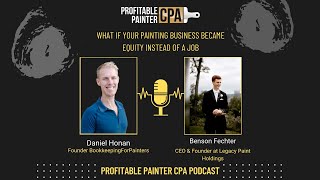
In this episode of the Profitable Painter Podcast, host Daniel Honan (CPA and former painting contractor) interviews Benson, founder of Legacy Paint Holdings. Benson recounts his entrepreneurial path—from starting a student‑run painting company during the COVID‑19 shutdown, expanding to multiple locations across the U.S., and then pivoting to a consulting firm (Precision Painting Advisors) that helped over 100 painting contractors. He emphasizes the importance of systems, a "fail fast, learn fast" mindset, deliberate reading (about one book per week), and mentorship. Drawing on these lessons, Benson launched Legacy Paint Holdings in 2024 as a traditional roll‑up of painting companies. He explains how consolidating small painting businesses creates economies of scale, allowing the combined entity to command EBITDA multiples of 8‑12× (versus 2‑4× for standalone firms). The roll‑up targets established contractors with $750k+ revenue, 15‑25% profit margins, and owners who are young, ambitious, and not tied to day‑to‑day painting work. Benson discusses acquisition criteria, the cultural fit, and the long‑term upside for partners, including accelerated growth, higher valuation, and the potential to reinvest proceeds into subsequent roll‑up rounds. The conversation closes with a CTA for interested contractors to apply via legacypaintholdings.com and a reminder that mindset and belief in growth are critical for success.
Chapters
Welcome to the Profitable Painter Podcast. The mission of this podcast is simple: to help you navigate the financial and tax aspects of starting, running, and scaling a professional painting business. From the brushes and ladders to the spreadsheets and balance sheets, we've got you covered. But before we dive in, a quick word of caution. While we strive to provide accurate and up-to-date financial and tax information, nothing you hear on this podcast should be considered as financial advice specifically for you or your business. We're here to share general knowledge and experiences, not to replace the tailored advice you get from a professional financial advisor or tax consultant. We strongly recommend you seeking individualized advice before making any significant financial decision.
Welcome to the Profitable Painter Podcast, the show where painting contractors learn how to boost profits, cut taxes, and build a business that works for them. I'm your host, Daniel Honan, CPA, former painting business owner and your guide to mastering the numbers that drive success. So let's dive in and make your business more profitable one episode at a time. Super excited today to speak with Benson from Legacy Paint Holdings. Welcome to the podcast, Benson. How's it going?
Good, good. Thanks for having me on, Daniel.
Yeah, absolutely. I know you got a lot of cool stuff going on, uh, at Legacy Paint Holdings, so super excited to dive into the conversation. Could you just for the listeners, could you give us an idea of how did you get started in the painting industry and what's been your journey along the way?
Yeah, I grew up in a contractor family in Pittsburgh, Pennsylvania. My family has been in the trade since the '70s, ranging everything from mechanical contracting, heavy-duty construction, electric, landscaping, HVAC, you name it. My family's been, been involved with. So from a very young age, I had a front row seat to what it looked like to run a successful contracting business, specifically on the backend side of it. I grew up very entrepreneurial, wanting to help with the family business, raking leaves, shoveling driveways, every little side hustle that a teenager would have, which led me to my senior year of high school, which was the COVID-19 pandemic, 2020. I— when the whole world shut down, my senior year of high school shut down, and I was just waiting to go off to college, Providence College, Rhode Island, where I got my business management degree. And I knew I wanted to do something during that time period, and I had always known I wanted to start my own trades business, sort of following the, the family footsteps. And so in April 2020, I started my first company, a small painting company, with my brother, who's 2 years younger than me. Uh, we had a minivan we were driving around at the time and a couple ladders at my, uh, grandmother's house. And with the limited painting experience we had from mission trips in years past, uh, we put an ad out on Craigslist and we started a painting company. I— and very quickly became good at the, the backend side of it, the marketing, hiring people, systems, financial planning, all of that. And by the time we got to the end of June of that first year, we was completely off the tools doing estimates, managing projects sort of above the, the day-to-day of the business, uh, and realized we were doing something pretty, pretty unique, pretty special. Um, sort of wrapped up that summer, uh, early August of 2020. We did over 30 projects during that first, um, first summer and learned a lot in the process. So I go off to school, uh, in Rhode Island, Providence College, where join the entrepreneurial circles that are there. And this is when I came to find out about the larger student painting organizations that exist across the country, which I was unfamiliar with when I started my painting business in Pittsburgh. And as I was learning about this, it dawned on me that, well, why couldn't I just create or replicate a similar version of this, but do it actually through students, since I myself was a student at the time. And so a friend of mine that went to one of these sort of recruiting pitches, we got to talking after the meeting and said, hey, you know, here's what I did in Pittsburgh. Why don't you do this in Providence this summer? I'll do it in Pittsburgh and, you know, we'll see what can happen. And so we went full speed ahead, ran everything in Pittsburgh, ran everything in Providence. And that summer of 2021, across two locations, we did over 100 projects that summer. And learned even more doing that. Certainly the, the multi-location aspect, managing multiple crews at the same time, which I hadn't really done, uh, the, the previous summer, uh, all of the, you know, financial planning and bookkeeping, you know, multi-location, understanding our numbers and our margins and everything there. Uh, and we wanted to do it just the two of us before we expanded it a little bigger. So we go back to school that fall with all this experience that we had, and we recruited 3 additional students to open 3 additional locations that next summer. Uh, And so that next summer we were in Southern Rhode Island, a town called Newport, Hartford, Connecticut, and just north of New Orleans in a town called Hammond, Louisiana, and had 5 locations running that summer. Across the 5 locations, we did about 300 projects, was a little bit less than 300 projects, and was certainly burning the candle on both ends that summer. I was driving back and forth from Pittsburgh to New England to Louisiana. You know, put like 60,000 miles on my, my truck that summer, uh, and learned a ton doing it. And so we go back to school and we're doing a, call it, you know, a 360-degree audit on the last 3 seasons, um, of doing this and realized a couple things. Thing number 1, we were operating during a 14-week season and there are 38 other weeks throughout the year that probably could, should be finding a way to make some money. Uh, and B, relying on high school and college students long-term probably wasn't the best solution in building, you know, a strong sustainable business. And so that fall, I started a consulting business called Precision Painting Advisors, where we work directly with painting companies across the United States, essentially saying what worked for us, we're going to help these companies with. So everything from sales and marketing, HR, financial planning, doing basic things such as making budgets, job costing, you name it, we would help painting companies with. And by the time I got to Christmas of that year, 2022, it became clear to me that that's really where I was passionate about and where I wanted to lean into. So I exited the student painting company at the time and dove full into the consulting wing. I spent about the next 2 years doing that, and I worked with over 100 painting companies across the US, companies as small as doing doing $40,000, $50,000, $60,000 a year, right? Sort of one-man show that is just going job to job all the way up to companies doing $8, $9, $10 million a year that had 80 guys out in the field on a given day. And so I got the whole range of everything there. And what it all came down eventually to me was one word, and that one word is systems. You either had the systems in place that you could plug in and then delegate throughout the organization or you didn't and you were the bottleneck that caused, you know, the business to not be able to scale and to grow. And got into thinking about this and seeing sort of the trends in the economy that have been happening with roll-up groups that have been put together in the HVAC space, roofing, plumbing, landscaping, electric. But nobody was really doing a traditional roll-up in the painting space. And so last year, it was August of 2024, we got a group of initial investors together. I and we started Legacy Paint Holdings and began acquiring painting companies. We've been acquiring painting companies across the US since September of 2024. We have 8 companies in our portfolio right now, from New England to Michigan to Pennsylvania to Texas and Oklahoma. We're pretty spread out at this point and have ambitious goals to continue to grow and to scale and to put together this traditional roll-up. So Excited to be here, excited to be on the podcast, sort of share a little bit more about my story, my journey, how it can be helpful to the other painting contractors listening to this.
Yeah, that's an amazing story. And so you started running your own painting business in high school?
Yes.
Senior year?
Okay.
And then you went from running one painting business to multi-locations during student— when you're a student at university and instead of doing the traditional like student works painting or college works painting, you basically started your own version of that and ran multi-locations during college. And then, and then towards the latter half of your college period, you actually started working as an advisor. 2 other painting businesses, working with over 100 painting businesses from startup to $10 million and helping them with their systems. And then, and then most recently in this past year, or yeah, this past year, you've, you've started a holding company. So that is incredible amount of learning that you have done. That's the only thing I can think of. That's what you've been doing is just an incredible amount of learning in a very quick amount of time. Um, so I'm just like, how, how did you, uh, what do you attribute— are you, uh, like, what are you doing to learn things so quickly and then implement so quickly? Like, uh, what's the secret sauce? So take some notes.
Yeah. Um, no, I mean, it's, it's been coming up on 6 years since I started the, the painting company this coming spring, and I joke that I've got my sort of PhD in the painting business world over the last 5, 6 years. Uh, and really it's two things. I think thing number one is I try and I joke, but I want to fail fast. And what I mean by that is I want to go quick, learn quick, make mistakes quick, and then not make the same mistake twice. And I mean, I have a laundry list of things that I have done wrong and failed at. And once I failed once, I was able to create the system that prevented that failure from happening again in the future. Beyond that, I'm an avid reader. Myself. I ever— I made a New Year's resolution to myself in 2020 that I was going to read at least one book a week, and I have very, very consistently read a book a week for the last 5 years. Um, you look at the 50 weeks in a year, multiply that by 5, that's 250, you know, books over the course of 5 years. And I, I like everything from your, your fiction to your non-fiction to the business-specific books to the more broader political landscape books. I just like learning and learning new things and then trying to implement those things in my life, in my business. And I think, you know, refusing to settle has been a big part of it as well and setting big goals for myself. Like we have a goal that by the time we get to 2030, we're going to be a $100 million company. And I have, you know, no doubt that we're going to be able to accomplish that goal. And Set big goals, accomplish them, you know, move on to the next one.
So it sounds like deliberate— the learning is deliberate. It wasn't an accident. And so you said you're reading a book a week and you said it ranges from different things. Are you— so you— is it just whatever interests you or is it like something you're trying to solve at the moment or like, or is it a combination of things? Like, because it, it, it, you're obviously very, um, goal-oriented and driven. So it, when you said that you read sometimes just for fiction, that kind of threw me a little bit because I'm, I would think if, because of everything you've accomplished so quickly, I would guess that your books would just, just be like things that I need to read to get to the next level. But it doesn't sound like that's what you're doing.
It's a combination. And I will say I sort of like to follow threads where they take me, right? So I'll explore one topic that I'm interested in and I'll take that topic to its logical conclusion and sort of read the books and everything that come up there. And so for me, I think fiction— and I don't read a ton of it, to be honest. There are a couple of good authors that I like when they come out with new books and stuff. I like to read. But I think reading in general, no matter what the topic is, and there are obviously like very specific sales books or very specific financial books or, you know, very specific books that'll help you in a specific area get better at something. Uh, I like reading a lot of people's personal stories, memoirs, understand, uh, people. And I think that's what reading allows you to do. Uh, they, they talk about There's a guy I follow, his name is Dennis Prager, and he talks about the three mirrors that we all have. Mirror number one is the mirror that you look at every day when you're brushing your teeth and you see back at yourself. Mirror number two is if you want to understand how you think or somebody else thinks, go read what they've written and you'll have a good idea of how that person thinks. And mirror number three is if you want to get an idea of what your character is or somebody else's character, go find the five people that you spend the most time around, whether it's yourself or somebody else. You have a good idea of yourself or somebody else's character. And I think on the writing side, the business world is so much about relationships and building relationships, and especially in the acquisition space that I'm in now, I— that's entirely what this business is about. And I like to understand different ways of thinking and different perspectives of the world. You know, and wherever the threads take me, I'll go and I'll follow them. You know, I think it's good to have your business-specific books, but I think it's good as well to have a mix of different perspectives that are in there as well.
Okay. So it sounds like you're reading a lot of memoirs and autobiographies and biographies. Is that right?
Yeah, that's a fair perception. Okay.
Now that makes a lot of sense. And I haven't done as much as probably you did for on the podcast for like a year. I read a biography or autobiography a week and it, it definitely one of the— I don't know who you, who you were kind of— I was kind of choosing entrepreneurs or military conquerors like Napoleon or something like that. And one thing that a common thread that, uh, that I saw was the something that you mentioned was thinking big, like having big goals was a common theme. And you can look at everyone, everyone from Napoleon to Arnold Schwarzenegger to Jeff Bezos, like all those people who kind of accomplished more than you would think one man could accomplish. They always had like some really big goal and everyone kind of thought they were crazy for going after it. Is that, is that one of the things that you learned is to set goals higher, bigger than what you, you know, would initially kind of naturally set? Is that, is that something you gleaned from your reading or is that just a an artifact of your personality?
Yeah, I'd say a couple things. One of the characters that I followed closest, I would say, since I started my business personal development journey, uh, has been Dr. Jordan Peterson. I, you know, I read 12 Rules for Life right when it came out, followed his lecture series, and I followed his journey, you know, ever since. Uh, and for, for him, one of the big things that he says, which I completely subscribe to is you need to, to set a goal, set an ambitious goal, you know, work backwards in terms of like what needs to get done every single day to accomplish that goal, and work every day like your life depends on it. And you're going to sooner or later accomplish whatever that goal you, you initially set out was. And so certainly the, the idea of goal setting and then being intentional, right, when they ask the, uh, quarterback at the end of the Super Bowl, uh, how he, he won the Super Bowl and got there. He doesn't say, "I lucked myself in," or, "I accidentally found myself here." Very similar in business and in life. You're not magically going to end up at the mountaintop. You have to deliberately plan and, and get there. And so that has been a big part of my journey as well. Uh, and on a personal note, uh, you know, growing up, my, my mom passed when I was quite young. I was, was 9 years old, uh, sort of late elementary school, and had I do have 3 younger siblings. At the time, they were 7, 5, and 3. And we moved in with my grandmother, and I had to take on a big role in terms of supporting my grandmother and helping to get us to the point where we are today. And I learned from a young age the power of just not giving up and to continue to push forward, push forward, push forward. You're going to fail. You're going to fall down, but you get back up, you keep pushing forward. And I think a combination of like the people that I followed and then, you know, the personal experiences that have happened to me, like, as long as you just don't give up and you keep learning, you're going to become a better person, have a better business, and be a whole lot closer to whatever that goal you have is. Yeah.
Yeah. You mentioned a couple of times now not being afraid to fail. I think that's a, that's a common fear of trying something that might seem a little risky, you know, like whether it's spending money on that marketing firm to help you grow your business, or, you know, hiring more of a team or hiring, you know, a certain position. There's that, that fear of failure that's kind of preventing, which to be honest, they're probably right to fear. You probably are gonna fail when you try that, try something for the first time for sure. It, could you just tell me more about how you think about failure and I guess did you have an issue with that initially? What, what allowed you to kind of not be afraid to continue just just push forward and fail multiple times and not be worried about it and just learn and then move forward?
Yeah, I would say certainly growing up in an entrepreneurial household helped, right? I saw the power of failure, you might be able to say, and the power of learning from that failure. And so I guess I'm unique in that sense that I understood growing up that it's okay to fail and it's not necessarily something to be afraid of, but something to expect because problems do happen. They will always happen and you're just going to have to learn how to overcome them and move forward. And so, you know, I definitely think that's a big part of it, but also just until you experience it yourself and until you've knocked on 10 doors and been told no 10 times and then had to knock on the 11th expecting a yes, like you're just not going to get it until you get it. And I think for like you said, the contractors that might be afraid to, you know, spend a couple thousand dollars on marketing or cleaning up their books or whatever it might be to invest back into themselves and back into their businesses. You know, you are eventually going to get it right, but along the way you're going to fail. You're going to waste, you know, conceivably waste money. And there's going to be, you know, some roadblocks on on its way. And I think it's a lot easier in retrospect to take a look at, you know, your life and the years in your business and, you know, paint the rosy picture that it might have been. But if you ask any successful person, they've had their share of stumbling blocks and failures along the way. It's just that they didn't give up when they happened, right? Since we've been acquiring companies, we've had 2 that we've acquired that haven't been good fits for the group, and we've had to cut our losses and move on from that. That's something that has enabled us just within the past year plus of doing this, right? We now know very specifically what we're looking for, the type of business, the type of general manager that's going to be running that business. We know exactly what we need now, but we probably wouldn't have had that if we didn't have a couple bad apples in the first round of this. And so it's going to happen. You have to expect failure and then learn fast and don't make the same mistake twice.
Yeah. So just look, you know, you've done so much so quickly. And we talked about you're deliberately learning, you're not afraid to get the reps in and fail to speed up the learning process. Is there anything else that before we move on from this, that you think is a key driver to being able to accomplish so much so quickly?
Yeah, I mean, like you said, we covered fail fast, learn fast. We covered the intentionality piece. We covered set your big goals and work towards those big goals. I would say the last big thing is surrounding yourself with the right people. And we talk about that third mirror, for example, of being— character is who you spend the most amount of time with, and you typically become the median of that group of close people that you're around. And something I very intentionally did when I started from the painting company to the consulting business to now the roll-up that we're putting together, I— being mentored by somebody that is further along in the business world than I am today. And I have great mentors in the roll-up space. I have one that exited twice from HVAC roll-ups that he's put together. I have one that is pretty close to an exit in electric and one that is pretty close in a landscaping group right now. Really high-quality, good guys that I talk to on a very, very regular basis and gather insights and data and where have they failed so I don't make that same mistake. And I think seeking those people out and whether those people— I've, I've paid mentors in the past and I think it's, it's good to have paid them. And I've also just connected with people and I've built relationships with mentors where they wanted to help me and I needed help. I— and so I think having a little bit of both is helpful and investing in somebody that is further along in the path that you are so that they can help steer you around those roadblocks. Is, is invaluable because then you get moved, you know, a couple months, maybe even years ahead of where you are, and you're still going to fail yourself, but at least you have somebody to lean on that, that has been there before and that's going to help you in your journey.
Yeah. And going back to the biography, especially autobiographies, those almost act like a kind of like a mentor, almost like the way that some of those I'm just thinking like Henry Ford's autobiography or Sam Walton's. They're writing it and they're trying to basically kind of tell their kids or like the ones that come after them, like, hey, this is what I did, this is what I tried, this is what worked, this is what didn't work. So it almost functions as a, as a mentor for business, especially like those autobiographies of those like business owners that killed it. Is that— do you kind of view it the same way, or—
I do, right? I think just reading in general helps with that, right? You understand more, you're learning more. And I think it's a shame in today's world where everything has been shifted towards the 15-second TikTok-style videos, like we're not sitting down and reading and learning anymore. And I think we've lost a lot in that sense, right? Like, I can't remember the last TikTok I watched, but I can sure remember the last book I read. And like the lasting impact that a good book can have on you versus, you know, the meaningless short-form video content that exists today.
Yeah, that's a great point. So let's shift gears a little bit. I appreciate we kind of went really big on there, uh, so I appreciate you going there with me. Um, so Legacy Paint Holding, you mentioned that it's more of a traditional roll-up. Could you talk more about that?
Yeah, I mean, so roll-ups are nothing new. They've existed for as long as money has been invested into small businesses. These, these roll-up groups have happened. It's certainly not limited to the home services specialty contracting space. Say within the last 5 years, it's really been the golden age of private equity's involvement in the home services space. Wall Street Journal put out an article last October essentially saying if you want to become a millionaire in today's economy, don't become a doctor, go become an electrician, go become a plumber, go become a skilled tradesman and run a skilled trades business. That is where the future of the economy is going. And so the roll-up, essentially what we're doing is pulling any companies together, and we'll probably get to around 20 to 30 companies in the group before we eventually exit, um, pulling their cash flow, pulling the revenues and the profits, and systematizing and putting a ribbon on top of the business. And that's going to make the business inherently more valuable. So a typical painting company on their own, um, in one location might sell for anywhere from 2 to 4x its EBITDA. Whereas these roll-ups are selling all the time for anywhere from 8 to as high as 16 times their earnings. And we've talked to private equity partners and groups about where we sort of need to be, and we're right within that range of eventually being in that 8 to 12x earnings. And so it's the power of the economies of scale where you get bigger numbers, more locations, larger dollars. You're just going to get a much higher multiple on your earnings. And so what we're doing is that every partner that we get involved with, they are reinvesting back into the holding company, into the group. They are shareholders in the company. And so their ability to exit and to exit for a far greater multiple is so much more than they would be able to ever accomplish on their own. And it's just what happens when a large market like the paint industry starts to consolidate in these roll-up groups.
Gotcha. So, uh, just to recap, um, so a typical— let's just take an example. Let's say you have a $5 million painting business that's netting $1 million in net profit, AKA EBITDA. So $1 million in EBITDA, AKA net profit, um, roughly speaking. So you could maybe sell that $5 million painting business for like $2 million to $4 million. You know, that's that 2 to 4 multiple because you basically take that 2 to 4 multiple and multiply it by a million. And that's, you know, roughly speaking, you can maybe sell it for $2 to $4 million. But you're saying you're taking, you know, 20, 20, um, let's just say just to do the math easy, 20 of those $5 million companies So that equals $100 million in revenue. And instead of just doing a 2 to— so $100 million revenue on the same, the same net margin, which was 20%, that would be $20 million in net margin, net profit, EBITDA, same thing. So $20 million instead of just multiplying by 2 or 4 to get—
multiply it by 40.
Yeah, multiply it by 10. So that would be $200 million. Uh, or even, even more. So, um, so basically you're combining these companies together so that you can, uh, have a larger company overall under the same corporate, you know, structure. And then you can sell it for way more money because you'll bring in bigger players that are really willing to spend more on, on a company that has more EBITDA, more revenue. And then you're in the folks that are partnering up with you, it sounds like, and you can— they're able to take advantage of that, that roll-up success when you, when you exit years from now. Is that right?
Yeah. And so that's the ultimate, right? There are sort of two primary reasons why a company joins our group. Reason number one is we certainly grow and scale the business in the short term. We're providing the backend support and the systems that are required for scale. But obviously long term, and we have a 3 to 5 year play here where you can go from essentially investing your business into the group to turning into a millionaire within just a couple of years. It's very powerful what the economics of a roll-up can do. And then even beyond that, the beauty of the roll-up space is the multiple bites out of the same apple. Right? And so when we do get to the point where we exit, um, like, let's say an individual painting company at time of exit, their payout is $5 million, just to use a round number. You know, they might, um, be given $2 million or $3 million in cash and then reinvest that additional $2 or $3 million back into the next round that is going to happen. They will have the opportunity to get a nice return now on that $2 or $3 million that they've reinvested. The next round will just be acquiring more painting companies, doing the same exact thing, and then flipping that to an even bigger private equity. Uh, and, and so as that happens, uh, you turn your asset, your painting business, into, you know, $1 today turns into $5 tomorrow, turns to $20 the, the next day. Uh, and, and that just can't happen outside of any other vehicle of the roll-up. Awesome.
That, yeah, that makes a lot of sense. And it sounds like a great opportunity for some folks. So can you talk more about who would this be a good fit for? Like, because I'm sure it's not a good fit for everybody. Who would really truly benefit from working with someone like Legacy Paint Holdings.
Yeah, and we're very particular about the partners that we bring on for the very reason of we need the right company, the right structure, and the right person at the helm of these companies. And so really we're looking for established businesses, right? We don't want the one-man show or the company that has the seasonal helpers. We need an established business that at least has a crew or two out in the field, sort of bare minimum.
I—
and the owner of the company is not the guy that has the paintbrush in his hand from 7 AM to 6 PM every day. Uh, ideally we're looking for companies that are doing $750,000 or more in revenue, uh, that ideally have net profit margins of at least 15% or more, so shooting for 20 to 25%. Um, and beyond that We're looking for ambitious, hungry individuals. Uh, and when I say— what I mean by that is the companies that we brought in, and I'm certainly not going to name them, but the companies that we brought in that didn't work out, uh, was because they sort of saw our group and our roll-up as more of a— lack of a better term— a retirement plan than something that they wanted to invest in and be involved with and wanted to grow. Uh, and there just wasn't that buy-in there. And, and the two companies, older individuals that own these businesses and seemed like a good fit at the time, but it just didn't work out the way we wanted it to. And so we're really looking for younger contractors as well. I think that's important for us in terms of the culture that we're building. Uh, I myself am 24 years old. A company we just acquired in East Texas, the, the guy running that business is just 23 years old. Uh, the companies in our group, I mean, we're 40 and younger outside of one instance right now, right? So we're young, ambitious, hungry guys. We do have a woman-owned company, uh, that, that want to grow, are eager and excited, uh, and as long as those things are there, then, then we're going to have a successful partnership, um, you know. And, and honestly, like, to me at this point, like, the person matters almost more so than the, the fundamentals of the business because we know how to put the right structures in place, the right marketing team in place, the right production strategy in place, the right pricing systems. All of that is our bread and butter, and we know how to do it as well as anybody else does, and we can implement those things. But if we don't have the right driver in that vehicle pushing the business forward, then we might not— might as well not even get involved in the business in the first place. And so that's sort of like the ideal person that we're looking for: established business, young, hungry, eager to grow, and wants to create a legacy, right, for, for themselves, their families, their businesses, their teams. All of that is super important to us.
Gotcha. And you're— the, the benefit to them is they get that support to— you've done this multiple times, obviously, on building the structure, helping with the systems, and helping you really grow that top line and bottom line. To get to the next level so that you, you can take part in the additional profits. And then obviously the long-term play is, is that eventual sale potentially, uh, that they could get that, that high—
be—
take part in the, the higher EBITDA, um, piece there.
Absolutely. That's a pretty good summation. Okay, awesome.
No, that's super interesting, and, uh, I feel like we could probably go on for the next couple hours, um, But I, I know we got a little bit of a time limit here, so I want to provide you the opportunity to, you know, if you have any asks of the audience or any final thoughts, um, I'll open it up to you.
Yeah, I think for the contractor listening to this podcast or podcasts in general that are in this specific niche, right, you've probably already made the decision that I want to grow, I want to be better, I want, want my business to be in a better space and a better spot than it is in right now. And certainly a financially focused podcast such as, such as this one. And so talking about like the economics of the painting business and the roll-ups, and I'm sure that's appealing and intriguing to, to some of you. And we are actively looking for new partners, uh, across the country, right? We're not done in New England, we're not done in Pennsylvania, we're not done in the areas that that we are currently in. And so if this sounds like something that, you know, might be worth having a conversation or a sit-down about, I would invite you to go to our website. It's legacypaintholdings.com, and there's a little form at the bottom of the website where you can fill it out and set up a conversation with myself or one of my team members, uh, sit down with you, go through your numbers, go through your business, what your goals are, what your dreams are, and ultimately, if there's a fit That is our job to find that fit together. And sort of the last thing there is so much of a painting contractor's potential is all locked in their beliefs and what they believe they can or can't accomplish. It sounds really simple and really basic, but it definitely is true. If you do believe that you can grow your company to $5, $6, $7, $10 million, and you set the goals and very, very specific, like, micro-target, micro-goals every single day that will help you to get to $10 million, you are going to get there. You're going to get a whole lot closer to there than you are today. So certainly don't, don't limit yourself. Don't limit your beliefs or your mindset or what you think is, is possible, because the second you stop growing is the second you start dying. And we certainly don't want that as business owners. So I, I appreciate the time, Daniel. Uh, it was, was definitely a great conversation that we you had here today, and, um, I, I hope your, your audience found some, some, at least a couple key takeaways that they can, uh, implement in their business from this.
Absolutely. I, I really appreciate your time. I think it was a super interesting conversation. You've accomplished so much so quickly, and, uh, I, I was taking notes, so I'm sure other people were too. Um, I really appreciate your time, Benson. And for the audience and the listeners, with that, we will see you next week.
More from Daniel







What’s REALLY Holding Your Painting Business Back? (Find Your Bottleneck in 5 Minutes)



