2016 Georgetown Commencement Speech - Daniel Pink
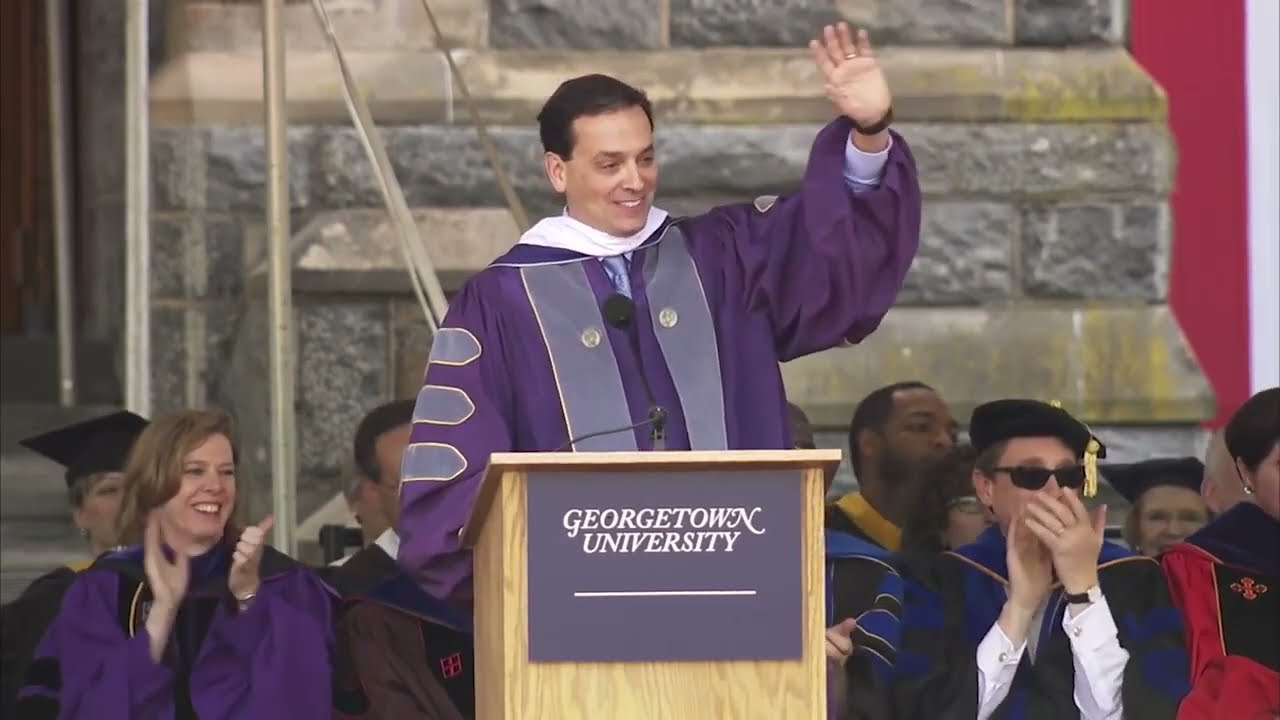
Daniel Pink conducts a live experiment where people draw an E on their forehead to test perspective-taking. The exercise reveals that powerful people struggle to see from others' viewpoints. His advice to graduates: balance ambition with humility and stop assuming you're the smartest person in the room.
By virtue of the authority vested in me by the Congress of the United States and by the Board of Directors of Georgetown University, I officially confer upon Daniel Pink the degree of Doctor of Humane Letters, honoris causa. And it's now my pleasure to present to you Mr. Daniel Pink, who will give the commencement address.
Okay. President DeGioia, Vice Provost Bass, Dean Otter, Secretary Quinn, Father O'Brien, Rabbi Gartner, faculty, staff, guests, and students, thank you for this degree. It's an incredible, incredible honor. I'm so, so Grateful. Before I begin, I want to offer a quick word to all of you soon-to-be graduates. It's been only about 90 seconds, but I have to say, it's awesome being a Georgetown alum. I think you're going to enjoy it. As Denise Keyes told you, I spent the last 2 decades trying to understand how people work, how organizations function, and in particular, how we can use social science— psychology, economics, linguistics, and so on— to do things a little better. So this afternoon, I want to tell you about one piece of research that yields one important lesson as you embark on your careers and your lives. One piece of research, one lesson. However, because this is a school of continuing studies, But where innovation is baked into the curriculum and where learning is often experiential, I want to do things a little differently. Instead of telling you about this study, we're going to recreate the experiment itself right here in real time. I was expecting a slightly more enthusiastic response to that, but—
Yeah, good.
I will soldier on here. So here's what we're gonna do. I'm gonna be the experimenter. All of you will be the participants. Got it? I'm the experimenter. All of you are the participants. And when I say all of you, I mean not just the graduates, but everyone. Mom, Dad, aunts, uncles, brothers, sisters, sons, daughters, cousins, spouses, partners, friends, colleagues, those people over there who are looking for a Starbucks. Everyone.
Everyone.
Everyone, I'm going to give you 3 very simple instructions. You are to follow these instructions. You are not to overthink these instructions. And I'm talking to you, doctoral students. Seriously, they're very, very easy. The odds of someone being harmed are small. Let's get started. Instruction number 1. Identify your dominant hand. Very good. Instruction number 2, with your dominant hand, snap your fingers 5 times very quickly.
Awesome.
Instruction number 3, with the forefinger of your dominant hand, the pointer finger of your dominant hand, on your forehead, draw for me a capital E. Excellent. We've now completed the experiment, so let me explain. This is an experimental technique that social psychologists have used since the early 1980s to measure what's called perspective-taking, the ability to get out of your own head and see things from someone else's point of view. Let's go over the instructions again, and they'll make a lot more sense. Identify your dominant hand. For this kind of research, you have to— I'm just going over the instructions again. You can do it again if you want, but— for this sort of research, you have to control for handedness because left-handers' brains and right-handers' brains sometimes operate differently. OK? Snap your fingers 5 times quickly. What's that instruction about?
Nothing.
Nothing. It's just a distraction. All of you are trying to figure out what the test is for, and this is just a way of faking you out. Finally, you get to the part that the researchers really are looking for, which is this: On your forehead, draw for me a capital E. Now, there are 2 different ways to draw the E. All right? I can draw it like this, so you can see it, your perspective, or I can draw it like this, so I can see it, my perspective. Now, in the actual experiments, they use erasable markers, not fingers, so it's even clearer. Here's what this measures. Put people into an experimental setting, control for handedness, make them snap their fingers, ask them to draw an E. What do they do? Do they take their own perspective? Or do they take someone else's perspective? When you don't know what's being measured, what's your instinct? What's your default? What's your go-to move? To take your own perspective? Or someone else's perspective? A few people over there sort of erasing their E's, trying to— only at Georgetown would you have students struggling to get the right answer all the way to commencement. Now, just to be clear though, if you drew the E from your own perspective, it doesn't mean you're a bad person. It could just mean that you're a husband. Because what really matters here is context. And there's one dimension of context I want to focus on: power. When people feel powerful, do you think they're more likely to take their own perspective or someone else's perspective?
Their own.
It's usually not even close. The research shows that when you remind people of their achievements, when you ask them to describe a time they had authority over somebody, they become much more likely to draw the E in the self-oriented way. As some of these researchers explain, and here I'm quoting, power leads individuals to anchor too heavily on their own vantage point, insufficiently adjusting to others' perspectives. Here's the key, or what you public relations grads turned social media consultants would call The major key. In general, not all the time, but lots of the time, there's an inverse relationship between feelings of power and perspective-taking. The more powerful someone feels, the worse, typically, his or her perspective-taking abilities become. High-status people in organizations and in society typically aren't very good perspective-takers. But low-status people? They're usually great at it. After all, they're not in control. So to survive, it sure helps to know what the people who are in control are thinking. This is the one idea, the one idea I want you to remember. A rich body of science shows that in general, the more powerful people feel, the more their perspective-taking abilities degrade. I tell you this Because all of you are about to become more powerful. In a few minutes, 28 of you will receive a bachelor's degree. And not just any bachelor's degree, a bachelor's degree from Georgetown. More than 400 of you will receive a master's degree. That places you in elite company. Today, only 9% of Americans have a master's degree or above. 91% of this country has not achieved what we're honoring you for today. Tomorrow, you will be more powerful than you were yesterday. Next year, you will be more powerful than you were this year. As time goes on, your salary will climb. Your responsibilities will expand. The scope of your influence, maybe the size of your office, will enlarge. And that's great. You should be powerful. You're really good. And everyone assembled here today wants you to take the education you received and set budgets and allocate resources and hire a team and make decisions of consequence. We want to see you. We want to see you talking on TV and testifying before Congress and making billion-dollar deals. We want you to become a name partner or a CEO or a cabinet secretary. And many of you will. And when you're in these positions, sometimes perspective-taking can't be your top priority. If you're an emergency management specialist responding to a massive derailment or an IT honcho battling a hacker attack, you might not have the time or the luxury to shift perspectives. And yet, and yet, Be careful. Power can be a heady brew. Now, because your education was enriched by Jesuit values, you're less susceptible than others to its intoxicating properties. But mark my words, before long, some of you will begin drawing the E differently than you drew it today. And if you don't notice or don't care, if you gradually lose the ability to see the world through another's eyes, all the experience and expertise you've accumulated will melt into a puddle of unrealized potential. But if you work to balance power and perspective-taking— and again, you'll have to work at that, it won't come automatically— you'll become a more effective leader because you'll offer reasons beyond I said so for why anybody should follow you. You'll become a more skillful negotiator because you'll understand all the positions around the table. You'll become a wiser decision maker because your judgment will be informed by a wider set of views. But perhaps more than anything, you will avoid what could be the biggest mistake that bosses, teachers, executives, government officials, and anyone else in a position of power can make. It's a mistake that I've made. It's a mistake that the people on this stage have surely made. It's a mistake that some of you have made during your time at Georgetown. And the mistake is this: thinking you're the smartest person in the room. My hard-won experience, coupled with 2 decades of watching organizations in action, has taught me this: if you think you're the smartest person in the room, You've just proved that you're not. Believing that you're the smartest person in the room— trust me on this— never ends well. It's how companies crumble. Example: Enron. It's how governments make tragic mistakes. Example: the US in Vietnam. And it's how otherwise capable people undermine their achievements and limit their contributions. Example, you might be thinking of somebody right now. And believing you're the smartest person in the room is especially dangerous today. Why? Because our rooms have gotten a lot smarter. If I may paraphrase the Broadway musical Hamilton— And no 2016 commencement speech is complete Without a Hamilton reference, we're bringing more people into the room where it happens. This graduation is proof. I want to show you something. I have in my hands a copy of the order of the exercises, the program for the very first Georgetown graduation in 1817. That day. 199 years ago, only 2 students received a diploma: George Dinnies and Charles Dinnies. They were brothers. George was the valedictorian of the graduating class. Charles was number 2, the salutatorian. Their parents must have been so proud. But the program also lists right here the other students then at Georgetown who had come to participate in the ceremonies. Let me read you some of their first names, just their first names. William, Henry, Charles, James, James, George, James, William, Charles. They're all men, of course. But listen again, George, Henry, James, Charles Williams. Everybody seems to have been named for a king of England. Now let me read you the first names of some of this year's School of Continuing Studies graduates: Abdo, Aditya, Ajoye, Ahad, Ahmad, Alejandra. Alejandro, another Alejandro, Amel, Amir, Anastasios, Angelita, Azuka, Asha, Assad. And those are just the A's. Now, to be fair, to be fair, you do have one Charles graduating today. Holla Charles Curry Jr. in the Technology Management program. But at this graduation, you've also got a Carlos. Carlos Ayala Quintero in Public Relations. You've got 2 Georges this year, George Karam and George Dwyer in Liberal Studies. But unlike in 1817, unlike many people imagined in 1817, you've also got a Georgina. Georgina Davila Martinez. I don't have photographs of that 1817 ceremony, but it's a pretty safe bet that not only were all the students men, All of them were white. Look around today. Look around today. More than 40% of the graduates this afternoon are women and men of color. Let me say that again. More than 40% of the graduates today are women and men of color. Somewhere up there, the Dinnies brothers are looking down at this graduation, and they're really confused. These days, it's tough to be the smartest person in the room because our rooms have gotten way, way, way smarter. So don't even try. Instead, my fellow almost alumni, In a few moments, as you exit the stage with your diploma in hand and move through the threshold of the rest of your life, remember the lesson of the E. Use your power, but sharpen your perspective-taking. Argue like you're right, but listen like you're wrong. And most of all, follow the most excellent role model of Charles Dinnies, the salutatorian at that first graduation back in 1817, and try to become the second smartest person in the room. Congratulations to the families that supported you. Congratulations to the faculty that educated you. And congratulations most of all to you, the graduates, the remarkable, dazzling, boundary-breaking, perspective-taking, change-making Georgetown School of Continuing Studies Class of 2016. Thank you very much.








