6 Things You Should Never Do in Public
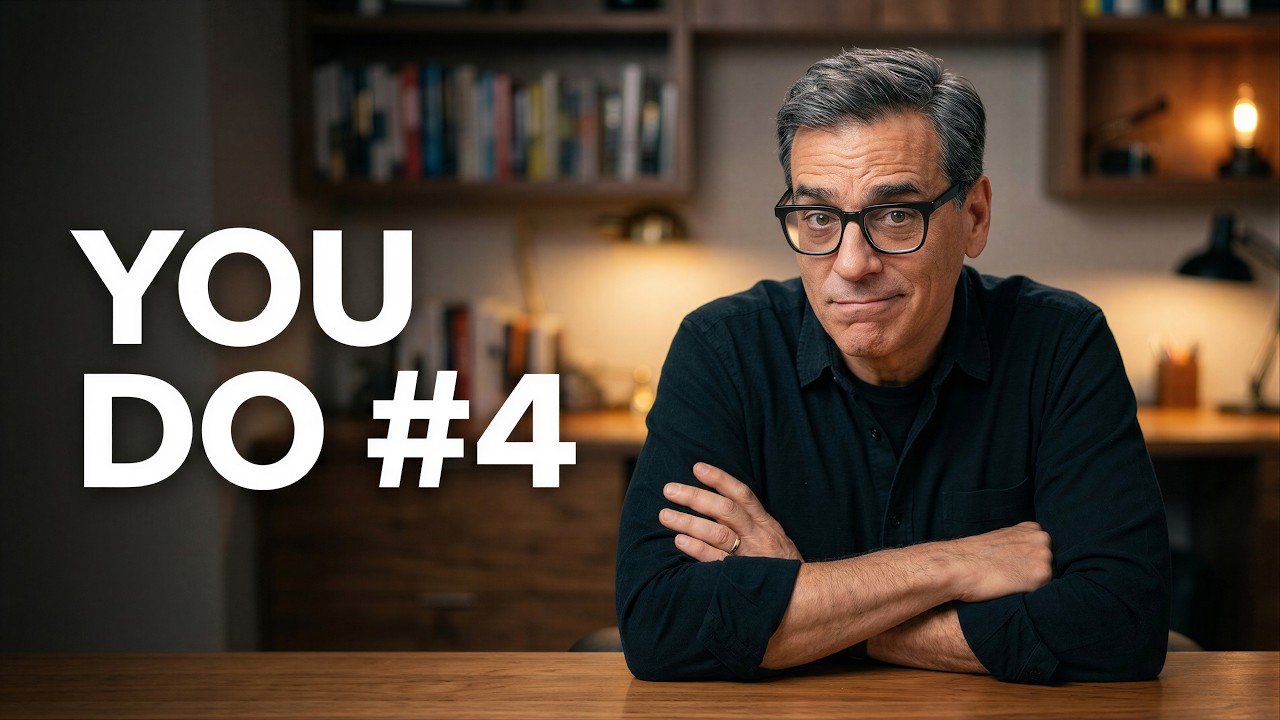
Daniel Pink breaks down six research-backed rules for public behavior: keep grooming and strong smells private, use headphones instead of half-conversations, don't block doors or escalators, respect personal space boundaries, treat lines as sacred, and practice civil inattention with strangers. Following these rules reduces social friction and improves how everyone moves through shared spaces.
Chapters
You're in a quiet train car and the guy across from you takes a call on speakerphone, so now everyone gets both sides of the argument he's having with his wife. You're riding the escalator up and the person in front of you reaches the top and stops dead to look at their phone, while the stairs keep delivering human beings directly into their back. You're on a plane, mid-meal, and the seat in front of you comes down like a drawbridge, full speed, full recline, zero warning. You've been in line for 10 minutes behind someone who, upon finally reaching the register, looks up at the menu for the very first time and starts planning their order. In every one of those moments, the same question hangs in the air: What's the right thing to do? Is there even a right thing to do? The answer is an unqualified yes, there is. Sociologists and economists have spent decades studying exactly these situations, and if I were made dictator tomorrow, the 6 rules in this video would be law by By Friday. Now, since that dictator appointment is still pending, I'll settle for trying to convince you. I've spent 20 years writing about the science of human behavior, which means I come to you today with peer-reviewed citations and personal grievances, and I will be presenting both. 6 rules of public life. Each one comes with the science of why it exists and what to do instead. Keep score as we go, because at the end, I want your number. How many of these 6 do you agree with? And stick around for rule 6, because it's the one people break constantly while feeling like good people the entire time. Before we get going, if you're not subscribed to this channel, hey, can you do me a favor and just click and subscribe? Then we can get moving. Rule number 1, keep your backstage behavior backstage. The sociologist Erving Goffman had a famous idea. All of us are performers. In public, we're on the front stage, composed, presentable, holding it together. And then there's the backstage— home, bathroom— where we're alone. Where the costume comes off and the grooming happens. Clipping your nails on the train is dragging the backstage onto the front stage. That's why it doesn't just annoy people, it revolts them. Every stranger in that car is quietly doing you the courtesy of maintaining public composure. And the clippers announce that you've just decided to opt out. You've turned a shared car into your bathroom and everyone else into unwilling guests in that bathroom. Instead, what you should be doing is clipping your nails at home over a trash can like a person with a secret to keep. Because grooming is supposed to be secret! That's the whole deal. Same rule, different sense. On an airplane, in a train, in a car, don't eat something we all can smell. Here's the thing about smell. It's a commons. I can look away from your behavior. I can put in earbuds, but I can't opt out of air. When you crack open something pungent in a sealed space, you've made a unilateral decision on behalf of 40 strangers for the next 20 minutes. Instead, save it. It'll taste better in somewhere that isn't a hostage situation. Rule number 2: The sound belongs to everyone. This one comes with my favorite piece of science in this whole video. Researchers at Cornell studied something they called a halfalog— hearing one half of a phone conversation— and they found that a halfalog drains bystanders' attention more measurably than hearing a full conversation between 2 people. Why? Because your brain is a prediction machine. A complete conversation has a rhythm it can follow and tune out. Half a conversation is unpredictable. Every silence might end, and your brain can't stop trying to fill in the missing side. You are literally unable to ignore it. Which means the guy on speakerphone isn't just being rude. He's conducting a small involuntary cognitive experiment on everyone in range. Instead, Phone to your ear or step away. Your ear was designed for this, folks. And a cousin rule: don't play music or videos out loud. When you skip the headphones, you've appointed yourself DJ of a captive audience. Here's the rule: headphones, headphones, every time. They cost a lot less than all the goodwill you're burning. Rule number 3: don't be the bottleneck. Public space is a flow system. Thousands of strangers coordinating without a word. And it only works if nobody becomes the clog. The classic, blocking the train doors. The system runs on one sacred sequence: people off first, then people on. Off, then on. Stand in the doorway and you've single-handedly jammed the whole exchange and undermined human civilization. Instead, step onto the platform, let them off, reboard. You lose 4 seconds and gain hours. A related rule: don't stop at the top of the escalator. Everyone behind you is still moving. That's how escalators work. Clear the landing before consulting your phone, your family, or your spiritual compass. And while we're on escalators, stand right, walk left. It's a coordination norm. Nobody decreed it, but everyone depends on it. And my personal favorite in this family: don't reach the front of the line. Get to the front of the line and then begin deciding what you want. You've had the entire line to prepare. The menu has been visible, in some cases for the duration of a short film. Reaching the counter undecided makes you the system's single point of failure. Instead, decide while you wait. Ladies and gentlemen, that's what waiting is for. Rule number 4: Respect the contested inches. Public space is full of invisible property lines, and the strangers around you are all honoring them. A subway seat is a defined parcel. Your knees do not get an easement onto the seat beside you, and your bag doesn't get its own ticket. Bag on your lap, knees in your zone. This one is so contested that MTA, the Metropolitan Transit Authority, literally ran an advertising campaign about it. The airplane is where this rule gets genuinely philosophical. Economists use the reclining seat to teach something called the Coase theorem. The puzzle of who actually owns those 4 inches behind your seat. The button says you. The knees pressed against your chair say something else. The honest answer is, it's contested territory. Which means reclining at full speed, at full recline, mid-meal service isn't claiming your property. It's an invasion with a headrest. Glance back, recline slowly, partial credit for partial recline. And then there are the armrests. A 3-seat airplane row runs on a quiet treaty. The middle seat, punished on both sides, denied a wall, denied an exit, gets both armrests. That's the compensation package. Aisle and window, you already won. Surrender the elbow room. It's a tiny tax on your incredible fortune. Then there's the buffer zone. First, leave a gap at the urinals. Take the ends first. Also, don't loom at the ATM. This spacing instinct is so real that scientists have actually measured it. In one case, with a study so ethically dubious, it's now taught as a cautionary tale. Researchers in the '70s hid a periscope in a men's room to prove that crowding a stranger measurably disrupts the proceedings. Science confirmed what you already knew. Space out, back up. Rule number 5, the line is a moral institution. Not a suggestion, an institution. First come, first serve might be the most fiercely defended fairness norm we have, and here's the tell. The outrage at a line cutter is wildly out of proportion to the seconds actually lost. Nobody's mad about the time. They're mad about the principle. You declared your time more valuable than anyone else's, out loud, with your body. Stanley Milgram— yep, the famous obedience researcher— once sent students to cut into more than 100 New York City lines just to document what happens. People objected, sometimes physically, over spots in line. That's how deep this one runs. So instead, just remember, the back is right there. It's not far. That's the point of being in a line. The line also has an internal physics. Don't tailgate the person ahead and don't drift so far back that strangers have to guard the gap for you. One comfortable car length. That's the norm. Also, let's talk about boarding planes. Don't be gate lice. That's the name that airline crews give to the crowd that swarms the boarding gate before its group is called. Standing up sooner does not move the plane. It has never once moved the plane. Stay seated until they call your group. Rule number 6: Strangers are people, not scenery. This is the one people break while feeling like good people, so watch closely. Goffin found that strangers passing on the street perform a tiny ritual he called civil inattention. A half-second glance, then away. That glance is a complete message: I see you're a person and I'm no threat. And the look away is the second half of the message. Hold the stare and you've broken the contract. It stops reading as attention and starts reading as a challenge. Glance, release, that's the whole move. The modern version: don't photograph identifiable strangers without asking, especially kids. Being in public doesn't erase a person's claim on their own image. Legality isn't the bar, agency is. If someone is doing something wonderful, ask or compose a shot without recognizable faces. The photo you take of a stranger without asking turns a person into content scenery. With a pulse. And the version everyone excuses themselves. Don't argue with an employee who cannot change the rule. When the flight cancels or the return gets refused, we displace our frustration onto whoever's available instead of whoever is responsible. The gate agent did not invent thunderstorms. The barista did not set corporate policy on oat milk. Aim your complaint at people with actual power over the outcome. There's usually a form for that. And hand the human in front of you a little grace instead. Nothing reveals character faster than how you treat someone who can't fight back and can't fix it. So, that's the rulebook. 6 rules, but really 1 rule wearing 6 outfits. Public life is a cooperative game strangers play together, all day, with no referee. It works only because each of us assumes everyone else will hold up their end. The glance away. The surrendered armrest. The space left in the doorway. The patience shown to an employee who didn't cause a problem and can't fix it. Each one is a tiny vote for the kind of shared world you want to live in. Break these rules and nothing happens to you exactly. Everyone just quietly knows. And honestly, being good at this stuff is now a competitive advantage. The bar is on the floor. You can clear it by deciding what sandwich you want before reaching the counter and by keeping your nail clippers At home. I'll see you next time. Headphones in. If you like this video, you'll probably enjoy this one where I share 16 things that everybody should know how to do, some of which you probably don't know how to do. Thanks for watching. Make sure to subscribe.








