How the Most Creative People Get Their Breakthroughs (It Isn't Hard Work)
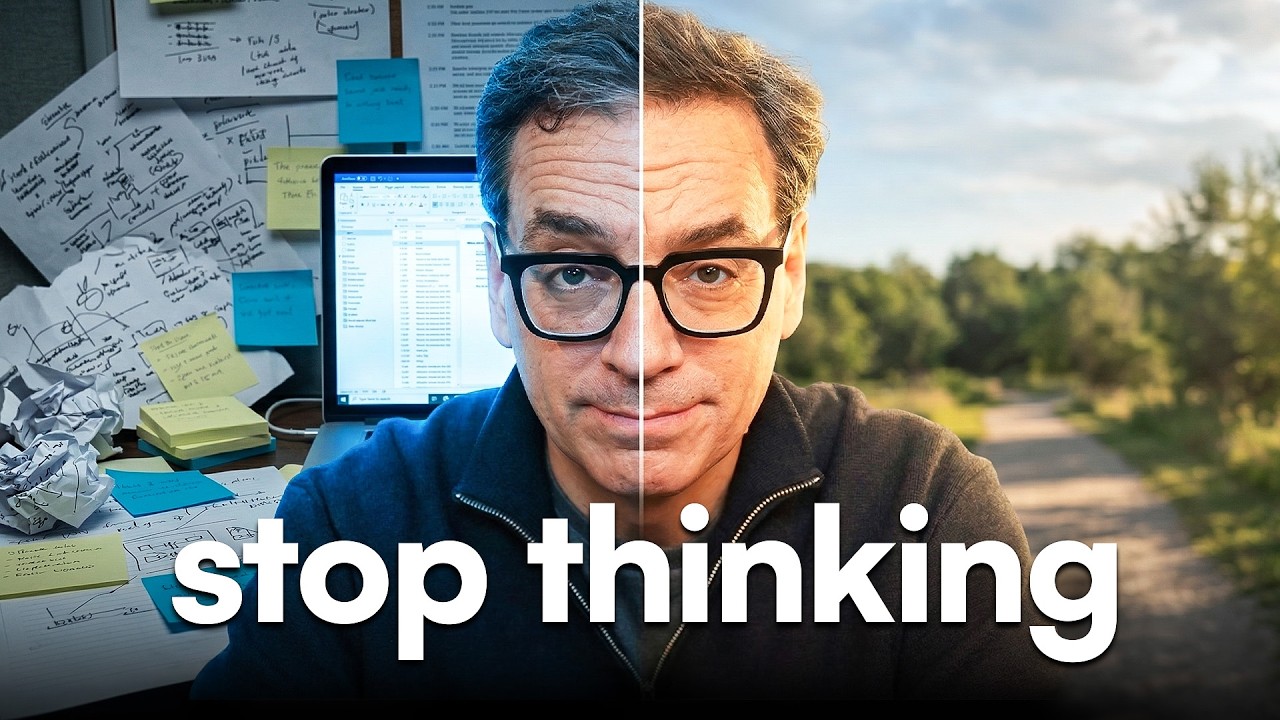
Daniel Pink explains that breakthroughs don't come from grinding at your desk. They happen when your mind shifts into a wandering mode, often while showering or walking. He shares research on separating intense work from deliberate breaks, and interviews David Epstein about Nobel Prize winners who made discoveries during unstructured "Friday evening experiments."
Chapters
Why do your best ideas show up at the worst possible time? Not when you sit down to work, not when you open your laptop, not when you're staring at a blank screen trying to force something smart to happen. They hit in the shower, on a walk, behind the wheel, right as you're about to fall asleep. That's not a discipline problem, and it's not a creativity flaw. It's a misunderstanding of how ideas actually form. I've spent more than 20 years studying human motivation and behavior. Interviewing scientists, digging through thousands of studies, and writing books about how people think, work, and create. And the science keeps pointing to the same conclusion: your best ideas don't come from trying harder. They come when the mind is allowed to loosen its grip. In a minute, I'll explain why that is and how to redesign your day so your best ideas stop ambushing you at inconvenient moments and start showing up when you can actually use them. And later, my friend David Epstein is going to join us to tell us a remarkable story about a scientist who studied trying to think his way to breakthroughs and accidentally discovered a system that produced them instead. It's called Saturday Morning Experiments. The diagnosis. We tend to think ideas come from focus, that we can sit down, concentrate, and then conjure brilliance from the universe anytime we'd like. But science says something very different. For instance, one well-known study found that physicists and writers had their aha moments when their minds were wandering. That's because psychologists and learning experts like Barb Oakley distinguish between 2 mental modes: focus mode— that's when you're concentrating, analyzing, executing— and diffuse mode— that's when your mind is wandering, relaxed, and open. Focus mode is great for editing, refining, finishing. But most insights, those eureka moments, come from diffuse mode. That's why ideas pop up when you're showering, working out, shaving, or putting on makeup. In these moments, Your brain's default mode network kicks in. This network specializes in making remote connections. Your brain quietly asking, what does this have to do with that? Which explains something important. Daydreaming is not wasted time. It's time deployed in a new way. It's where old thoughts break down and recombine into something new. That's also why trying to Force ideas often backfires. Pressure narrows thinking. Relaxation widens it. So when you say, I get my best ideas at the worst time, what you really mean is, my life is optimized for execution but not for insight. Part 2: The Prescription. So what do you do? You don't wait passively for lightning to strike, and you don't quit working hard. Instead, you build an idea bank. Friendly system. Here are 3 specific research-backed moves. Move number 1: Separate idea time from work time. Most people demand 2 incompatible things at once: generate original ideas and execute efficiently. That's like asking your brain to sprint and wander at the same time. Instead, divide the labor. Do your hardest thinking after focused work, not before it. Too often, We wait for an idea and then start working. The better sequence is the opposite. Work first and then let the idea find you. Here's why. Research on creativity shows that insights often come after you've saturated your brain with a problem and then stepped away. That's the key— stepping away. So try this. Work intensely for 60 to 90 minutes, then stop. Take a walk, do some laundry, space out. You're not slacking. You're letting your brain wander on its own, and that's the key to creative thinking. Move number 2: Schedule moderately engaging activities on purpose. Researchers call it the shower effect. Activities that balance linear thinking with unbounded divergent thinking help the mind find its way to unexpected ideas. So build these moments into your schedule. 15 minutes of quiet thinking time, solo walks. These might feel indulgent, But they're not. Research shows that people consistently underestimate how much they'll enjoy simply sitting with their own thoughts. And thinking and moving at the same time is even more potent. One Stanford study found that people who walked generated nearly twice as many creative ideas as people who were sitting. Not because walking is magical, but because it gently occupies your body while freeing your mind. So here's a rule I recommend. If something reliably gives you ideas, it goes on your calendar. Not as a reward, as part of the job. 15-minute walks aren't breaks from thinking, they're how thinking actually happens. Move number 3: Capture ideas immediately or they will evaporate. Here's something super frustrating that's happened to me and probably happened to you. You're in diffuse mode, an amazing idea comes to you, but you don't have a way to capture it and Poof! Advantages. Don't let that happen to you. Stop trusting your memory and instead build a system so you're prepared when ideas strike. Keep a notes app open on your phone or a small notebook nearby or voice memos in your phone. Your only job in the moment is to capture that idea, not to evaluate, because messy beats forgotten. Then later during that focus time, you can decide what's worth keeping. Creativity is generous, but it's also fleeting. And remember, your brain is for having ideas, not for keeping them. Part 3, the reframe. Let me leave you with this. The problem isn't that your best ideas come at the worst time. The problem is that you've been taught the wrong definition of work. Real creative work has 2 phases: loading the problem and letting it go. Execution happens at the desk. Insight often happens everywhere else. So stop apologizing for walks, stop calling daydreaming a waste of time, and for gosh sakes, take a shower. Those moments aren't distractions from your work, they're the source of it. So here's your experiment. This week, schedule one walk, one shower, or one quiet block of nothing, and protect it like a meeting. If you design for that truth, your best ideas won't feel inconvenient. They'll feel inevitable. And now, through the magic of YouTube, I'm in the office of David Epstein, the science writer, author of the 2 blockbuster books, The Sports Gene and Range, author of a new soon-to-be blockbuster book, Inside the Box. And he is here with some, I guess, some advice on what we can do about all this.
Yeah, Dan. I mean, you've been talking about why sometimes our best ideas come at the worst time. And you probably think of Saturday morning as really the worst time to have your best work ideas. But when I was writing Range, I spent some time interviewing a scientist named Oliver Smithies. While I was going through his diaries that were all digitized, I noticed that all of his breakthroughs seemed to come on Saturday mornings. And I asked him about that, and he said, oh yeah, some people ask me why I ever worked any other days. I call it Saturday morning experiments, he said. It's a time when I'm not under as much pressure. I can kind of wander and connect ideas. And it was during one of those Saturday morning experiments where he was trying to figure out a different way to isolate DNA molecules. order to study them, and had this idea harkening back to childhood when he helped his mother starch his father's shirts.
Whoa.
That the starch would be kind of gooey, and maybe he could use that to essentially trap the molecules that he wanted to study. And that turned into an innovation that changed the world, and he went on to win the Nobel Prize. All of his breakthroughs were coming in this Saturday morning time when he said, you're not beholden to short-term results, you can wander. And he would even use other people's equipment. in his wandering. So his colleagues had an acronym, NBGOKFO— no bloody good but okay for Oliver— because they would leave their old stuff out because on Saturday morning he would experiment with it. So that was his wandering time. And I asked, well, why couldn't you wander like that during the week? And he said, I just can't. There's other people around, there are tasks that need to be done. It had to be Saturday morning.
Right. Where— and did he do this at his house? Did he do it going to his office or laboratory?
Both, but he would often go into the lab. And in fact, he told me that he had a key to like the custodian's closet in case he wanted to use any of the weird equipment in there, which is actually where he got the starch from. So everyone knew this, so they started to give him access during the weekend.
Yeah, this reminds me a little bit of Andre Geim and Konstantin Novoselov, who won the Nobel Prize in Physics. They did something called Friday evening experiments. Yep, yep, exactly. And where they made a huge breakthrough in material science in one of these Friday evening experiments. They also ended up winning the Ig Nobel Prize For levitating frogs.
The silliest work.
Yeah, and the same thing. So it's like, if you give yourself space to wander, you're gonna do stuff that's a total waste of time.
Yeah, yeah.
But that's kind of the point, because in the universe of all that stuff that's a waste of time, could be something is a breakthrough.
And that's the only way to get to it.
Right, right. So you're saying that if I do Friday evening experiments or Saturday morning experiments, I'll win the Nobel Prize?
That's exactly— I think you're more likely to win the Ig Nobel, but you know, you never know. The point is that you have to have Some of that time where you're able to wander. It's like you mentioned Andre Geim and his lab group. That started— their discovery of graphene, which is what they won the Nobel for— that started with ripping like thin strips of basically pencil lead, you know, graphite, with Scotch tape, and it turned into the world's only single atom thick material, right? So it looked stupid basically, but they didn't judge and they allowed themselves that wandering time that apparently is really hard for people to get during a normal week.
Wander, Look stupid, don't judge. I think that's 3 good lessons from all of this.
Absolutely.
That's what we're doing here. We're wandering.
Looking stupid and not judging.
2 out of 3. All right, if this was interesting to you, there's a companion video I did with David that you might like. David tells this great story about a bored maintenance engineer who basically helped set Nintendo on a completely different path, and I jump in there too to talk a little bit about why boredom isn't something to get rid of, but actually one of the ways new ideas emerge. That video is right here.








