How To Force Your Brain To Be Motivated (when you don’t feel like it)
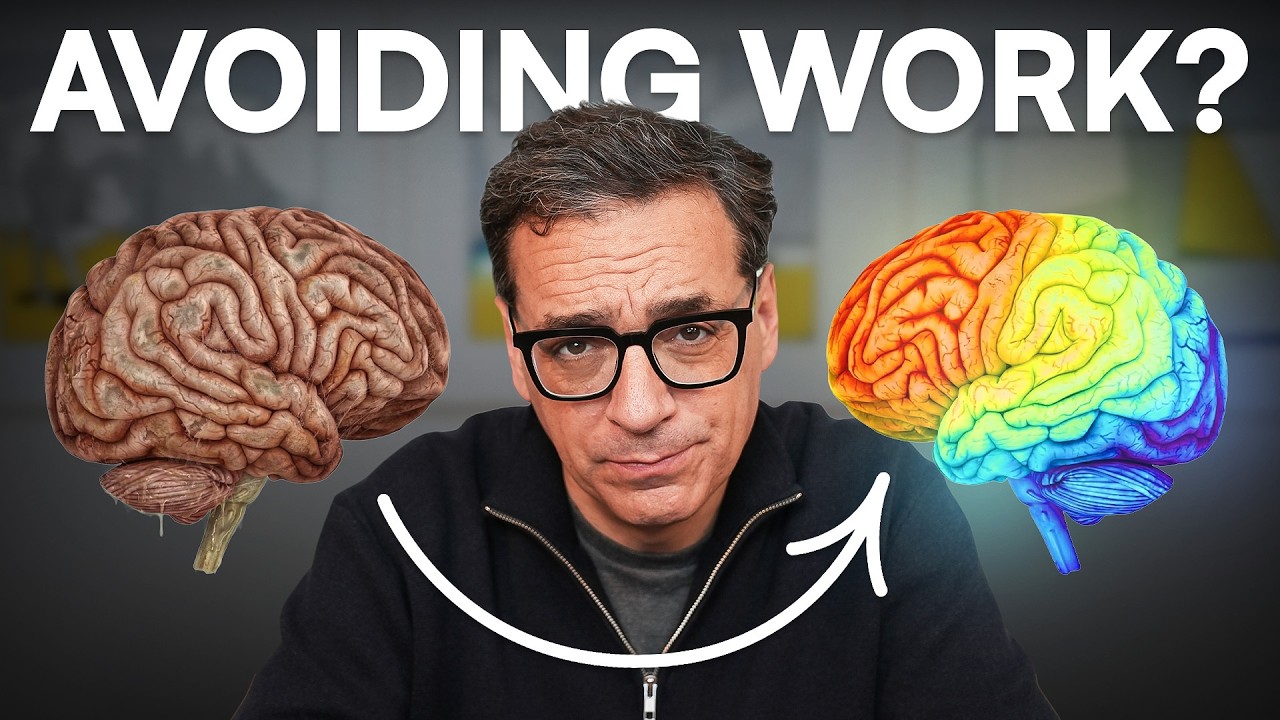
Daniel Pink argues that autonomy, mastery, and purpose drive motivation better than rewards or threats. Give yourself a tiny choice or set your own deadline, break goals into micro-progress steps, and write a one-sentence purpose statement linking your work to something larger.
Chapters
You know those moments when your brain just doesn't want to do the thing? The email, the workout, the project. You stare at it, you know you should start, but your brain says, nope, not today. Here's the good news. You can actually force your brain to be motivated. Not with bribes, not with guilt, but with science. Trust me, I've studied this stuff. I've tried it myself. It works. Let me show you how. Part 1, why carrots and sticks don't work. For years, we've been told that motivation is simple. Dangle a carrot, wave a stick. Do the thing, get the prize. Don't do the thing, Get punished. That works fine for easy mechanical stuff like stuffing envelopes or maybe cleaning your garage, but for anything that requires creativity or sustained attention, we have 60 years of science that shows that these if-then rewards— if you do this, then you get that— are way less effective. Sometimes they even backfire. You can't bully your brain into caring. Part 2: The 3 real drivers of motivation. So if carrots and sticks often fall short, what works better? On the job, that begins with being paid fairly. The evidence says that money does matter, but it matters mostly as a threshold motivator. It's table stakes. Once we cross that threshold, 3 other drivers lead to enduring motivation. Think of them as 3 switches you can flip to trick your brain into wanting to act. The first is autonomy, the urge to direct your own life. Here's a technique. Give yourself a choice, even a tiny one. Don't say, I have to write this report, say, I'm gonna write this report at the coffee shop or at my desk. My choice. Even small choices create a sense of ownership, and ownership fuels action. The second is mastery, the desire to get better at something that matters. Here's a technique for that. Break big goals into micro-progress. Your brain loves progress. So instead of saying, I need to master Spanish, try, I will learn 10 words today. That tiny hit of progress creates a motivational loop that pulls you forward. The third is purpose. Understanding why what you do makes a difference in the world or a contribution to someone else. Here's a technique for that. Reframe dull tasks by connecting them to a bigger why. Don't think, I'm slogging through this budget spreadsheet. Think, I'm making sure my team has the resources they need. Purpose fuels persistence. Part three: rewards that backfire and rewards that work. It's not that all rewards are bad; that's not true. People love rewards. It's just that we have to be careful. The if then words I mentioned—if you do this, then you'll get that—are fragile. They're contingent, and contingency creates pressure. It narrows focus. The minute the reward disappears, so does the motivation. But there's another kind: non-contingent rewards. Instead of dangling a prize in advance, you surprise yourself or someone else after the effort. You finish the report? Take yourself out. for a great coffee. Your team nails the presentation? Celebrate afterwards. Why does this work? Because it feels authentic, not manipulative, and authenticity strengthens motivation. Part 4, flip from extrinsic to intrinsic. We think we need hacks, tricks, or hacks for the hacks, but the real move is simpler. Flip from extrinsic drivers to intrinsic ones. Extrinsic drivers— money, grades, gold stars— can get you to start, but they can also stifle creativity and stall long-term Motivation. Intrinsic drivers, curiosity, self-direction, meaning, that's the fuel that lasts. That's what forces your brain not just to start, but to keep going. Part 5, 4 quick ways to force your brain into gear. Number 1, choose your deadline. Don't wait for someone else to impose it. Pick your own and stick to it. That's autonomy. And it's important to understand why this is so important. You know, autonomy is kind of an abstract word, and one way to understand it is to think about What's the opposite of autonomy? The opposite of autonomy is control. And here's the thing, you and I and all of our other fellow human beings, we don't like being controlled. When people are controlled, they only have 2 responses. They comply or they defy. And to do your best work, you don't want to be fully compliant and you don't want to be fully defiant. You want to be engaged. And a way to be engaged is for you to take back control. In even small steps like setting your own deadline. Which I do in my own writing. I get deadlines from editors, but I abide by my own deadline. When you do that, you feel a sense of control, and control leads to engagement. The second idea: start a streak. 10 minutes a day is better than 10 hours once a month. Slow, consistent progress is how people achieve mastery. And one of the things we know from the research is that the most powerful day-to-day motivator on the job in any kind of endeavor is making progress, even small progress. That's what leads to mastery. The trouble is we don't always see the progress that we're making. And so what you have to do is look for ways to record your progress, memorialize your progress. One of the things that I do is I have a notebook on the right side of my desk, and every night when I'm done working, I write down 3 ways I made progress. I very rarely look at it again, but it's a way to memorialize and see the progress that I'm making because I know that progress is the most important ingredient in achieving mastery. 3, write a one-sentence purpose statement before you start. Just one sentence. Why does this matter? That's purpose. Let me tell you a story from my own life. In my last book, the book about regret, I was struggling early on. I couldn't get anything done. I would show up at my office and I would just meander. I would just wander around and not achieve anything. And it got so bad That I found a coach. I just reached out to my network and said, I need a coach for this. And I talked to the coach for like 10 minutes, and he said to me, this is easy. You don't have a purpose. What I want you to do is I want you to write a one sentence for me that describes the purpose why you are writing this book. And I don't want to talk to you again until you do that. So I hemmed and I hawed and I waited. And finally, about 2 weeks later, I wrote the sentence and he says, okay, now you feeling okay? And I'm like, yeah, okay, I got it. And I put that sentence on the wall next to me and anytime I struggled, I looked at that sentence because purpose was an important motivator for me to do my best work. Number 4, give yourself a now-that reward. Surprise yourself after the work. That's motivation without manipulation. Here's one of the things that I do. If I have a really good writing day, one way that I will reward myself is to come into my house afterwards at 7 o'clock or 7:30 at night and make one of my favorite things in the world, and that is a martini. And I will sit and drink my very cold martini and say, wow, this was a good day. Now, I don't promise myself that in advance, but afterward it is a lovely, tasty reward. And very cold reward. Hey, if you like this video, you'll probably like my book Drive: The Surprising Truth About What Motivates Us. But before you go ahead and read that whole thing, check out our PDF summary. The link is in the description, and you can download it there totally for free.








