Northwestern University graduation speech
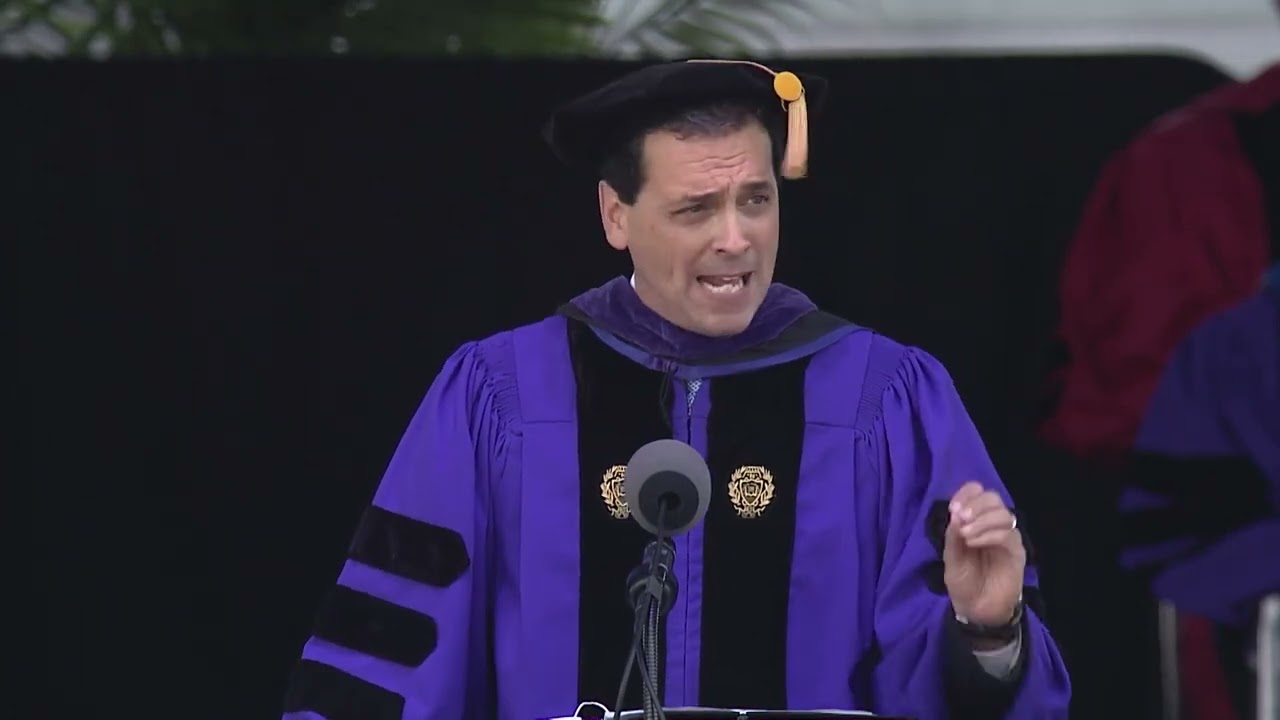
Daniel Pink, a Northwestern alumnus and bestselling author, tells graduates that a writing professor's advice to "write to figure it out" changed how he saw his career. He shares stories of alumni who abandoned their original plans—a material-science major who became a furniture maker, an economics major who became a fiction teacher—and urges the Class of 2014 to embrace ambiguity instead of rigid outlines.
Chapters
It is now my great honor to introduce our speaker, Daniel Pink. Daniel is a Weinberg alumnus and a New York Times bestselling author. He's written a number of books, I think 5, about work, business, and behavioral science that have sold more than 2 million copies worldwide. His articles and essays appear in the New York Times, Wired, and many other publications. This fall, Daniel will host a new series on National Geographic Television about human behavior. I joke with him that although he was a linguistics major and then went on to get a JD at Yale Law School, I think he's actually— having read some of his work, I think he's a social psychologist.
Thank you. But whatever.
So early in his career, Pink worked in politics and government, including serving from 1995 to 1997 as chief speechwriter to Vice President Al Gore. After Daniel earned his BA in linguistics from Weinberg College, where he— I should add, he was elected to Phi Beta Kappa and was also a Truman Scholar. He later received a JD from Yale Law School, where he was editor-in-chief of the Yale Law and Policy Review. Please join me in welcoming Daniel Pink back to Northwestern University. Thank you.
President Shapiro, Dean Mangelsdorf, Trustees Carr, DeHaas, and Finley, associate deans, faculty, distinguished guests, thank you for this high honor. And great privilege. Wow, look at all of you. It's been a long 4 years, hasn't it? Some of you didn't think you'd make it here. Many of you have no idea what's going to happen next. But still, here you are, sitting in hard seats, baking in the sun.
I'm sweating.
And nursing a wicked hangover. But enough about you parents. I'm here to talk to the students, the proud and mighty Class of 2014. Today I want to tell you a story about something I learned one afternoon my senior year at Northwestern. It's an insight that has shaped my life and that might be helpful in yours. As Sarah mentioned, 28 years ago I graduated from the College of Arts and Sciences with a degree in linguistics and all of the job prospects attached thereto. 1986 was an exciting year for the NU Linguistics Department. We graduated a record number of students. There were 4 of us. Now, when you major in linguistics, or art history, or classics, or, God forbid, anthropology—
Boo!
People always ask you the same question. You got it. What are you going to do with that? What are you going to do with that? Now, I know that ever since childhood you've been told there's no such thing as a stupid question. There's no such thing as a stupid question. Well, that's a stupid question. And if you get it this weekend— and I'm looking at you, Slavic Languages and Literature Department— Just respond with a brief, you never know. Because you never know. Which leads to my story. I took lots of excellent classes here during my 4 years at Northwestern, but— and among the best were several small seminars I took in the college's amazing writing program. I took what was then called Writing the Short Story. with the wonderful Sheila Schwartz, who taught us how to use mundane details to reveal cosmic truths. I took Writing Poetry with the legendary South African poet Dennis Brutus, who told me he'd give me an A- in the course if I promised never to write poetry again. And best of all, in the spring spring of my senior year, I took Writing the Essay with a young and brilliant instructor named Charlie Yarnoff, who still teaches at NU and who happens to be sitting here today. Now, I already knew how to write an essay, of course. Like many of you, I grew up in the American Midwest. In Columbus, Ohio. Wow, a bunch of people who've obviously never been to Columbus. And back in central Ohio, we learned how it was done. So when I lugged my 25-pound electric typewriter up the stairs to the 3rd floor of Bob Hall my freshman year— yeah, I had essay writing pretty much down. Figure out your thesis. Make an outline, execute against that outline. Build your essay like you build a house: thesis, outline, execution. And like all of you, I'd gotten pretty good at it, but I wanted to get better, and I figured this guy Yarnoff might help. Alas, alas, on one of our very first essay assignments, I found myself struggling. My thesis was soggy and bland. Part A of the essay wobbled like the lime Jell-O they used to serve for dessert at Sargent Hall. Part B was a 6-car pileup of clichés and platitudes. Part C, well—
I'm sorry.
Part C was blank. So on the day before our essay was due, I dragged myself to class. Filled with dread and self-loathing, I explained my predicament and began frantically suggesting ways to repair my crumbling house. Maybe I should tighten the thesis. Maybe my outline should have 4 parts instead of 3. Maybe it wasn't as awful as I thought, and I should just power through and finish the job. Charlie Yarnoff didn't agree with any of my suggestions. No, he told me, your problem is something else. You don't know what you think. And then he unleashed 9 words that changed my life. Dan, he said, sometimes you have to write to figure it out. Sometimes you have to write to figure it out. I was stunned. This went against most of my previous instruction and much of what I thought this country stood for. Wait a second, that's allowed? You didn't have to know exactly what you wanted to say before you tried to say it. Writing wasn't only a way to memorialize your thinking, it was a way to figure out what you actually thought. Now today, from the vantage point of someone who's been on the planet for nearly 50 years and who spent many, many of those years writing for a living, this insight no longer seems so remarkable. But to 21-year-old me, it was a revelation. Sometimes you have to write to figure it out. This was huge. This was liberating. This was a little scary. I took the advice back to my creaky apartment on the corner of Clark Street and Sherman Avenue, which sat above what was then the Sherman Snack Shop, in what today, like much of America, is probably a Panera. And since that spring day, I've carried Charlie's words with me. When I'm sitting at the computer trying to do my job and the cursor just blinks and blinks and blinks, taunting me for my incompetence and incoherence, I many, many times say to myself, Dan, sometimes you have to write to figure it out. Now, if that were all I got out of this senior year encounter, indeed, if that were all I got out of Northwestern, That alone might have been enough to justify all those student loans and work-study jobs. But what I didn't realize then is that this advice wasn't just savvy guidance for how to write. It might be the wisest advice I know for how to live. Let me explain. Every one of you seniors today is thinking about, obviously, about the rest of your life. And many of you are thinking about it in a systematic thesis, outline, execution sort of way. You've come up with a perfectly formulated aim. You've outlined the precise steps that will get you there. And now, once your diploma is in hand, you'll move to the execution phase. Sound familiar, econ majors? And if you're not thinking this way, your parents probably wish you were. They love you. They worry about you, how you'll deal with the possibility of massive debt and minimal job options. They want you to be okay. And the way to be okay, we all believe, is to have a specific plan. Except maybe it's not. Sometime before graduate weekend ends, try this experiment for Find someone in his or her 40s, 50s, or 60s who's doing something you admire, something that contributes to the world, something that you might like to do yourself one day. Then ask that person how they got there. I guarantee you, 97 times out of 100, the smartest, most interesting, most dynamic, most impactful people will answer that question like this: It's a long story. Why? Because they lived to figure it out. At some point in their lives, they realized that carefully crafted plans, like meticulously outlined essays, often don't hold up. And tweaking the topic sentences or rearranging the subsections isn't enough. Sometimes the only way to discover who you are or what life you should lead is to do less planning and more living, to burst the double bubble of comfort and convention and just do stuff, even if you don't know precisely where it's going to lead, because you don't know precisely where it's going to lead. Now, this might sound risky, and you know what?
It is!
It's really risky! But the greater risk is to choose false certainty over genuine ambiguity. The greater risk is to fear failure more than mediocrity. The greater risk is to pursue a path only because it's the first path you decided to pursue. That's why I have so many extraordinary Northwestern friends and classmates Who are doing things they never envisioned when they sat in your seats long ago. A material science major who ended up as a furniture maker. A scary smart economics major who dropped out of law school to teach fiction. A political science major who 20 years later was elected commissioner of the World Series of Poker. Even Even a nerdy guy from Columbus, Ohio, who thought he'd become a lawyer and maybe a congressman, but who ended up thrilled beyond measure to be working out of a garage writing books. They, we lived to figure it out. And this is much less frightening than it seems. Believe me on this. As Sarah mentioned, 9 years after graduating from Northwestern, I had the good fortune of working in the White House. I got my job the old-fashioned Washington way. The first choice imploded in a scandal. I was nervous until I read something that Peggy Noonan, a speechwriter for President Ronald Reagan, once wrote. She said she had a 3-stage reaction to working in the White House. In stage 1, she took the job, arrived on her first day, and thought, I hope nobody realizes how stupid I am. In stage 2, a couple of months later, she realized, hey, I'm as smart as anyone here. And in stage 3, after a few more months, she looked around and said, oh my God, we're in charge? Mark my words, then ask your parents. Oh my God, we're in charge will be the central recurring experience of your adult life. So, So fear not, my soon-to-be fellow alumni. If you don't know what you're doing, that makes you roughly as competent as everyone else out there. And if you, unlike so many of them, are willing to throw away the outline when it no longer makes sense, to harness the wisdom of Charlie Yarnoff, to live to figure it out, you can do great things. Thank you. Godspeed, and congratulations to the amazing, astounding, awe-inspiring Weinberg College of Arts and Sciences Class of 2014! Thanks so much.
That was terrific. Thank you. Thank you, Daniel. That was terrific. Thank you.








