OMG, you're in charge: MCAD commencement speech - part 1
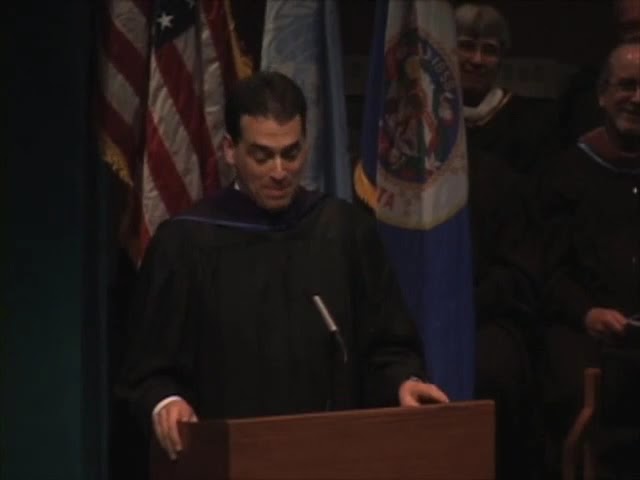
Daniel Pink, author of A Whole New Mind, tells MCAD graduates that right-brain skills like artistry and empathy will matter more than rule-based left-brain work. He abandoned his own plan for law school and argues an arts degree is now a valuable credential, not a backup plan.
Chapters
We are privileged now to welcome to MCAD Daniel Pink as our spring 2008 commencement speaker. An expert in innovation, competition, and the changing world of work, he's the author of the bestselling books Free Agent Nation and A Whole New Mind, both of which are renowned for their audacious and illuminating approaches. His articles on work, business, and technology appear in newspapers and magazines such as the New York Times, and Wired, where he's a contributing editor, and he's provided analysis of business trends on CNN, CNBC, ABC, NPR, and other networks in the United States and abroad. As an independent business consultant, he's advised startup ventures and Fortune 100 companies on recruiting, innovation, and work practices. A free agent himself, Dan held his last real job in the White House, where he served from 1995 to 1997 as Chief Speechwriter to Vice President Al Gore. He's also worked as an aide to Under— to United States Secretary of Labor Robert B. Reich, an economic policy staffer in the United States Senate, a legal researcher in India, and a latrine builder in Botswana. From retreat— latrine builder to bestselling author, it seems Dan could teach us all a thing or two about achieving a successful career. And in fact, that's what he's done with his latest book, The Adventures of Johnny Bunko, subtitled The Last Career Guide You'll Ever Need. It's a must-read for new graduates, and in fact, in addition to sharing his personal words of wisdom today with, with you, Dan is presenting a copy to each of today's graduates.
Thank you, Dan.
A little bit more about the book. It's a fast-paced manga collaboration that Dan did with MCAT alum Robert Tenpasse, and it's truly innovative in how it delivers its wisdom to a reader who would typically probably shy away from a traditional business book. It's a wonderful read for anyone facing a fork in their career path. Parents and other family members, I urge you to pick it up as well. Borrow it from your graduate. It has something really about focusing our lives for every one of us. And if you search for Johnny Bunko online, you'll find an animated trailer also by an MCAD alum, Lindsay Testolin, that's a treat. Dan, thanks for your collaboration for our— with our alums, and thank you for being with us today for this occasion. Please welcome Daniel Pink.
Well, thank you very much for that nice introduction. Thanks to all of you for being here, and congratulations to the class of 2008. As President O'Keefe mentioned, in a former life, before I chose the oh-so-very noble calling of writing business books, I worked in the equally noble calling of writing speeches for politicians. And because of that experience as a political speechwriter, people often ask me, Dan, what makes a good speech? And I've thought about that question quite a bit over the years, and I have determined that good speeches in general and good commencement speeches in particular always have 3 key ingredients, 3 key elements in any good speech, anywhere, anytime. They are brevity, levity, and repetition. Let me say that again. Brevity, levity, and repetition. So I'm going to try to be brief. I'm going to try not to be too, too severe and serious. And I will repeat the important stuff over and over and over And over and over and over again. A few moments ago, about 140 of you strode across the stage, shook some hands. Your parents beamed. Many of them snapped photos. A few shed tears. And now, as mom and dad sit here in these plush red seats, a single thought is running through their heads.
What?
That thought is, how in God's name did this kid hoodwink me into spending a small fortune so she could get a degree in animation? Or sculpture? Or comic art? Oh, the humanity! Many of you parents are wondering, what have I done? And the rest are sneaking glances at your beloved children and wondering, what will they do? Well, to all you parents, I say this: fear not, or at least fear less. In the economy your children are about to enter, the abilities they have developed here at MCAD will serve them very, very well. It used to be that the abilities that mattered most in the workforce were those that we might think of as left-brain abilities, the logical, linear, rule-based abilities, accountant abilities, computer programmer abilities. But make no mistake, today those left-brain SAT spreadsheet abilities still matter. They're necessary, but they're no longer sufficient. Think about it. These days accountants Compete with TurboTax, a $29 piece of software that does the job just as well for a lot less. Computer programmers compete with armies of code slingers in India and Bulgaria who do standard computer programming for a few dollars an hour. To survive today, you really have to be able to do work that's hard to outsource, hard to automate, and that delivers on the new demands of this very abundant age. And that means that the abilities that now matter most in a very, very hard-headed way, are really the right-brained ones. Artistry, empathy, inventiveness, big-picture thinking— these abilities, let's call them MCAT abilities—
Yeah!
Have become paramount. The future truly, in a hard-headed economic sense, belongs to those who can take a mundane product or service and infuse it with design, style, narrative, or emotion. Those who can empathize and connect with people in a way that an overseas call center or an online download simply cannot. Those who can do what artists do best: give the world something it didn't know it was missing. In an era where routine knowledge work has become a commodity, the most valuable degree for business truly may be a degree in the arts. Now, that's not why you came to MCAD. It's just a happy accident. So family and friends, rest easy. Through no fault of their own, these young men and women have developed the central cognitive skills of the 21st century economy. Now, to you students. Feeling better, huh? Central cognitive skills of the 21st century economy. Not bad. Maybe your parents will be so pumped they'll take you out to a really nice dinner tonight. But I want to tell you something else you need to know. 3 things, in fact, that I've learned the hard way. Here's the first one. Back when I was your age, I had a plan. Everyone did. It was what you were supposed to do. Plan it all out. That's why I went to law school. I wasn't especially interested in law, but everyone told me it would—
Pay off.
Their exact words: Keep your options open. Give you something to fall back on. Well, a funny thing happened. I went, and I didn't like it. At all. Instead of returning to school the fall after my first year, I went to India. Now, I did eventually finish. Barely. I actually graduated in the part of my law school class that made the top 90% possible. But, but I never practiced law a day in my life. So what did I get out of the experience? A wife.








