Why Forcing Yourself To Work... Never Works
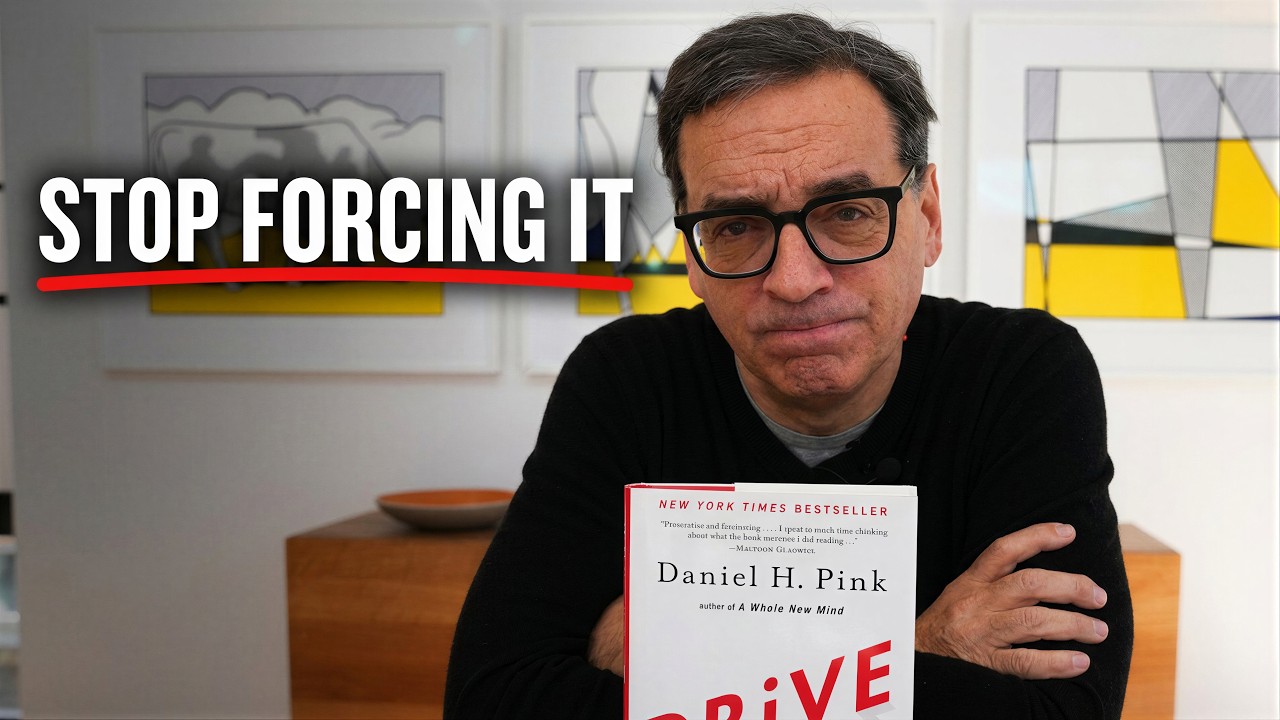
Daniel Pink breaks down why carrots and sticks fail and what actually drives performance: autonomy, mastery, and purpose. He cites experiments showing rewards can hurt creative work, then walks through four dimensions of autonomy and three laws of mastery, ending with concrete challenges to reshape how you work.
Chapters
About 15 years ago, I wrote a book about motivation, and it succeeded beyond anything I imagined. 159 weeks on the New York Times bestseller list, several million copies in more than 40 languages. Amazon later named it one of the best leadership books of all time. And yet, here's the strange thing. Most of what we do at work and school still ignores the book's central finding. Too many of us still try to motivate ourselves using outdated ideas, and the evidence shows they often backfire. So, This video isn't a book summary or a chapter-by-chapter recap. It's unfinished business. I'm gonna walk through the 7 most important insights from Drive, the ideas people tell me they found most surprising, most useful, and most unsettling. By the end, you'll see how motivation actually works and what you can do differently starting now. So let's start with the belief that causes the most damage. Insight number 1: carrots and sticks don't work nearly as well as we think. We tend to believe that motivation is simple. If you reward behavior, you get more of it. If you punish behavior, you get less of it. And 50 years of social science, especially the work of Edward Deci and Richard Ryan, says that's true. Sometimes, but not all the time. There's a certain kind of motivator we use in organizations and schools. Social scientists call it a controlling contingent motivator. I call it an if-then reward, as in if you do this, then you get that. If you hit this target, Then you get a bonus. If you finish your homework, then you get dessert. In the first 2 chapters of Drive, I review decades of research that distills to a simple conclusion: if-then rewards work well for simple tasks with short time horizons. But they work far less well for complex creative tasks with long time horizons. To see why this fails so often, there's a simple experiment that makes it obvious. Imagine you're sitting at a table. In front of you are a candle, a box of tacks, and a book of matches. Your task is to attach the candle to the wall so that the wax doesn't drip onto the table. Now, most people try to tack the candle directly to the wall. That doesn't work. Or they try melting the candle to the wall. That doesn't work either. Eventually, after lots of frustration, they have an insight. Empty the tack box. Tack the box to the wall. Use it as a platform. for the candle. The key is seeing the box not just as a container but as part of the solution. Now, here's the kicker: when psychologist Sam Glucksberg ran this experiment back in the 1960s and offered cash rewards for the fastest solution, the incentivized group took 3.5 minutes longer to solve the problem than the group with no reward at all. Let that sink in. The reward didn't sharpen thinking; it dulled it. The reward didn't accelerate performance; It slowed it. That counterintuitive finding launches the entire argument of drive. So here's a simple takeaway. Use if-then rewards for straightforward mechanical tasks with easy outcomes and a short timeline, but avoid them for complex creative tasks. And once you see that, the bigger question becomes this: What actually drives us? Insight number 2: Human beings have 3 drives, not one. One reason we get motivation so wrong is that we oversimplify human nature. We treat people as if they're one-dimensional or maybe two-dimensional, but human beings are three-dimensional. We have 3 drives. First, we have biological drives. We eat when we're hungry, we drink when we're thirsty, we sleep when we're tired. Extrinsic motivation. In many instances, we do respond predictably to rewards and punishments. Pay your kid to take out the trash and she'll probably do it. Fine an employee for showing up late and they'll likely show up on time. At least at first. But that's not the whole story, because we all have a third drive: intrinsic motivation. Edward Deci, the social scientist I mentioned a moment ago, put it like this: Human beings have an inherent tendency to seek out novelty and challenges, to extend and exercise their capacities, and to explore and to learn. In other words, we don't just do things to survive or to get a prize. We do things because we like doing them, because they're inherently fulfilling, because they're the right thing to do, because they connect us with others. The reward is the activity itself, the learning, the progress, the sense of purpose. This third drive isn't a bonus. It's a core part of who we are. So another takeaway, find your third drive by writing down 3 things you do for free. Maybe it's create art or work with kids or build a business. Doesn't matter. List them. And that's a window into what really motivates you. Now, this doesn't mean rewards don't matter. They do, just differently than we think. Insight number 3, rewards still matter, just not the way we use them. Let me be very clear about something. Drive is not an argument against rewards. Human beings like rewards. You like rewards. I like rewards. This is an argument for using rewards based on science, Not intuition. Because not all rewards are created equal. Start with a basic truth. On the job, people need to be paid and paid fairly. That's a baseline condition for motivation. If people are underpaid or treated unfairly, motivation collapses. And let's be honest, a lot of people today aren't being paid what they deserve. Baseline rewards are necessary, but they're not sufficient. Problems arise when the rewards become the reason for doing the work. To see why, consider a now-classic experiment led by Stanford psychologist Mark Lepper. He studied preschoolers who loved to draw, and he divided them into 3 groups. The first was the expected reward group. These kids were told ahead of time, if you draw, then you'll get an award. The second was the unexpected reward group. They were simply asked to draw, and only after they finished did they receive an award. The third was the no-reward group. They drew with no promise and no prize. 2 weeks later, during free play, the researchers watched what happened. The unexpected reward and the no reward kids kept drawing just as much and with the same enjoyment as before. But the expected reward kids, the one who'd drawn in order to get the prize, lost interest. They spent far less time drawing. Only one thing killed motivation. Knowing in advance there was a reward. When drawing became something they did to get something else, it stopped being something they did because they loved it. Now, this can get tricky in the workplace. There's no perfect recipe for compensation. And insight 3 doesn't mean that everybody should be paid the same. Some people contribute more and therefore should be paid more. And this doesn't mean that variable compensation is bad, but it must be simple, hard to game, and connected to outcomes that matter. When rewards become overly complex or complicated, they stop motivating and start distorting behavior. Now let's move to what works better. Insight number 4: Autonomy is the starting point of motivation. Once people are paid fairly, something else matters even more: autonomy. Autonomy is the ability to have some control over one's life and work. And this isn't some fluffy, feel-good concept. Research shows that organizations offering greater autonomy often outperform control-oriented firms Sometimes dramatically. Autonomy doesn't mean isolation. It doesn't mean anarchy. Maybe the best way to understand autonomy is to think about its opposite: control. Human beings have only 2 reactions to control. They comply or they defy. But we don't want pure compliance at work or at school, and we don't want defiance either. We want engagement. And the way that people engage, The way that you engage is by getting there under your own steam. One of the most underlined sections of the book is the part where I break autonomy into 4 components. The 4 Ts: task, what you do; time, when you do it; technique, how you do it; and team, who you do it with. Give people autonomy over even one of these and motivation climbs. Think about remote work. For decades, bosses said it wasn't possible, that people couldn't handle that much autonomy. Then COVID forced a massive worldwide experiment. What happened? Turned out that people, literally hundreds of millions of people around the world, could handle autonomy just fine. Autonomy isn't the opposite of accountability. For talented people, it's the pathway to accountability. Because control gets compliance, autonomy gets commitment. Here's a takeaway from the book. Try an autonomy audit. Rate yourself from 1 to 10 on each of the 4 T's: task, time, technique, and team. The lowest score is where your motivation might be leaking. Autonomy gets people started, but something else determines whether they stick with it. Insight number 5: Mastery is what keeps people going. Autonomy helps people start. Mastery is what helps them persist. Harvard's Teresa Amabile has found that the single biggest day-to-day motivator on the job is making progress in meaningful work. When we move forward, when we get better, when we see improvement, that's inherently motivating. But mastery isn't easy. It follows 3 laws that I write about in the book. First, mastery is a mindset. Carol Dweck's research on growth mindset shows that believing you can improve is what allows improvement to happen. Second, mastery is a pain. It involves what one sociologist calls the mundanity of excellence. Showing up, practicing, struggling, repeating. Third, mastery is an asymptote. You can approach it, but never fully reach it. That's frustrating, but it's also what makes mastery compelling. As the basketball legend Julius Erving once said, being a professional is doing things you love to do on the days you don't feel like doing them. Here's a takeaway on mastery. At the end of each day, take 60 seconds to list 3 ways you made progress that day, no matter how small. Seeing progress creates momentum, and momentum fuels mastery. And even progress isn't enough if the work feels meaningless. Insight number 6: Purpose changes performance. Autonomy gives direction. Mastery provides momentum. Purpose supplies meaning. Purpose is the sense that what we're doing matters beyond ourselves. Maybe it helps a teammate or a customer. Maybe it helps tackle a big problem like climate change or hunger or the erosion of the rule of law and democratic norms. Purpose doesn't have to be grand. Just has to be real. Researchers at Harvard Business School studied cooks working in the back kitchen of a cafeteria, people who never saw the customers eating their food. Then the researchers installed a simple iPad that allowed the cooks to see the people they were cooking for. Nothing else changed. Same pay, same hours, same recipes. But customer satisfaction with the food jumped by 10%. Why? Because the cooks now understood why they were cooking. Purpose doesn't make the work easier. It makes the work matter. And when work matters, people do it better. Another takeaway for you. Next time you or a colleague are stuck, don't ask how to do the task. Write a report, conduct a meeting, deal with a supplier. Ask why you're doing it in the first place. Performance improves when people connect the work in front of them to the people it serves. Put all of this together and motivation starts to look very different than we've assumed. Insight number 7. You don't install motivation. You create the conditions for it. For a long time, we've had this backward. We've assumed motivation is something that managers, teachers, and parents apply from the outside. But when I spoke with Edward Deci while writing Drive, he said something that stuck with me. He said, we have to get past the idea that motivation is something we do to people and instead understand it's something that people do for themselves. So here's the real formula. Pay people well, give them autonomy, help them pursue mastery, connect their work to a purpose. Carrots and sticks are tools. Autonomy, mastery, and purpose are needs. Ignore them and motivation withers. Support them and motivation shows up on its own. Which brings us to the real takeaway. Let me bring this home. The argument in Drive isn't just that carrots and sticks are flawed, it's that there's a tragic mismatch between what science knows and what organizations do. We, you and I, our fellow human beings, are not passive creatures waiting to be prodded. We're not donkeys chasing carrots. We're born to be autonomous, to seek mastery, to yearn for purpose. So here are 3 challenges for you to do this week. Number 1, remove one if-then reward from work that requires real thinking and creativity. 2, increase autonomy. For yourself or someone else over one of the 4 Ts. And 3, ask one honest question: why does this actually matter? Here's how I close the book. We know the richest experiences in our lives aren't when we're clamoring for validation from others, but when we're listening to our own voice, doing something that matters, doing it well, and doing it in the service of a cause larger than ourselves. That's not just the promise of drive. It's a better way to work. And a better way to live.








