5 Business Structures for Your Credit Repair Business: Which One is Right for You?
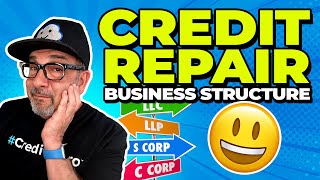
Daniel Rosen breaks down five business structures for credit repair: sole proprietorship, partnership, LLC, C corporation, and S corporation. Most startups begin as sole proprietorships because they're fast and cheap to form. The right choice depends on your liability concerns, tax situation, and growth plans.
Chapters
Hey, credit heroes. Want to build a credit repair business that lasts well? Today I'm going to show you how to choose the perfect business structure to minimize risk and maximize your potential for future success. So you better stick around. My name is Daniel Rosen, and welcome to Credit Repair Business Secrets. A business structure is a legal framework that defines how your business is organized and operates. And choosing the right structure. It may not seem like the most exciting part of owning a business, but it's actually one of the most important decisions that you will make as an entrepreneur. It's the point where the dream of owning a business actually becomes a reality. It's a decision that establishes the ownership hierarchy, registration requirements, legal liability and tax obligations, including perks like business expense deductions for startup costs, equipment and software. Now, this step can be intimidating, but don't worry. I didn't go to business school. I didn't even graduate from high school. But I learned how to bootstrap a business from nothing. And I promise it's easier than you think. Here's how this relates to us. The most common structures for credit repair businesses are are sole proprietorships, partnerships, limited liability companies, which are LLCs, S corporations and C corporations. A sole proprietorship is a structure where one person is fully responsible for all parts of the business. There is no legal distinction between the company and the owner. The owner literally files their business income on their personal tax returns. This is the simplest, least expensive and most common structure in America, accounting for 73% of all businesses. A partnership structure is similar to a sole proprietorship, but it's not as common for credit repair. This is where two or more owners create a business, split the profits, debts, losses and liabilities, and each pays their share from the business income on their tax returns. A limited liability company or LLC is a hybrid structure that combines the benefits of sole proprietorships, partnerships and corporations. An LLC provides limited liability protection for the owners who are called members, meaning their personal assets are safe. If the business experiences financial difficulties or lawsuits in this structure, profits and losses, they pass through the owner's income without facing corporate taxes. Now, corporations are the most complex and expensive business structures to set up and run. Corporations are legal entities separate from their owners, also known as stakeholders, which means that the owners are protected against legal liability. The downside is that they're heavily taxed and regulated. A C corporation has an unlimited number of owners, also known as shareholders. They take profits through dividends and they pay corporate taxes, also called double taxation. Now this gets tricky because all corporations start as C corporations for Example, if you wanted an S Corporation, you would have to file a status change with the irs. An S Corporation is the most unique structure because it combines elements of sole proprietorships, partnerships, LLCs and corporations. S corporations have the very same liability protection as LLCs and the very same benefits as sole proprietorships or partnerships. This means that S Corps allow profits and losses to pass directly to the owner's personal income without being subject to the high corporate tax rate of various states. I know S Corps sound like the best option, but there are also many compliance hurdles when setting them up and running them. So here's the thing to remember Choosing the right business structure. It's a personal decision and it's based on your circumstances and the goals of you as the owner. Each structure has positives and negatives which must align with your situation and your vision. No one else can choose it for you. Now, I'm not an attorney or a financial advisor and I can't tell you which type is best for your credit repair business. But I can tell you that if you choose the most simple structure for your credit repair business, the registration process only takes a few minutes and it costs almost nothing. And you can always change your mind later. That's right, your business structure is flexible. Here's why this is important. If you start with a simple business structure like a sole proprietorship, the more successful you become, the more likely you'll eventually shift to a more complex structure like a corporation. Keep in mind that Disney, Coca Cola, Mattel, and Walmart, they all started as sole proprietors. Now, some entrepreneurs change their structure to lower their personal liability or tax burden, and others do it to grow their business or to take on investors, or to merge or to make acquisitions. So take time to learn each type of business structure and know that the one you don't choose today might be the one that you need in a few years. Just remember to base your choice on your circumstances and your goals. And right now now most credit repair businesses start with a simple structure because it saves time and money during early years when the company doesn't need the added benefits of an LLC or a corporation. So how do you set up one of these simple business structures? Here's what you need to know. A sole proprietorship is the definition of being your own boss and taking control of your life. If you start conducting business on your own, you congratulations. You're automatically a sole proprietor. In most cases, you don't even need to file paperwork or take specific federal, state, or local action to form a sole proprietorship. You don't need an EIN number if you don't have employees. You just need a business name, Social Security number, address and a business bank account. The only real requirement involves using your name as the business's legal name. For example, if I call my business Daniel Rosen Credit Repair, it doesn't cost me anything in California. In most states I don't even have to register it because it's clear who the owner is and the type of business. Now if you want to be a sole proprietor, but you want to give your business a unique name like Credit Booster Squad, then you'll need to register it and file doing business as paperwork. And this is called a DBA. In California, the filing fee for DBA ranges from $10 to $100. Now the last time I checked it was about $30 in Los Angeles county. But again, rules and fees change. So double check the requirements in your state. Remember, a sole proprietorship is definitely the easiest and least expensive option. But it's not a legal entity. There's no legal separation between the business and the owner. You and the business are one. Your profits must be reported as self employed income on your tax return by filing a Schedule C with your annual 1040 forms. If you pass away, the business dies with you. If the company is sued, your suit and your personal assets can be in danger. Now for some entrepreneurs, this risk is worth the reward of freedom and total control. But for others, they choose a slightly more complicated business structure with more protections like an llc. The important thing is that you choose the perfect business structure that's right for you. Now, if you already have a sole proprietorship and you want to convert it to a different business structure, go to creditrepaircloud.comfreetraining and register for our Masterclass. The Masterclass was built by a team of credit heroes with decades of experience serving thousands of clients. And it comes with six months of software, in depth marketing, sales and business lessons, plus advanced disputing affiliates and automations training courses. Here's my final point. Choosing a business structure may not seem like the most important decision a business owner will make, but it turns your dream into a reality and it puts your credit repair business in the best position for long term success. And I'll end by saying if you want to learn the full blueprint for a successful credit repair business, check out my episode credit repair business 101 a step by step step guide for 2,023. And if you'd like to get certified in the disputing process and gain confidence, check out our Credit Hero Challenge. Doors are closing soon, so sign up now@creditherochallenge.com and start changing lives.









