Credit Repair MILLIONAIRE Vamba Freeman: How to Build a MILLION DOLLAR Business by Word of Mouth
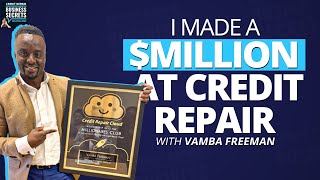
This is a recorded YouTube podcast interview (Credit Repair Business Secrets) where host Daniel Rosen interviews Vamba Leon Freeman, a credit-repair business owner who reached over $1,000,000 in revenue using Credit Repair Cloud. Freeman describes his personal backstory (immigrant from Sierra Leone, lost an IT job, experienced homelessness), how he learned credit repair (paid $1,500 for training), and how he built a referral-driven business with nearly 1,000 clients by focusing on results, personal communication, monthly updates (imports), and partnerships with realtors and lenders. He emphasizes quality over quantity, hands-on client care, building a team, and plans to add real estate and insurance services to create a one-stop offering.
Questions this video answers
November 2, 2021.
$1,500 (paid for training; drove to San Jose every Saturday).
Almost 1,000 clients.
Sacramento, California (lives in Elk Grove).
Around age 10 (close to 11).
Chapters
Hey, credit heroes. Today we're going to talk with credit repair millionaire Vamba Leon Freeman. He built his credit repair business up to a million dollars in just a few years. And today he's going to share his secrets of exactly how he did this. So you better stick around.
My name is Daniel Rosen, and welcome to Credit Repair Business Secrets.
Okay, let's get into this. Vamba Freeman recently made it into the millionaires club by making over a million dollars in his Credit Repair Cloud. Here is his award that I just pulled off the wall of our Credit Repair Cloud offices. And today he's going to share with us exactly how he did it. So please welcome to the podcast Credit Repair Cloud millionaires club member Vamba Freeman. Welcome, Vamba. Welcome to the podcast.
Thank you, Daniel. It's a pleasure to be. To be here with you and just want to thank you for making my life easier for me. Once Credit Repair Cloud was introduced to me, it truly changed everything. It truly changed everything.
Were you doing it all manually before?
Yes, I was doing everything manually before. I didn't have a CRM. I have a bunch of folders created. It really made my life simple.
Well, I'm happy you found us.
Yes.
And how does. And I see you got your big award behind you. How does that feel to win this?
It feels great. It's an awesome achievement. Never in my life. I'm an immigrant from. From. From Sierra Leone, refugee of refugee from two wars. I truly should not be here. That's why I like to tell people I've seen. I've seen the worst of life and I'm here and fighting hard to achieve. And so far I have an IT degree. But I strongly felt like helping people has always been in my nature to help people. And Credit Repair for me has been very personal because I've been there and I know how it feels. And just helping these people and changing lives every day is like a feel is every time I get a kudos. Every time I get a positive review and email. Thank you very much. That's a fuel to my life. I just, I just the caffeine I need and Credit Repair Cloud has truly made it possible because if the CRM wasn't available, to be quite honest, I'll probably give up by now because trying to keep track of everybody, keep track of your work, especially dealing with those updates every month, I would have gave up by now. That's just being 100% honest. It has truly simplified things for me.
Well, and you sure use it well. You're doing incredible. You're doing. You've got so many clients. Can I say how many clients you have?
Yes, you may. I'm proud. I'm proud for you.
He has, you have almost a thousand clients. That is amazing. But I want to get to that in a minute. First I want to find out. You said you're originally from Sierra Leone.
Yes.
Where are you right now?
Right now I'm in Sacramento, California. I live in Elk Grove. My office is in Sacramento, California.
Nice. And when did you come from Sierra Leone?
I came from Sierra Leone at the age of 10, close to 11. Grew up in San Jose for about a few years and moved to Sacramento late 1999 when my family moved up here.
And what were you doing before Credit repair?
Before credit repair, I worked. I worked IT for a utility company. I have an IT degree that's. I work. I work for utility company for almost eight years.
So what got you into credit repair?
I had a great job and I lost my job. Got injured, lost my job. And when that happened, I couldn't work. I lost, I lost everything that everything went downhill. I lost everything. During that process of trying to fight my previous employer, I went homeless because I couldn't work. I was homeless for almost six months. Couch surfing for six months. And that I think that was a. I always tell people that it's always a reset moment in everybody's life. I knew my reset moment was now there's something I was supposed to learn from what was happening to me. And, and it just happened that by my credit being damaged because I wasn't working fully attend to my previous obligations that, that my credit went downhill. I became homeless. I couldn't get a place. I could not finance a piece of gum if I had to. So that's what, that's what really opened my eyes in regards to the, the importance of, the importance of credit and how credit makes this whole economy, how this whole economy revolves around credit. So when I tell people it's personal for me, it's extremely personal for me because every, that's, that's, that's what have grown my clientele base too because every time I get my. I talk to every single one of my clients. There's no robot involved. I talk to every single one of my clients. I enroll every single one of my. All consultations are done through me. So for me, I want to talk to all my clients. I want to know, I want to know what, what's the reason for repairing their credit? Because that's one of the biggest things to find out. That's the first thing I ask my client, what is your reason why would you like to repair your credit? If you find out the why, then you can tell the person is truly as motivated. You can help them get to their goal.
Wow. But how did you first start to learn credit repair?
I first started learning credit repair when. When I first got into my credit. My credit. Roth and I went up to an individual down in San Jose and I asked him to help me repair my credit. And the whole process was kind of humane, the way I was treated, not picking up phone calls. I had to drive to San Jose several times just to. Just to get things taken care of. I just didn't like the whole process. And I started doing a little research, and when I found out that about 43% of U.S. households have issues with their credit, and I'm like, that's me, that's me. I'm one of the 43%. And. And it turns out a lot of people don't know where to turn a lot of people on, a lot like myself. I didn't even believe that you could challenge some of these things on your credit. You could reach out to creditors and try to settle some of your debt. I didn't believe my. I believed in the myth that seven years, everything will be fine. That was my remedy to credit repair. In seven years, everything will be fine. Wow. I did my research, and I actually reached out to the fellow that helped me and said, hey, can you help me? Can you teach me? Can you teach me how you. How you prepare credit? And I actually paid him for him to teach me. So it was a. It was a $1500 investment, and I drove from here to San Jose every Saturday, and I spent the whole day in his office working for free just so I can learn the basics.
That's awesome. And then how did you start to turn that into a business? Was that a long process?
When I first started, I had. I asked few family members, hey, can I help you with your credit? You know people that know you, like, you're. You're an IT guy. How do you. What do you know about credit? Yeah, so it was. There was. There was that curve. There's that learning curve, and people turn me down. They want to release their personal information because that's not what they know me. That's not what they know me for. They know me for. They knew me for it. And. And I love photography too, so they know me for those two things. So. But that never deterred me because I knew that once I help one person that Would lead to another person. That would lead to another person. That'll lead to another person. But I never deter me. I remember when I first started it, the first two months, I only had three clients. Two, three months.
But you got them results.
Yes.
And then you had stories to tell to the next clients.
Exactly.
Did it take a lot of money to launch the business initially?
No, it did not take a lot of money to launch the business. The initial cost, my investment to get this started in regards to paying the 1500 fee for him to teach me and actually getting the CRM. Because when I learned a manual way and I did research online and I came across you guys and with my IT background, it's like, okay, I need a solution. There's a better way for me to. To help my clients and be more efficient. That efficiency is always what I'm looking for. And I came across you guys and the fee was. I was also my last, last dime to. I don't know if I can say the fee was like 299. I'm like, it's a lot of money. Like 199amonth. That's a lot of money. But I saw the benefit and I always ask myself, does a benefit outweigh the cost? And I could see that the benefit sure does outweigh the. Outweigh the cost. So I didn't. I didn't hesitate.
That's awesome. Is this your first business or have you always been entrepreneurial?
Always. I've always been entrepreneurial. I have, but this is my first successful business. I've done. I've sold knives, I've sold vacuums, I've done marketing in supermarkets. But. But all these things kind of prepare me for this moment. That's how I looked at it. It prepared me, you know, all those. All those coaching from every single sales. Sales job that I've done on the side prepared me for this moment. How to talk to my clients, how to solve issues. It got me here.
That's awesome. You know, this is my first successful, successful business too. I tried lots and lots of things and I was homeless as well. And, you know, it's surprising. I've interviewed so many of our Millionaires club members, and a whole lot of them have been homeless.
Wow.
It's really fascinating. So I want to know what's the most important thing you've learned in your business?
The most important thing I've learned so far in this industry is to be patient with people. Just being patient and being humble. Don't really not letting success get to your head and just being patient with people. And they have taught me a lot and has taught me to be patient with people.
Did that come naturally or was it different before you learned that?
I think my situation that I went through, it taught me to be humble. It taught me that what is given can't be taken. So that's what really got me to be more humble.
Awesome.
Knowing where I'm from, what others go through on the other side of the world, all of that has made me humble. More humble.
That's amazing. And now you have close to a thousand clients and we were looking earlier, Keenan and I, I don't see a big online presence for your business. So I want to know, how do you get so many clients? What's your secret?
I'm result driven. I always tell people I haven't ran any ad in over two years and majority of my clients are referral based. And I have clients from Seattle down to Fresno, all the way to Midwest, Indiana, New York, down Florida. And it has been word of mouth, word of mouth. I don't play with another man's hard earned money they give me to pay me to do a job. I make sure I stay on top of things and execute everything that I said I was going to do for them at the best of my ability. And that's the respect I keep gaining among my clients. I'm so overwhelmed with business right now, I'm afraid to put out ads because I feel like it might lower my quality of my quality, that is, I don't, I don't care about quantity, I care more about quality. I care about the level of service, service that I'm providing for my clients. So that's why I don't run too much online ads, because every day I'm getting phone calls every day.
That's amazing. So you're not running ads, you're not doing social media. Do you have automations? People always think that's so important, but it sounds like you don't need that either. Do you have them?
No.
Automations, you're just awesome at what you do and really good at working with people.
Yes.
I think people listening to this or watching this podcast need to hear that because people always think they need all these bells and whistles and automations and doodads and it really is just the basics of being good with people, isn't it?
Yeah, that's, that's all. It just the biggest thing is just remember that's the thing. Every single client that I talk to, I don't skip a pro I'll never skip a process if, if it comes down to even taking their first name, I'm repeating their first name and phonetically saying each letter. All that counts. People don't. People don't. All that counts is as an apple B as in board people. It just shows that you care, you know, you're not just taking that name and hurry up and punching in things and jumping them and going to the next person. All of, all of my conversations start with, how are you doing? You have, you know, I take it on a personal level, you know, and, and, and people truly appreciate that I take the. I take things on a personal level. Talk to them first. Ask them, well, the biggest things. Just check with them. Why are you fixing your credit? And when I'm done, I'm on. Because I have network of realtors that I work with. When I'm done, I have lenders that I work with too. We, when I'm done, I'm gonna make sure I place you in the right hand, somebody that has the same value as I do to make sure that you're taken care of. And that's how I've been so successful thus far in credit repair.
Awesome. And those realtors and mortgage people are those other kinds of businesses, are they sending you clients as well?
Yes, they are. Every day I get multiple emails. Every day I get, I'm getting text messages, phone calls, they always sending me clients and I get a lot of shout outs from there from their clientele base and they say that's the guy to go to, reach out to him. And that right there tells me I'm doing something right.
Absolutely. So I want to go back a little bit to the clients and the service you provide and how you communicate with them. How often do you communicate with your clients?
Yeah, every 30 days.
And what do you do in that check in with them?
Every 30 days we actually do our import, take a screenshot and email them the progress. Because most clients don't log into the portal to see what's going on either. We send them text message and tell them to log into the portal to see what's going on. But every 30 days we do imports and we send them an update just to keep them engaged.
Yeah. So many people don't communicate with their clients and then they wonder why their clients leave. And it's just that simple, isn't it? You just keep them informed, what's happening?
Yeah, yeah.
Now, I saw on your Facebook you have a really cool office. Have you worked out of an office this whole time or did you start at home or.
I worked out of office. My reason for working out. An office. Yes, I can work from home, but it just legitimize. It's just my opinion. I think it just legitimize because there are a lot of. There are a lot of people that have done wrong to people in this industry. It legitimize me, it legitimize my office. People know where to find me. They can google me. I rarely have walk ins. People rarely walk into. Maybe once a week I'll have one person walk into my office. So it's just here to legitimize my business.
Awesome.
I like the quiet. The quiet. I have my kids at home. I have the refrigerator at home. I'm more productive away from the house.
Yes, same for me during the pandemic. Everyone's working from home, but I've been here all through the whole time. I like getting away.
Yeah, same here.
Yeah, you can concentrate more. I saw in one of the pictures of your office you had this really great quote that said, take care of your clients and they'll take care of you.
Yes. Simple as that.
Is there a story behind that?
Yeah, the story behind that is how my business have grown. My business have grown based on my level of professionalism towards my client. Just taking care of them is pretty treat. Treat others the way you like to be treated. It's as simple as that. Am I perfect? No, I'm not perfect, but I do my best to. Are there clients every once in a while that my has my slip through the cracks? Yeah, there are clients that might slip through the crack every once in a while, but am I performing at 90 percentile? Yes, I'm performing a 90 percentile. Am I at 98 percentile? Yes, I'm a 98 percentile. Are they a 2% that I cannot please? Yes, there might be that 2% that I cannot please. But I'm gonna do my best to make sure that if I'm wrong, I call on my clients, I let them know that I'm wrong. There is no. There's no, oh, I'm high MIT and no, we all make mistakes. I have made my mistakes in this business. But it's all about how, how you treat your clients when you know you're wrong. Not just pushing them to the side and say, let me go. I know I'm gonna get multiple clients. So I don't, I don't need you. Bad news travel fast. That's the biggest thing to remember. Bad news travel fast. And I truly believe in that, and if my client's not happy, I'm calling. I'm trying to figure out where I went wrong and how I should not repeat that mistake again. I don't just push things to the side and say, okay, next.
Very, very smart. Do you have a team?
Yes, I have a team of. There have been times where I actually have worked in this office by myself for a couple of months do due to turnover, I'm not happy with because I am looking. When I'm trying to put a team together. I know how dedicated I am. And I'm trying to put people together as dedicated as I am. And if I don't see that in an employee, I let them go. Because it takes one bad apple to ruin a whole bunch. So if I don't see, if, if I have to put in an extra hour and work three to four more hours to cover up the other person that was here that wasn't doing what they were supposed to do, then I have to do. There's been time. I have worked by myself three, four months, and I've done my best to stay on top of things as a team of three of us. Here I have a receptionist, I have a young lady that helps. Helps with my updates after I deal with the first. The first round of things is the same with three of us. Hopefully to grow, but I want to take my time. I'm taking my time to grow because once again, it's quality, not quantity.
Absolutely. What does having a team do for you?
Having a team gives you that support. Delegated. Delegating certain tasks because you cannot be everywhere at once. And when. During the height of the pandemic, some clients just didn't understand that we cannot just all be in the same environment. Some clients strongly believe that once they come to a credit repair firm to help them, there's a button that is push and everything just disappears. And we were falling behind due to that.
Have.
Due to us not having too many enough. There's. There's three of us here. Everybody has a task. If you know, during the pandemic, if you're coughing or you're sneezing, you're not coming to the office. No, it's not happening. So that, that's, that's when you know you truly need your team. When you guys are jelling and one person is not there, workload. Workload falls on the other people and you guys have to cover for that person. That's what a team does for you. It makes. It makes a big difference. But not just having a Team, but a team that has the same vision and drive as you.
Absolutely. And now that the team has freed up some of your time, what are you focusing on the most in your business right now?
I am focusing on now I have a little bit, a little bit of time. I'm working on getting my real estate license.
Awesome.
Because I want to add a notch on my belt because a lot of my clientele's, A lot of my clients come to me needing that help. So one, one stop shop. I'm helping them on that level. If I can help them help get. Because my clients trust me. That's why they send their family member. I had, I have, I have a story to tell you. I had a client that told me we're not going to tell anybody about you until you help our entire family first. Until you help our family first before we tell anybody about you. Because we don't want them, we don't want them to overwhelm you. So that's the, that's that level of trust. So with. And this and all of them in that family, most of them want to buy houses. Most of them want to buy houses. So my, my goal and vision is to create a one one stop shop. Whether it be for life insurance, get my. Getting my life insurance license, getting my real estate license. Just a one stop shop. My clients need something. Let me just help them help, help them right there and then and get over with, make their life easy for them.
Very, very smart. What do you think is your biggest superpower in business?
Oh, my biggest superpower. My kids.
Oh, wow.
I would say to myself that poverty ends with me. I said I was going to be the, I'll be the first person that will hit that million dollar mark and I've hit that. And for them now they're saying that that's my biggest superpower in business is to. Is to leave a legacy for them. Now I hate that I hit that ceiling. Now. The sky's the limit for them too now hopefully. Because every generation is supposed to live better than the next generation. And I'm doing better than my dad. My dad did better than his dad, you know, And I want them to do better than me because now they see that there is no glass ceiling, they can do better too. That's what drives me the most.
That's awesome. Creating generational wealth.
Yeah, exactly.
What would you do differently if you started your business from scratch today?
If I start my business from scratch today, what I'll do differently is try to get a team together because I'm so used to doing things by myself. I think that's one of the things that's one of my biggest falls, because I'm a workhorse. I love to work. And when you love to work, you just feel like, okay, I can do it. I can do it. I got it. I'll put in the hours. Is building that strong, building that team. It does make a difference.
Absolutely.
Yeah.
For the first more than 10 years of our business, it was just me wearing all the hats.
Wow. Hats up to you.
I was Phil on sales. I was Tammy on support.
Yeah.
I had little pictures of the people that I was pretending to be because you got to do what you got to do to get things started.
Yeah.
But it's. It nearly killed me trying to do everything.
Yeah.
Especially when customers came into the picture. When it started actually work, it was just too overwhelming. You got to get help.
It does. It does. It does. It does get overwhelming. That's absolutely true.
Yeah. So you're. What you would have done is get help sooner.
Yeah.
I think that's what I would do, too. Yeah. That was where I really, really went wrong. So I'm glad you have a team that's so good.
Yeah.
Okay, now we're going to do something. We're going to switch gears. We're going to go into a rapid fire of questions where you answer whatever pops into your head for, you know, just a couple words or a sentence of whatever pops into your mind. Okay.
All right. All right.
If you could go back in time, what do you know now that you wish you had known when you first started?
Uh, advertise more. Ah. Okay.
What's the most important lesson you've learned as a business owner?
The most important lesson I've learned as a business owner is, like I said, we'll go back again to the. To building the team. Not. Don't put that responsibility on your shoulder. You know too much responsibly because your clients need you, your family needs you. Yeah. That's. Building a team is. Is important.
Yeah. And have a life. Is there a book that's changed your life or that you'd recommend a book.
That have changed my life the most is. I have it right here that I read every now and then. Is market marketing outrageously. Not to be shy. Just approaching people. And. And don't. Don't. It's. It has. And there was another book that changed my life. I always forget the name of it. I give it to one of my. I gave it to one of my employees a year back. Years back. But there's a quote in there that always doesn't resonate in me. And it says, life is like the way. The way it was framed. It's like life. Life is like a bunch of wild mustangs in, In a while. Okay. If one. If the opportunity is like a bunch of wild mustangs in the wild. If you see it and it's a nice opportunity, grab onto it and don't let go. Ride it as long as you can. And that is how I see the credit repair business is a great opportunity. I. I was reading that book around that time and I held on to it and I live. I never let go. That's. Yeah, and we gotta find out. I gotta find. And I'll send you the name there.
Okay, cool. What does business ownership mean to you?
It means everything. It means freedom. It means freedom, the ability to create your own schedule, take your own vacation, make your. You. You define your own earnings. You don't have to report to anybody but your clients. Your clients become your bosses. You have multiple bosses. That's how I look at things. People always tell me, oh, you work for yourself. You don't have a boss. No, I have bosses. I have multiple bosses that I have to answer to. That's how, that's how I look at. That's how I look at being a business owner. I have multiple bosses that I report to. And I love, I love the freedom to. And to create my own income, work as long as I want. Some days I work two hours, some days I work one. Some days I work as much as I'm here from 5am I don't leave to 10pm at night. I love that freedom.
That's awesome. Last question. What's your advice to anyone right now out there watching this? Who wants to start a credit repair business?
Do it. 43% of Americans need help with their credit. You can't go wrong. Let's just remember, if you do decide to do it, if you do decide to help others, don't just get into it for the money. Money will come, but it's not what it's all about. If you take care of people, it's like field of Dreams. And if you build it, they will come. Take your time. Build it. Understand it. Understand your client's need. Don't some people get into it, hoping, wishing, thinking, they'll get into it, make quick money and leave. Or. Or get into it and take advantage. People. People come into a wrong with the wrong mindset. If you, if you're gonna do it, if you are going to get into this business, get into it and just have that feel of dream mentality. Just build it. If you build it, they will come. And that's how that has been. That has been my mindset since I started this business. And I'm building it and they're coming. I'm not running ads. I don't have a Facebook presence and I don't have. I don't have any fancy. The only thing I have is credit repair cloud to help me with, with some automations. But other than that, I don't have. I don't. I'm not running any fancy ads. I'm not doing any fancy IG postings. I'm just taking care of people. I'm just taking care of people. That's my primary objective, is to help people and the rest shall follow.
Well said. That was beautiful. I love that. Yeah. So many people just want to chase the money and it's really about helping people and really changing lives. And if you do that, the money does come.
Yeah, it does, it does. It does. It will come in abundance. That, that I will tell you for sure once you keep people happy. I had, when I was running one months that I'm running this business by myself. I don't have a department, an accounting department. I am the accounting department. I don't have a collection department. I don't chase my clients for money. They will call me and say, hey, you guys haven't debited my account yet for service. What's going on? Because I'm trying to do everything myself. They will remind me because they're seeing the changes that I'm bringing to their lives where they don't feel like they've been had. They see the changes. They see that I'm actually doing exactly what I've said I'm supposed to do. I'm following up with them. When they call me, my clients have my cell phone number. They have my desk number. They have the office number, they have email. All my clients have my cell phone numbers on my card. There's no, oh, you can't get a hold of me. No. My cell phone number is on my card. If they want it, I give it to them. There's no such thing as, oh, I can't get a hold of that guy there. No. Because I know that's one of the biggest mistake people make in this industry where the clients cannot get a hold of.
Absolutely.
Wow.
That is really, really good advice. Thank you so much for your time today. I really appreciate you. You're so inspiring and Congratulations again on the Millionaires Club Award and all of your success. You deserve it.
Thank you very much everyone out there.
If you are enjoying this podcast, click below to subscribe so you don't miss out on any of the secrets that we share every week here on the Credit Repair Business Secrets podcast. If you're feeling kind, rate me, give me a review so we can move up the charts and leave a comment or ask a question, because I read each and every one of them and thank you, Vamba. Thank you so much for being here.
Thank you, Daniel. It was a pleasure talking to you. And I just want to thank you for putting together such a fabulous software. It does exactly what you say it's supposed to do. You don't need to be a rocket scientist to even operate it. All you need is a heart and your willingness to help others. You have an awesome team. There has not been a time where I have emailed you guys, requested for help where I don't get a ping back immediately. So all of that and the software is never down. There's not a down moment where even if something goes wrong, you guys, you guys are on it and it's back up in a matter of. In a matter of minutes or hours or whatever. But it's. There hasn't been a time where I ever felt like credit repair cloud is not a software for me. It has been. It has been a hit every single year. And I just want to. I just want to thank you. I mean, I just want to thank you. You guys, you have. Your vision has truly changed my life and will continuously help people vicariously through your software.
Well, thank you so much, Vampa. I really appreciate that and have a great day. You guys keep changing lives.
Hey everybody, it's Daniel again, and really quick. I'd like to invite you to join what I believe is the best thing we have ever created inside the credit repair cloud community. And it is a challenge that we call the Credit Hero Challenge. If you're just planning out your business or you're just getting it started and you dream of having a successful business of your own so you can quit your 9 to 5 and fire your boss and have financial freedom, or so you can add another revenue stream to your existing business, if that's your dream, you need to to get into this challenge. We created this challenge to help you to create and launch your very own credit repair business to build a proper foundation for a really successful business. This challenge is going to help you to understand the strategy, the tactics and all the things you need to be successful at Credit Repair. It really is the greatest thing we have ever built, and it will change your life. So I recommend you do it right now. Stop everything. Pause this audio, go online, and go to creditherochallenge.com that's creditherochallenge.com and join the next challenge. And there's a challenge that's starting in just a few days. So go get started right now@creditherochallenge.com.









