1,000,000 AI Conversations with Brian Halligan, Lenny Rachinsky, Rabois, Lemkin with Delphi's CEO
Delphi's CEO created digital versions of four SaaS founders and ran a million simulated conversations to map how their advice changes by company stage, market type, and team structure. The technology captures a person's decision-making heuristics in a temporal knowledge graph, then adapts their thinking to new contexts.
Chapters
Please welcome to the stage co-founder and CEO Delphi, Dara Ladjevardian. Hey everyone, this is a big crowd. I think I'm gonna phone a friend for some advice.
Hey, ready to dive into strategies for scaling your SaaS growth to the next level?
Hey Jason, I'm speaking on stage at SaaStr. Any pieces of advice for giving a killer presentation?
Just don't bore them. And remember, every minute you spend on stage should create at least $1 million in future value for the audience, or it's not worth their time. What's your main topic? Let's make sure it's packed with actionable insights.
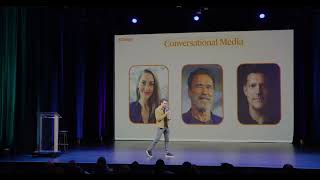
All right, thank you, Jason. No pressure. $30 million in value in 30 minutes. Uh, but I, I think we can do it. My name is Dara Ladjevardian and I'm the co-founder and CEO of Delphi. And right now ChatGPT makes generic advice widely available. And in a world where everyone has access to near-free instantaneous personalized AI, it's easier than ever to be good at something. But it's harder than ever to be the best at something. Where's the alpha? How can you be in the top 1% when everyone has tools to be good? The alpha is entrusted curation from what I call expert minds. And so in this conversation, I'm gonna talk to you about what a digital mind is and what I learned from having a million conversations with some of the top minds in SaaS. First, let me tell you how I got here. In 2021, I was the founder of an LLM startup, and at the time, LLMs were not sexy. Everyone was telling me to work on crypto or American dynamism, and I heard conflicting advice from all, all sides. But I was reading a book about my grandfather, who was the owner of a 30,000-person company in Iran before the revolution, before he got kicked out, lost everything, had to come to the United States with nothing, and built his life back. And what was unique about my grandfather was not necessarily his success, but his decision-making frameworks. And I wanted to be able to ask him, "What would you do in my situation?" and apply his decision frameworks to me. But I couldn't do that because a book doesn't respond, and he had had a stroke 2 years prior, so I couldn't ask him directly. But I ended up creating a digital version of him that I could talk to, and I was actually able to apply the way he thought about the world to an entirely new situation of AI that he's never heard of in his life. So I was able to adapt his knowledge to new situations. And that experience got me thinking about the, the experience of being a founder in today's age. There's a new podcast every day about a best practice. There, there's Twitter thought leaders. There's so many books on my bookshelf that I'm supposed to read in order to become a good founder. But none of these sources adapt to the rapidly changing market conditions we see today. They expire and they're not personalized to you. And so with Delphi, we set out to create something that allows people to create a digital version of their mind, to scale one-on-one interactions, and give them the ability to repurpose old knowledge and apply it to new situations. How does it work? You can upload your data from many different sources, and we create a digital mind, which I'll get to in a second. And from there, people can call, text, or FaceTime you across any platform— Slack, Zoom, Discord, your website— and it will notify you whenever it doesn't know how to answer. It'll give you insights based on what people are asking. It'll tell you leads you should reach out to, founders you should invest in, based on your frameworks for evaluating people. So what does creating a digital mind actually mean? So you upload data from all these sources, and what we do is create your worldview, your decision-making heuristics, experience patterns that can be applied to new situations, mental models for navigating complex situations. And it's not always right. You know, that's, that's a thing that'll get better with technology. But an example of this would be if I were to ask my grandfather's clone, how would you think about starting an AI company? He built a business in a very uncertain time in Iran. And so those principles of uncertainty can now be applied to today, which is kind of an uncertain time where things are moving very fast. How do people use their digital minds? Some people use it at the top of the funnel. As a new kind of personal website or content companion that can capture emails, answer questions, qualify leads. CEOs can use this as 24/7 customer support that leads to higher NPS because user— users are connecting with a version of a human. They know it's not a human, but it's a version of a human. We have CEOs using it internally to scale themselves for decision-making, for new hires, onboarding and training. And then we have people actually monetizing their digital mind and making 7 figures in revenue as a new form, form of a book or a course. I think Jason already showed you a couple of his use cases, so I'll go over these quickly. It knows you and your product. It can, it can actually sell your product as well. And Lenny, uh, for those of you who are familiar with him, he uses it in the top of the funnel, every Substack he writes. You can ask his digital mind follow-up questions, and then it will give him insights on what he should write about next, based on what's resonating with people. So 1 million conversations. Did I actually have a million conversations? Well, if you do the math, that would take 641 years. I did not have time for that. But you know who does have time for that? My digital mind. It can be in multiple places at a time, and it doesn't have the problem of speaking. It, it can speak immediately. So what we did is we simulated a million conversations with my digital mind and 4 other people and had it report back to me on what the most interesting insights it could learn from these conversations relevant to SaaS founders. And we did this in 24 hours instead of 641 years. So I'm gonna be going through some of those insights that we learned that I think are relevant to you guys here. First, I'll introduce our mind panel that I think many of you are familiar with. Brian Halligan, co-founder of HubSpot, advisor at Sequoia, pioneer of inbound marketing. Lenny Rachinski, uh, product lead at Airbnb and one of the most renowned people in product thought leadership today. I'm a weekly active user of LennyBot. We have Keith Rabois, who, prolific investor, Operational experience at LinkedIn, Square, and PayPal. I had the opportunity to work for him at Open Store. And the man of the week, Jason Lemkin, founder of SaaStr. So we will be talking and learning from some of these digital minds here and see what they have to say in different situations. And so what we learned is a lot of the advice that we get actually contradict each other. And An example here: What's your number one piece of advice for founders? Ryan Halligan says focus on creating outsized customer value, such that your product is so valuable that it doesn't make sense switching to anyone else. Lenny's main focus is retention. Keith Rabois talks about inverting inertia, that the world doesn't want what you're creating, so time is your enemy until it is your friend. And Jason talks about don't quitting. The ones who survive are the ones who win. So the question is, do you listen to all of these, some of these, none of these? And who's right? The answer is, they're all right, it just depends on your context. So right now, this is generic advice, but by providing more context about who you are, you can get more specific, and the advice changes drastically. And from these 1 million simulated conversations, we found 4 dimensions that changed the nature of the advice that was given most drastically. Those dimensions were your stage as a company, your market context, your team dynamics, and where you are on the AI adoption curve. So first we'll start with market context. I mean, stage. Uh, I'm skipping 0 to 1 million ARR stage because I think most people here are past that. At the $1 to $10 million ARR stage, Brian talks about building a predictable growth engine. And Lenny talks about systematizing your growth levers, starting to build repeatable processes. Keith talks about making sure your unit economics make sense before you go to $100 million, because then you're just gonna be losing money. And Jason focuses on hiring a great sales leader. At the $10 to $100 million phase, the advice changes a little bit, but it's mostly building systems. Brian's focus is about building culture, documenting your values, building a system that can scale, and your people so that you don't necessarily have to be in every room. Lenny continues to talk about building frameworks for decision-making, and Keith talks about really being focused on metrics and, like what Jason says, obsessing over hiring. So at the stage level, advice doesn't change that much. But it more so grows. So let's think about Jason's advice of don't quit. I asked him, and when I say him, I'm talking about his digital mind, and for the rest of the talk, that's the case. Uh, at the $0 to $1 million ARR stage, the why behind the don't quit is because you need to survive. You're not going to survive if you, if you quit. At the $1 to $10 million ARR stage, it's about fighting against the chaos of growth. And at the $10 to $100 million ARR phase, don't quitting is about surviving against competition. And another example is that early stage, they say speed matters a lot, and later stage, they say durability matters a lot. But the best companies can balance both. And one of my favorite books is called "Loonshots." They talk about how you can build, like, a skunkworks division in your company to innovate while building durable products. And I think a company that does this very well— and no, this is not an ad— is Ramp. They have a team of engineers who are focused on zero-to-one product— products, and they have a team of engineers who are focused on the financial tools that require a lot of durability and reliability. The next dimension is market context. Unlike stage, which grows, market context is something you commit to in the very early days. And the advice here changed pretty drastically. Depending on what we shared. So for emerging markets, advice from Brian is to adapt to local context. There is no one-size-fits-all advice, and you really have to understand the niche at which you're building for. Keith mentions validating through proof points. At Trade Republic, Christian systematically validated the model, uh, in a skeptical financial market and was able to prove that out in order to scale. Lenny talks about finding desperate customers. In the early cloud markets, there was no solution for really scaling your software product, so people were willing to try anything. And as he says, if you're the only banana in a market full of apples and people want bananas, they're gonna try your product with the imperfections, which is your benefit, because as a startup, you don't have the same resources as the big guys. And Jason talks about building 10x better than the alternative solution if this emerging market did not exist. Now, in the established markets, we talk about creating switching costs. Really want to build a moat and build a product that is 10x better than the competitors, and differentiating through your superpowers. Why are you better than the other person who is trying this? Lenny and Jason talk about dominating a niche. At Airbnb, they focus on, uh, travel-conscious people, and with ZoomInfo, they focus on building the best database product before expanding to other things. Then we have crowded and uncrowded markets, which is kind of similar to emerging and established. In crowded markets— Keith's favorite word— be contrarian and correct. What is your contrarian insight that is leading you to— that justifies your existence against all the other players in this space? Lenny talks about the thimble strategy. So Superhuman competed with Gmail by focusing on building an email product that people are willing to pay for. Because of speed and simplicity. And that gave them a huge wedge in the market. And in the uncrowded market, Keith again says establish on proof points. Lenny talks about justifying your why now moment. And I think that's very relevant to AI right now. There's a lot of good why now moments for starting something. Shopify's why now moments was that e-commerce was growing and there was a high need for tools to manage your business. And then Jason talks about creating urgency through the cost of inaction. I think a great example of this is I never knew how much I needed SOC 2 compliance until I got 50 emails from Vanta and Drata telling me I needed SOC 2 compliance. So being proactive and showing people why they need you. And lastly, the— probably the biggest, uh, divide in advice was who your customer is. On the enterprise level, it's about creating transformative outcomes. People don't care about your product. And with Salesforce, it wasn't about the CRM, but increasing sales. Keith talks about solving foundational zero-to-one problems. Lenny talks about finding the person who's willing to try this new thing, your sponsor at a company. And Jason talks about building institutional trust, like getting SOC 2 compliance. At the SMB level, it's really about economic efficiency. The lifetime value of SMBs is not always long, so you need to be economically efficient from day one. And you need to have a very, very hyper-simple product because these are people that are pitched products left and right. So what you need to have is minimal friction, as Jason and Lenny says. And on the consumer side, it's really about creating emotional value, creating connection, designing for organic virality. Like at PayPal, the product solved such a clear pain point that people wanted to share it, and that's how they grew in the early days. Also around brand. Brand and consumer are linked together. And so if you think about the three differences between these in like one word, enterprise is about outcomes, SMB is about economic efficiency and simplicity, and consumer is about emotion and virality. The third one is about your team, which again is something that is baked pretty early on in your company's life cycle. So something you may wanna be intentional of. And the first dimension of team is whether you are a solo founder or a co-founder. Keeter Boyd talks about Peter Thiel building a team of specialists in the early days, like Max Levchin for technology, Reid Hoffman for strategy. Brian Halligan recommends if you are a solo founder, you should build an inner circle of experts. And Jason talks about creating synthetic co-founders that can help you focus on the things that really drive the needle. If you have a co-founder, however, Brian Halligan talks about how him and Dharmesh had a decision-making framework where whenever they had a decision, they would always choose the more ambitious path. And this allows you to move quicker if you can align with a co-founder on specific frameworks of how to make a decision. Business approach. This is one of my favorites. So in technology, there are really two schools of thought. There is the Lean Startup and YC, you know, talk to customers, iterate, figure out what's good in the market. And then you have Build by Tony Fadell, which is more about intuition. And there are pros and cons to each. Brian Halligan says to the data-driven founders that avoid being prisoners to your metrics. You know, when they initially decided that they would launch a free CRM tool, there was no data to justify that decision. They followed their intuition. Keith talks about— my favorite line that he told me when I worked at Open Store was, You want to be like Christopher Nolan. He doesn't ask his audience how he should direct his movies, and those end up being some of the best movies out there. But at the same time, you still want to validate your assumptions with data, like they did at PayPal. And if you don't, and you just follow your intuition, you end up with a Frankenstein product. So intuition followed by data is a theme in Build by Tony Fadell that Keith supports. Jason talks about If you're going to be a data-driven founder, at a certain point you've got to move from the data and just execute. You can explore, but then you've got to commit and execute, and that focus can lead to pretty large outcomes. And even those who are visionary, they make sure they build operational excellence, like Steve Jobs hiring Tim Cook. And this was a very important idea for our company, Delphi. You know, when we started the company, there was no data that justified that a cloning company could work. Like, it wasn't working for the first year. We probably should have pivoted to, you know, talking to PDS for B2B SaaS. That's what all of our investors were telling us. But we really followed the intuition approach. Um, and it has paid off, but now we're at a time where we need to start being more data-driven and have more operational excellence. And another big intuition-driven decision that we're about to make is we're moving away from a usage-based pricing model. I think in the AI world right now, you see most companies pricing on usage. But when I created the clone of my grandfather, the costs were 10,000 times more expensive. And so if you just project it out, costs are going to go down to zero, and you don't want the value of your product to be based on usage. You want it to be on the outcomes. Is it making people money? Is it saving people time? So we're about to make that huge bet. No data to support that we're not going to go bankrupt, but I'm feeling pretty good about it. And then there's ambition. Whether you're creating a company to be a category king, you're gonna be making decisions that have, that are about defensibility and durability and having a long-term mindset. Where if you're really looking to have an acquisition, your focus is gonna be around profitability and strategic positioning. So if you followed advice in one of these categories, if you focused on profitability and you wanted to be a category king, that's going to lead to very short-term outcomes. And this is why context is so important when you think about information. We're in this information-abundant world, and if you just listen to the thing that has the most likes on Twitter, that's not gonna work for your specific circumstance. And the last thing is AI. I think a lot about how everything we know about best practices in software and business was literally invented in the past 25 years for SaaS companies. And it's unlikely that that's just going to continue to be the norm. These things adapt and grow. And so I often think about whenever we're thinking about, you know, ops, design, product, how would this have been different if AI was around in 2000? Things would have just turned out very differently. And so we're seeing that right now. The normal advice would be pick a niche and dominate it before expanding, but AI is actually very good at being horizontal. Similar to how advice can apply to many different situations, uh, you can build a product that apply— that adapts to many different use cases and Pre-AI, obviously, I think data is still important, but data was the most important pre-AI. But I think in an AI world, what is more important is actually the feedback loop. If you have data, that's great, but the flows of where the data goes and how it's used is actually more important than the model itself. Then we have outbound sales. So in a world where everyone has access to an AI agent that can send unlimited personalized emails to every single person that could be a potential customer. People aren't going to check their emails anymore. I don't know about you guys, I, I get so many personalized, like, ChatGPT language emails and phone calls that I don't even check my phone anymore. And so people are going to be allergic. I imagine there's probably going to be an email tool that's like a filter for the top layer, and there's going to be a more like personalized email. But if that's the case, You need to really focus on trust, transparency, and brand, and creating authentic pull. Because I think in a world of generic AI slop, the companies that win are the ones that are going to be the trusted filters, the trusted voices, the people that are not taking advantage of the abundance of AI, but rather being thoughtful about how it can be used in a way that's valuable to others. An interesting stat for GitHub Copilot is that it has a 35% acceptance rate. And it's still a widely popular product. So another shift with AI is that products don't always have to be perfect. People are okay with imperfection as long as it's helping them ideate or move faster. They'll be fine with it. And then the last one is headcount. Before, maybe you have to raise massive rounds to hire 100 people to build a billion-dollar company, but it is easier than ever to be a polymath. It is required at Delphi that every single person on the team, even frontend engineers, even product engineers, knows how to use LLMs in code specifically. I'm not talking about just ChatGPT because a designer can now be a product manager and can be a frontend engineer. A frontend engineer needs to know LLMs to rethink UX principles from scratch, dynamic interfaces. I think that's probably where we're going on the UX front. And so one person can now do the job of 5. And so you don't need to raise as much money. And these, these are all things that if you move forward into the AI world without thinking about how AI changes the underlying principles of what we know about software, you may end up raising too large a round that you don't need. You may end up using an AI tool to spam every single person's inbox, hurting your reputation. You may end up spending too much time on building the perfect product. So it is really key, as we've seen from these people, to rethink what you know from first principles on the ground up. What does a post-AI world look like? And some new mental models come about from that. One is about UX. So in, in a pre-AI world, we thought about form fields and tabs, and like, really the only way to have a product that could have multiple use cases was a really complex UX. But now with generative interfaces and natural language interfaces like Airtable's AI, you could get a lot of— you could have a complex product masked by a simple interface. And if you think about the iPhone, the idea that you were going to combine an iPod, an internet browser, and a phone in one device seems crazy. That's like way too complex and confusing. But the iPhone was an interface that hid that complexity and made it seem very natural. And I think we're going to see the same a lot right now with, uh, with AI, with Delphi, for example, you know, we were building a Zapier-like interface that allows you to create actions, but then we were like, wait, why are we doing this? Just because Zapier did it. We're just going to create a generative interface where you can type the, the functions that you want and it generates on its own. So I think with UX, you should think about is Is— does AI enable you to add more to your product while making it simpler at the same time? That is a new thing that AI enables. AI first versus AI only. I think we see a lot of companies raising money because of AI hype. Uh, AI is not the product. It is a thing that enables new things. And so I think a question to ask yourself is, am I building an AI to solve a problem or am I building an AI because it sounds sexy on our deck? Then we have data. Before, maybe you needed a lot of data for something in a company to actually work out, but now you can move a lot faster. That data is available. Um, market defensibility. I think the incumbents are at the biggest advantage in this AI world. One, they have the data. Two, it's really not hard to build with LLMs. Don't let anyone tell you that it's difficult. It is very easy to learn and build. And it is likely that most of the innovations in LLMs will be taken by the incumbents. And therefore you want to make sure you're building something actually differentiated versus something that Google, who usually does not innovate, but these days LLMs is, is again a sustaining advantage as Keith Rabois says. And then the last part is, are the metrics, the success metrics. Pre-AI, we're obsessed with addiction, with engagement, getting people in our apps for for as long as possible. But the promise of AI is actually that you spend more time in the real world, you spend more time with the people that matter. And the success metrics for AI are time saved. Uh, how does that change the dynamics of what we think about software in a world where the past 20 years have been about addiction and engagement? I think that mindset— personally, that my prediction is that addiction mindset is going to go away and Hopefully, in the ideal world, software is valued by how much value it gives us in the real world. So, competitive advantages in the AI world. It is easier than ever to become an entrepreneur. You know, you can talk to Lovable, build an app. You can get advice from anyone in the world. I think what becomes your advantage is one, knowing what questions to ask and knowing what advice to listen to. And also knowing that advice is only useful with context and, and really being aware of what is specific about you that may change the advice that you're listening to. Your code can be copied. Your go-to-market strategies can be copied, but the only thing that cannot be copied in your business is your people. There's a phrase, you know, the team you build is the company you build. And I think it's that times 1,000. Your people are your IP. Their minds are your moat. And this is why hiring, I think, is just— even though you don't have to hire as much in an AI world, quantity is less, but the bar for quality is a lot higher. So let's talk about key takeaways. Advice filters. When you listen to advice, think about your company stage. Does this match where I am in my company? Uh, and as we talked about with the company stages, advice does not expire. It just grows. And what you focus on changes. And we have market context with established markets. You want to focus on creating a wedge with a niche group or creating competitive advantages, creating transformative outcomes. Whereas for emerging markets and uncrowded markets, you want to validate proof points, create momentum, create urgency, see if there are any tailwinds that are validating this market. Team composition. Uh, you want to think about if you're a visionary founder, it's great. You need to balance that with operational excellence and data-driven, uh, decision-making. And AI transformation. I think this is the most important one. Anything you think you know about advice and software, like really take a step back, put yourself in 2000 and think, how would this advice have evolved if AI were around in the beginning of the internet? That has helped us a lot at Delphi. And so painting a picture for the future, we're going towards a world where you could run a million simulations about your next quarter before creating your OKRs for that quarter. It can go through every single possible scenario, and then it can help you say that this is the right way to go. You can have a board of advisors of all the top people in the world in your pocket who can give you advice not to automate your decision-making, but to augment, because you still need to be self-agent and you still need to decide if it's relevant to you. Every person in your company is an asset of knowledge that can remain in your company long after they are gone. And in 1995, Bill Gates said that content is king. And I think today, when content is actually abundant, it's context that is king. Context is the thing that matters. Context is how you're going to find that alpha. And so here are some of the minds that we talked about today. If you want to talk to some of them, you can scan those QR codes. And thank you. That is my talk. We still have some time, so I think we can do some question— Q&As if anyone has questions.
Good morning. I think that was one of the best talks so far. So thank you for putting this together. It was really amazing. And I think the context aspect is really important. But let me ask you a question. As a Founder, CEO, do you sleep in the AI world? I think there is so much FOMO creation and you need to be much quicker than 10 years ago. And I remember 10 years ago we didn't sleep. How does it change now? Is it really about faster, less sleep, getting much more done, or is it about working smarter, or what's your advice here?
Yeah, I think it's two things. One, starting with the end in mind. Like, I think it can be very easy to get distracted with GPT-4o, GPT-5, like all these new models and all these new things. I think that's a distraction. I think you just have to assume, okay, X years from now, hyper-intelligent AI, pretty much free, which is why we're making this pricing change, uh, fast and can pretty much do anything. Like, make decisions in that world instead of making decisions in the world we have now and getting distracted by the day by day. So again, an example of a decision making— decision made on that mindset is us moving to unlimited usage. So I just think it's going to go down, go to free. Another example is, you know, we have some customers who are, uh, you know, really excited about AI outbound. And I'm telling them like, guys, like, it may sound sexy now to use AI outbound, but In the long term, it's just going to piss people off if everyone is doing that. And I think what you said, working smart, is really important as well. I think you can grind all night, but you want to make sure— again, velocity is speed with direction. You want to make sure you're going in the right direction.
Great presentation.
Thank you.
Great presenter. I'm Justin from Satu. I was wondering if you can go into more detail about how you train these four individuals.
Yeah, so I read a book in 2014 called How to Create a Mind by Ray Kurzweil, where he literally talks about how you can replicate the mind using computer science. He describes it as a hierarchy of pattern recognizers. And it was actually reading that book that gave me the insight with my grandfather. The LLMs are pretty much pattern recognizers, and if you could put them together in a way, maybe you could recreate someone's mind. So for us, what is the best way to represent a network of ideas that changes over time? Temporal knowledge graph. So knowledge graph is great because you could represent not just someone's, uh, beliefs and experiences, but the people in their lives and how those things change over time. So temporal because your knowledge graph in 2015 may say something that you believed and your knowledge graph today may say something, and we could track the change of that belief over time. To be able to predict how you might say something in the future. We're pretty model agnostic at this point, so we use multiple models. We don't train our own models yet, uh, thinking with the end in mind. At a certain point, it's gonna be near free to train your own model. So the decision I've made is we could train our own model right now, but like, why would we spend all that money? Like, the product works really well by just mapping out the mind and leveraging multiple models on top of it. So I think that's another framework. Like, do you really need to spend all the money right now to train models? Probably not. That's going to get a lot cheaper. Don't waste your time with that and focus on building the important aspect of your product, which for us is the representation of the mind.
Hi. Oh, thank you. That was an amazing presentation. Um, so really echo the sentiment, and you just brought it all together. And because so much of us sitting in the audience listening to speakers going, well, that's not relevant to me because I'm enterprise, or I'm at this stage, so that's amazing. Um, for companies that are already, you know, quite developed and now you're bringing AI everything, it's quite easy to embed it in the technical team or the marketing team, but the whole company has to change. Can you talk about the cultural reorganization of embedding those, that everybody suddenly wakes up starting to think about this?
Yeah, so at the top of the funnel for interviewing, like when we interview people, they have— if they don't use Claude or Codex in their coding interviews even, we don't hire them. He's just like, yeah, why wouldn't you use these tools? So you want to make sure people are curious enough to be thinking about these new technologies. And for people that are already there, what I told my team a week ago is that, hey, if, if there's a way we are doing something, I want you to think about how it can be done better with AI. And just like, there may not be anything, it may waste time honestly in the short term, But you start to build a muscle. I actually think it's a muscle where you start to see opportunities in every single thing in the business once you really understand where AI can fit.
Amazing. Thanks. Look forward to using your product.
Hi, my name is David. Amazing presentation. I love what you're building.
This is great.
I have a more philosophical question for you.
My favorite.
Yeah. How do you think having a digital twin of yourself, of your mind, of your emotion, your intricacies evolves in the hands of someone else, of a corporation, whatnot? How do you see those digital minds evolve over time?
Yeah, to hear your take. Great question. So with Delphi, we only let people create digital minds of themselves. They have to submit a photo of them holding their ID, and I manually verify everyone right now. It eventually, it's It's not going to scale. They're not conscious beings. I think, you know, we actually have two settings in the product where either it does not reason and stays exactly the way it is today, where it only answers questions that it has answered before in the past, or we have the adaptive setting where it can be predictive of what you might say in new situations. So I guess maybe the ethical concerns would be like, what if it says something wrong, or what if it says something bad? We built pretty strict guardrails. Like, we work with doctors and lawyers where if it says something wrong, it could lead to, like, a lawsuit. So pretty confident in the guardrails. If you're talking about your digital mind in someone else's hands, when I talked about the company use case, what I imagine is that if a company wanted to maintain the digital mind of one of their employees who's leaving, they would probably have to pay them. And it would be like you're paying for an asset, and they would have to agree to it. But never would there be a case where someone else has control over your digital mind. Did I answer your question?
Could be a very long conversation, the two of us.
Yes. Around a bottle of wine. Oh, yes. I dream about this stuff every night, so happy to chat about it. Anything else? All right. Well, thank you, guys.